

You wake with a headache behind one eye, a sore jaw, and the uneasy feeling that you barely slept. Your dentist notices clicking when you open your mouth. A neurologist treats the headaches. A sleep clinic evaluates your snoring. Each appointment makes sense on its own, yet your symptoms continue because jaw mechanics, facial pain, and nighttime breathing can influence one another.
The collaborative care model offers a more connected way to approach that overlap. Instead of asking one clinician to solve every part of a complicated problem, it gives several professionals a shared plan, defined responsibilities, regular communication, and objective measurements. For people with TMJ symptoms, facial pain, headaches, or sleep-related breathing disorders, that coordination can make the difference between a series of isolated treatments and a coherent care pathway.
When Seeing One Specialist Is Not Enough
Maya's morning headache, sore jaw, and poor sleep sent her to several offices. A neurologist adjusted headache treatment. Her dentist made a night guard after hearing about jaw clicking. A sleep clinic assessed loud snoring and daytime fatigue. Each clinician addressed a legitimate concern, yet no one initially connected her clenching, sleep disruption, muscle tenderness, and nighttime breathing.
Her records became thicker while her plan remained divided. One clinician asked whether another had reviewed the sleep study. Another suggested a device without knowing how painful Maya's jaw felt each morning. Maya was not failing treatment. Separate providers were being asked to address a connected problem without a dependable way to share findings and coordinate decisions.
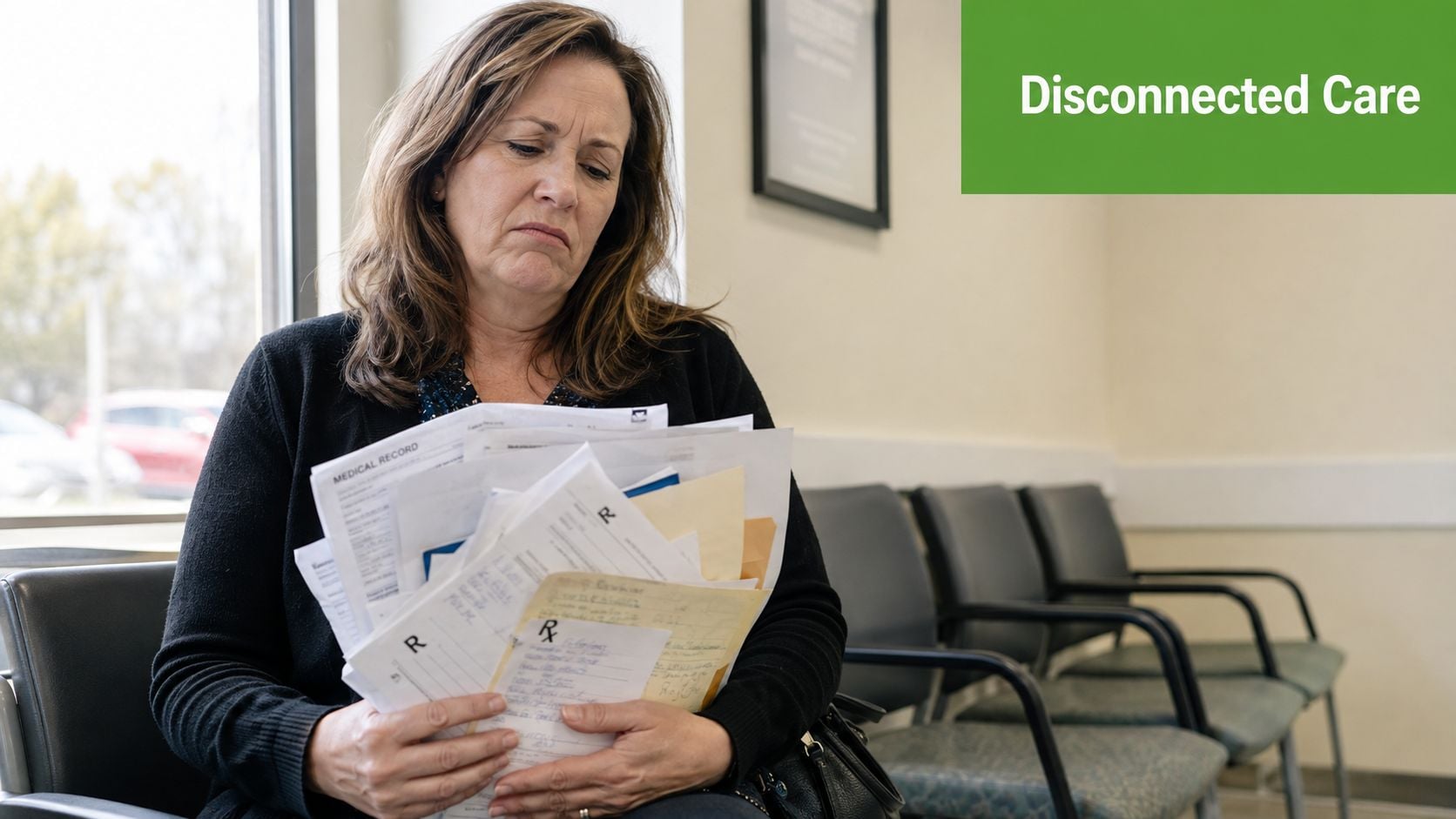
The missing connection
Jaw disorders, facial pain, and sleep-related breathing disorders involve overlapping but distinct questions. A dentist may assess tooth wear, bite forces, and jaw loading. A sleep physician may determine whether snoring reflects obstructive sleep apnea or another breathing problem. A neurologist or pain specialist may evaluate headache patterns, nerve sensitivity, and persistent muscle pain. An orofacial myofunctional therapist may examine tongue posture, swallowing, and habitual mouth breathing.
These symptoms do not need to have one cause. The collaborative care model gives clinicians a process for testing possibilities and choosing the treatment sequence. The team might stabilize severe pain before introducing an oral appliance, evaluate airway function before attributing every morning headache to bruxism, or add exercises that support nasal breathing and oral posture.
Patients also need practical direction about which professional should assess each concern. This guide to what specialist treats TMJ can help when jaw pain appears with headaches, facial tension, or sleep complaints.
Practical rule: A referral should transfer information, not just a patient.
Coordination depends on shared examination findings, test results, treatment goals, and symptom changes. The patient stays at the center of the plan instead of carrying every update between offices. That shared view helps the team address jaw mechanics, airway health, and neurological pain together, where isolated treatment can miss their interaction.
What the Collaborative Care Model Actually Means
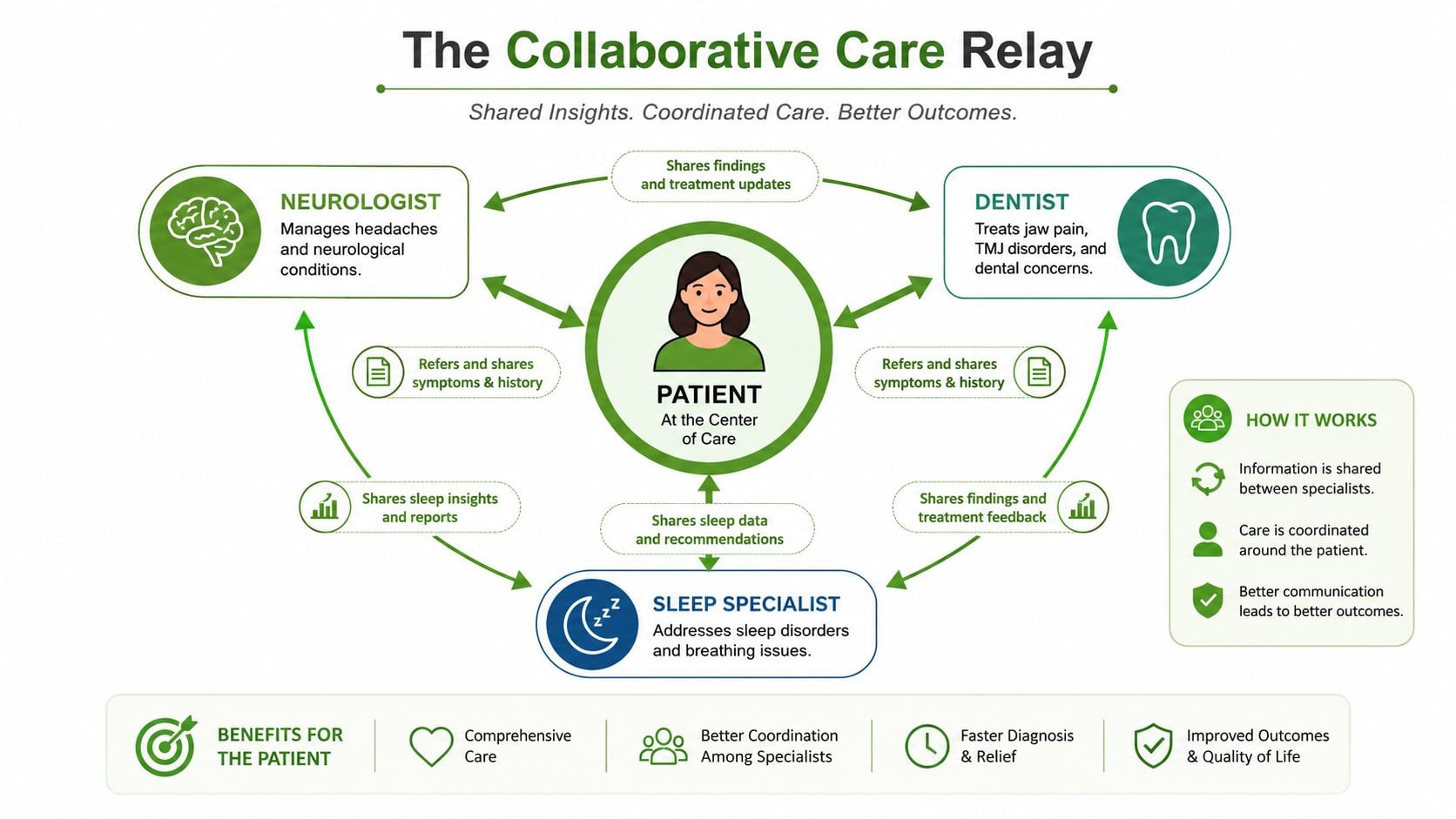
Think of coordinated care as a relay team. The runners don't all sprint at once, and they don't leave the baton on the track for the patient to retrieve. Each person knows the shared goal, understands the previous runner's findings, and knows when to take responsibility for the next part of the work.
Traditional fragmented care often depends on referrals that end at an appointment. The collaborative care model adds structure after the referral. The team creates a shared plan, tracks the patient's progress, discusses cases when needed, and changes treatment when measurements show that the current approach isn't working.
Three operating parts
Measurement-based care turns symptoms into information the team can follow. For a patient with facial pain, that might include pain intensity, headache frequency, jaw opening, chewing tolerance, sleep quality, and morning symptoms. For suspected sleep-related breathing disorders, the team may review sleep-study findings, oxygen-related measures, snoring patterns, daytime alertness, and treatment adherence. The exact tools depend on the clinical question, but the principle is consistent: decisions should respond to observed change rather than memory alone.
Case management gives the patient a dependable point of contact. A care manager may check whether a referral was completed, help explain instructions, identify barriers to an oral appliance or therapy program, and report changes back to the team. This role matters because complex care often fails between visits, when no one is clearly responsible for follow-up.
Specialist consultation brings advanced expertise into the plan without forcing every clinician to practice outside their scope. A sleep physician can advise on breathing-disorder evaluation. A pain clinician can help distinguish muscular, joint, neuropathic, and headache-related patterns. A dentist can assess occlusion, tooth wear, jaw loading, and appliance considerations.
What a coordinated visit sequence looks like
A patient may begin with an intake that maps pain, jaw function, breathing, sleep, medications, stress, and prior treatment. The lead provider then sends relevant findings to the other clinicians. The team agrees on priorities, such as confirming a sleep diagnosis, reducing acute jaw irritation, or beginning breathing and oral-posture work.
Progress is reviewed at planned intervals. If pain improves but snoring persists, the sleep pathway receives more attention. If an appliance worsens jaw symptoms, the dentist and pain clinician can reassess rather than letting the patient alternate between unrelated offices.
Mental and physical symptoms can also interact, so patients may benefit from resources such as this holistic mental wellness blog when stress, mood, trauma history, or sleep-related distress affect recovery. That doesn't mean facial pain is “just psychological.” It means the team considers the whole patient while still investigating physical mechanisms.
Who Is on the Care Team and What They Do
A patient with jaw pain, snoring, and morning headaches may need answers from several clinical disciplines. The care team assigns each question to the appropriate professional, then connects the findings so treatment decisions do not happen in isolation. The process often begins with a lead dentist or physician who organizes the assessment and brings in specialists as the pattern becomes clearer.
The lead clinician gathers the history, examination findings, records, and referrals. They look for links among jaw movement, muscle tenderness, tooth wear, headaches, nasal breathing, snoring, and daytime symptoms. Their role is similar to a conductor keeping one piece of music together. They do not replace the sleep physician's or neurologist's expertise. They make sure each specialist is working toward the same clinical goal.
| Specialist Role | Primary Focus | Contribution to Team |
|---|---|---|
| Lead dentist or physician | Initial assessment, jaw function, treatment priorities | Maintains the shared plan and coordinates referrals |
| Sleep specialist | Sleep-related breathing disorders and diagnostic evaluation | Interprets sleep findings and guides airway-focused treatment |
| Orofacial myofunctional therapist | Tongue posture, swallowing, lip seal, and breathing habits | Builds functional patterns that support jaw and airway goals |
| Pain management expert | Facial pain, headaches, muscle and nerve-related symptoms | Clarifies pain mechanisms and helps sequence treatment |
| Neurologist | Headache disorders and neurological contributors | Differentiates primary headache conditions from overlapping pain |
| Care manager or designated coordinator | Follow-up, communication, and adherence barriers | Keeps appointments, measurements, and patient questions connected |
How the roles intersect
The sleep specialist may identify a breathing disorder that changes whether, when, or how the dental team uses an oral appliance. A dentist may find that jaw tissues are too irritable for immediate device use, so pain-focused care comes first. A myofunctional therapist may identify mouth breathing or poor tongue-rest posture that needs attention alongside medical treatment, not as a substitute for it.
The pain specialist examines whether symptoms arise from the jaw joint, chewing muscles, nerves, headache disorders, cervical structures, sleep disruption, or a combination. That distinction matters because facial pain does not always follow a straightforward temporomandibular disorder pattern. A neurologist may assess headache or other neurological contributors when the symptoms do not fit a localized jaw problem.
Patients should ask how clinicians share findings and handle conflicting results. A multidisciplinary approach to pain management works best when the team can explain who reviews the information, how priorities are chosen, and what happens if an intervention changes jaw symptoms or breathing.
The practical benefit is continuity. Jaw mechanics, airway health, and neurological pain can influence one another, so the patient should not have to coordinate separate treatment plans alone. Each provider contributes a different instrument, while the shared plan keeps one intervention from undermining another.
The Evidence Behind Coordinated Treatment
The evidence for collaborative care comes primarily from behavioral health and primary care, not from trials specifically designed around TMJ disorders or sleep-related breathing disorders. That distinction matters. The research supports the coordination method, measurement, follow-up, and specialist supervision. It shouldn't be used to claim that every jaw or airway intervention has been proven through the same studies.
The model's evidence base began taking shape in the mid-to-late 1990s and has since been tested in more than 90 randomized controlled trials in the United States and abroad, according to a major review published in JAMA Internal Medicine. That review reported improved depression outcomes at six months, with a standardized mean difference of 0.25, and continued benefit for up to five years, with a standardized mean difference of 0.15.
What the numbers mean clinically
A standardized mean difference lets researchers compare results across studies that may use different symptom scales. It doesn't translate directly into a guaranteed amount of pain relief for an individual patient. It does show that coordinated treatment can produce a measurable advantage over usual care across groups of patients.
The UK CADET trial found PHQ-9 depression scores 1.33 points lower at four months and 1.36 points lower at twelve months for collaborative care than for usual care, as summarized in the University of Washington evidence base. In a U.S. primary-care study, 45% of intervention patients achieved at least a 50% reduction in depressive symptoms at twelve months. A later trial reported that 71.6% of collaborative-care patients reached the composite primary outcome at twenty-four months, compared with 54.7% receiving usual care, using the same evidence summary.
A separate American Academy of Family Physicians review found improved depression outcomes across several follow-up periods in a meta-analysis of 28 studies. The reported standardized mean differences were −0.34 at zero to six months, −0.28 at seven to twelve months, and −0.35 at thirteen to twenty-four months.
Why this matters for jaw and airway care
The transferable lesson is operational. Teams improve their chances of helping patients when they identify symptoms systematically, assign follow-up, communicate across disciplines, and adjust treatment from measured response. A technical review of collaborative care mechanisms identified measurement-based stepped treatment, systematic identification, case management, and psychiatric supervision as important implementation features. It reported increased antidepressant use, with an odds ratio of 1.92, and improved depressive symptoms, with a standardized mean difference of 0.24, compared with usual care.
Those findings don't prove that a coordinated TMJ and sleep clinic will deliver a particular outcome. They support a safer conclusion: complex conditions deserve a system that can detect competing causes, monitor progress, and keep clinicians from working at cross-purposes.
Collaborative Care Versus Traditional Treatment Paths
A traditional pathway can look reasonable on paper. You visit a dentist for jaw clicking, an ENT for nasal obstruction, a sleep doctor for snoring, and a neurologist for headaches. The problem begins when each appointment produces a separate recommendation and no one decides how those recommendations fit together.
A collaborative pathway treats communication as part of the clinical intervention. The team agrees on the central questions, shares relevant records, and decides whether the patient needs parallel evaluation or a carefully sequenced plan.
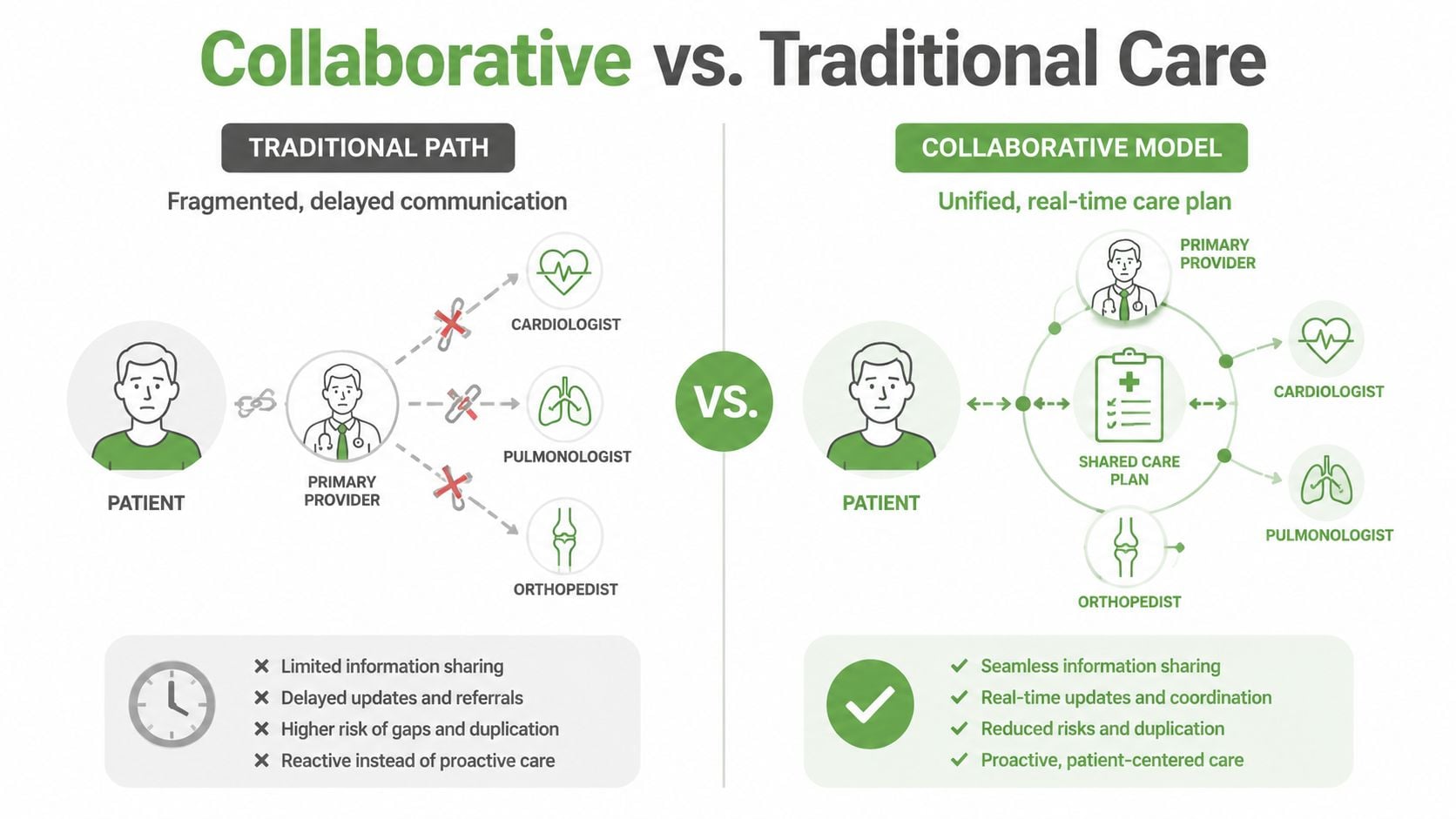
| Care feature | Traditional path | Collaborative care model |
|---|---|---|
| Information flow | The patient often carries records and repeats the history | Clinicians exchange relevant findings through an agreed process |
| Treatment planning | Each provider may focus on a single symptom or body area | The team establishes priorities across jaw, pain, sleep, and breathing |
| Treatment sequence | Interventions can be added without a shared order | Providers coordinate timing and reconsider steps when symptoms change |
| Follow-up | Responsibility may end when the referral is completed | A designated clinician or coordinator tracks progress |
| Patient experience | The patient acts as messenger between offices | The patient receives one understandable plan with clear next steps |
A concrete difference in practice
Suppose a patient reports jaw soreness after using an oral appliance. In a fragmented system, the patient might stop the device, return to the dentist, and separately report poor sleep to the sleep clinic. The sleep clinician may not know that the jaw became painful, while the dentist may not know whether the appliance improved breathing.
In a collaborative model, the symptom triggers a shared review. The dental provider examines fit and jaw loading. The sleep specialist considers whether another treatment approach is appropriate. The pain clinician addresses the flare, and the therapist reviews muscle use, tongue posture, or breathing habits if those factors are relevant.
This is particularly important in dental sleep medicine, where oral appliances may be considered within a broader sleep-management plan. An appliance is a tool, not a complete explanation for every headache, jaw symptom, or breathing complaint.
The collaborative model also improves the patient's ability to understand uncertainty. Not every symptom will have one immediate answer. A team can explain what it knows, what it still needs to test, and what finding would change the plan. That transparency is more useful than cycling through treatments without a shared hypothesis.
How Providers Can Implement This Model
A practice doesn't become collaborative by placing several specialties on the same website. Providers need a working system that defines who receives referrals, who reviews results, how cases are discussed, and who contacts the patient afterward.
Start with a shared intake
Use one intake process that captures jaw pain, headaches, facial symptoms, snoring, witnessed breathing pauses, sleep quality, daytime fatigue, nasal breathing, medications, prior appliances, and relevant medical history. The form should support clinical judgment, not replace it. A patient with severe symptoms still needs a proper examination and appropriate diagnostic testing.
Then define referral triggers. A dentist might refer for sleep evaluation when the history suggests a breathing disorder. A sleep clinician might request dental assessment when jaw symptoms complicate oral-appliance planning. A primary-care clinician or neurologist may refer when facial pain and sleep disruption appear together or when initial treatment hasn't explained the pattern.
Build communication into the workflow
A useful implementation plan includes:
- One shared record: Store examination findings, test results, treatment goals, and patient-reported changes where authorized team members can review them.
- A case-review routine: Discuss patients whose symptoms overlap, whose treatment has stalled, or whose new findings change the working diagnosis.
- Named responsibility: Assign one person to track referrals, unanswered questions, and follow-up rather than assuming everyone will remember.
- Standard outcome measures: Choose practical measures for pain, jaw function, headaches, sleep symptoms, adherence, and quality of life. Review them consistently.
- Patient-facing language: Give the patient one written plan that identifies each clinician's role and explains what happens next.
The model also needs escalation rules. A clinician should know when persistent daytime sleepiness, suspected obstructive sleep apnea, neurological warning signs, severe pain, or worsening function requires prompt medical attention rather than routine follow-up.
Plan for reimbursement and equity
Payment is a genuine operational constraint. Reporting on Medicaid coverage found that agencies and most Medicaid managed care organizations in 14 states provide little or no reimbursement for Collaborative Care Model services, creating state-by-state access gaps, as described by The American Journal of Managed Care. Practices should verify payer rules, document coordination work, and avoid assuming that a commercially viable workflow will transfer directly to Medicaid-heavy settings.
Equity requires more than offering the same pathway to everyone. The APA recommends culturally adapted outreach, a more diverse workforce, and quality tracking stratified by race and ethnicity in its discussion of reducing mental health inequities through CoCM. Clinics should also assess transportation, broadband access, language needs, staffing, and the practical burden of repeated appointments.
For practices improving patient communication and referral experience, resources on service quality for more leads may offer useful operational ideas. The clinical priority remains clear: better service must support better coordination, not replace it.
Taking the Next Step Toward Integrated Care
TMJ symptoms, facial pain, headaches, snoring, and disrupted sleep often cross professional boundaries. A collaborative care model respects those boundaries while connecting the people who work within them. Its strongest lesson is simple: the patient shouldn't have to be the communication system.
Ask prospective providers how they share records, who coordinates the plan, what they measure, and how they respond when treatment affects another symptom. Insurance coverage varies by payer and location, so ask which services are covered and what alternatives exist if coordination isn't reimbursed. During an initial consultation, bring medication details, prior imaging or sleep-study reports, appliance history, and a short symptom diary.
If you're a provider, begin with one referral pathway and one shared outcome process. A reliable small system is more useful than a large network that rarely communicates.
Pain and Sleep Therapy Center brings together care related to TMJ disorders, facial pain, dental sleep medicine, orofacial myofunctional therapy, breathing, and neurological concerns. To discuss whether an integrated evaluation fits your symptoms, visit Pain and Sleep Therapy Center and request the next appropriate step.