

A baby pulls away from the breast, the latch hurts, and feeding leaves everyone tense. Or an adult notices that their tongue feels restricted and wonders whether that could relate to jaw tension, mouth breathing, or sleep. In either situation, tongue tie release may come up as a possibility, but the presence of a tight-looking band under the tongue doesn't by itself establish that a procedure is needed.
A useful starting point is to ask what function is limited and how that limitation will be assessed before and after treatment. This guide explains what release involves, what the research can and can't tell families, and why coordinated assessment and follow-up matter as much as the procedure itself.
When a Tongue Tie Release Might Be on Your Radar
A parent may be working with a lactation consultant because their baby struggles to latch or feeding is painful. An adult may have heard that restricted tongue movement could be relevant to jaw tension or mouth breathing. A clinician may be weighing whether another professional should assess a patient's feeding or oral function. These situations can prompt a search for signs that a baby may have a tongue tie, but a search result can't determine whether the tissue is causing a particular person's symptoms.
A tongue tie, also called ankyloglossia, is a restriction involving the band of tissue beneath the tongue. Some people have a visible frenulum without meaningful difficulty using their tongue. Others may have restricted movement along with a specific functional concern. The central question isn't just what the tissue looks like, but whether its restriction is linked to an observable problem.
That distinction matters because the procedure releases tissue, not an established pattern of feeding, swallowing, or muscle coordination. A baby may still need help with positioning and latch after a release. An adult may need evaluation of jaw symptoms or breathing concerns rather than an assumption that a frenulum explains them.
A practical starting point: Ask the clinician to name the function that appears limited, how it will be assessed, and what change would count as meaningful improvement.
The decision can feel urgent when feeding is painful or sleep is disrupted, but urgency shouldn't replace careful assessment. A release can be one option within a broader plan. The aim is to understand the problem, consider supportive care, and decide together whether a procedure is likely to address a clearly identified restriction.
What a Tongue Tie Is and How It Is Diagnosed
Everyone has a lingual frenulum: the band of tissue running from the underside of the tongue to the floor of the mouth. When that band limits tongue movement enough to matter, clinicians call the condition ankyloglossia, or tongue tie.
The frenulum works like the tether on a tetherball. The ball can still move; the tether limits how far it travels. In the same way, a restrictive frenulum may limit how high the tongue lifts toward the palate, how far it extends past the lower lip, or how freely it moves side to side.
Range of movement is what counts. Consensus guidance treats ankyloglossia as a functional diagnosis, meaning a visible band becomes a tongue tie when restricted movement pairs with a measurable problem. The Academy of Breastfeeding Medicine's position statement stresses this link between restriction and function, and notes that breastfeeding difficulties sometimes improve with skilled nonsurgical support before any procedure is considered.
What an assessment considers
A clinician will watch the tongue move and ask what prompted the referral. For an infant, that often means observing a feed and asking about latch, milk transfer, and swallowing, along with what feeding support has already been tried. Similar symptoms can have several causes, so a careful evaluation examines the whole feeding picture before attributing difficulties to the frenulum.
For adults, the same principle applies. Restricted movement needs to connect to a defined concern. If jaw pain, breathing symptoms, or sleep problems are part of the picture, they warrant their own evaluation, since a visible frenulum alone does not establish cause.
Two terms come up often during these conversations. Frenotomy usually means cutting or dividing the restrictive tissue. Frenectomy generally means removing tissue as part of the release. Your treating clinician can explain which approach they recommend and why.
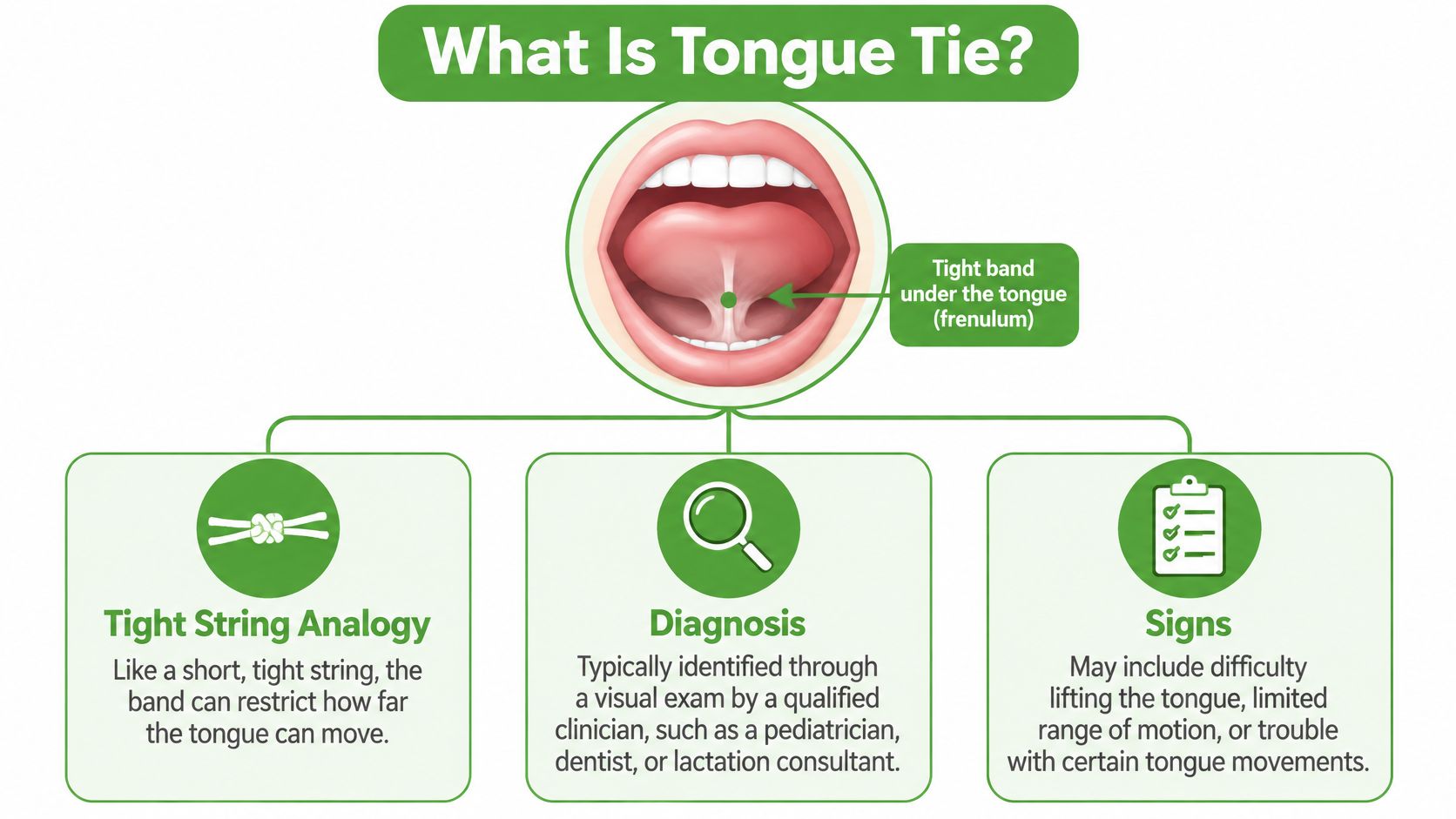
A diagram can show where the frenulum sits. It cannot show whether that tissue is causing a particular person's symptoms. Identifying a restriction also answers only the first question. Whether releasing it restores function depends on the quality of the assessment, the support around it, and what happens afterward.
Who May Benefit from a Tongue Tie Release
Candidacy depends on the person, the concern, and whether an assessment finds a meaningful link between restricted tongue movement and impaired function. The evidence is most directly focused on infants with breastfeeding difficulties. It is more limited for claims about speech, sleep, breathing, or other concerns across different ages.
For infants, release may be considered when a clinician identifies restricted movement alongside a feeding problem. The strongest evidence relates to short-term maternal nipple pain and some latch-related measures, not a guarantee that feeding will improve for every family. A 2023 systematic review and meta-analysis reported improvements in breastfeeding self-efficacy at 5–10 days (SMD 0.60; 95% CI 0.48–0.71) and 1 month (SMD 0.91; 95% CI 0.79–1.04). It also reported decreased maternal nipple pain at 5–15 days (SMD −1.10; 95% CI −1.49 to −0.70) and 1 month (SMD −1.23; 95% CI −1.79 to −0.67) (review in Pediatric Research). These findings support considering release for an identified feeding concern, alongside skilled lactation assessment.
For older children, families may ask about speech or feeding. A clinician should assess the specific difficulty and refer for appropriate evaluation, such as speech-language assessment when speech is the concern. The appearance of a frenulum alone doesn't establish that a release will resolve a speech or feeding issue.
Adults may wonder whether a restriction contributes to chewing, swallowing, jaw discomfort, or mouth breathing. Those symptoms can have multiple explanations. A functional assessment should clarify what movement is limited and whether that limitation plausibly relates to the person's concern.
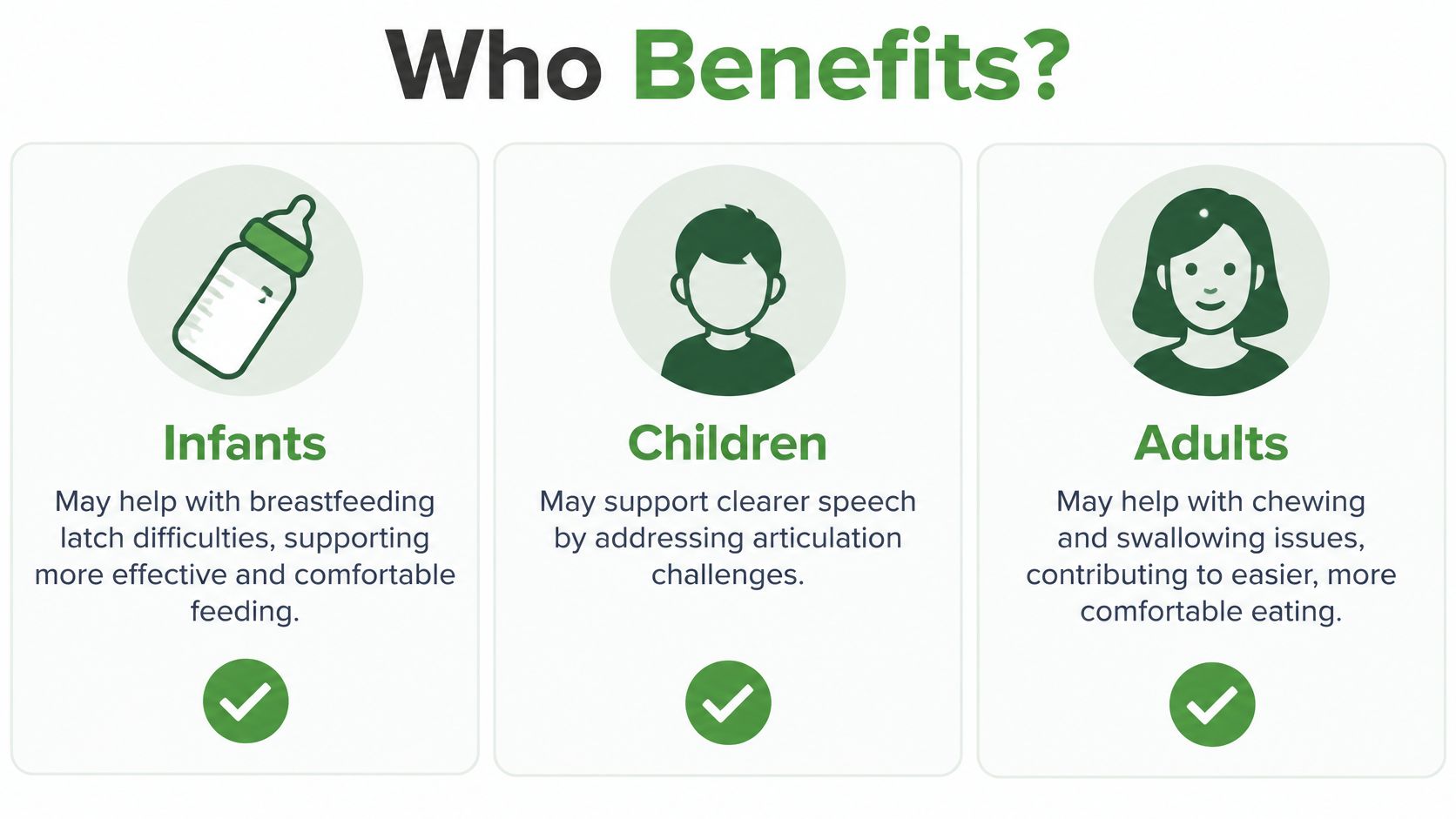
The categories in this graphic are prompts for discussion, not proof of benefit for any individual. In practice, a release may be considered as an adjunct to lactation support or other appropriate therapy. It isn't a substitute for finding out what's impairing function and whether that problem responds to conservative care.
Laser vs Scalpel - How the Procedure Is Performed
A release sounds straightforward: divide the tight tissue under the tongue, and movement should follow. In practice, clinicians reach that goal with one of several instruments. A laser uses focused light energy to cut and seal tissue at the same time. A scalpel or scissors cuts mechanically, sometimes followed by a stitch or gentle pressure to control bleeding. Electrocautery, which uses heat, is another option some clinicians prefer.
The instrument matters less than many families expect. As noted earlier, the Academy of Breastfeeding Medicine's 2021 position statement reports that comparative studies haven't established that one instrument produces better functional outcomes than another. What varies more is the clinician's judgment: which tissue to release, how completely, and what support follows.
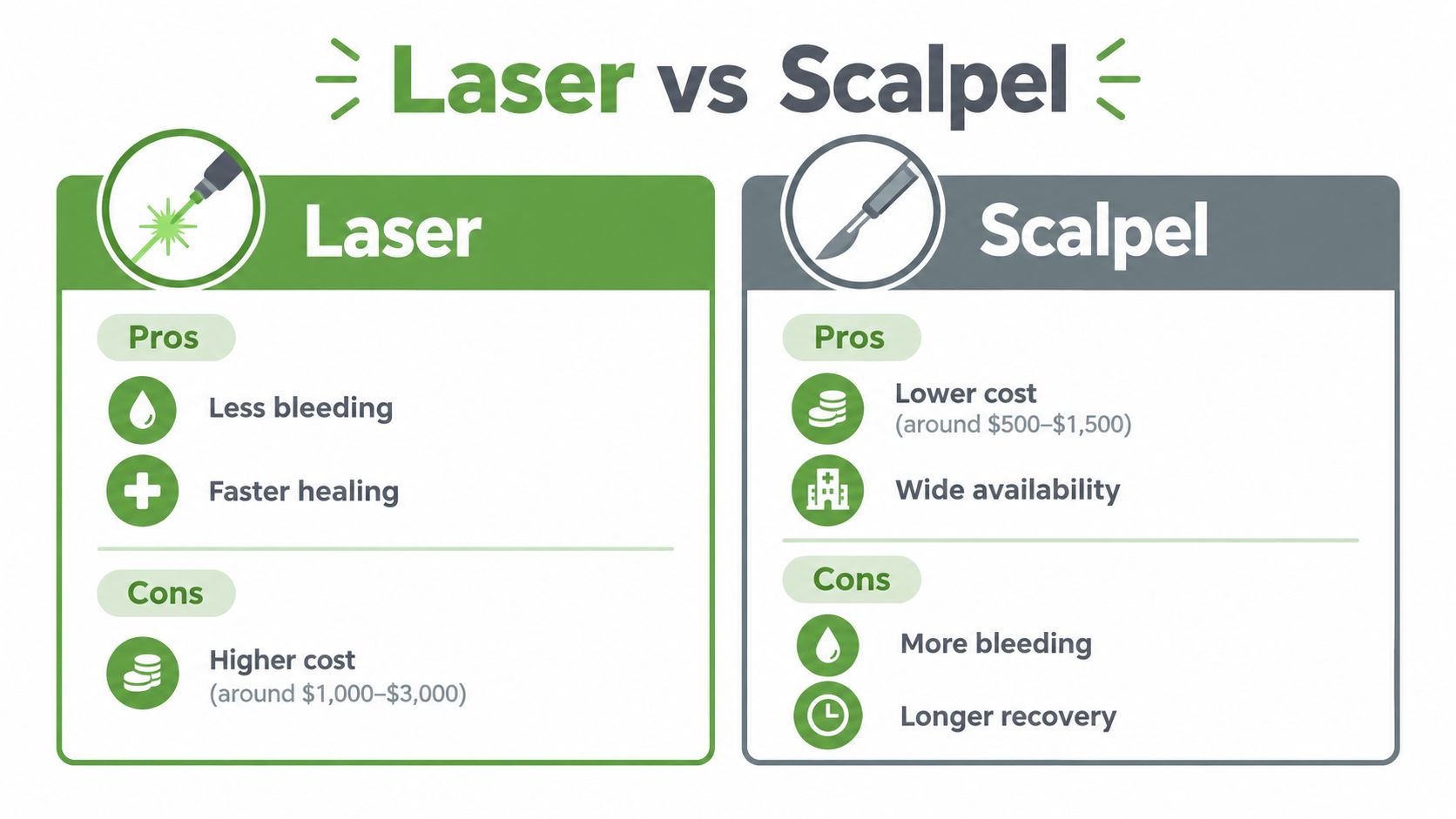
A chart like this can list differences in bleeding or healing, yet those differences depend heavily on technique, the individual case, and the aftercare plan. None of them reliably predicts how well a tongue will function weeks later.
Questions to ask before deciding
Before agreeing to a procedure, ask how the clinician confirmed that the tissue restricts movement, exactly which tissue will be released, and what discomfort or risks to expect. Reasonable follow-ups include who will support feeding or oral function during recovery, what the healing checks look like, and what the next step would be if the original difficulty continues.
The release itself changes tissue. It works a bit like loosening a stiff hinge: the door can finally swing, but someone still has to learn to use it smoothly again. A tongue that has compensated for months or years keeps its old habits after the restriction is gone. The clinician's training, case selection, and follow-up plan deserve at least as much attention as the tool in their hand.
The video below shows a procedure demonstration. Watching technique helps you understand what happens in the chair, though no video can predict an individual result or indicate which instrument suits a particular case.
What the Evidence Says About Outcomes
The research doesn't support describing tongue tie release as a predictable fix for every feeding problem. It points instead to a more specific discussion: some maternal nipple pain and short-term latch-related outcomes may improve, while measured infant feeding outcomes and longer-term results are less consistent.
A 2017 Cochrane review assessed five randomized trials involving 302 infants with tongue tie and feeding difficulties. In a pooled analysis of two studies involving 155 infants, release produced virtually no difference on a standardized 10-point infant feeding scale: the mean difference was −0.1 points (95% CI −0.6 to 0.5). Two trials reported higher rates of breastfeeding improvement, while the review also found a short-term reduction in maternal nipple pain. The authors described the evidence as mixed and limited by small trials and short follow-up (Cochrane review).
A 2011 systematic review examined 17 studies involving 733 infants with ankyloglossia and breastfeeding difficulties; 680 underwent frenotomy. Among the subgroup with available three-month follow-up data, 275 of 409 infants, or 67.2%, were still breastfeeding after the procedure. The review described generally improved breastfeeding characteristics and concluded that release appeared safe and might help some mothers continue breastfeeding. Because the evidence was largely observational and the outcomes varied, 67.2% isn't a guaranteed success rate or proof that release alone caused continued breastfeeding (systematic review).
A large UK randomized trial compared release plus standard breastfeeding support with support alone. At three months, breastmilk feeding continued for 67 of 76 infants (88%) in the release group and 75 of 87 (86%) in the support-only group. The adjusted risk ratio was 1.02 (95% CI 0.90–1.16), showing no evidence of a difference between groups for that outcome (trial report).
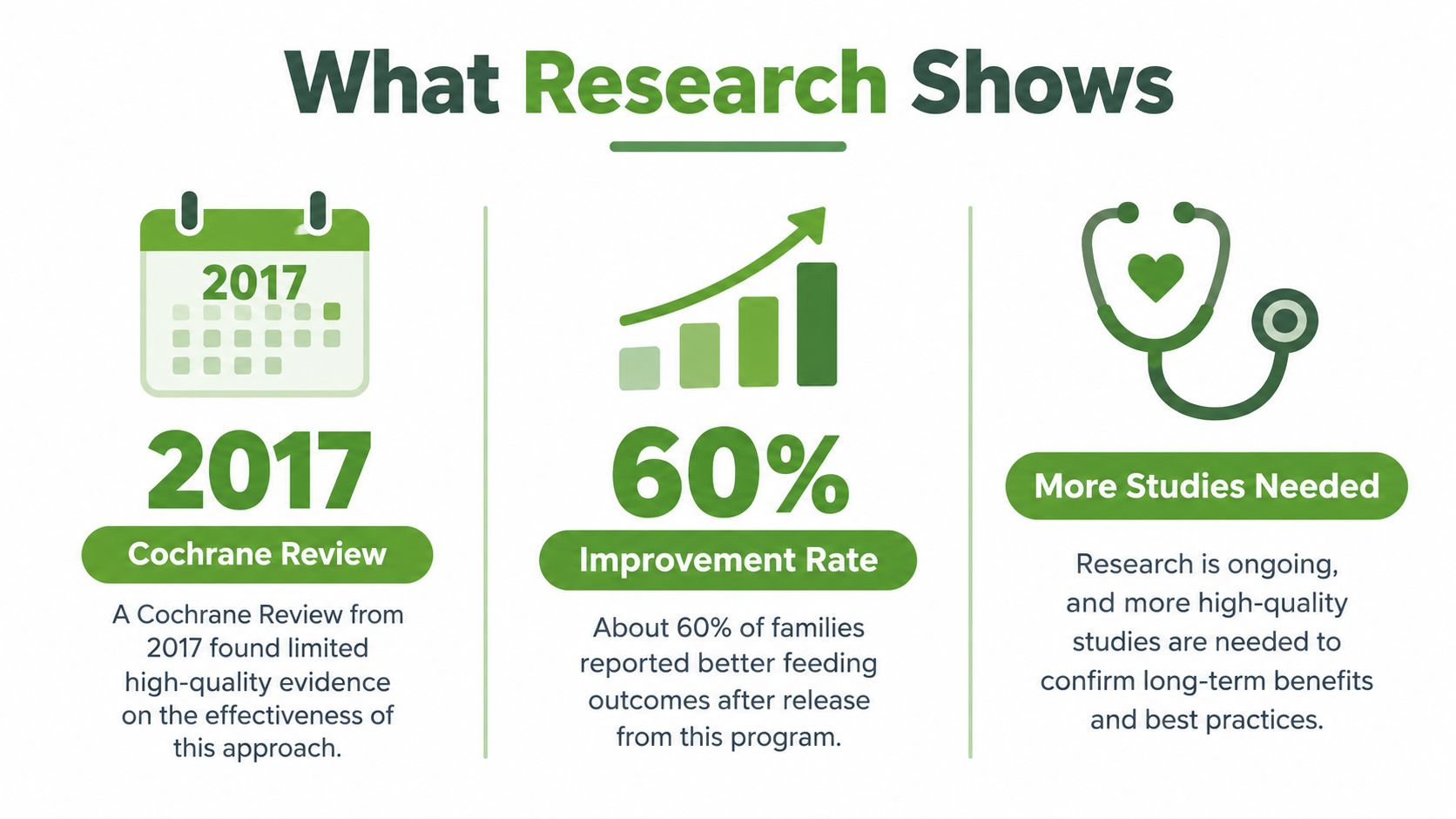
The infographic's “60%” improvement-rate callout isn't supported by the cited evidence summarized here, so it shouldn't be used to estimate an individual's likelihood of improvement. The broader lesson is to agree on functional measures, such as latch comfort or effective milk transfer, and reassess them after care. For other concerns, the relevant outcome should match the problem being treated. A release is a step, not an outcome.
Risks, Limitations, and When to See a Specialist
A release is a procedure with potential complications, even when the clinician expects it to be straightforward. Families should ask about bleeding, infection, scarring, reattachment, and oral aversion. Less common but clinically relevant risks include injury to salivary structures and, rarely, airway obstruction. The practice's overview of tongue tie complications can help readers prepare questions, but an individual clinician should explain the risks relevant to the proposed procedure.
A procedure also can't promise to resolve breastfeeding problems, speech concerns, mouth breathing, snoring, or sleep apnea. Each symptom needs to be assessed on its own terms. If an infant has feeding difficulty, a lactation consultant can help assess latch and feeding support. A speech-language pathologist may be appropriate when speech or swallowing function is the concern; an ENT or physician may be needed for concerns outside a dental practice's scope.
It's reasonable to pause if no one has explained the functional problem, the alternatives, or how improvement will be assessed. A second opinion can help clarify whether release is appropriate or whether conservative support is a sensible next step.
Before consenting, ask what nonsurgical support has been considered, what the procedure is intended to change, and who will coordinate follow-up. When care involves more than one clinician, a clear plan for patient intake to follow-up care can help families understand what information and coordination to expect across appointments.
In Charlotte, NC, Pain and Sleep Therapy Center evaluates TMJ, orofacial pain, and dental sleep concerns, and offers in-house 3D CBCT imaging and home sleep testing. Those tools assess other aspects of oral and airway health; they don't replace a functional tongue assessment or determine by themselves whether release is indicated. A referral to a clinician with relevant expertise can help when symptoms span feeding, oral function, jaw concerns, or sleep.

Recovery and Aftercare - What to Expect
The treating clinician should provide case-specific instructions for aftercare. Patients may notice soreness or sensitivity, and an infant may need time and feeding support as they adjust. Ask in advance whom to contact with concerns and what symptoms warrant prompt clinical advice. Seek urgent medical help for breathing difficulty or other emergency symptoms.
Follow-up matters because healing and function aren't the same thing. The clinician can check the healing site and reassess the original concern. For an infant, a lactation professional can help evaluate latch and feeding after the procedure. For other patients, appropriate oral-function therapy may be considered when it fits the identified problem.
Support the function, not just the healing site
Patients and parents shouldn't assume that a particular exercise or stretching routine is required for everyone. Follow the treating clinician's instructions, and ask for a demonstration if an exercise has been recommended. Guidance about post-frenectomy exercises can help prompt questions, but it shouldn't replace instructions specific to the procedure and patient.
Keep track of the symptom that prompted treatment. A parent might note whether feeding seems more comfortable and discuss ongoing latch difficulty with the clinician. An adult might report whether the specific oral movement or concern identified before treatment has changed. If symptoms persist, return for reassessment rather than assume that more tissue needs to be released.
A useful follow-up plan identifies what will be checked, who will provide support, and when the patient should contact the clinician. If healing seems concerning or the original functional difficulty remains, the treating team can decide whether further assessment, therapy, or another course of action is appropriate.
Making an Informed Decision About Tongue Tie Release
The central question is not whether a frenulum looks tight. It's whether restricted movement is linked to a specific problem, whether appropriate support has been considered, and whether the patient and clinician can agree on a meaningful way to assess change.
Before deciding, ask:
- What function is limited? Ask the clinician to describe the observed restriction and how it relates to the concern.
- What else could explain the symptoms? Feeding difficulty, jaw discomfort, and breathing concerns can have different causes and may need different evaluations.
- What are the alternatives? Discuss conservative support, including lactation help or appropriate oral-function therapy, when relevant.
- How will follow-up work? Clarify who will assess healing and function and what to do if the original concern continues.
Evidence suggests that some families may see short-term improvements in maternal pain or latch-related measures, but outcomes aren't assured. The available evidence doesn't establish that a laser is functionally superior to a scalpel, and release alone doesn't guarantee restored function. The procedure should fit into a coordinated plan rather than stand in for one.
Pain and Sleep Therapy Center in Charlotte, NC, led by Dr. Greg Larson, DDS, can assess concerns involving orofacial pain, jaw function, and dental sleep medicine, and can help coordinate discussion of tongue mobility and related care. For a complimentary consultation, families and adults can contact the practice and ask whether an evaluation fits their concerns.
Pain and Sleep Therapy Center offers evaluation for tongue mobility and related orofacial and sleep concerns, with care coordinated around each patient's functional needs. If you're considering tongue tie release in Charlotte, NC, visit Pain and Sleep Therapy Center to request a complimentary consultation and discuss your questions with the team.