
Can a person learn to breathe more comfortably without changing how well the lungs work or whether the airway stays open during sleep? That question helps explain both the appeal and the limits of the Buteyko breathing method.
Breathing habits, lung function, and nighttime airway obstruction aren't the same thing. For patients exploring mouth breathing, snoring, jaw tension, or disrupted sleep, understanding those differences makes it easier to choose breathing exercises for the right reason, without overlooking a condition that needs medical or dental care.
What the Buteyko Method Is and How It Works
The Buteyko breathing method is a structured breathing-retraining approach intended to reduce habitual overbreathing through controlled, mostly nasal breathing and brief breath holds. Its basic idea resembles retuning an engine that idles too fast, rather than trying to make the engine larger.
Consider someone sitting at a desk with the mouth open, shoulders slightly raised, and frequent large breaths. That person may be moving more air than the body needs at rest, but appearance alone doesn't establish hyperventilation. A clinician must distinguish a breathing habit from nasal obstruction, respiratory disease, or another reason for increased breathing.
Overbreathing can become automatic, rather like holding a fist clenched without noticing it. Retraining starts with recognizing the pattern, not assuming that every deep breath is harmful.
The emphasis is on comfortable nasal breathing rather than forceful breath control.
The building blocks of breathing retraining
Buteyko practice generally introduces these components in sequence:
- Nasal breathing: Moving air through the nose when nasal airflow is comfortable.
- Lower tidal volume: Taking a smaller amount of air with each resting breath, without straining.
- Slower respiratory frequency: Reducing unnecessarily rapid breathing rather than chasing a rigid breathing rate.
- Relaxed diaphragmatic breathing: Allowing comfortable lower-rib and abdominal movement without exaggerated belly breathing.
- Brief pauses after a normal exhale: Exploring a comfortable pause, not a maximum breath hold.
“Diaphragmatic” doesn't mean taking the biggest possible breath. A person can breathe with relaxed movement instead of repeatedly lifting the shoulders or expanding the chest forcefully.
Ukrainian physician Konstantin Buteyko developed the method in the 1950s, giving it roughly seven decades of history; the 2013 Cochrane review traces that development and identifies 13 studies involving 906 adults with mild-to-moderate asthma. Historical use, however, isn't proof of effectiveness for every condition now associated with breathwork.
Why the carbon dioxide explanation needs caution
The original hypothesis proposed that excessive ventilation and reduced tolerance of carbon dioxide could contribute to asthma-related symptoms. Reducing ventilation might limit excessive carbon dioxide loss, sometimes described as carbon dioxide washout.
But a plausible mechanism isn't the same as a demonstrated mechanism. A review of randomized trials in BMJ Open found that participants often slowed their breathing without reliably changing end-tidal carbon dioxide, the carbon dioxide measured at the end of an exhalation.
That weakens the claim that carbon dioxide normalization is the main reason people benefit. The more defensible description is breathing-pattern retraining, not a proven technique for deliberately raising carbon dioxide.
A longer comfortable breath hold isn't a diagnosis of healthier lungs, better oxygen delivery, or a safer airway during sleep.
Assessment may include breathing route, resting breathing rate, symptoms, and appropriate objective testing. Buteyko isn't a cure, a replacement for prescribed medication, or a stand-alone treatment for obstructive sleep apnea.
What the Research Shows for Asthma and Sleep Breathing
The clearest way to read the Buteyko literature is to ask what each study measured. Some trials tracked how patients felt. Others measured airway physiology or sleep itself. Those are different questions, so the evidence below is grouped by outcome rather than by optimism.
Buteyko evidence by condition and outcome
| Condition or outcome | What studies report | Certainty and limits |
|---|---|---|
| Asthma symptoms | Australia's 2024 Natural Therapies Review concluded that Buteyko may reduce asthma symptoms, basing that finding on six trials involving 339 adults and children. | Low certainty; the review's wider pool of 11 Buteyko trials was small, generally enrolling 28 to 100 participants. |
| Asthma control, pooled estimate | An evidence synthesis summarized on PubMed reported a standardized mean difference of -0.33, with a 95% confidence interval of -0.54 to -0.13 and no observed statistical heterogeneity. | Symptom-level outcome; differences in study methods still limit interpretation. |
| Asthma control and medication use | A randomized asthma trial reported better control and lower medication use with Buteyko added to usual care. | Single trial; findings concern asthma, not sleep apnea or jaw pain. |
| Lung function (FEV1) and quality of life | Research comparing Buteyko with control or pranayama interventions has not shown a consistent advantage on these measures. | Small trials and inconsistent findings limit confidence. |
| Obstructive sleep apnea | No established treatment effect is shown for Buteyko alone. | Validated sleep testing remains necessary; breathing practice doesn't replace indicated CPAP or oral appliances. |
Symptoms and physiology answer different questions
A symptom questionnaire asks how a person feels and functions. Lung-function testing asks how the respiratory system performs under standardized conditions. A sleep study measures breathing during sleep.
These outcomes can move independently. Someone may feel less troubled by breathing, notice fewer unnecessary sighs, or gain confidence managing a breathing pattern without showing a meaningful change in FEV1, a measure of how much air can be forcefully exhaled. A calmer symptom diary can sit alongside an unchanged spirometry reading.
That doesn't make symptom improvement unimportant. It means the claim must match the measurement: better symptom control isn't evidence that airway inflammation has resolved, lung capacity has increased, or nighttime obstruction has disappeared.
Evidence boundary: Feeling better is valuable. It doesn't, by itself, establish that a respiratory condition is controlled.
The low certainty rating matters here too. Small trials can produce encouraging averages while leaving real doubt about how reliably the next patient will respond, which is why the asthma findings sit several steps below a firm recommendation.
The earlier Cochrane review belongs to the method's research history: it catalogued asthma trials rather than sleep outcomes. Asthma and obstructive sleep apnea are different clinical problems, even when both involve breathing.
What this means for sleep-related symptoms
A person who practices nasal breathing while awake may build a useful habit. That habit says little about what happens in the throat after sleep begins, when conscious control fades and the airway may narrow or collapse.
For anyone with suspected apnea, obstructive sleep apnea diagnosis should establish the problem before breathing exercises become the main plan. Testing also provides a baseline against which any therapy can be judged.
Asthma care stays with the treating physician. Lower medication use inside a trial is a supervised research finding, not an instruction to cut back on inhalers.
The practical takeaway is modest but useful: Buteyko may support breathing habits and symptom management, while prescribed treatment and appropriate testing address the risks a comfortable breathing exercise cannot measure.
Why Nasal Breathing Matters During Sleep
Clinicians who focus on the airway pay close attention to which route air takes during sleep, because the passage air travels can change how stable the throat stays overnight. The clearest way to see the difference is to look at studies that measured airway resistance directly.
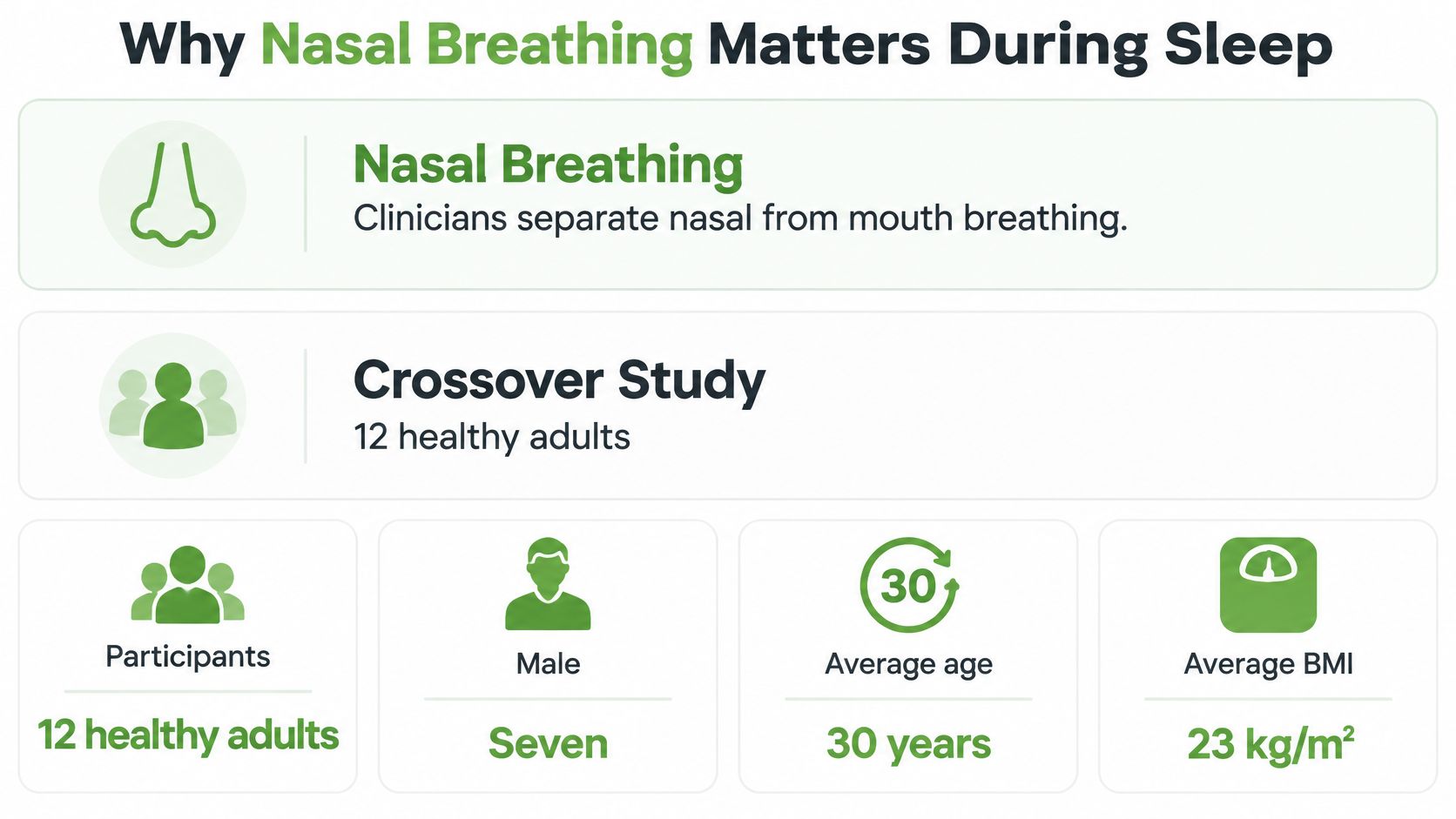
A randomized crossover study in the European Respiratory Journal examined 12 healthy adults, including seven men, with an average age of 30 years and an average body-mass index of 23 kg/m². During supine stage-two sleep, median upper-airway resistance measured 5.2 cmH₂O·L⁻¹·s⁻¹ with nasal breathing versus 12.4 with oral breathing, and the apnea-hypopnea index averaged 1.5 ± 0.5 versus 43 ± 6.
Those numbers describe physiology under controlled conditions. They show what happens to airway mechanics when the mouth opens, and they leave open the separate question of what a breathing exercise does for a given patient.
Airflow route can affect airway stability
A narrower or more resistant passage is more likely to collapse under the pressures generated during breathing. A soft straw bends under suction before a rigid one does, and the throat follows similar physics. Mouth opening, tongue position, and surrounding anatomy all shape the outcome, so the airway is never explained by a single habit.
Modeling work points in the same direction. A 2020 computational-fluid-dynamics study in PLOS ONE found higher airflow velocity during oral breathing than during nasal breathing with either an open or closed mouth, and its Starling-resistor model identified oral breathing as the primary condition leading to pharyngeal collapse. This was a computer model, so it describes airflow physics rather than testing Buteyko treatment in patients.
Nasal blockage itself also matters. In a sham-controlled crossover study of 10 patients with sleep apnea and nasal obstruction, treatment with a topical decongestant and external nasal dilator reduced the oral fraction of ventilation during sleep by a mean of 30%, with a 95% confidence interval of 12% to 49%.
Check why the mouth is open
Taken together, these studies show that breathing route influences airway physiology. They stop short of showing that practicing Buteyko prevents apnea, and they do not establish nasal strips or decongestants as standalone sleep-apnea treatments.
- Persistent nasal blockage: Needs assessment rather than stronger efforts to keep the mouth closed.
- Snoring with pauses: Calls for evaluation of nighttime obstruction.
- Comfortable daytime nasal breathing: Provides a starting point for habit work, not confirmation that sleep breathing is safe.
The distinction between nasal breathing and mouth breathing is useful when describing symptoms to a clinician. For families weighing advice about keeping the mouth closed at night, Inspire Dental Group's nasal breathing guidance for Vancouver families adds context for that conversation without replacing an assessment.
How to Practice the Basic Buteyko Exercises
A 2024 randomized trial in the European Journal of Medical Research studied 60 adults with asthma over three months, comparing 30 participants receiving Buteyko plus usual care with 30 receiving usual care alone. Its protocol included nasal breathing, reduced-volume breathing, and a comfortable control pause.
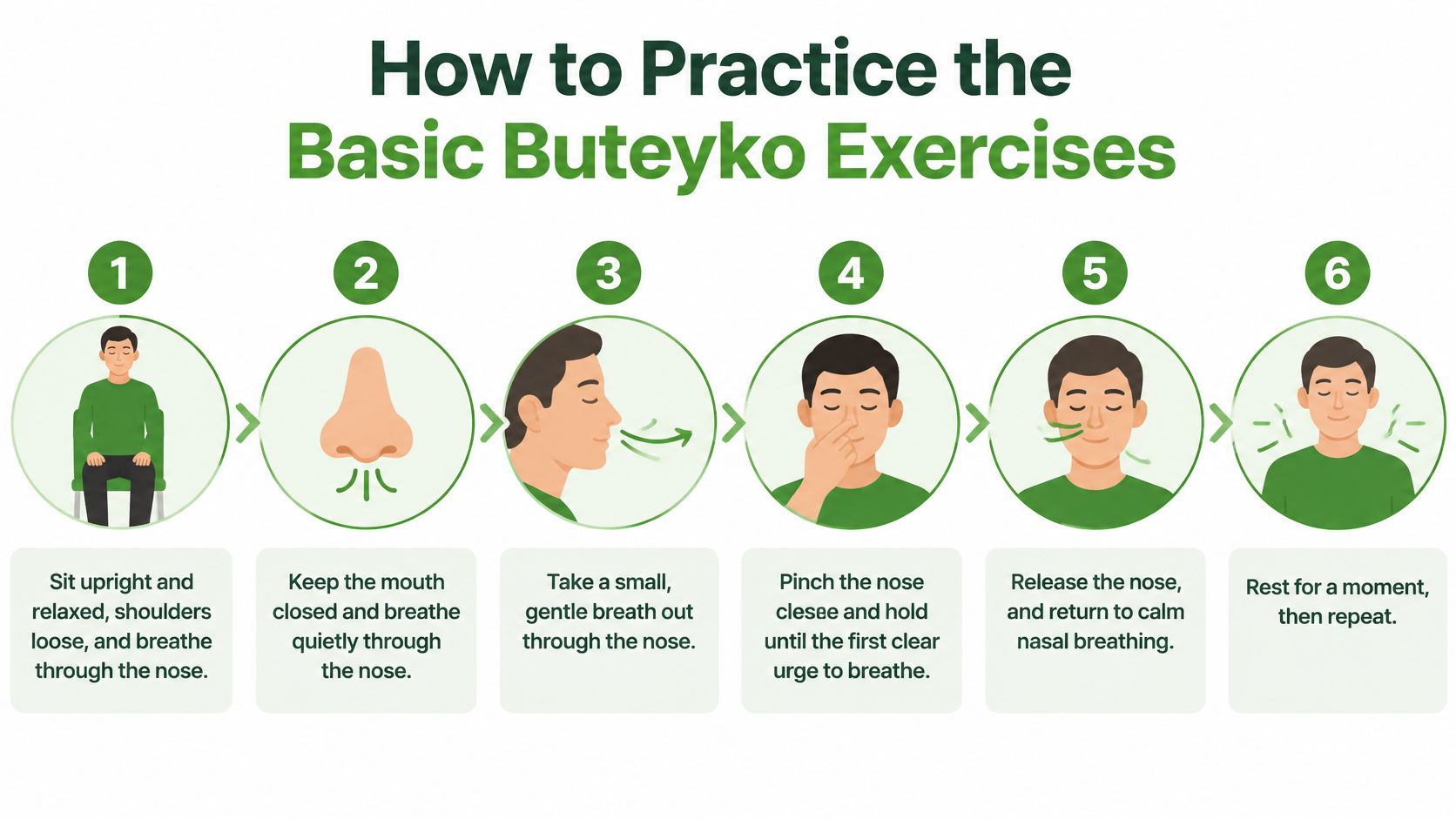
The sequence below explains that pause. It's best learned with a qualified instructor after medical clearance for breath-hold work, particularly when respiratory symptoms are present.
A comfortable control-pause sequence
Sit upright and settle. Keep the shoulders loose and breathe through the nose at an easy, unforced pace. The aim is a comfortable starting pattern, not a rigid posture or deliberately deep inhalation.
Let out a normal, gentle breath. Allow an ordinary exhale rather than pushing air out. Emptying the lungs forcefully changes the exercise and can make the pause uncomfortable.
Close the nose with the fingers. Keep the mouth closed without clenching the teeth. Pinching the nose creates a clear pause, but jaw tension adds effort that isn't needed.
Stop at the first clear urge to breathe. This is a comfortable observation, not an endurance challenge. Waiting for strong discomfort or struggling to extend the hold misses the purpose.
Release the nose and resume gentle nasal breathing. Rest until breathing feels normal again. Gasping, taking a large recovery breath, or opening the mouth to recover suggests the hold was too forceful.
Repeat briefly, with normal breathing between pauses. Keep the breaths quiet and comfortable rather than making them progressively smaller at any cost. An instructor should adjust the exercise if repeated pauses create strain.
The graphic summarizes the sequence without turning it into a breath-holding competition.
Keep the exercise separate from a diagnosis
The trial also assessed reduced-volume nasal breathing during vigorous walking in place. That doesn't mean an unsupervised beginner should add exertion or stronger breath holds.
A control-pause time can describe a practice session, but it can't determine asthma control, diagnose sleep apnea, or explain TMJ pain and headaches.
Safety rule: Stop if dizziness, chest tightness, or wheezing occurs. Seek medical advice rather than trying to breathe through worsening symptoms.
Breath holds should never be practiced while driving, in water, or anywhere a loss of awareness could cause injury. Active breathing difficulty calls for the person's prescribed medical plan, not another exercise attempt.
How Long Training Takes and How to Find an Instructor
Breathing retraining is habit practice, not a quick test with a pass-or-fail result. A structured course may involve repeated practice over months, but the asthma trial's duration isn't a guaranteed timetable for changes in snoring, daytime fatigue, or jaw symptoms.
A useful plan defines what is being practiced, what will be monitored, and when the treating clinician will reassess it. Otherwise, a person may continue an exercise because the breath-hold time is increasing.
Keep a diary that supports clinical decisions
A short daily record can include:
- Practice: Minutes spent on comfortable nasal breathing and whether it felt easy or forced.
- Control pause: Time in seconds, if an instructor recommends tracking it, without treating it as a health score.
- Nighttime observations: Snoring, waking, gasping, or a bed partner's report of breathing pauses.
- Daytime symptoms: Morning headaches, sleepiness, and jaw or facial discomfort.
- Existing respiratory care: Asthma symptoms and rescue-inhaler use, for review with the treating physician.
Reviewing a written record is more useful than trying to remember whether sleep felt better several weeks earlier. The physician or dentist can decide whether symptoms warrant further testing or a different treatment emphasis.
Choose an instructor who respects medical boundaries
Patients should ask about the instructor's training background, experience with breathing-pattern education, and screening before breath holds. Screening should include asthma and heart or lung conditions, along with coordination with the treating physician or dentist.
An appropriate instructor explains how exercises will be modified if nasal airflow is limited or symptoms occur. Promises to cure apnea, eliminate asthma, or stop prescribed medication are warning signs.
New breathlessness, chest tightness, wheezing, or worsening symptoms require prompt medical attention. They shouldn't be interpreted as a necessary adjustment phase or evidence that training is working.
Combining Buteyko With Myofunctional and Airway Care
Breathing retraining makes more sense when the clinician first identifies the barrier. Habitual mouth breathing, restricted nasal airflow, altered tongue posture, and a painful jaw joint don't call for identical exercises.
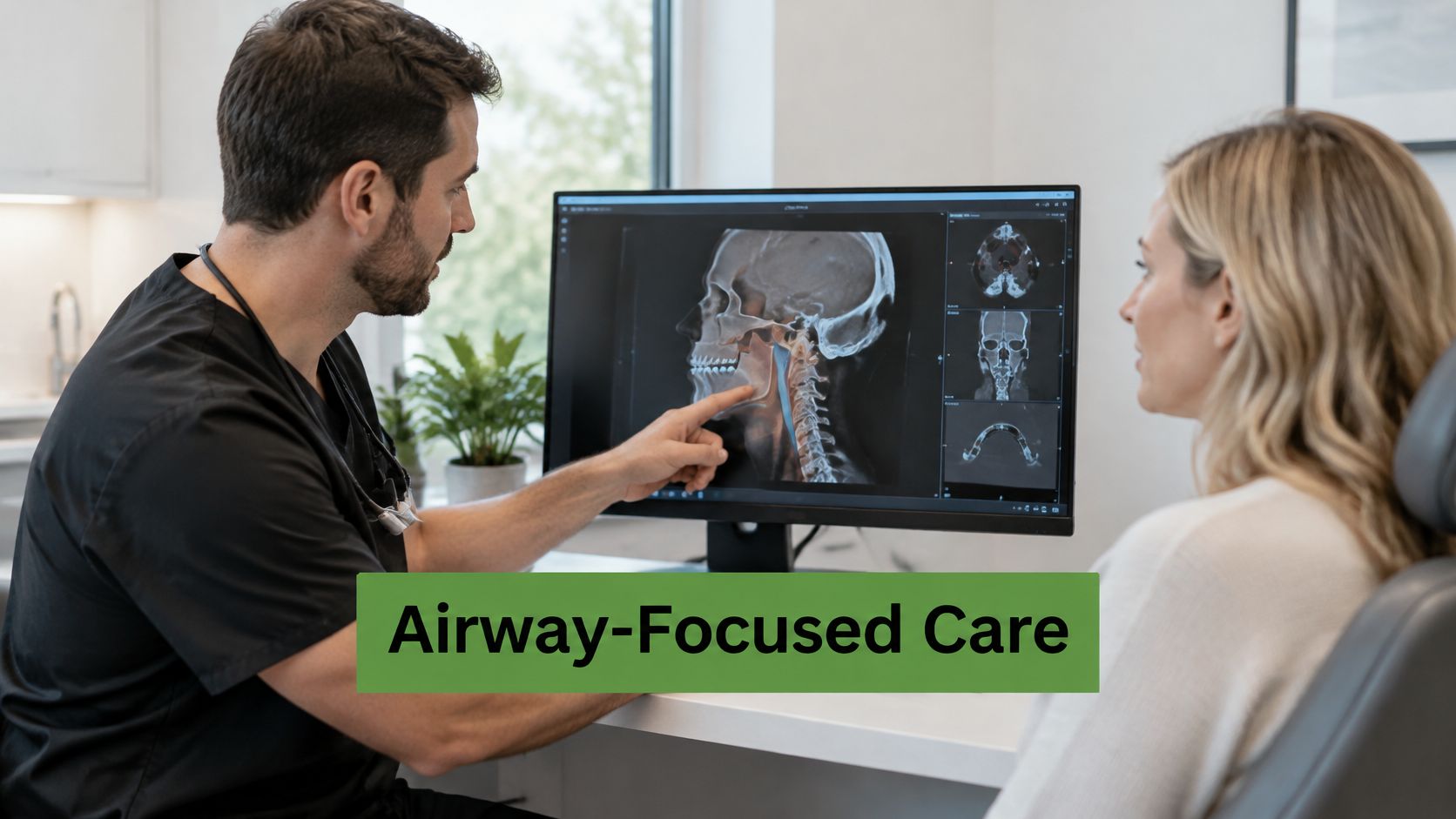
An airway assessment considers both structure and function.
Match the tool to the barrier
Orofacial myofunctional therapy, or OMT, addresses tongue strength, nasal breathing, and swallowing patterns. It can help clinicians work on oral habits that a simple instruction to breathe through the nose doesn't address.
A custom sleep-apnea appliance has a different job: it supports the airway mechanically during sleep. Functional exercises don't perform that mechanical task, and wearing an appliance doesn't automatically retrain daytime oral habits.
At Pain and Sleep Therapy Center, we combine functional therapies with oral appliances, using the appliance for nighttime support while OMT and breathing retraining address underlying functional issues. We match the emphasis to the barrier, such as tongue posture, habitual mouth breathing, or a sore jaw joint.
The explanation of myofunctional therapy for sleep apnea can help patients understand how muscle work fits into an individualized plan. It shouldn't be interpreted as a promise that exercises alone will resolve obstruction.
The accompanying video provides additional context for discussing coordinated care.
Coordinate care rather than collecting treatments
The center's interdisciplinary team includes dental sleep medicine, orofacial myofunctional therapy, Buteyko breathing, neurology, and pediatric oral health. Coordination with the patient's physician or dentist helps keep breathing work aligned with the actual diagnosis.
- Tongue posture or oral habits: May warrant functional assessment and individualized exercises.
- Jaw or facial pain: Calls for evaluation before adding movements that could aggravate symptoms.
- Nighttime airway obstruction: Needs treatment selection and objective follow-up, not symptom impressions alone.
Patients with orofacial pain may need a different starting point than someone whose main concern is snoring. All Stars Dental's explanation of night guard options for grinders can also help frame questions about grinding protection, but a grinding guard and a sleep-apnea appliance shouldn't be assumed interchangeable.
The practical sequence is identify the barrier, choose the tool, then measure the result.
Who Should Consider It and What to Do Next
Who may consider Buteyko breathing and what to do first
| Situation | Role of breathing work | Step before or alongside |
|---|---|---|
| Daytime mouth breathing | May help build nasal breathing habits. | Clinical check of nasal airflow and oral habits. |
| Diagnosed asthma | Adjunct for breathing habits, not a replacement. | Keep prescribed medication and follow the treating doctor. |
| Snoring, witnessed pauses, or daytime sleepiness | Cannot rule out sleep apnea on its own. | Validated sleep testing chosen by a clinician. |
| Difficulty tolerating CPAP | May complement a broader plan. | Discuss alternatives, including oral appliance therapy, with a dental sleep professional. |
| Jaw pain, clicking, or jaw-related headaches | May be part of airway and posture care. | TMJ and orofacial pain evaluation first. |
| Heart or lung disease, or pregnancy | Breath holds need medical approval. | Ask a physician before starting. |
| Children with mouth breathing or tongue-posture concerns | Not a stand-alone plan. | Pediatric evaluation by a qualified professional, including tongue posture, nasal breathing, and swallowing patterns. |
Choose the evaluation that matches the problem
The same breathing exercise can suit one person and distract another from needed care. Frequent snoring, observed pauses, unrefreshing sleep, morning headaches, and excessive daytime sleepiness warrant assessment for a sleep-related breathing disorder.
Testing should fit the problem. Clinicians choose the appropriate sleep study when apnea is suspected, while imaging can help assess anatomy. Imaging does not replace a sleep study or show by itself what happens throughout the night.
A clear decision path helps:
- Name the main concern. Distinguish mouth breathing from suspected apnea, asthma symptoms, jaw pain, or daytime fatigue.
- Arrange the matching assessment. Sleep symptoms require evaluation for sleep apnea, while painful jaw movement may need a TMJ/TMD assessment.
- Keep indicated treatment in place. Add supervised breathing practice only where it serves a defined purpose, then reassess symptoms and relevant objective measures.
- Match the tool to the barrier. Tongue posture, habitual mouth breathing, and a sore jaw joint can each call for a different plan.
Persistent headaches or migraines associated with jaw symptoms deserve their own assessment rather than an assumption that mouth breathing explains them. Children also need an age-appropriate evaluation before adult breathing routines are adapted for them. In children, orofacial myofunctional therapy may be used to guide jaw and facial growth and establish healthy nasal breathing habits.
What assessment involves in Charlotte
Pain and Sleep Therapy Center's process in Charlotte, NC starts with a detailed airway assessment and ends with a therapy the patient can keep using. The center offers root-cause evaluation and treatment for snoring, mouth breathing, sleep apnea, TMJ tension, and chronic breathing dysfunction. Its diagnostic process goes beyond a standard sleep study to find the structural and functional problems causing airway collapse.
The diagnosis step includes a detailed assessment with 3D CBCT imaging and airway analysis. The practice offers CBCT 3D imaging, which scans the airway, joints, and bone in three dimensions. This helps the team look at structure and function together, then decide whether breathing retraining, myofunctional therapy, an appliance, CPAP, regenerative support, or a combination fits the case.
The practice is led by triple board-certified Dr. Greg D. Larson and an interdisciplinary team that includes dental sleep medicine, orofacial myofunctional therapy, Buteyko breathing, neurology, and pediatric oral health. Pain and Sleep Therapy Center uses Buteyko breathing as a functional tool that improves breathing behavior, symptom control, and quality of life.
The most useful question is whether breathing-pattern retraining addresses an identified problem, can be practiced safely, and is being assessed with the right measures. For some people, targeted muscle and breathing therapies alone are enough to resolve mild sleep apnea. For others, Buteyko-style breathing works alongside myofunctional therapy, oral appliances, CPAP, or regenerative options.
Pain and Sleep Therapy Center offers coordinated evaluation of breathing habits, sleep-related airway concerns, and jaw or facial pain in Charlotte, NC. Patients interested in whether Buteyko breathing belongs in their care can request a consultation to discuss symptoms and an appropriate next step.