
Ask why someone wakes with a dry mouth and a raw throat, and they'll say they slept with their mouth open. Ask what made the mouth open in the first place, and the answer usually stops there. That's the gap worth closing, because a mouth that opens out of habit and a mouth that opens because the nose can't move air are two different problems with two different solutions, and one of them can get worse when you tape it shut.
Obstructive sleep apnea is common enough that the question deserves a real answer. The Wisconsin Sleep Cohort's first large community prevalence study, published in 1993, found OSA, defined as an apnea-hypopnea index of at least 5 events per hour, in approximately 24% of men and 9% of women; later United States estimates placed it at about 26% of adults aged 30 to 70, or at least 25 million adults (American Academy of Sleep Medicine).
Mouth breathing sits at the center of that picture without being proof of it. It's a signal worth triaging, the way a cough is worth triaging: common, informative, and never a diagnosis by itself.
Mouth Breathing Signs That Point Toward Sleep Apnea
Mouth breathing is strongly associated with sleep-disordered breathing, but it is not a test for obstructive sleep apnea. The association is strong enough to justify a proper conversation and far too weak to support a diagnosis made at the kitchen table.
In an NIH-indexed adult study, 72.2% of habitual snorers reported mouth breathing compared with 23.3% of non-habitual snorers, a gap that was statistically significant at p < 0.001 (the published adult study). The same study found habitual snoring in 18.5% of participants and snoring of any frequency in 37.9%, which says something about how wide this spectrum runs.
What the numbers actually show
A high percentage among snorers doesn't mean most mouth breathers have apnea. Many people who breathe through their mouth have normal sleep studies, and some people with clear apnea never notice their lips parting at night. The useful question isn't "do I mouth breathe?" but "what else happens while I sleep?"
Self-report is the weakest part of the picture. A bed partner who has watched you stop breathing mid-snore and restart with a gasp is describing something no questionnaire captures, and that observation outranks anything you can recall from the inside.
| Sign | May point toward | Next step |
|---|---|---|
| Witnessed pauses or gasping during sleep | Possible obstructive sleep apnea | Request objective sleep testing |
| Loud, habitual snoring | Airway narrowing during sleep | Sleep evaluation with a physician |
| Morning headaches | Possible sleep-disordered breathing | Discuss with a physician or sleep specialist |
| Excessive daytime sleepiness | Disrupted sleep or breathing events | Sleep testing |
| Dry mouth or sore throat on waking | Open-mouth breathing overnight | Check nasal breathing and sleep quality |
| Persistent nasal congestion | Nasal obstruction forcing mouth breathing | ENT or physician evaluation |
| Open mouth during sleep with no other symptoms | Habit or nasal obstruction, not proof of OSA | Evaluate nasal breathing before trying mouth taping |
When the pattern justifies testing
One row on its own rarely settles anything. Three together change the conversation, especially if a partner is doing the reporting.
Any combination of witnessed pauses, gasping, and excessive daytime sleepiness is enough reason to ask a physician or sleep specialist for objective testing rather than a symptom quiz. The sleep apnea overview and the snoring page on our site describe what those evaluations involve. What mouth breathing cannot do is confirm or exclude apnea. Only a sleep study can.
How Blocked Noses Push Breathing Into the Mouth
Picture the nose as the main road into the airway and the mouth as a side street. When the main road narrows, traffic reroutes onto a road that was never built for the volume. Air still gets in, which is exactly why the problem hides, but it arrives through a passage that behaves differently the moment you fall asleep.
What raises nasal resistance
- Congestion and allergic inflammation: Swollen, mucus-coated tissue narrows the opening, and airflow drops.
- Enlarged turbinates: These bony, fleshy structures on the side walls of the nose swell in cycles and can block one or both sides.
- A deviated septum: A crooked divider narrows the passage, sometimes sharply on one side.
- Other obstruction: Polyps, swelling after a cold, and structural narrowing all redirect air through the mouth.
During sleep, that oral route is associated with up to approximately 2.5 times higher total upper-airway resistance than nasal breathing (review of oral and nasal breathing mechanics).
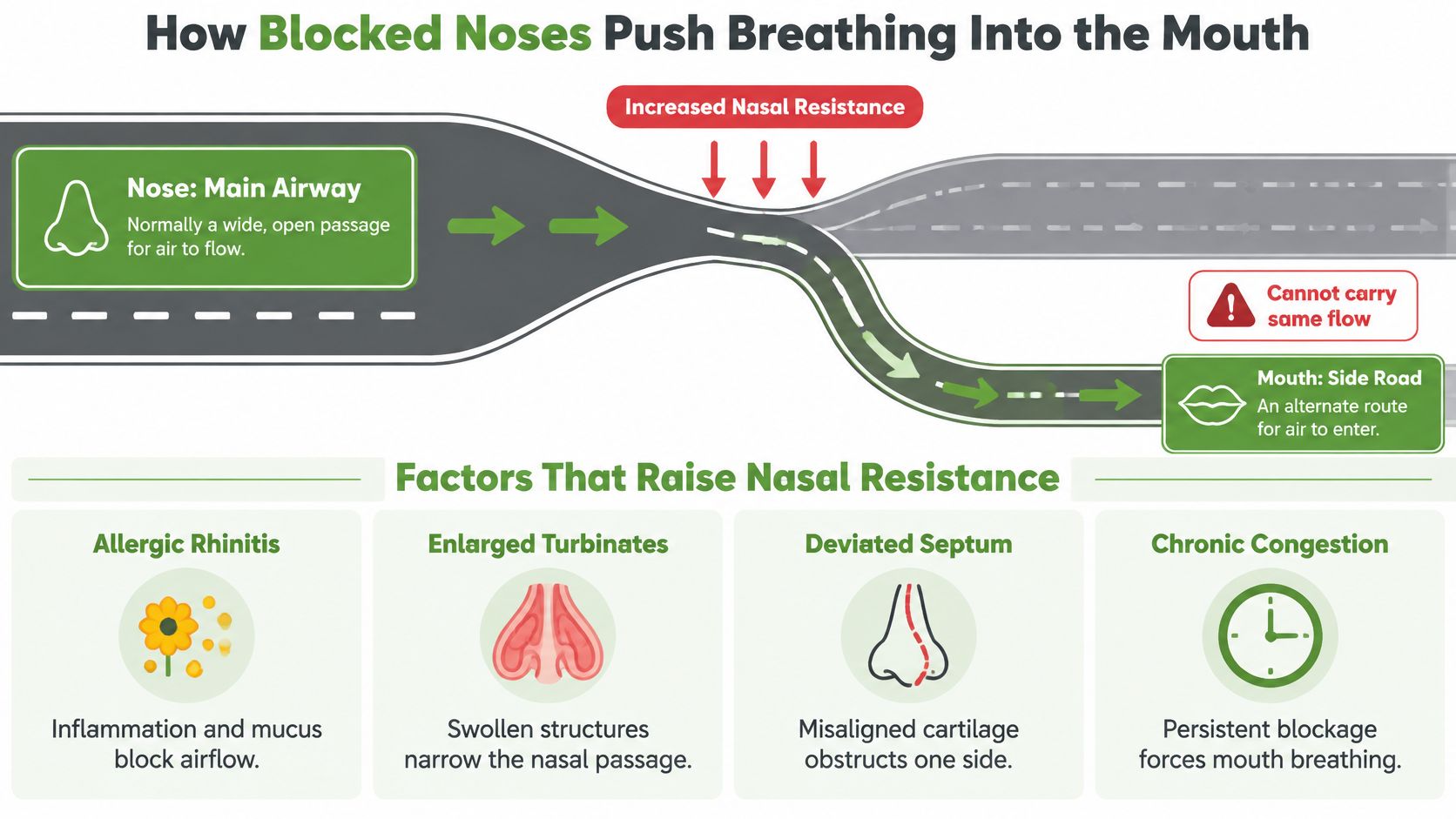
The map above shows the same rerouting problem in one view, with the factors that push traffic off the main road.
The chain from blocked nose to collapse
Open-mouth posture repositions the jaw, tongue, and hyoid bone down and back. That shift reduces the space behind the tongue, and the pharynx becomes easier to flatten when the muscles relax in sleep. Quieting the nose also reduces the reflex signals that normally help keep upper-airway dilator muscles tense and ventilatory drive steady.
The chain to watch for: blocked nose, mouth opens, jaw and tongue drift backward, airway narrows, tissue collapses, snoring or a pause follows.
What else sends air through the mouth
Nasal obstruction is the most familiar cause, not the only one. Enlarged tonsils and adenoids commonly narrow the airway in children. A tongue tie can limit tongue posture and resting oral seal. Jaw and palate structure shapes how much room the tongue has. Habitual open-mouth posture, learned over years, can outlast the congestion that started it.
Treat each of those as a reason to ask for an evaluation, not as a diagnosis you make for yourself. The mechanics make the link between mouth breathing and sleep apnea plausible and worth investigating. They don't establish that apnea is present, and that distinction still requires objective testing.
How Mouth Breathing and Sleep Apnea Feed Each Other in Children
Could a child's open-mouth sleep be both a response to breathing trouble and part of a cycle that keeps it going? Mouth breathing does not prove sleep apnea, and forcing the mouth shut can remove a compensatory route when the nose is obstructed. The pattern is a reason to assess what is making breathing difficult.
Research on children describes a possible relationship between mouth breathing and sleep-related breathing problems, but definitions and measurements vary across studies. That uncertainty matters: the pattern can raise a question for evaluation, but it cannot answer it by itself.
A loop, not a straight line
A child who snores and sleeps with an open mouth may have more than one factor at play. Mouth breathing can accompany airway narrowing, while disrupted breathing may make it harder to return to comfortable nasal breathing. Treating congestion alone may leave sleep-related breathing problems unaddressed. Treating apnea alone may not change daytime nasal breathing, swallowing, or lip posture.
A study in Scientific Reports classified 21 of 103 adolescents, or 20.4%, as mouth breathers (Scientific Reports). A pediatric article also addresses mouth breathing and sleep-related breathing concerns in children (pediatric sleep and mouth-breathing research). These findings concern overlapping patterns, not interchangeable diagnoses. A child who breathes through the mouth does not necessarily have apnea.
What parents can watch for
Notice snoring that occurs most nights, pauses followed by a snort or gasp, or restless sleep. Sweaty covers, waking in a bad mood despite enough time in bed, lips resting apart, and a dry mouth in the morning can add context. These signs do not confirm apnea, but they are useful to share with a clinician.
Different professionals may help assess different parts of the picture: an ENT can evaluate tonsils, adenoids, and nasal structure; a sleep physician can assess the need for testing; an orthodontist can examine growth and bite; and an allergist can assess ongoing inflammation. Breathing-focused therapy may support care after the airway has been assessed. The next step depends on what is contributing to the child's symptoms.
If your child snores or has pauses in breathing, request a pediatric sleep apnea evaluation. Mouth breathing deserves attention, but it is a symptom to investigate, not proof of a single cause.
How Sleep Apnea Is Confirmed and What the Numbers Mean
Could mouth breathing or snoring alone confirm sleep apnea? No. The American Academy of Sleep Medicine recommends objective testing, rather than symptoms or screening questionnaires alone, to diagnose adult obstructive sleep apnea (AASM diagnostic guideline). For an otherwise uncomplicated adult with signs of moderate-to-severe risk, either polysomnography or a technically adequate home sleep apnea test may be appropriate.
The testing rule that settles arguments
A home test can be a valid first step, but its result has limits. If it is negative, inconclusive, or technically inadequate, the guideline calls for polysomnography. One night of limited-channel data that looks clear does not, by itself, prove the airway is fine.
Testing is relevant to a growing number of adults. A 2025 ResMed study projects that obstructive sleep apnea could affect nearly 77 million U.S. adults by 2050, a nearly 35% increase from 2020 (ResMed newsroom).
Reading the numbers on a report
The apnea-hypopnea index, or AHI, counts breathing events per hour of sleep. The threshold depends on whether symptoms are present, so the number should be read alongside the clinical picture.
| Measure | Threshold or criterion | What it means |
|---|---|---|
| Adult OSA with symptoms | At least 5 predominantly obstructive events per hour | Diagnosis when symptoms coexist with these events |
| Adult OSA without symptoms | AHI of 15 or more events per hour | Diagnosis even when no symptoms are present |
| Hypopnea scoring | Airflow reduced at least 30% for 10 seconds, plus 3% desaturation or EEG arousal | Defines a hypopnea under current consensus criteria |
| Home sleep apnea test | Technically adequate test in an otherwise uncomplicated adult | Useful when the clinical picture fits |
| Polysomnography | Laboratory sleep study | Used when a home test is negative, inconclusive or technically inadequate |
A hypopnea is a partial reduction in airflow, not a complete pause. Under current consensus criteria, airflow must drop by at least 30% for at least 10 seconds, with either a 3% oxygen desaturation or an arousal recorded on EEG (review of OSA diagnosis and management). Two people with the same AHI may feel different if their oxygen levels and sleep disruptions differ.
What to ask for: the full report, not only its summary line. Review the AHI, oxygen-desaturation data, sleep-stage breakdown, and position data.
The AHI describes events, not why the airway narrows or collapses. A proper assessment looks beyond the sleep report at the jaw structure, tonsil size, tongue position, and airway. Mouth breathing may be a clue to an airway problem, but it does not establish sleep apnea, and forcing the mouth shut can remove a compensatory route when nasal obstruction is the underlying issue.
A sleep apnea diagnosis evaluation considers the report alongside airway structure and function. The numbers help confirm and describe sleep apnea; they do not explain the whole cause on their own.
Airway-Focused Treatment Options and How to Choose
Which treatment fits depends on the diagnosis, airway, and what a patient can tolerate. CPAP uses positive pressure to hold the airway open. An oral appliance repositions the jaw, supporting the airway in a different way. Pain and Sleep Therapy Center provides CPAP coordination and oral appliance therapy for patients diagnosed with obstructive sleep apnea. Options may also include muscle retraining, breathing work, and regenerative support.
Where an oral appliance fits
For diagnosed obstructive sleep apnea, the center coordinates care with the patient's sleep physician. A custom oral appliance may be an option for someone who cannot use CPAP, after they have given it a real try, or who prefers an alternative. Patients need an official diagnosis from a sleep study and documentation of CPAP intolerance. Switching from CPAP to an appliance is coordinated directly with the sleep physician.
The process begins with a consultation reviewing the sleep study, teeth, jaw, airway, and medical history. After the custom appliance is fitted, the patient completes a new sleep study while wearing it. The follow-up measures the Apnea-Hypopnea Index (AHI) on treatment and checks that oxygen levels remain stable. This confirms whether the device is keeping the airway open.
| Option | Best suited for | Key limit or side effect |
|---|---|---|
| CPAP | Patients diagnosed with obstructive sleep apnea | Mask leaks, pressure intolerance, aerophagia |
| Custom oral appliance | Patients diagnosed with obstructive sleep apnea who meet the requirements for appliance care | Bite changes, jaw soreness, temporomandibular discomfort |
| Myofunctional therapy | Functional muscle and breathing issues; may be enough for some people with mild sleep apnea | Daily-life changes can follow objective improvements |
| Buteyko-style breathing | Improving breathing behavior, symptom control, and quality of life | Does not replace diagnosis or prescribed OSA treatment |
| Nasal obstruction treatment | Congestion or structural blockage contributing to mouth breathing | Does not treat apnea on its own |
The side effects nobody warns you about
CPAP difficulties can include mask leaks, discomfort with pressure, and aerophagia, or swallowed air that causes bloating and burping. Breathing metrics often improve first, with alertness following if the patient can tolerate the mask and pressure. A clinician can help assess these issues before a patient gives up on treatment.
An oral appliance also has trade-offs. Bite changes, jaw soreness, and temporomandibular discomfort may occur, so jaw symptoms should be assessed as part of care. Pain and Sleep Therapy Center evaluates TMJ pain, facial pain, sleep-breathing issues, and regenerative treatment options together rather than treating each complaint in isolation.
A small study reported persistent mouth breathing after appliance therapy in both groups: 7 of 13 participants (53.8%) using an oral appliance plus a mouth shield, and 10 of 17 (58.8%) using an oral appliance alone (Journal of Clinical Sleep Medicine). This illustrates a distinction: an appliance can support the jaw at night, but it does not by itself retrain breathing behavior.
The center combines airway-focused care with myofunctional therapy and breathing retraining. For some people with mild sleep apnea, targeted muscle and breathing therapies alone may be enough. Others may need an oral appliance alongside functional therapies, with the device supporting the airway at night while therapy addresses muscle function and breathing behavior. Energy, snoring, mood, and awakenings may take longer to change than objective measures.
The practical choice is based on diagnosis, tolerance, and contributing airway problems. Snoring may improve before a follow-up sleep study shows the full effect on airway events, so objective testing remains important.
Triage Mouth Breathing Before Taping or Breathing Drills
Could mouth breathing be a symptom of an airway problem rather than a habit to correct? Tape, chin straps, and breathing drills may be presented as simple fixes, but first ask whether the nose can carry enough air. A systematic review of mouth taping examined 10 eligible studies involving 213 participants. It found minimal evidence beyond mild obstructive sleep apnea, with only two studies reporting modest benefits. Several studies also raised safety concerns, including asphyxiation when nasal airflow is obstructed.
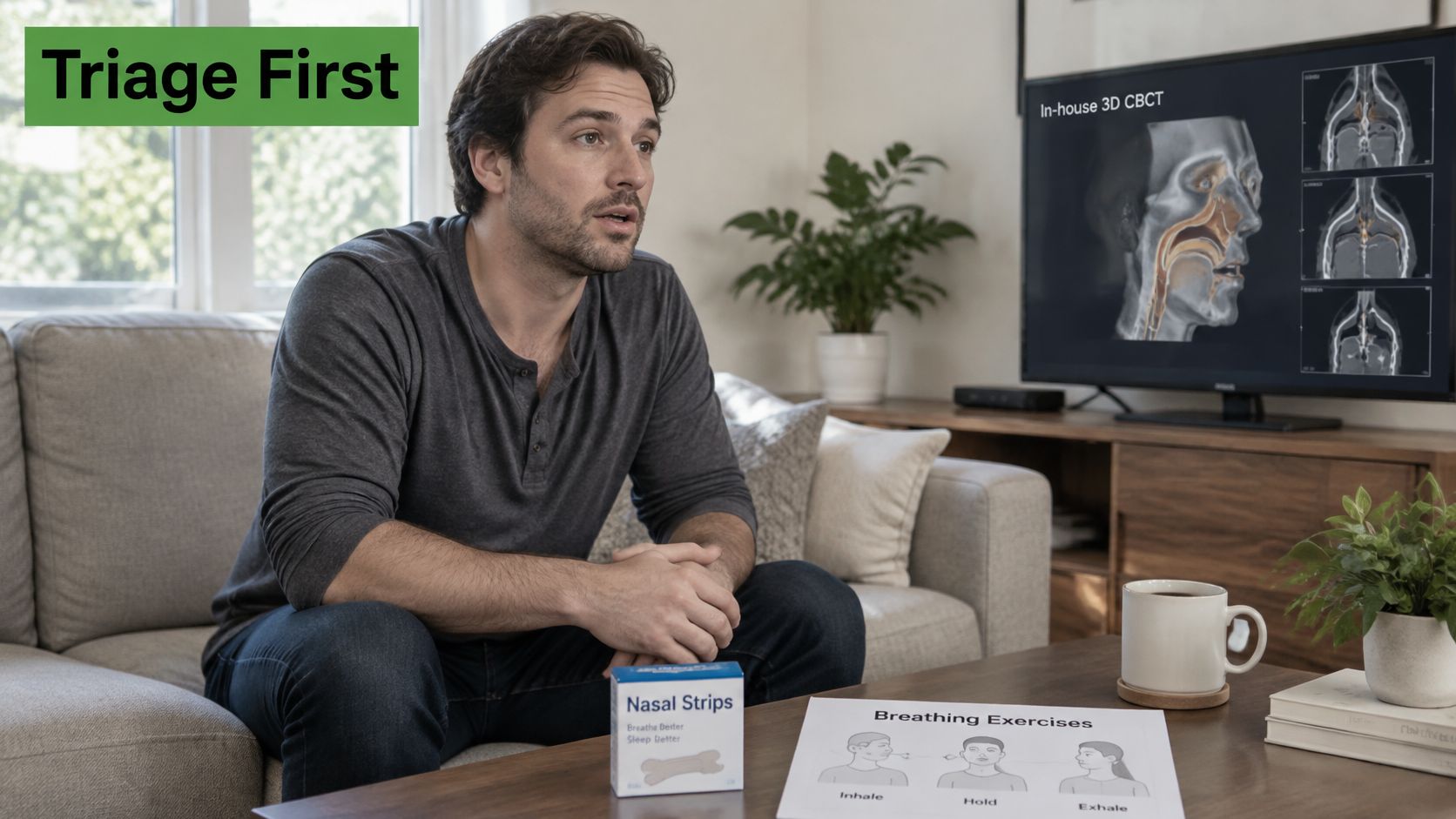
The airway imaging shown above illustrates what tape cannot determine: whether the nasal passage is open.
Two different problems wear the same label
Some people breathe through the mouth as a behavior. Others do so because allergic rhinitis, enlarged turbinates, a deviated septum, or chronic congestion restricts nasal airflow. In the second case, the open mouth may be a compensatory route. Forcing it shut can remove that route without addressing the blockage.
Mouth taping is therefore not a substitute for checking why the mouth is open. The SleepHabits' mouth taping safety review is one resource readers may encounter when researching the practice, but the key first step is assessing nasal airflow and possible sleep-disordered breathing.
The order that keeps you safe
- Check nasal patency first. Persistent congestion, one-sided blockage, or a visible structural problem warrants an ENT or allergy evaluation before trying to restrict mouth breathing.
- Screen for sleep-disordered breathing second. Witnessed pauses, gasping, morning headaches, and heavy daytime sleepiness are reasons to seek a sleep evaluation before starting breathing drills.
- Discuss other options third. Once nasal airflow and sleep breathing have been assessed, talk with a clinician about nasal-breathing work, chin straps, or tape rather than experimenting alone.
Closing the mouth does not open the airway. If the nose is blocked, tape removes a backup route without addressing the cause.
Nighttime choking or gasping, severe nasal blockage, and oxygen desaturation on a home device call for prompt medical attention, not a change to a self-directed routine. Pain and Sleep Therapy Center offers root-cause evaluation and treatment for snoring, mouth breathing, sleep apnea, TMJ tension, and chronic breathing dysfunction.
What to record before your appointment
For one to two weeks, collect useful observations. Ask a bed partner to note pauses, gasps, and changes in snoring volume. A phone recording app can also capture snoring overnight; listen at normal speed. If you already have a sleep report, bring the full report, including its AHI and oxygen data, along with a list of medications and allergy treatments.
These details can help turn a vague complaint into a clearer clinical picture. Mouth breathing and sleep apnea are connected closely enough to deserve assessment, but mouth breathing alone cannot diagnose sleep apnea. If you or your bed partner notices pauses, gasping, or a mouth that stays open during sleep, seek an evaluation to determine what is driving the symptom.