
A bed partner hears loud snoring, then an unsettling silence, then a gasp. By morning, the sleeper remembers none of it and wonders why getting through the day feels so difficult. That mismatch between what a partner notices and what the sleeper remembers is often the starting point for recognizing obstructive sleep apnea symptoms.
Fatigue, morning headaches, and irritability can seem unrelated to nighttime breathing. None proves sleep apnea on its own, but a pattern of daytime complaints alongside observed breathing interruptions deserves medical attention.
Night and Day Symptoms at a Glance
The most recognizable nighttime pattern is snoring, a breathing pause, then a sudden return of breathing with gasping, choking, or snorting. A partner may describe the sequence clearly while the sleeper reports sleeping straight through.
A clinical review of obstructive sleep apnea identifies habitual snoring, witnessed pauses, gasping, disrupted sleep, and excessive daytime sleepiness as core clues. It also describes less obvious complaints, including morning headaches, insomnia, nighttime reflux, and nighttime urination.
Symptoms by timing and observer
The distinction between who experiences a symptom and who notices it matters. A sleeper can report a headache, but a partner may provide the only account of interrupted breathing.
Obstructive sleep apnea symptoms by timing and observer
| Symptom | When it appears | Who usually notices |
|---|---|---|
| Loud or habitual snoring | Throughout the night | Bed partner |
| Witnessed breathing pauses | During sleep, lasting seconds or longer | Bed partner |
| Gasping, choking, or snorting | As breathing resumes after a pause | Bed partner, or the sleeper if briefly awake |
| Restless or fragmented sleep | Throughout the night | Sleeper, often unaware |
| Excessive daytime sleepiness | Daytime, especially during low-stimulation activities | Sleeper, family, colleagues |
| Morning headache | On waking | Sleeper |
| Dry mouth or sore throat | On waking | Sleeper |
| Nighttime urination | During the night | Sleeper |
| Nocturnal reflux | During the night or on waking | Sleeper |
| Difficulty concentrating or irritability | Daytime | Sleeper, family, colleagues |
Snoring alone doesn't establish OSA, and quiet sleep doesn't exclude it. NIH's Office of Research on Women's Health describes snoring as common but not universal and includes morning headaches, dry mouth, concentration difficulty, and mood changes among possible symptoms.
Insomnia, reflux, and nighttime urination are less specific. They can occur for other reasons, so their usefulness comes from the overall pattern rather than from checking an isolated box.
Why observations deserve attention
Symptoms are common, but evaluation often doesn't follow. In the U.S. national baseline used by Healthy People 2030, only 32.9% of adults aged 20 and older reporting sleep-apnea symptoms sought health-care evaluation during 2015–2016.
For another plain-language resource, The Sleep Consultant helps readers recognize common sleep apnea symptoms. Such resources can help organize concerns, but they can't determine whether breathing events meet diagnostic criteria.
Practical rule: Write down what a partner actually observes, including when pauses happen, how often gasping occurs, and whether the sleeper seems to struggle for breath.
A useful note describes a sequence rather than a conclusion. “Snoring stopped, breathing looked effortful, then there was a gasp” gives a clinician more information than “slept badly.”
Why Breathing Pauses Go Unnoticed at Night
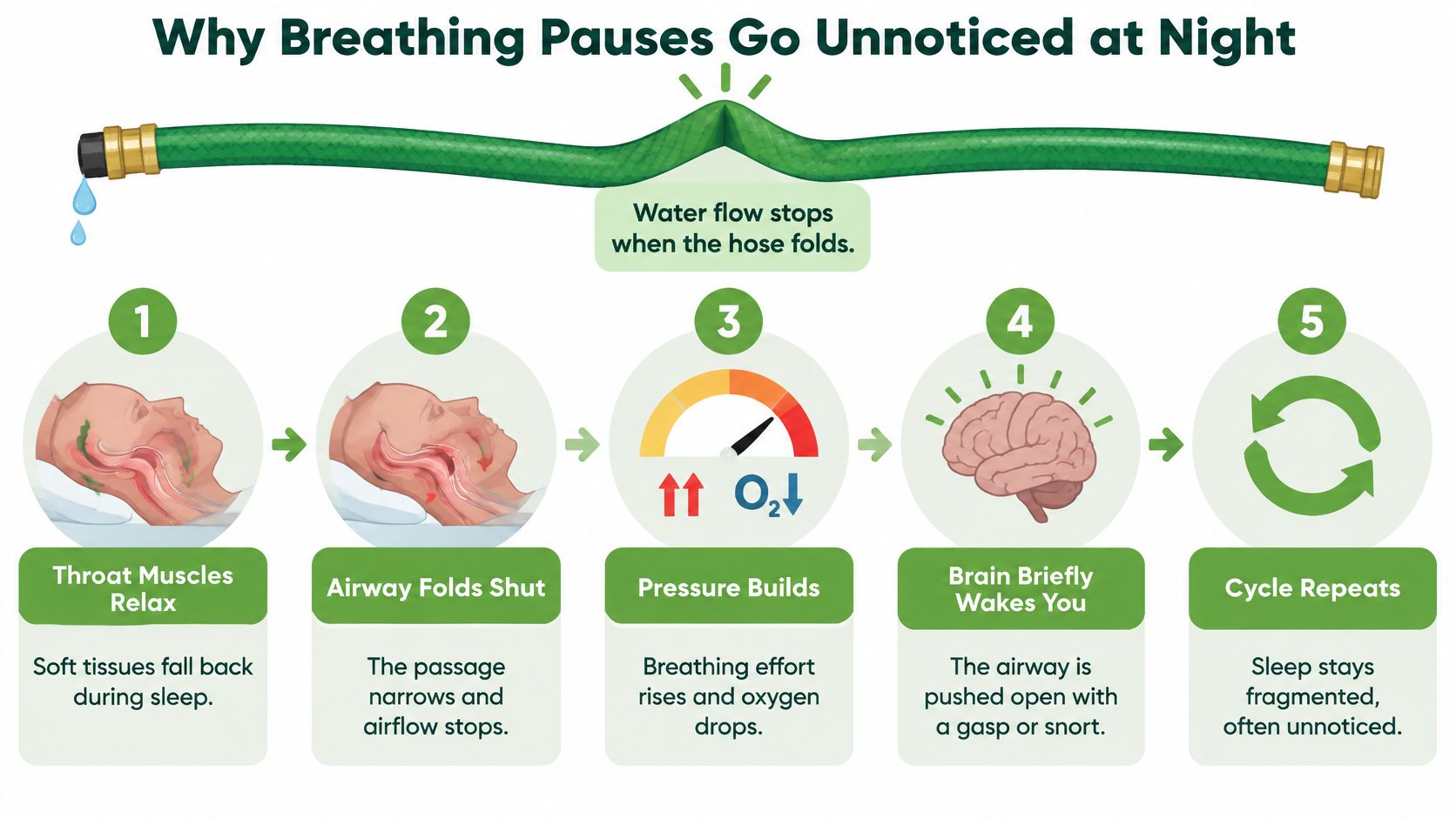
A kinked garden hose offers a simple analogy: water stops flowing when the hose folds, and flow returns when the bend opens. During obstructive sleep apnea, the problem is a narrowing or collapse of the upper airway, not a lack of effort to breathe.
The analogy has limits. The brain and breathing muscles respond to the obstruction, and a brief arousal helps reopen the airway.
What happens during an obstructive event
The sequence usually follows this pattern:
- Throat muscles relax. During sleep, the tissues supporting the upper airway relax, allowing the passage to narrow or collapse.
- Airflow falls or stops. Obstructive breathing events typically last at least 10 seconds, as described in the National Heart, Lung, and Blood Institute's sleep apnea guide.
- Breathing effort increases. The body continues trying to draw air through the narrowed passage while blood oxygen can fall.
- A brief arousal restores airflow. The airway opens, sometimes with a gasp or snort, and breathing resumes.
- The sequence repeats. The sleeper returns to sleep without necessarily remembering the interruption.
The diagram follows that sequence from narrowing to repeated sleep disruption.
Time in bed isn't the same as uninterrupted sleep
Consider someone who goes to bed at a reasonable hour and doesn't remember waking. A partner, however, hears repeated pauses followed by noisy breaths. Both accounts can be accurate because an arousal doesn't always become a remembered awakening.
Those interruptions can fragment sleep enough to leave the person unrefreshed. Morning headaches, fatigue, and poor focus can therefore occur despite apparently adequate time in bed.
A partner's description adds information that the sleeper can't supply. It doesn't measure event frequency accurately, but it can identify a recurring pattern that warrants testing.
A normal-feeling morning doesn't measure how steadily someone breathed during the night.
The number of breathing events per hour comes from a sleep recording, not from how dramatic an episode sounds or how tired someone feels afterward. Some people have conspicuous gasping; others have quieter, less noticeable obstruction.
The shared mechanism is repeated interference with breathing and sleep continuity. That explains why nighttime sounds and daytime complaints can belong to the same clinical picture without proving the diagnosis by themselves.
Daytime Signs and Screening Cues
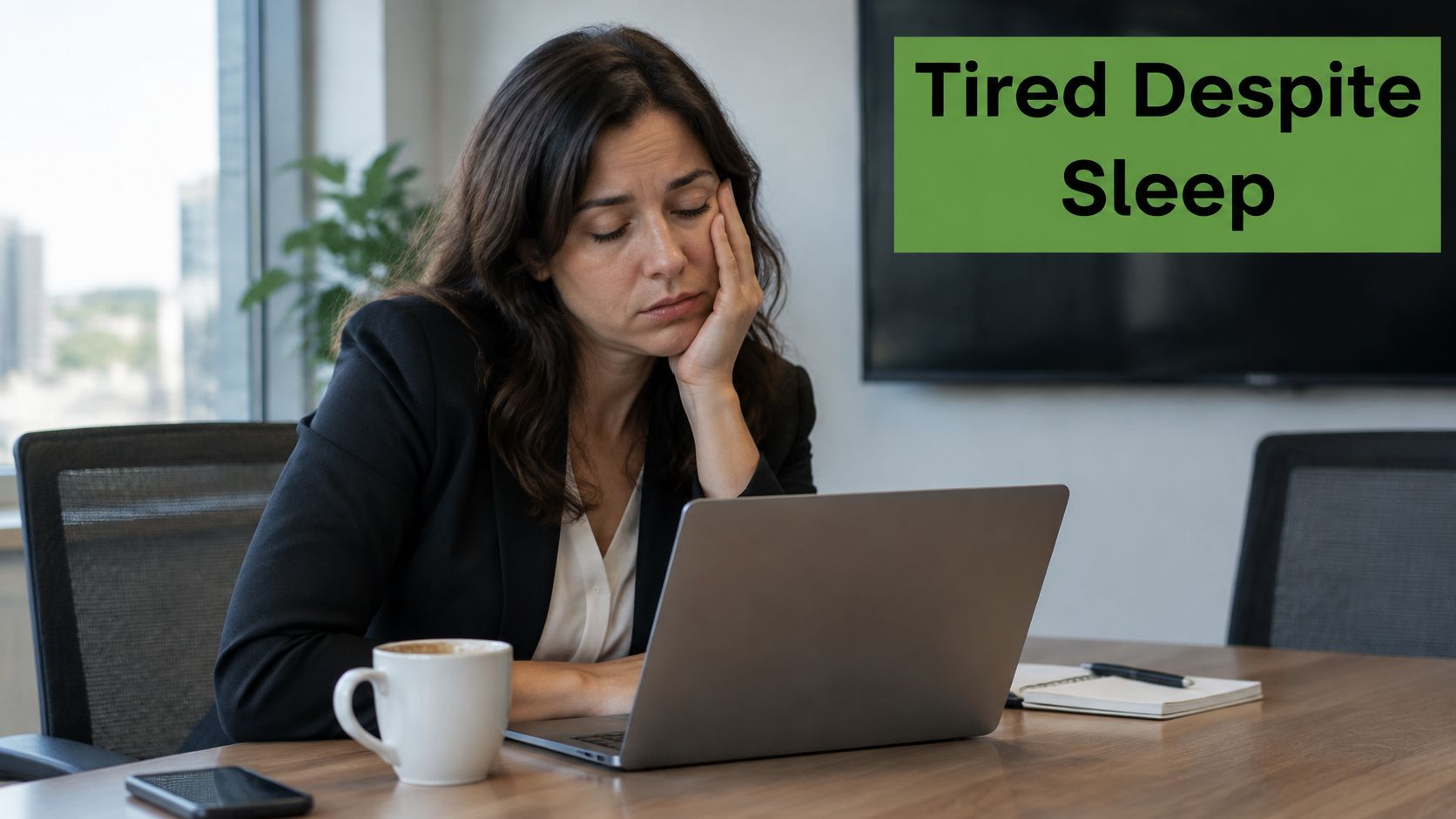
Someone spends an apparently full night in bed, drinks coffee, and still nods off while reading or sitting through a meeting. A demanding workload seems like the obvious explanation. It may contribute, but persistent sleepiness shouldn't automatically be attributed to stress.
Sleepiness and fatigue aren't identical. Sleepiness means a tendency to fall asleep; fatigue means low energy or exhaustion. A person can feel drained without dozing, and both experiences deserve a clear description during an evaluation.
The following image captures a common concern: looking adequately rested on paper while struggling to stay alert at work.
Complaints that are easy to explain away
Daytime symptoms can overlap with stress, low mood, aging, and insufficient sleep. A clinician needs the context, including whether the complaint is new, persistent, or accompanied by a partner's observations.
Useful details include:
- Unintended dozing: Falling asleep while reading, watching television, or attending a quiet meeting.
- Disproportionate fatigue: Feeling exhausted despite allowing enough time for sleep.
- Attention and memory difficulty: Losing track of a conversation or repeatedly rereading familiar material.
- Irritability or low mood: Changes that accompany unrefreshing sleep rather than having an obvious explanation.
- Morning headaches: Headaches present on waking, even if they ease later in the day.
These are clues, not a signature unique to OSA. Persistent mood symptoms or headaches also deserve assessment by the appropriate physician rather than an assumption that breathing is the cause.
A Jordan University Hospital study of 71 patients already diagnosed with OSA reported snoring in 91.55%, daytime sleepiness in 73.24%, and dyspnea, meaning breathlessness, in 69.01% during follow-up. Those figures describe diagnosed patients, not how common these symptoms are in the general population.
When screening should lead to a conversation
The American Academy of Sleep Medicine's clinical review identifies fragmented sleep, fatigue, morning headaches, snoring, and gasping as relevant indicators. It also explains that risk varies with age, sex, ethnicity, and socioeconomic factors.
A questionnaire can organize those clues, but a screening score isn't a diagnosis. Frequent snoring or snorting, sleepiness despite an adequate sleep opportunity, and daytime difficulties paired with observed pauses are reasons to discuss testing.
The center's information about sleep apnea symptoms and snoring can help patients distinguish a noise complaint from a possible breathing concern. The useful question is not whether snoring is bothersome, but whether breathing and daytime function appear affected.
Can OSA still be present after a negative questionnaire or without witnessed pauses? Yes. Someone who sleeps alone has no observer, and a partner who sleeps soundly may miss events.
Safety first: Drowsiness while driving requires prompt medical attention, not another trial of coffee or an open window.
Persistent symptoms and relevant risk factors justify a clinician's assessment even when a checklist looks reassuring. Absence of reported daytime sleepiness also shouldn't automatically end the conversation.
How Symptoms Differ by Sex, Age and Life Stage
The same condition can sound like different complaints, much as the same song sounds different on different instruments. One person describes loud snoring; another describes insomnia, exhaustion, or waking with a headache.
Women more often report fatigue, insomnia, morning headaches, mood disturbance, or fragmented sleep rather than the most recognizable snoring-and-sleepiness pattern. A 2025 study of 622 adults found significantly more fatigue and extreme fatigue among women than men, but fatigue alone didn't reliably predict moderate-to-severe OSA in women.
Different complaints, similar reasons to investigate
Fatigue is a reason to ask better questions, not a reason to assign a diagnosis. Attributing every complaint to depression, anxiety, menopause, or poor sleep can leave breathing-related disruption unexplored.
Symptom patterns by sex, age and life stage
| Group | Symptoms more often reported | What to notice |
|---|---|---|
| Adult men | Loud snoring, witnessed pauses, daytime sleepiness | The classic pattern is more often recognized by a partner |
| Adult women | Fatigue, insomnia, morning headaches, mood changes, fragmented sleep | Often attributed to depression, anxiety, or menopause; loud snoring may be absent |
| Women after menopause | Persistent fatigue, unexplained sleep disruption, morning headaches | Discuss sleep-disordered breathing with a physician when symptoms stay unexplained |
| Adults with insomnia-like complaints | Trouble staying asleep, unrefreshing sleep, daytime tiredness | Breathing events can coexist with insomnia; ask about pauses and gasping |
| Older adults | Nighttime urination, fragmented sleep, daytime fatigue | Risk indicators vary with age; these signs can be mistaken for normal aging |
| Children | Loud snoring, mouth breathing, restless sleep, daytime behavior changes | Refer to a pediatrician or sleep physician for evaluation |
These patterns aren't exclusive categories. A man may report insomnia rather than sleepiness, and a woman may have loud, disruptive snoring.
OSA can occur without loud snoring or obvious sleepiness, including when complaints resemble insomnia. Persistent unexplained sleep disruption after menopause deserves a discussion rather than automatic reassurance.
The following video provides another way to learn about sleep-related breathing concerns.
Children need a pediatric assessment
Adult screening assumptions shouldn't be applied directly to children. Parents noticing habitual snoring, mouth breathing, restless sleep, or daytime behavior changes should contact a pediatrician or sleep physician.
The center's pediatric sleep apnea information can help parents prepare their observations. A pediatric evaluation determines what those signs mean and which testing, if any, is appropriate.
Health Risks Linked to Untreated Breathing Pauses
The reason to investigate breathing pauses isn't just to make a bedroom quieter. Repeated obstruction can expose the body to intermittent oxygen drops and repeated activation of its stress response.
These processes are associated with fragmented sleep, daytime cognitive difficulty, and cardiovascular strain, including high blood pressure. They don't predict an individual person's outcome, and a clinician must consider the full medical history.
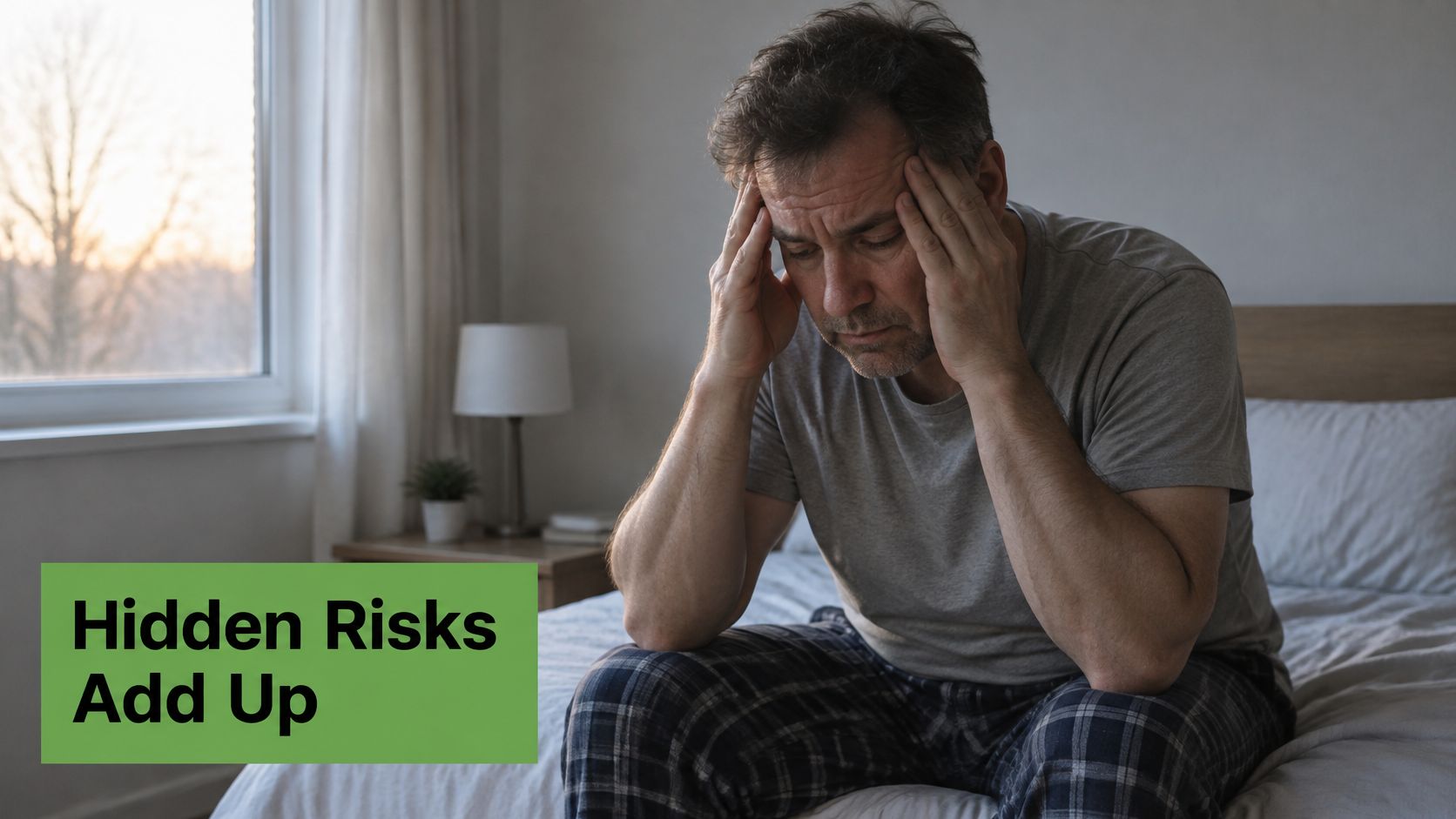
The daytime burden can feel frustrating even before someone understands its cause.
Where jaw symptoms fit
Nighttime clenching or grinding, morning jaw soreness, and waking headaches can occur alongside sleep-related breathing problems. Their coexistence doesn't establish that one caused the other.
A patient with both patterns should describe both. Evaluation of jaw-related headaches and migraines and TMJ or TMD symptoms can help distinguish jaw-muscle or joint pain from other concerns that require medical assessment.
Information about the long-term effects of untreated sleep apnea provides context, but risk discussions should remain individualized. The purpose is to support timely evaluation, not to assume that every symptom signals serious harm.
When routine scheduling isn't enough
Blood pressure, heart rhythm problems, and other medical conditions belong under a physician's care. A dental sleep medicine practice doesn't treat those conditions, even when it participates in managing diagnosed OSA.
Some symptoms require a faster response:
- Chest pain: Contact emergency services rather than waiting for a dental or sleep appointment.
- Fainting: Contact emergency services for immediate assessment.
- Driving near-misses caused by drowsiness: Stop driving and arrange prompt medical evaluation. Use another driver or alternative transportation.
A morning headache or sore jaw usually calls for a different assessment pathway than an emergency symptom. Keeping that distinction clear helps patients seek the right care without dismissing concerns or assuming the worst.
When to Request a Sleep Test in Charlotte
Your partner notices you stop breathing, then gasp. You wake with headaches or struggle to stay alert during the day. These observations do not confirm obstructive sleep apnea, but repeated breathing pauses or unexplained daytime impairment are reasons to request a clinical evaluation. A bed partner's account can help, especially if you do not remember waking or do not snore loudly.
The American Academy of Sleep Medicine diagnostic guideline recommends an in-lab sleep study or, for appropriately selected adults at increased risk of moderate-to-severe OSA, a technically adequate home sleep apnea test. If a home test is negative, inconclusive, or technically inadequate, the guideline recommends an in-lab study.
A practical path from observations to answers
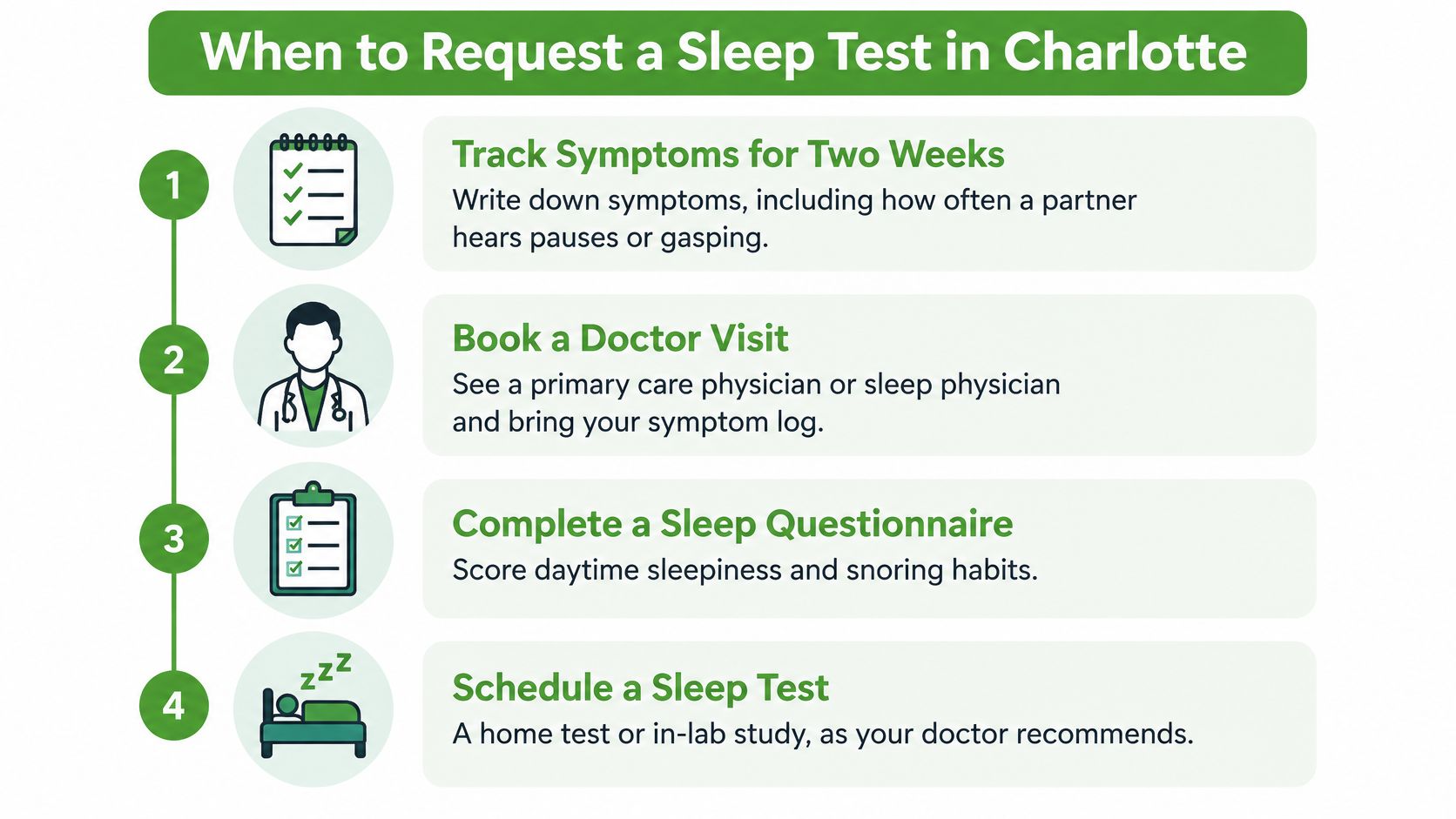
- Keep a symptom log. Note morning symptoms, unintended dozing, and how often your partner observes pauses or gasping. Start when you can, but do not delay care for concerning symptoms.
- Book a medical visit. Bring your notes to a primary care physician or sleep physician. Include jaw pain, headaches, existing diagnoses, and previous sleep-test results.
- Ask which test fits your history. A complex medical history or concern about another sleep-related breathing disorder may make an in-lab study more appropriate.
- Follow up on an unhelpful home result. A negative home report may not settle the question; ask whether an in-lab study is indicated.
- Review the results with a qualified provider. Test findings need to be considered alongside symptoms, medical history, and recording quality.
- Discuss treatment after diagnosis. If CPAP is not tolerated or you prefer another option, ask whether a prescription oral appliance is appropriate and how its effect will be checked.
The visual below outlines preparation and testing. A questionnaire can help organize symptoms, but it cannot diagnose OSA.
Choosing and interpreting the test
Sleep test types and when each is used
| Test | Typically used when | What it measures | Main limit |
|---|---|---|---|
| In-lab polysomnography | Complex medical history, possible other sleep disorders, or after a negative or inconclusive home test | Airflow, breathing effort, oxygen saturation, brain activity, heart rhythm, and movement | Requires an overnight stay at a sleep center |
| Home sleep apnea test | Uncomplicated adults at increased risk of moderate-to-severe OSA | Airflow, respiratory effort, oxygen saturation, heart rate, and sometimes body position | Usually does not record brain-wave activity; a negative result does not reliably rule out OSA |
Common diagnostic frameworks use an apnea-hypopnea index of at least 5 events per hour with compatible symptoms, or at least 15 without reported symptoms, as described in the AASM respiratory-event scoring discussion. The AASM patient guide explains why clinicians interpret the event index alongside symptoms and medical history.
The center's obstructive sleep apnea diagnosis information describes its evaluation approach. Home testing is intended for selected patients, not as a universal screening shortcut.
Dental sleep medicine after diagnosis
The joint AASM and AADSM oral appliance guideline supports prescription oral appliances for adults with OSA who cannot tolerate CPAP or prefer an alternative. Dental assessment can consider the teeth, bite, jaw joints, and chewing muscles, particularly when jaw pain or bruxism is also present.
Pain and Sleep Therapy Center provides sleep-related breathing evaluations and dental sleep medicine care. The Charlotte-based practice is led by triple board-certified Dr. Greg D. Larson and includes an interdisciplinary team. An oral appliance's effectiveness should be checked objectively rather than judged only by quieter snoring.
For concerns about observed breathing pauses, morning headaches, or persistent fatigue, Pain and Sleep Therapy Center offers dental sleep medicine evaluation and custom oral appliance therapy when appropriate. Bring a partner's observations and previous sleep reports to discuss suitable next steps.