
Obstructive sleep apnea happens when sleep reduces throat-muscle tone and the tongue or soft tissues narrow a vulnerable airway, not because of one universal cause such as weight. A 10% increase in body weight is associated with approximately a sixfold increase in OSA risk, but being overweight isn't a requirement for the condition.
Advice to lose weight first can leave an important question unanswered: what is closing the airway? A recessed jaw, crowded throat, or reduced muscle responsiveness may matter more than body size in an individual patient. Understanding obstructive sleep apnea causes helps clinicians choose an evaluation and non-surgical care plan that fits the person, rather than the stereotype.
Why the Airway Closes During Sleep
Consider a slim adult who sleeps poorly and whose partner has noticed breathing pauses. Because the person isn't overweight, the symptoms might be dismissed as ordinary snoring. The breathing pauses still warrant evaluation.
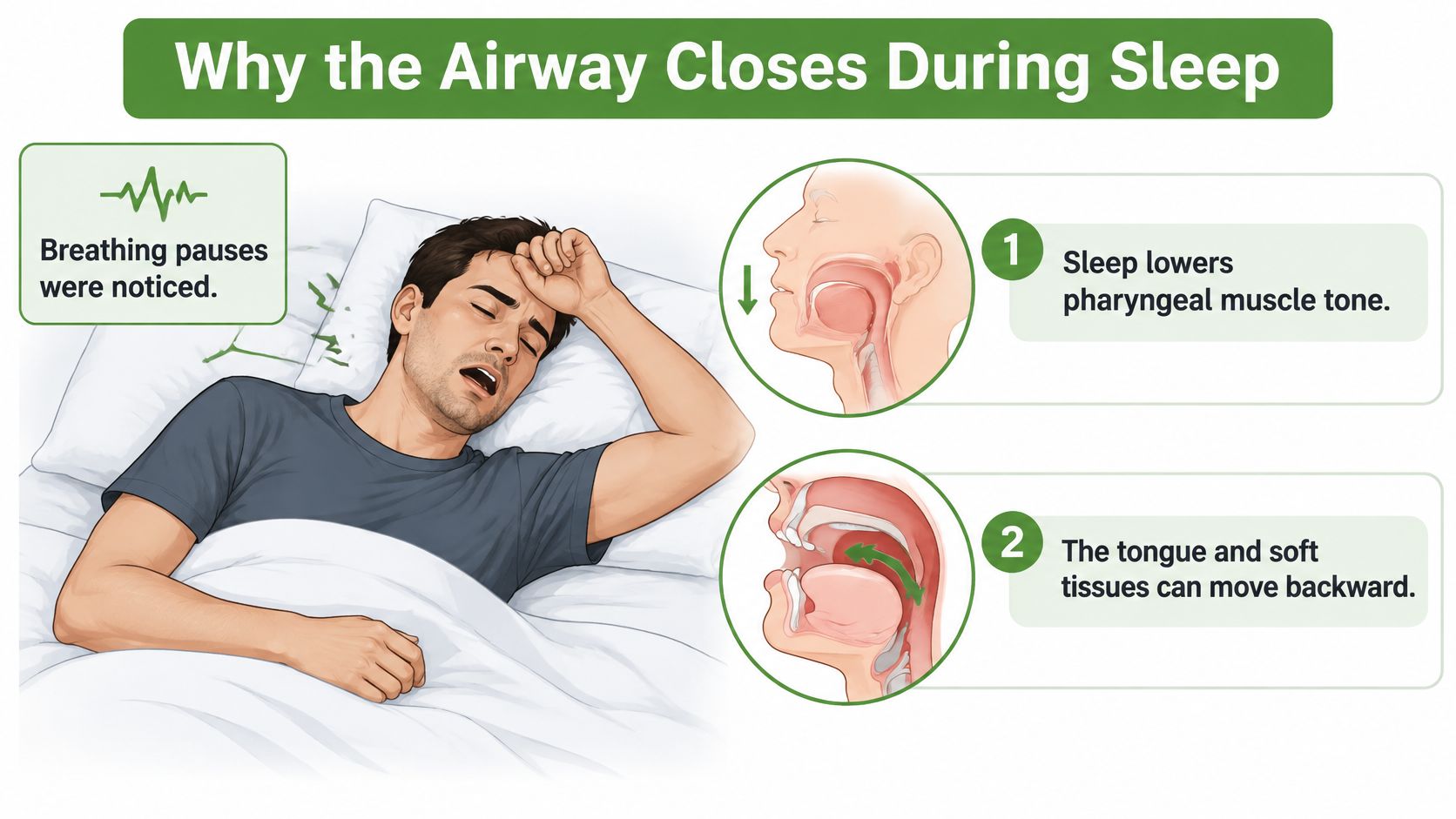
During sleep, activity in the muscles supporting the throat decreases. In a susceptible airway, the tongue and surrounding soft tissues can move backward and narrow or block the passage. The problem is the interaction between available space and the muscles that normally maintain it.
The illustration summarizes this relationship between muscle relaxation and airway crowding.
A doorway that can narrow in several places
The airway resembles a doorway with flexible walls rather than a rigid pipe. A passage may look adequate while someone is awake, yet become too narrow when its supporting muscles relax.
An upper-airway anatomy review describes potential collapse at the soft palate, tongue base, throat side walls, or epiglottis, sometimes at more than one site. The posterior tongue helps maintain airway openness, while the genioglossus is a major tongue-protruding and throat-opening muscle.
Snoring and apnea aren't interchangeable. Snoring is vibration of narrowed tissue; apnea involves substantially reduced or stopped airflow. Information about snoring symptoms can help distinguish noisy breathing from warning signs that need a sleep evaluation.
Anatomy matters at any body size
Several craniofacial features can leave less room for airflow:
- Small jaw: Micrognathia and mandibular hypoplasia describe a small or underdeveloped lower jaw.
- Backward jaw position: Retrognathia, or a recessed lower jaw, can reduce space behind the tongue.
- Other structural features: A long face, long soft palate, or low-positioned hyoid can affect airway dimensions. The hyoid supports tongue-related structures in the neck.
For prevalence context, the NHLBI causes and risk factors resource is associated with estimates that approximately 3%–7% of adult men and 2%–5% of adult women have OSA accompanied by daytime sleepiness. Established contributors include increasing age, male sex, family history, menopause, obesity, smoking, and alcohol use. Alcohol further relaxes mouth and throat muscles, while smoking promotes airway inflammation.
Body shape can't show how much breathing space remains when the throat's supporting muscles relax.
People seeking care for TMJ or TMD symptoms or night clenching may also report disrupted sleep. Bruxism isn't presented as a cause of OSA; jaw symptoms and breathing symptoms need their own assessment. The practice's sleep apnea symptom information offers additional context.
For readers also considering the relationship between sleep and weight, Trim's resource on better sleep for weight management provides related reading. Weight concerns shouldn't delay investigation of witnessed breathing pauses.
Causes That Make the Airway Collapse
How each obstructive sleep apnea cause affects the airway
| Contributor | How the airway is affected | Often seen in | What evaluation checks |
|---|---|---|---|
| Neck and throat fat | Raises pressure outside the pharynx and narrows the lumen | Higher weight, larger neck | Neck size, fat distribution, not BMI alone |
| Small or recessed jaw | Leaves less space behind the tongue | Any weight, including lean adults | Jaw position and craniofacial structure |
| Large tongue or low tongue posture | Tongue moves backward as muscle tone falls | Mouth breathing, large tongue | Tongue size, rest posture, and function |
| Enlarged tonsils or adenoids | Tissue fills the pharyngeal space | Children more than adults | Airway exam; physician if tonsils dominate |
| Nasal obstruction | Adds upstream resistance and favors mouth breathing | Septum deviation, polyps, chronic congestion | Nasal airflow; medical care if structural |
| Weak dilator-muscle response | Airway cannot stay open once sleep reduces tone | Anyone with a susceptible airway | Sleep study plus muscle and jaw findings |
| Unstable breathing control | Repeated events influenced by drive and arousal traits | Not obvious on a dental exam | Physician or sleep specialist assessment |
| Alcohol or smoking | Further relaxes muscles or inflames the airway | Lifestyle exposure | History, not a stand-alone diagnosis |
Read the table as a cause map
The table isn't a way to diagnose OSA at home. It helps organize the questions a clinician asks when identifying the dominant mechanism. Several rows may apply to the same patient, and an awake examination can't establish which factor contributes most during sleep.
The anatomical rows describe different ways to crowd the passage. Extra tissue raises outside pressure; a smaller jaw reduces the space available behind the tongue; tongue posture changes where soft tissue rests. Enlarged tonsils or adenoids occupy space directly rather than changing skeletal dimensions.
Nasal obstruction works differently. It increases resistance before air reaches the throat and may encourage mouth breathing, but a blocked nose isn't the same as sleep apnea. The practice's explanation of a deviated septum and breathing provides context for that distinction.
Muscle response and breathing control
The NHLBI explanation of sleep apnea causes identifies upper-airway blockage, tongue displacement, and enlarged neck, tongue, or tonsils as important contributors. Clinically, the issue is a mismatch between the airway's mechanical load and the muscle response available to keep it open.
A tight airway may remain open while a person is awake because the dilator muscles compensate. During sleep, inadequate compensation can permit collapse. Critical closing pressure describes how readily the airway closes under pressure; it isn't something a person can judge from how freely the nose feels.
Nonanatomical traits also matter. A low arousal threshold means someone wakes readily in response to a breathing disturbance, while high loop gain describes an overly reactive breathing-control system. These traits can contribute to repeated events without an obvious abnormality on a dental exam.
Practical rule: A clear nose doesn't exclude severe OSA, and a loud snore doesn't identify the dominant cause.
Alcohol and smoking belong in the history as exposures that can worsen vulnerability, not as stand-alone diagnoses. The clinician uses the full pattern to determine whether structural crowding, tissue loading, muscle response, or breathing control needs the most attention.
Weight Neck Size and Lean Patients
Waiting for weight loss before evaluating breathing pauses can delay needed care. Weight management may be part of treatment, but it doesn't establish whether OSA is present or explain every person's obstruction.
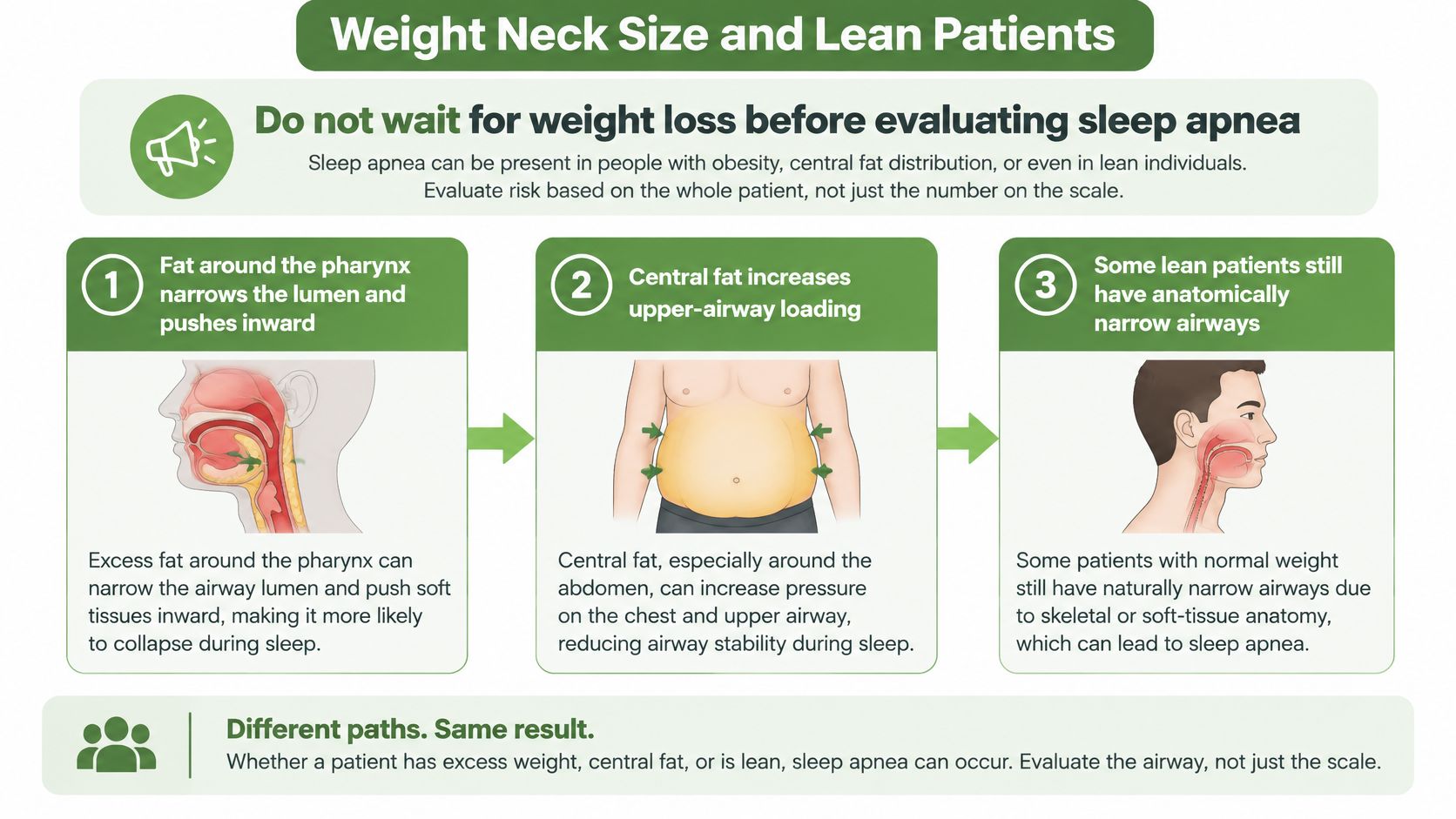
The graphic highlights why body size is only part of an airway assessment.
How fat distribution changes airway loading
An NIH-supported review of obesity and OSA describes linked mechanical pathways. Fat around the pharynx narrows its internal opening, or lumen, and pushes inward from outside. Central fat can also lower resting lung volume, reducing the downward traction that helps stabilize upper-airway tissues.
Metabolic and inflammatory signaling may also impair the muscles' ability to compensate. This helps explain why people with similar body mass can have different airway behavior. BMI doesn't describe where fat sits or how much structural space exists.
The American Academy of Sleep Medicine sleep apnea fact sheet reports that a 10% increase in body weight is associated with approximately a sixfold increase in OSA risk, and identifies neck circumference of at least 17 inches in men or 16 inches in women as a practical risk marker. Additional neck soft tissue can encroach on the airway, but those measurements aren't diagnostic cutoffs.
What weight-change findings mean
A 2024 review in the Journal of Clinical Endocrinology & Metabolism reported that a 10% increase in body weight predicted a 32% increase in the apnea-hypopnea index and a sixfold increase in the risk of developing moderate-to-severe OSA. This finding specifically addresses event frequency and moderate-to-severe disease risk; it shouldn't be treated as identical to the broader fact-sheet association.
A 2023 systematic review in Sleep Medicine Reviews concluded that approximately 10% weight gain, particularly in males, may signal developing or worsening OSA. These are associations, not a prediction of an individual patient's outcome.
This video accompanies the discussion of airway-related sleep concerns.
Most, but not all, people with OSA are overweight, as described in the NCBI clinical review of obstructive sleep apnea. A lean adult with snoring, witnessed pauses, morning headaches, fragmented sleep, or daytime fatigue may still need testing.
An assessment considers the following together:
- Neck circumference and fat distribution: These describe tissue loading more directly than BMI alone.
- Tongue and jaw anatomy: These help identify crowding independent of weight.
- Sleep position: Position-related changes can influence obstruction during the night.
Nasal Breathing Children and Menopause
Nasal blockage isn't simply a breathing habit
A deviated septum, nasal polyps, or persistent congestion can interfere with nasal airflow. The American Academy of Sleep Medicine educational presentation lists nasal obstruction among relevant airway abnormalities and highlights enlarged tonsils and adenoids in children.
Mouth breathing may accompany nasal blockage and sleep-disordered breathing. It doesn't establish the cause, and evidence for benefit from changing mouth breathing is limited when obstruction or more severe OSA is already present. Exercises can't be assumed to remove a structural blockage.
- Persistent congestion: A physician or dentist should assess whether nasal obstruction needs medical evaluation.
- Witnessed pauses or significant sleepiness: These call for sleep-breathing assessment rather than a breathing-habit explanation.
- Noisy breathing alone: Related snoring information can help readers recognize symptoms that deserve further discussion.
Children need a pediatric pathway
In children, an enlarged tonsil or adenoid pad can take up a substantial share of the available airway space. A small jaw may add to that crowding. Parents shouldn't assume a child's repeated breathing pauses are part of normal development.
A tongue-tie pattern that affects oral posture may be relevant to a pediatric oral-function assessment, but tongue tie alone doesn't establish OSA. Infant or child frenectomy decisions belong with the pediatric care team, not a general adult treatment plan. The practice's pediatric sleep apnea information describes this separate care context.
Menopause can change the symptom pattern
The Mayo Clinic explanation of OSA symptoms and causes provides context for sex-related risk: men are generally reported to be two to three times more likely than premenopausal women to have OSA, while women's risk increases after menopause. Women may need to be significantly more obese than men before the clinical syndrome becomes apparent, which can contribute to under-recognition.
Fatigue, insomnia-like disruption, morning headaches, mood changes, or concentration difficulties may be more noticeable than dramatic snoring. Hormonal transition interacts with age, weight distribution, and airway anatomy rather than acting as a single explanation.
A morning headache is a clue to investigate, not proof that sleep apnea caused it.
For related symptom context, the practice's headache and migraine information distinguishes jaw-related concerns that may also need assessment. Venus Health Co.'s resource for readers seeking to find relief from menopausal exhaustion offers broader fatigue-related reading; persistent symptoms still deserve medical evaluation.
Nasal symptoms, pediatric crowding, and menopausal fatigue require different clinical questions. None replaces a sleep test with a guess based on appearance.
How Clinicians Separate the Causes
A cause list becomes useful when clinicians connect it to measured sleep-breathing events. Home sleep apnea testing or in-lab polysomnography records breathing disturbances and oxygen changes. The apnea-hypopnea index helps grade severity by describing the frequency of breathing events during sleep.
A sleep study doesn't, by itself, identify the exact anatomical site of collapse. It documents the breathing pattern, while an airway-focused examination helps explain potential contributors. The practice's obstructive sleep apnea diagnosis information describes this evaluation pathway.
What each measurement can show
| Assessment | What it helps establish | Important limit |
|---|---|---|
| Home sleep apnea test | Breathing events and oxygen changes in appropriate patients | Usually doesn't directly measure sleep stages |
| In-lab polysomnography | Breathing alongside sleep stages and other monitored signals | Doesn't automatically locate the collapse site |
| Awake airway examination | Visible crowding, jaw relationships, tongue posture, and nasal airflow | Can't diagnose OSA alone |
| 3D CBCT when indicated | Jaw and airway structural relationships | An awake image doesn't show sleep-related collapse |
Many patients have more events while lying on their back, and events may cluster during REM sleep. Recording position helps assess positional patterns; sleep-stage information requires a study capable of measuring it. Not every home test provides the same detail.
During the dental examination, the clinician checks jaw position and retrognathia clues, tongue size and resting posture, the soft palate, visible tonsils, and nasal airflow. Neck circumference and fat distribution are recorded alongside BMI. In-house 3D CBCT imaging at the Charlotte practice can clarify jaw and airway relationships when imaging fits the clinical question.
A practical order for decisions
- Describe symptoms: Include a partner's observations, sleep quality, and daytime function.
- Measure sleep breathing: Select an appropriate study rather than relying on an airway photograph.
- Examine likely contributors: Connect structural and functional findings with the test results.
- Choose care: Refer structural nasal obstruction, dominant tonsillar findings, or unstable breathing control to a physician, ENT, or sleep specialist.
A negative or inconclusive home test doesn't necessarily end the evaluation when clinical concern remains. The clinician may recommend further testing before selecting treatment.
Matching the Cause to the Treatment
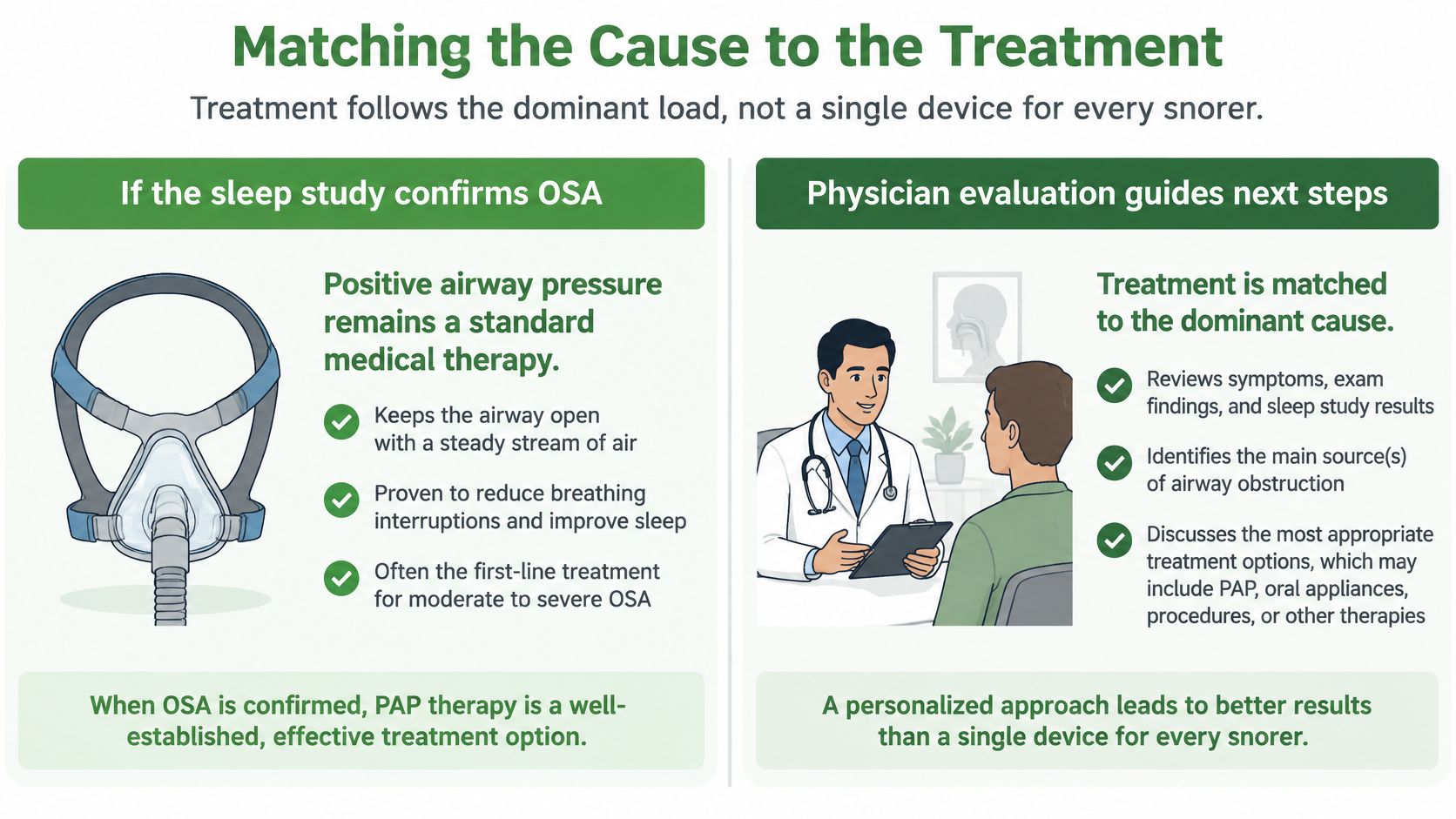
Treatment follows the dominant mechanism, not a single device for every person who snores. Once a sleep study confirms OSA, the care team considers severity, anatomy, symptoms, treatment tolerance, and the patient's preferences.
The illustration summarizes the relationship between confirmed disease and clinician-guided treatment selection.
Pair the finding with an appropriate care path
Dominant cause and matching care path
| Dominant cause | Care path | Who directs it |
|---|---|---|
| Confirmed OSA with any dominant cause | Positive airway pressure as standard medical therapy | Physician directs the decision |
| Jaw position and tongue collapse | Custom oral appliance as CPAP alternative or adjunct for appropriate candidates | Dental sleep medicine dentist with sleep physician coordination |
| Tongue, soft palate, and facial-muscle function | Myofunctional therapy as an adjunct, not a CPAP replacement | Trained provider within the sleep care team |
| Nasal obstruction, large tonsils, or adenoids | Medical or ENT evaluation before any device choice | Physician or ENT |
| Unstable ventilatory control | Specialist sleep assessment | Physician or sleep specialist |
| Mixed causes | Combined care sequenced by dominant load | Coordinated care team |
Positive airway pressure remains a standard medical therapy because it supports airway openness during sleep. A physician directs that decision. Patients shouldn't stop prescribed CPAP while waiting for a dental evaluation.
For appropriate candidates, a custom oral appliance positions the lower jaw forward to help preserve space associated with tongue-related obstruction. It isn't the same as a night guard used for tooth protection. The practice's sleep apnea care information provides context for dental sleep medicine options.
Where muscle training fits
A systematic review of myofunctional therapy included nine randomized trials involving 698 participants and reported lower apnea-hypopnea index compared with controls, with some trials also finding improvements in snoring intensity, oxygen saturation, or mouth-breathing measures. Protocols generally used daily home exercises, alone or alongside CPAP or nasal care. These findings support selected adjunctive use, not proof that exercises replace CPAP.
Home sleep testing at the Charlotte practice can document events before appliance selection when home testing is appropriate. Its technology information explains the imaging and testing context. Follow-up sleep testing helps determine whether a chosen therapy adequately controls breathing events.
For patients whose care also includes physician-led weight management, Weight Method on GLP-1 and sleep apnea offers related reading. Medication decisions belong with the prescribing physician and don't substitute for assessing airway anatomy.
Mixed causes usually need mixed care. Dental treatment, muscle training, and medical management should be coordinated rather than treated as competing explanations.
Request an Airway Evaluation in Charlotte
Before contacting a clinician, adults can note several features that help guide the conversation:
- Observed breathing changes: Witnessed pauses, gasping, or loud snoring.
- Daytime effects: Unrefreshing sleep or fatigue that interferes with ordinary activities.
- Known anatomy: A large neck or a small or recessed jaw.
- Less stereotypical symptoms: A lean adult with disrupted sleep, or a woman after menopause without dramatic snoring.
Appearance and BMI don't rule OSA in or out. A useful evaluation connects the symptoms with sleep-test findings and the structures that may be contributing to obstruction.
Local assessment and coordinated next steps
Adults in Charlotte, NC and nearby South Charlotte communities can consider Pain and Sleep Therapy Center Charlotte for an airway-focused dental examination. Assessment can include in-house 3D CBCT when jaw structure matters and home sleep testing when that is the appropriate next measurement.
The practice is led by Dr. Greg Larson, DDS, a Diplomate of the American Board of Craniofacial Pain, the American Board of Craniofacial Dental Sleep Medicine, and the American Board of Dental Sleep Medicine. The team information describes the practice's clinical background.
If jaw or facial pain is also present, orofacial pain information can help patients describe those symptoms separately. Medical concerns outside TMJ, snoring, and sleep-breathing care should be discussed with the patient's physician.
The purpose of the visit is to identify the right next step, not to assume an appliance is needed. Adults interested in discussing their symptoms can request a complimentary consultation.
Pain and Sleep Therapy Center offers airway-focused dental assessment, home sleep testing, and non-surgical dental sleep medicine options for appropriate patients. Visit Pain and Sleep Therapy Center to learn about evaluating jaw and tongue-related contributors to obstructive sleep apnea and request a complimentary consultation.