
At 2 a.m., your two-week-old baby latches, slips off, and starts clicking with each suck. Your nipple comes out flattened and lipstick-shaped, your breasts are sore, and your baby seems gassy and unsettled after a long feed. Weight gain has been slower than expected, and someone in a feeding group mentions tongue-tie. Suddenly, you're searching for “laser frenectomy infant” while holding a tired, hungry baby.
That search can bring relief, but it can also create pressure to choose a procedure before anyone has assessed the full feeding picture. A restrictive frenulum can contribute to feeding difficulty, yet a visible band of tissue doesn't automatically explain every latch problem or mean surgery is needed.
This guide separates what laser frenectomy can reasonably offer from what it can't guarantee. It also explains why breastfeeding support and, when appropriate, orofacial myofunctional therapy belong in the plan.
Why So Many New Parents Are Hearing About Tongue-Tie
A parent may hear the word tongue-tie for the first time after a rough feeding session, then hear it again from a lactation consultant, pediatrician, or pediatric dentist. Better access to feeding support means more families now get a closer look at latch, tongue movement, and milk transfer instead of being told to endure pain and wait it out.
That wider attention helps some babies get identified sooner. It also means ordinary differences in frenulum shape can be labeled too quickly. Clicking, spit-up, fatigue during feeds, or a shallow latch can come from positioning, milk-flow mismatch, prematurity, oral-motor immaturity, or low milk transfer for reasons that have nothing to do with a tie.
The diagnosis is common enough to attract attention, but the reported rates vary widely. A major review found infant ankyloglossia estimates ranging from 0.1% to 10.7%, and other newborn estimates are often cited in the 4% to 16% range. The same review also noted a male predominance of about 2.5:1 to 3:1. These differences matter because they show how much the definition and the exam method shape the label, as summarized in the review of ankyloglossia diagnosis and management.
The question is function, not appearance
A frenulum is normal anatomy. It becomes clinically relevant when it limits tongue movement enough to affect feeding, such as ongoing nipple pain, poor milk transfer, or slow weight gain.
Practical rule: A visible band of tissue is not the same as a feeding problem that needs treatment.
If you are trying to sort out whether your baby's symptoms fit tongue-tie, start with a careful guide to telling whether a baby has tongue-tie. Then ask for an assessment that watches a feed, checks tongue function, and considers other causes before anyone talks about a procedure.
What a Laser Frenectomy Actually Is
Every baby has small bands of soft tissue called frena. The lingual frenulum connects the underside of the tongue to the floor of the mouth. The labial frenulum connects the inside of the upper lip to the gum. If one of these bands is unusually tight, short, or thick, it may limit the movement needed for sucking, sealing, lifting, or cupping.
A laser frenectomy releases or removes restrictive frenulum tissue with a soft-tissue laser. Providers may use diode or carbon dioxide lasers, depending on their training and equipment. The clinician lifts the tongue or lip, directs the laser at the restrictive tissue, and reshapes the area to allow freer movement.

A useful analogy is a tight guitar string. The provider isn't trying to remove everything around the string. They're releasing the part that prevents the instrument from moving as it should. The exact depth and shape of the release depend on the tissue, the baby's anatomy, and the provider's clinical judgment.
Laser and scissors use different instruments
A scissors frenotomy uses sterile scissors to divide the restrictive band in a quick snip. A laser uses focused light energy and can seal small blood vessels as it works, which often gives the clinician a relatively clear field and may reduce visible bleeding during the appointment.
That technical feature doesn't prove a better feeding outcome. The laser frenectomy procedure overview can help families understand the process, but the decision still belongs to a qualified clinician who has assessed function and feeding.
The terms frenotomy and frenectomy are sometimes used interchangeably in everyday conversation. Frenotomy generally refers to cutting or releasing the frenulum, while frenectomy can imply removing more of the tissue. Ask the provider what procedure they mean and how they'll decide the extent of the release.
How Providers Decide a Baby Needs the Procedure
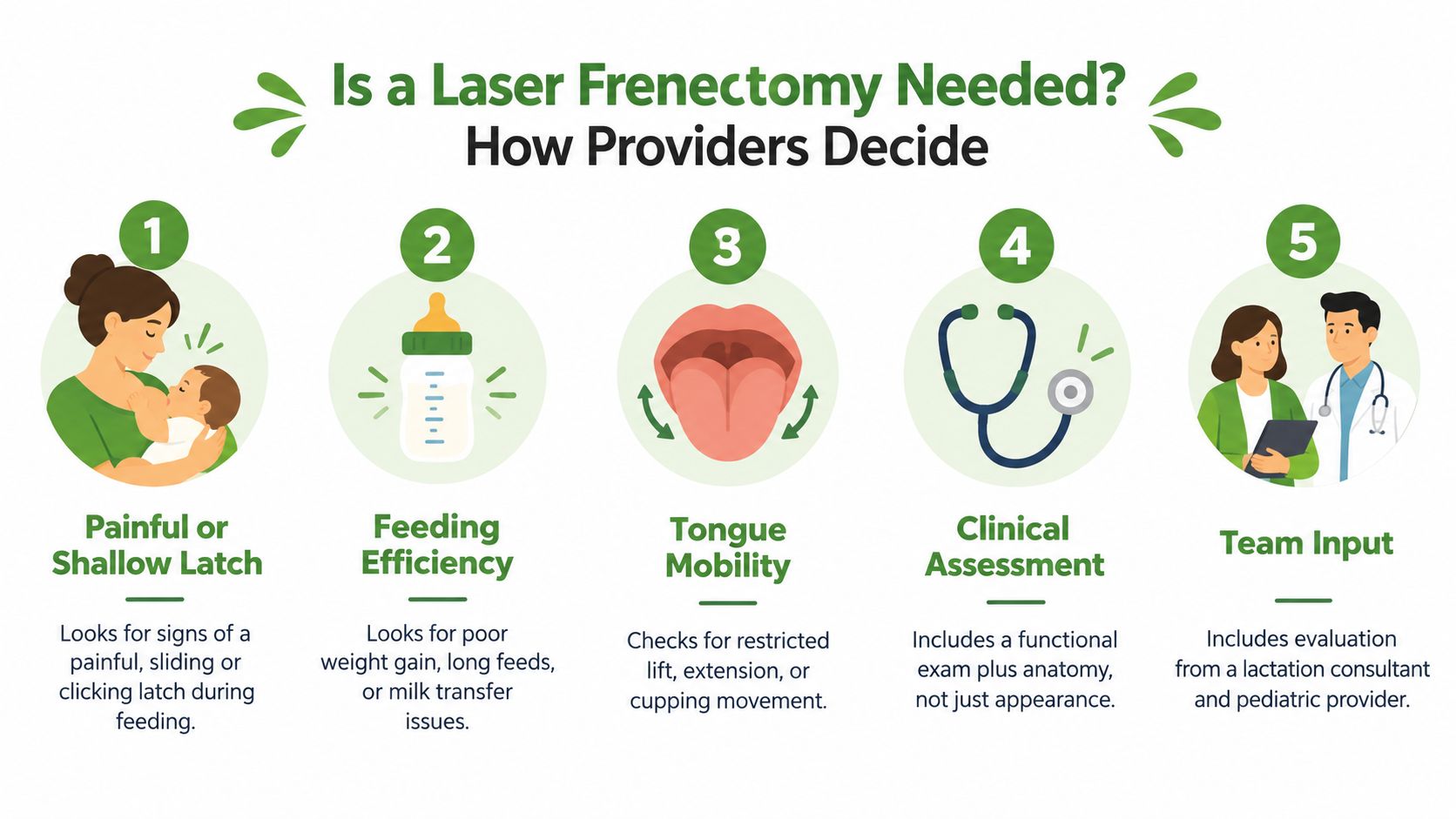
A parent may arrive after weeks of painful feeds, watching the baby slip off the breast and wondering whether a laser release will solve everything. The provider should begin with feeding function, not a photograph of the tissue beneath the tongue. Questions may cover feed length, attachment, fatigue at the breast or bottle, milk transfer, and ongoing nipple pain or injury.
Common reasons to investigate include:
- Latch discomfort: Pain continues despite position changes and skilled feeding help.
- Loss of suction: The baby repeatedly slips off, clicks, smacks, or struggles to keep a seal.
- Low feeding efficiency: Feeds last a long time, the baby tires, or milk transfer seems limited.
- Growth concerns: Weight gain is poor, or the baby remains unsatisfied after frequent feeds.
- Maternal nipple injury: Compression, cracking, or a lipstick-shaped nipple continues after feeding.
These findings do not diagnose tongue-tie on their own. They show that a hands-on feeding assessment is needed. Lactation support can sometimes improve the latch and milk transfer without surgery, so it belongs in the evaluation before a family decides on a procedure.
Classification tools provide structure
Clinicians may use the Coryllos classification to describe the frenulum's attachment and appearance. The Hazelbaker Assessment Tool for Lingual Frenulum Function, commonly called HATLFF, combines physical findings with observations of tongue function.
Neither tool can replace clinical judgment. A baby may have an unusual-looking frenulum and feed effectively. Another may have a less obvious restriction that becomes clear when the clinician checks tongue lift, extension, cupping, coordination, and milk transfer. The appearance is one piece of the assessment, much like checking a door hinge rather than judging the whole door from a photograph.
When waiting is reasonable
Watchful waiting can be appropriate when the baby is gaining well, feeding is comfortable, and tongue movement supports effective breast or bottle feeding. As noted earlier, some infants with a visibly restricted frenulum breastfeed successfully without surgery when their families receive skilled breastfeeding support.
A procedure may deserve discussion when severe pain, substantial nipple trauma, or poor weight gain continues despite appropriate feeding help. Laser can release tissue, but it cannot guarantee a comfortable latch, efficient feeding, or lasting improvement by itself. Ask how the provider assessed function, what feeding support is available before and after treatment, and whether myofunctional therapy may be appropriate. If the recommendation rests only on appearance, seeking a fuller evaluation or second opinion is reasonable.
Laser vs Scissors What the Evidence Really Shows
The central question is simple: Does laser frenectomy work better than scissors for infants? Current evidence doesn't establish laser as superior for clinically meaningful outcomes.
Both techniques release the restrictive tissue. Laser may offer rapid hemostasis and a clear operating field, while scissors are familiar, quick, and widely used for thin infant frenula. The instrument matters, but assessment quality, provider experience, postoperative guidance, and feeding support may matter more to the family's actual result.
A recent comparative study and professional guidance found no evidence that laser frenotomy produces better effectiveness than cold-steel frenotomy. Randomized data found that both approaches improved breastfeeding and weight gain, with differences limited to some short-term measures, including a breastfeeding score on day seven in the scalpel group. The findings are discussed in the comparative infant frenotomy research.
| Factor | Laser Frenectomy | Scissors Frenotomy |
|---|---|---|
| Tissue release | Uses focused soft-tissue laser energy | Uses sterile scissors or a scalpel |
| Bleeding during treatment | Can provide rapid hemostasis, but bleeding can still occur | Usually controlled with pressure |
| Pain and recovery | May involve little immediate pain when properly performed, but this isn't a guaranteed advantage | Often brief, with recovery depending on the release and the infant |
| Breastfeeding outcome | No proven overall superiority | No proven overall disadvantage |
| Technical considerations | Requires careful control of laser settings to limit thermal injury | Requires precise cutting and bleeding control |
| Main decision factor | Provider skill and functional indication | Provider skill and functional indication |
Marketing often presents laser as automatically less painful, faster healing, or more precise in every case. Those claims go beyond what comparative evidence can reliably promise. A laser may be a reasonable technique choice, but it's not a guarantee of a better latch, higher milk transfer, or avoidance of a repeat procedure.
What Happens on the Day of the Procedure
Most appointments begin with a final review of the feeding concern, the examination findings, and your consent. The provider may want the baby ready to feed afterward, and the clinic may swaddle the infant or have a parent hold the baby securely.
The provider lifts the tongue to expose the frenulum. Depending on the infant's age, the tissue, and the clinician's protocol, a topical anesthetic or another form of numbing may be used. Some clinicians use limited anesthesia in very young infants because the release is brief and the medication itself may interfere with feeding or add complexity. Ask exactly what your provider uses and why.
The active tissue work is short. Laser treatment often takes seconds, and scissors release is also rapid, although the exact time varies with anatomy and technique. Afterward, many clinics encourage immediate breastfeeding or skin-to-skin contact, both for comfort and to observe how the baby uses the new range of movement.
Bring a nursing pillow if you use one, a burp cloth, and a familiar blanket. Your baby may be fussy for the rest of the day, and the first feed may not look dramatically different. A total office visit may take 20 to 45 minutes, depending on the clinic's evaluation, consent, feeding observation, and discharge process.
Some parents find it helpful to watch a provider's explanation before the appointment, but an online video can't predict how your baby will respond. The following resource may help you visualize the general setting and sequence:
Recovery Timeline and Feeding in the First Weeks
Most infants can feed soon after the release, but recovery doesn't follow one identical script. A baby who has compensated for restricted movement may need time and coaching to coordinate the tongue differently.
The first day
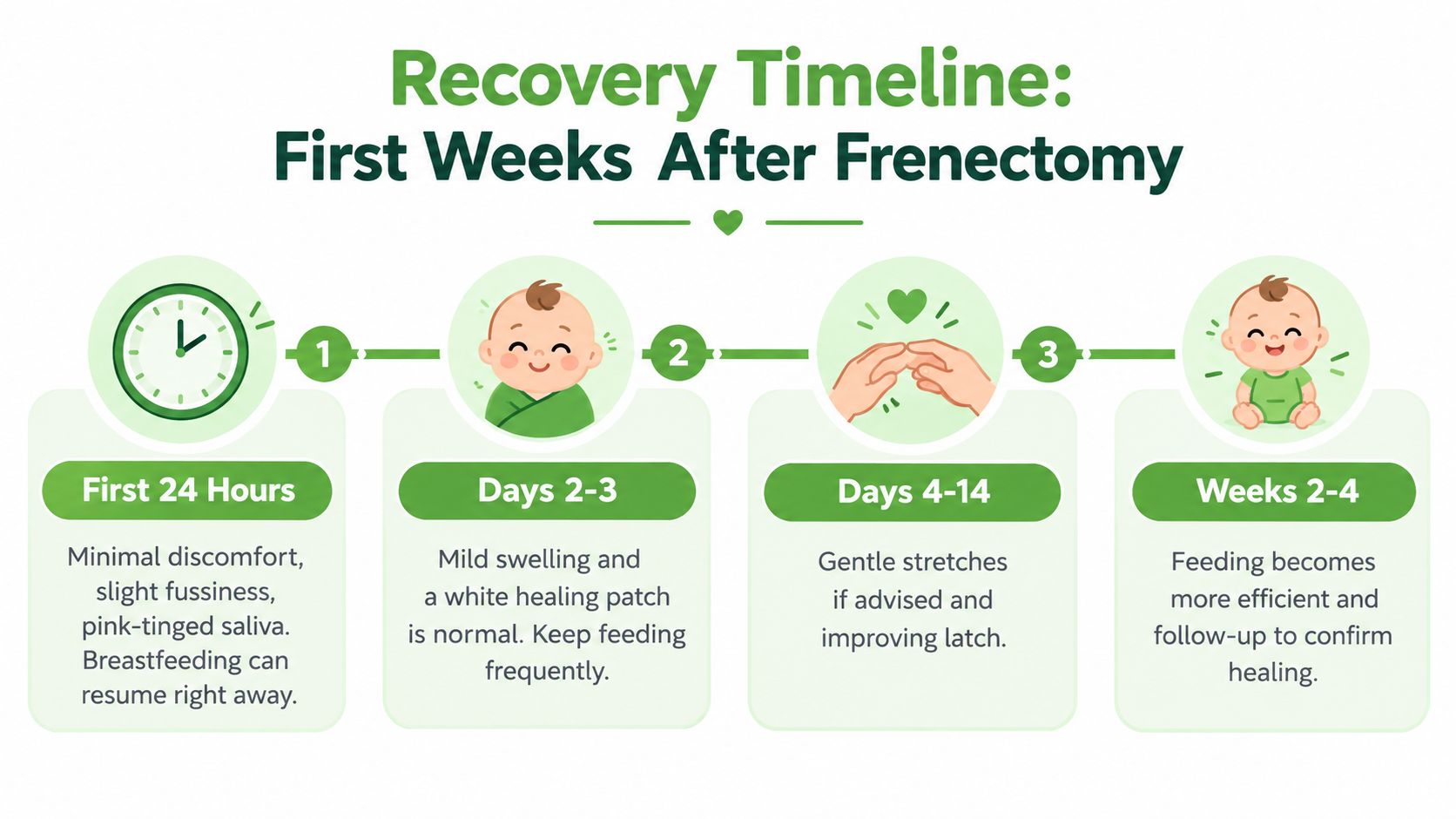
Breastfeeding or bottle-feeding can usually resume promptly, according to the treating clinician's instructions. Some babies appear to latch more comfortably within the first few feeds, while others remain unsettled because the mouth feels unfamiliar. Mild fussiness and slightly pink saliva can occur, but active bleeding isn't expected.
In the first 24 hours, the priority is frequent, responsive feeding and observation. Don't force a latch that has become distressed. Ask the provider what signs of adequate intake you should monitor for your baby.
The first several days
A white or yellowish patch under the tongue can appear as the wound heals. This is typically healing tissue, not automatically pus or infection. Mild swelling may also occur, but worsening redness, increasing swelling, or a baby who refuses multiple feeds deserves a call to the provider.
Post-procedure stretches are controversial in their exact format, so follow the instructions from the clinician who performed the release. If stretches are prescribed, ask the provider to demonstrate where clean fingers should apply gentle tension and how to keep the exercise brief.
The following weeks
During the first two to four weeks, feeding patterns may become more efficient as the baby practices new tongue movements. Some infants need continued lactation help because releasing tissue doesn't instantly correct a shallow latch, low milk supply, bottle preference, or learned compensation.
Contact the clinical team promptly for:
- Bleeding: Blood continues actively or doesn't stop with the instructed pressure.
- Illness: Fever, marked lethargy, or a baby who seems unusually unwell.
- Feeding refusal: The infant refuses multiple feeds or cannot maintain intake.
- Worsening wound changes: Increasing redness, swelling, foul odor, or drainage.
- Dehydration concerns: Noticeably fewer wet diapers or other warning signs your pediatric provider has explained.
Published newborn series describe rapid pain resolution and wound healing within about 30 days, but guideline-level sources caution that complications can be uncommon and underreported. The clinical review of laser frenotomy safety and healing also highlights possible concerns such as hemorrhage, oral aversion, lingual nerve injury, and thermal injury.
Why Lactation Support and Myofunctional Therapy Matter
The release changes tissue. It doesn't teach a baby how to use the tongue efficiently, and it doesn't automatically heal maternal nipple trauma or rebuild milk supply. That's why families often get better practical guidance when the procedural provider works alongside a pediatrician and an IBCLC.
A lactation consultant can watch a complete feed, assess latch depth, observe milk transfer, review maternal comfort, and help adjust positioning. They can also identify problems that look like tongue-tie but come from another source. A supported feed immediately after the release can be useful, but follow-up matters because the baby may need several attempts to develop a more stable pattern.
An orofacial myofunctional therapist focuses on oral rest posture, tongue movement, swallowing patterns, and coordinated exercises. For an infant, therapy may be gentle and highly individualized. The therapist may teach parents how to support the movement plan provided by the treating clinician rather than expecting the baby to perform adult-style exercises.
Build support around the procedure
A practical care plan might include:
- Before the procedure: Have an IBCLC assess the feeding problem and document what happens during a feed.
- Immediately afterward: Feed with professional guidance if possible, noting whether suction, comfort, or tongue movement changes.
- Early follow-up: Recheck feeding with the IBCLC within the timeframe recommended by the care team.
- Ongoing rehabilitation: If indicated, begin orofacial therapy and home exercises after the wound and the infant's readiness are assessed.
Access isn't equal for every family. Telehealth IBCLC appointments may help with positioning and feeding review, and some therapists can teach parents a simple home program when in-person visits aren't available. Don't add stretches or devices from social media without clear instructions from your child's own provider.
For a plain-language explanation of the therapy approach, see what orofacial myofunctional therapy involves. The important point is that laser frenectomy is one part of care, not a standalone promise of perfect feeding.
Choosing a Provider and Planning for Costs
Choosing a provider involves more than finding a clinic that owns a laser. Start by asking how the clinician evaluates infant feeding, how often they perform infant frenotomy, what training they have in the procedure, and how they handle complications or an uncertain diagnosis.
A useful consultation should leave you able to answer these questions:
- Assessment: Will someone observe a feed and evaluate tongue function, not just photograph the frenulum?
- Training: What credentials and specific infant frenotomy experience does the provider have?
- Equipment: What type of soft-tissue laser is used, and how does the clinician control thermal exposure?
- Safety: Does the office have a sterile setup and a plan for pediatric emergencies?
- Coordination: Will the provider communicate with your pediatrician, lactation consultant, or therapist?
- Aftercare: Will you receive written feeding guidance, wound instructions, and a direct number for concerns?
Be cautious if the consultation focuses almost entirely on appearance, promises an immediate cure, or dismisses questions about alternatives. The Irish College of Physicians' 2025 assessment of tongue-tie in newborns and infants concluded that evidence is insufficient to show laser frenotomy is superior to cold-steel frenotomy. It also reported unexpected issues in a prospective series, including intraoperative bleeding in 17 of 56 laser procedures, pacifier refusal in 69.6%, and wakefulness in 26.8%. Those findings don't mean laser is inappropriate, but they do argue against presenting it as risk-free.
Ask financial questions before scheduling
Fees vary by location and by what the clinic includes. The all-in charge may bundle the consultation, release, follow-up, and aftercare, or those services may be billed separately. Ask for a written estimate and clarify whether lactation or myofunctional therapy is included.
Call your insurer before the appointment and ask about coverage using the procedure codes your provider plans to submit, which may include CPT 41115 or 41010. Confirm whether the clinician is in network, whether medical or dental benefits apply, whether prior authorization is required, and what documentation supports medical necessity. Because coverage rules change by plan, verify the details directly with the insurer.
You can also ask whether the expense may qualify for an FSA or HSA, whether the office offers payment plans, and what happens if a claim is denied. Keep the evaluation notes, feeding records, receipts, and explanation of benefits in case you need to appeal.
The strongest decision is rarely “laser at any cost.” It's a documented finding that the restriction is affecting function, a clear discussion of scissors and laser, realistic expectations, and a support plan for feeding and recovery.
Pain and Sleep Therapy Center offers infant tongue-tie evaluation, pediatric laser frenectomy, and post-procedure guidance that can be coordinated with feeding and orofacial therapy needs. Visit Pain and Sleep Therapy Center to learn about the clinic's approach and request an evaluation.