The most popular advice for snoring is often the least responsible: buy a nasal strip, tape your mouth, or just sleep on your side. Those steps may reduce noise for some people, but they can't tell you whether your throat is repeatedly collapsing or whether your oxygen level is falling during sleep. Quieter snoring isn't proof of healthier breathing.
Stopping snoring and addressing sleep apnea require different decisions. Primary snoring may be an irritating sound without significant obstruction, while obstructive sleep apnea, or OSA, involves repeated partial or complete blockage of the upper airway. A Charlotte patient with loud snoring, witnessed pauses, gasping, morning headaches, or persistent daytime fatigue needs more than a gadget. They need an objective evaluation and a treatment plan matched to the airway, jaw, breathing pattern, and underlying risk factors.
Why Quieter Snoring Does Not Mean Better Sleep
Snoring happens when narrowed tissues in the upper airway vibrate as air passes through. Obstructive sleep apnea goes further. The airway can narrow enough to reduce airflow or close temporarily, and the brain may trigger brief arousals that restore breathing. You might not remember waking, but repeated interruptions can leave sleep fragmented and restorative rest incomplete.
Snoring is common across the population, and it doesn't reliably indicate how severe someone's breathing problem is. Habitual snoring has been reported by as many as 45% of men and 25% of women, while approximately 25% to 50% of people who snore loudly have OSA, according to information cited by the American Academy of Sleep Medicine. Loud snoring should prompt evaluation, but it can't diagnose apnea by itself.
Practical rule: Treat a change in sound as a symptom change, not as proof that the airway is open.
The difference between sound and obstruction
A bed partner may notice less vibration after a person starts sleeping on their side, uses a nasal product, loses weight, or begins an exercise program. That improvement can matter for relationship disruption and comfort. It may also leave the actual breathing events unchanged, particularly when obstruction occurs deeper in the throat.
A 2025 randomized controlled trial illustrates the distinction. After six weeks of orolingual myofunctional therapy, bed partners reported a 2.3-point improvement in subjective snoring score, but objective snoring detection and home-sleep-test AHI didn't change significantly. The trial is linked through its published report on orolingual myofunctional therapy and snoring outcomes. In clinical terms, a quieter night may be a worthwhile outcome, but it isn't the same as controlling apnea.
A useful patient-friendly overview of warning signs is the Bristol Dental and Orthodontics sleep apnea guide. It can help you organize concerns before speaking with a clinician, especially if your partner reports pauses, choking, or abrupt gasping.
Why fatigue deserves attention
The body can compensate for interrupted breathing for a long time. Patients often describe waking with a dry mouth, morning headache, jaw tension, or an unexplained sense that sleep never worked. During the day, they may struggle with concentration, mood, reaction time, or the energy required for ordinary tasks.
A large review of studies published from 1993 through 2013 found that OSA, defined as at least five breathing events per hour of sleep, affected an average of 22% of men and 17% of women. When excessive daytime sleepiness was also required, prevalence fell to approximately 6% of men and 4% of women, as reported in the epidemiological review indexed by PubMed. The gap shows why relying only on obvious sleepiness can miss people with clinically important breathing disruption.
Snoring treatment should therefore begin with a question: Is this primary snoring, or is it a sign of airway obstruction? Noise reduction has a place, but restoring safe, stable breathing requires diagnosis first.
Navigating the Diagnostic Pathway in Charlotte
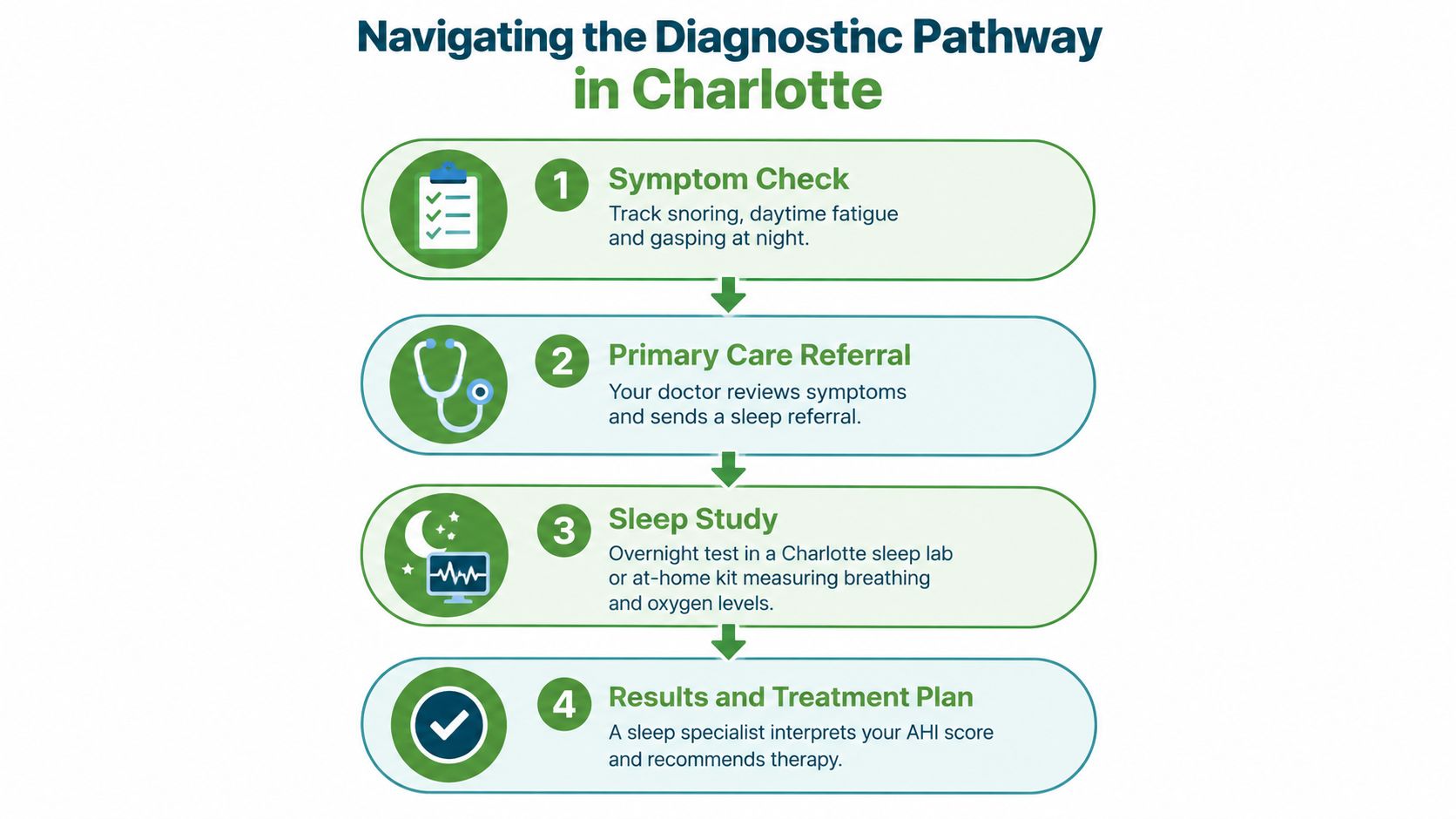
A reliable evaluation follows a sequence rather than a single purchase. Start by documenting what happens during sleep, then involve the right clinician, obtain objective testing, and interpret the result before choosing therapy. This approach prevents a common error, treating a sound while leaving unmeasured breathing events untouched.
Start with the symptoms that change the decision
Ask a bed partner whether they see breathing pauses, choking, gasping, restless movement, or abrupt changes in snoring. Record morning headaches, dry mouth, nighttime urination, difficulty staying alert, and fatigue that persists despite apparently adequate time in bed. Symptoms don't establish OSA, but they give your clinician the context needed to decide whether testing is appropriate.
Charlotte-area referral guidance identifies snoring, choking or gasping during sleep, difficulty sleeping, exhaustion despite apparently sufficient sleep, and inability to complete everyday tasks because of overwhelming fatigue as reasons to consider specialist evaluation. A symptom diary, a partner's observations, and a list of medications can make the initial appointment more productive.
Choose the right test
Atrium Health lists both in-laboratory polysomnography and home sleep apnea testing among its evaluation options. A home test may be appropriate for selected adults with a suitable clinical profile, while an overnight laboratory study can provide a fuller assessment when medical complexity or persistent suspicion makes additional monitoring important. Your clinician should choose the test, not an online advertisement.
The apnea-hypopnea index, or AHI, helps classify the frequency of breathing events. In high-risk sleep-clinic patients, AASM diagnostic guidance reports that approximately 87% meet AHI at least 5 events per hour, 64% meet AHI at least 15, and 36% meet AHI at least 30, based on the AASM diagnostic guidance. These figures describe a high-risk clinical population, not every person who snores in Charlotte.
A negative or technically inadequate home test doesn't reliably rule out OSA when suspicion remains high. In that situation, laboratory polysomnography may be necessary. Patients who want a practical overview of home testing can review how to diagnose sleep apnea at home, then discuss whether that route fits their symptoms and health history.
Build a coordinated local plan
Charlotte residents have established options through Atrium Health, including sleep testing and treatment pathways involving PAP therapy, oral appliances, upper-airway surgery referrals, and bariatric referrals. Listed Charlotte-area locations include 1601 Abbey Place, 3030 Randolph Road, and University City, with an additional Pineville location on Park Cedar Drive, according to Atrium Health's sleep-disorder services.
Dentists can contribute important information about jaw position, oral anatomy, tooth wear, and appliance suitability, but a dentist shouldn't replace appropriate sleep testing. Patients seeking a dental perspective can talk with Dr. Wiitala about snoring while keeping the larger diagnostic pathway in view.
Atrium's University City sleep-medicine service describes coordination among sleep medicine, behavioral sleep medicine, dental sleep medicine, otolaryngology, and weight management. The office is listed at 101 E. W.T. Harris Boulevard, Suite 3301B, Charlotte, NC 28262, with weekday hours from 8:00 a.m. to 5:00 p.m., as detailed by Atrium Health Sleep Medicine University City. That kind of coordination is useful when nasal obstruction, oral posture, jaw symptoms, weight-related risk, or PAP adaptation complicates the case.
Custom Oral Appliances and Positional Strategies
A mandibular advancement device, or MAD, works by holding the lower jaw and associated soft tissues forward during sleep. That can enlarge or stabilize the space behind the tongue for selected patients. The device doesn't rehabilitate every contributor to airway obstruction, but it can provide a medically supervised alternative or complement to PAP when the diagnosis and anatomy support it.
The important word is custom. A dentist trained in dental sleep medicine evaluates the bite, teeth, periodontal health, jaw joints, range of motion, and tolerance for advancement. A titratable device can then be adjusted gradually, with follow-up focused on comfort, symptoms, and objective control of respiratory events. A generic boil-and-bite guard usually lacks that precision and may create jaw discomfort, poor retention, tooth movement, or a false sense of security.
A practical comparison looks like this:
| Option | Main role | Clinical limitation |
|---|---|---|
| Custom adjustable MAD | Advances the lower jaw and can support airway stability | Requires dental evaluation, titration, and follow-up testing |
| Fixed or prefabricated appliance | May offer temporary positioning | Generally provides less individualized control |
| Nasal strip or external dilator | May improve nasal airflow and congestion-related noise | Doesn't treat throat-level obstruction or OSA |
| Positional therapy | Reduces back sleeping when events are position-dependent | Won't address obstruction that persists in every position |
| CPAP | Delivers positive airway pressure to maintain airflow | Requires fitting, acclimatization, and consistent use |
For a detailed explanation of appliance mechanics, see what a mandibular advancement device is. Oral appliances can improve quality of life and daytime sleepiness, while CPAP generally produces larger physiological benefits as OSA severity increases. Custom adjustable appliances generally outperform fixed or prefabricated alternatives, but they aren't automatically appropriate for every patient.
Position can help, but only when the pattern fits
Back sleeping allows the tongue and soft palate to move toward the throat. Side sleeping may reduce narrowing for people whose breathing events are clearly worse when supine. A clinician can identify that pattern from the sleep-study data rather than guessing from a single quiet night.
Positional therapy may involve a wearable trainer, a structured sleep-position aid, or another method that discourages rolling onto the back. Its practical weakness is consistency. People can return to their usual position during sleep, and the benefit disappears if the strategy isn't tolerated.
Follow the outcome, not the noise
A successful appliance plan includes symptom review, examination of the jaw and teeth, adherence assessment, and repeat sleep testing when indicated. Dental occlusal changes, jaw discomfort, and inadequate titration are real trade-offs, so patients should report bite changes or joint symptoms instead of pushing through them.
Snoring reduction is useful feedback, not a complete endpoint. The meaningful questions are whether the AHI improves, oxygenation is protected, daytime alertness changes, and the patient can use the treatment safely over time.
Rehabilitating the Airway with Targeted Exercises
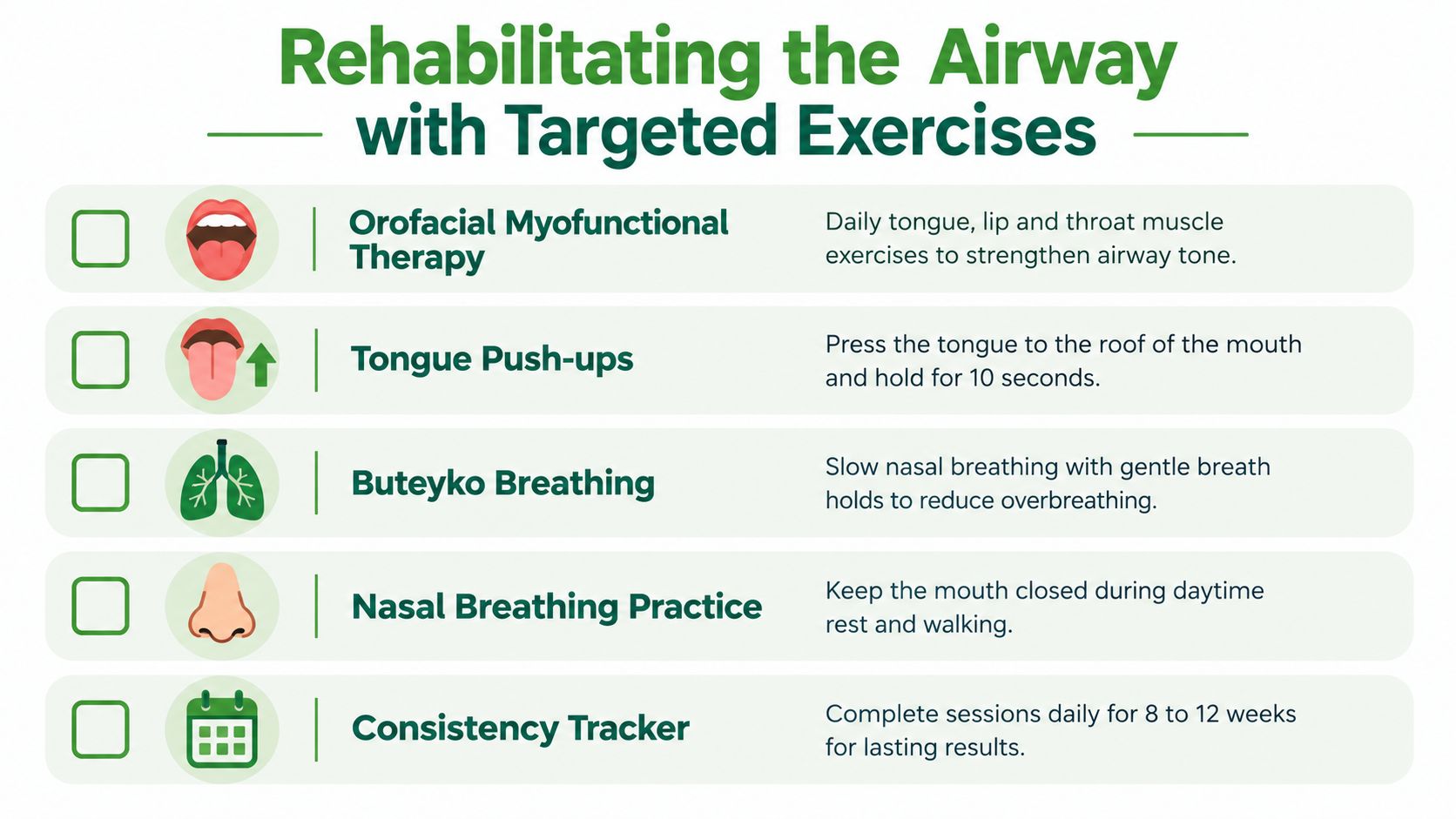
Devices work while you wear them. Airway rehabilitation trains the muscles and breathing habits that influence how the mouth, tongue, nose, and throat function throughout the day and night. Orofacial myofunctional therapy, or OMT, may address tongue posture, lip seal, swallowing mechanics, and upper-airway muscle coordination. Buteyko breathing retraining focuses on calm nasal breathing and reducing habitual overbreathing.
What daily training can involve
A supervised program should be individualized. A clinician may assess nasal patency, resting tongue position, lip closure, swallowing, facial muscle recruitment, palate shape, jaw movement, and TMJ status before prescribing exercises.
Common elements include:
- Tongue-to-palate control: Rest the tongue broadly against the roof of the mouth rather than letting it sit low and forward.
- Tongue resistance work: Press the tongue upward against the palate and hold for 10 seconds, stopping if the exercise causes pain or excessive jaw tension.
- Lip-seal practice: Maintain gentle lip contact without clenching the teeth, first during quiet rest and later during movement.
- Swallow retraining: Practice swallowing with the tongue raised and facial muscles relaxed, rather than using the lips or chin to compensate.
- Nasal breathing: Use slow, quiet nasal breathing during rest and walking, while addressing congestion or structural restrictions with an appropriate clinician.
The infographic's suggested consistency window is 8 to 12 weeks, while clinical guidance describes supervised OMT with daily home exercises over approximately 6 to 12 weeks. Adult meta-analysis found a mean AHI improvement of about 10.2 events per hour and an Epworth Sleepiness Scale improvement of about 5.66 points, as reported in the adult OMT review. Those findings don't make OMT equivalent to CPAP, especially in moderate-to-severe OSA.
A 2025 systematic review and network meta-analysis of 15 randomized controlled trials involving 473 adults and 139 children found improvements in adult daytime sleepiness, sleep quality, arousal index, and snoring intensity, but the overall AHI reduction wasn't statistically significant. The analysis suggested that training for more than 30 minutes daily may improve AHI, while evidence in children remains limited and adherence is important, according to the PubMed-indexed review.
Buteyko breathing needs clinical judgment
Buteyko-style work commonly emphasizes nasal breathing, quiet respiratory volume, and gentle pauses performed within a comfortable range. It isn't a substitute for opening a severely obstructed airway, and mouth taping shouldn't be adopted casually, especially when nasal blockage or undiagnosed OSA is present. The safe priority is to identify why nasal breathing is difficult, then build tolerance gradually.
The video below offers a visual introduction to exercise-based airway work:
Patients can learn more about myofunctional therapy for sleep apnea, but should view exercise therapy as an adjunct or selected option, not a universal replacement for PAP or another indicated treatment. In children, adherence is a particular concern. One pediatric trial reported compliance below 50%, with no improvement in AHI, minimum oxygen saturation, or snoring frequency, as summarized in the AASM-linked evidence above.
The Hidden Connection Between Jaw Pain and Breathing
Jaw pain, teeth grinding, tongue posture, and sleep-related breathing often appear in the same patient. That doesn't mean one problem automatically causes the others. It does mean an isolated treatment can miss the mechanical relationship between the jaw, oral cavity, muscles, and airway.
A restricted oral environment can leave the tongue low or crowded. During sleep, reduced muscle tone may allow the tongue and surrounding tissues to move backward, narrowing the airway. A patient may respond by clenching, thrusting the jaw forward, or grinding the teeth. Those behaviors can increase muscle fatigue and TMJ irritation, creating a cycle in which the person wakes with facial pain and still feels unrefreshed.
What the examination should connect
A airway and jaw assessment may consider:
- TMJ movement: Opening pattern, joint sounds, locking, deviation, and tenderness.
- Muscle function: Temporalis, masseter, neck, tongue, and facial muscle tension.
- Bite and tooth wear: Signs of clenching, grinding, instability, or appliance-related risk.
- Tongue mobility: Resting position, elevation, swallowing, and possible restrictions.
- Nasal airflow: Congestion, habitual mouth breathing, and structural concerns.
- Sleep evidence: Snoring pattern, witnessed pauses, AHI, oxygenation, and treatment response.
The connection matters in both directions. Jaw pain can make a mandibular advancement device difficult to tolerate, while an unrecognized breathing problem can contribute to nighttime clenching and persistent morning muscle soreness. A dental sleep clinician, orofacial pain specialist, sleep physician, ENT, and myofunctional therapist may each contribute a different part of the solution.
Avoid treating the bite in isolation
A night guard may protect teeth without improving airway obstruction. Jaw exercises may reduce muscle tension without addressing sleep-disordered breathing. A breathing program may encourage nasal airflow while a structural nasal problem remains untreated. These tools can have a role, but they need to answer the patient's actual diagnosis.
The same principle applies to surgery and medication. Non-surgical care can be valuable, but “non-surgical” doesn't mean “one-size-fits-all.” The appropriate plan may combine PAP coordination, a custom oral appliance, positional support, nasal care, OMT, Buteyko breathing, TMJ treatment, or referral to another specialty.
A comfortable jaw is important, but comfort alone doesn't confirm that nighttime breathing is safe.
A Charlotte clinic with coordinated dental sleep medicine, orofacial pain, airway rehabilitation, and medical referral capabilities can help keep these decisions connected. That approach is especially important when the patient has both chronic jaw symptoms and evidence of OSA.
Taking the First Step Toward Restorative Sleep
Persistent fatigue and loud snoring aren't character flaws or an unavoidable part of getting older. Charlotte residents have a practical route forward: collect the symptoms, arrange appropriate testing, review the result with a qualified clinician, and choose treatment according to severity, anatomy, preferences, and response.
Charlotte's short-sleep context makes that assessment worth taking seriously. CDC PLACES data report a 2022 crude prevalence of short sleep duration among adults in Charlotte of 39.0%, with a 95% confidence interval of 34.2% to 43.8%, as shown in the CDC PLACES Charlotte data. This measure doesn't diagnose OSA. It does show why ongoing fatigue and poor sleep deserve more attention when they appear with snoring, gasping, morning headaches, or difficulty staying alert.
Prepare for a useful consultation
Bring a sleep-study report if you have one, a medication list, and notes from the person who hears or observes your breathing at night. Write down whether snoring changes with position, whether you wake with jaw pain or headaches, and whether nasal congestion forces mouth breathing. If you have used CPAP, an oral appliance, nasal products, or exercises, describe both the benefit and the reason you stopped.
At a thorough Charlotte evaluation, the clinician may review your AHI and oxygen data, examine the jaw and airway, assess oral posture and swallowing, and consider nasal or ENT factors. A technology-driven evaluation should still lead to a human explanation. You should understand what the test measured, what it missed, what treatment is intended to change, and how success will be verified.
Pain and Sleep Therapy Center is one Charlotte option for coordinated care involving TMJ disorders, facial pain, dental sleep medicine, orofacial myofunctional therapy, Buteyko breathing, neurology, and pediatric oral health. Its services include home sleep testing, custom oral appliance therapy, CPAP coordination, exercise-based airway programs, and non-surgical TMJ therapies such as Prolotherapy, Platelet-Rich Fibrin injections, and cold laser therapy. The right plan may be as simple as positional support for suitable primary snoring, or it may require coordinated treatment for diagnosed OSA and jaw dysfunction.
The essential first step is not choosing between CPAP and exercises from a social-media post. It is finding out whether your airway is obstructing, identifying the contributors that can be changed, and measuring whether treatment works. When the goal is restorative sleep, energy, and clear daytime function, objective follow-up matters as much as the initial intervention.
Pain and Sleep Therapy Center provides Charlotte patients with evaluation and treatment for snoring, obstructive sleep apnea, TMJ disorders, facial pain, and airway-function concerns, including custom oral appliances and non-surgical myofunctional and Buteyko programs. Visit Pain and Sleep Therapy Center to review the available services and take the next step toward a personalized sleep and airway assessment.