
You may be reading this after another broken night. Your partner nudged you awake because of the snoring, or you woke with a dry mouth, a morning headache, and the familiar feeling that your brain never fully switched off. Someone may have mentioned an oral appliance, leaving you to wonder whether it's just a smaller version of CPAP or another mouthguard from a pharmacy.
A mandibular advancement device, usually shortened to MAD, is a dental appliance worn during sleep. It gently holds the lower jaw forward to help reduce upper-airway obstruction and the tissue vibration that produces snoring. It can be an effective treatment for carefully selected people, but it isn't a universal replacement for CPAP or a one-time fix. The fit, jaw position, severity of breathing disorder, and follow-up all matter.
A Small Mouthpiece With a Big Job
A MAD works by changing the position of your lower jaw while you sleep. The appliance sits over your teeth and holds the mandible, the lower jawbone, slightly forward. That movement can bring the tongue and nearby soft tissues forward too, leaving more room for air to pass through the throat.
A useful mechanical analogy is a sliding drawbridge. If the bridge shifts backward into a narrow tunnel, it can obstruct the passage. Move it slightly forward, and the tunnel has more usable space. A MAD doesn't force the airway open with air pressure. It changes the position of structures that may otherwise drift backward when your muscles relax during sleep.
What a MAD is, and what it isn't
A MAD isn't a nasal strip. Nasal strips may widen the outer nasal passages, but they don't reposition the jaw or directly support the throat. It also isn't a tongue-stabilizing device, which holds the tongue forward using a different mechanism.
CPAP takes another approach. It uses a machine and mask to deliver continuous positive airway pressure, creating an air splint inside the airway. A MAD is quiet, compact, and worn inside the mouth, but its effect depends more closely on your anatomy and the amount of jaw advancement you can tolerate.
The device may be prescribed for primary snoring, meaning disruptive snoring without confirmed sleep apnea, or for obstructive sleep apnea after proper evaluation. A custom appliance is designed around your teeth, bite, jaw joints, and treatment needs. That makes it different from a generic sports mouthguard or a soft nightguard intended to protect teeth from grinding.
Practical rule: If you're snoring regularly, don't assume the noise is the whole problem. A sleep evaluation can distinguish simple vibration from repeated airway obstruction.
The central question isn't only, “Will this stop my snoring?” It's also, “Does this control the breathing disorder safely for my severity?” Those questions require different kinds of follow-up.
How Snoring and Sleep Apnea Actually Happen
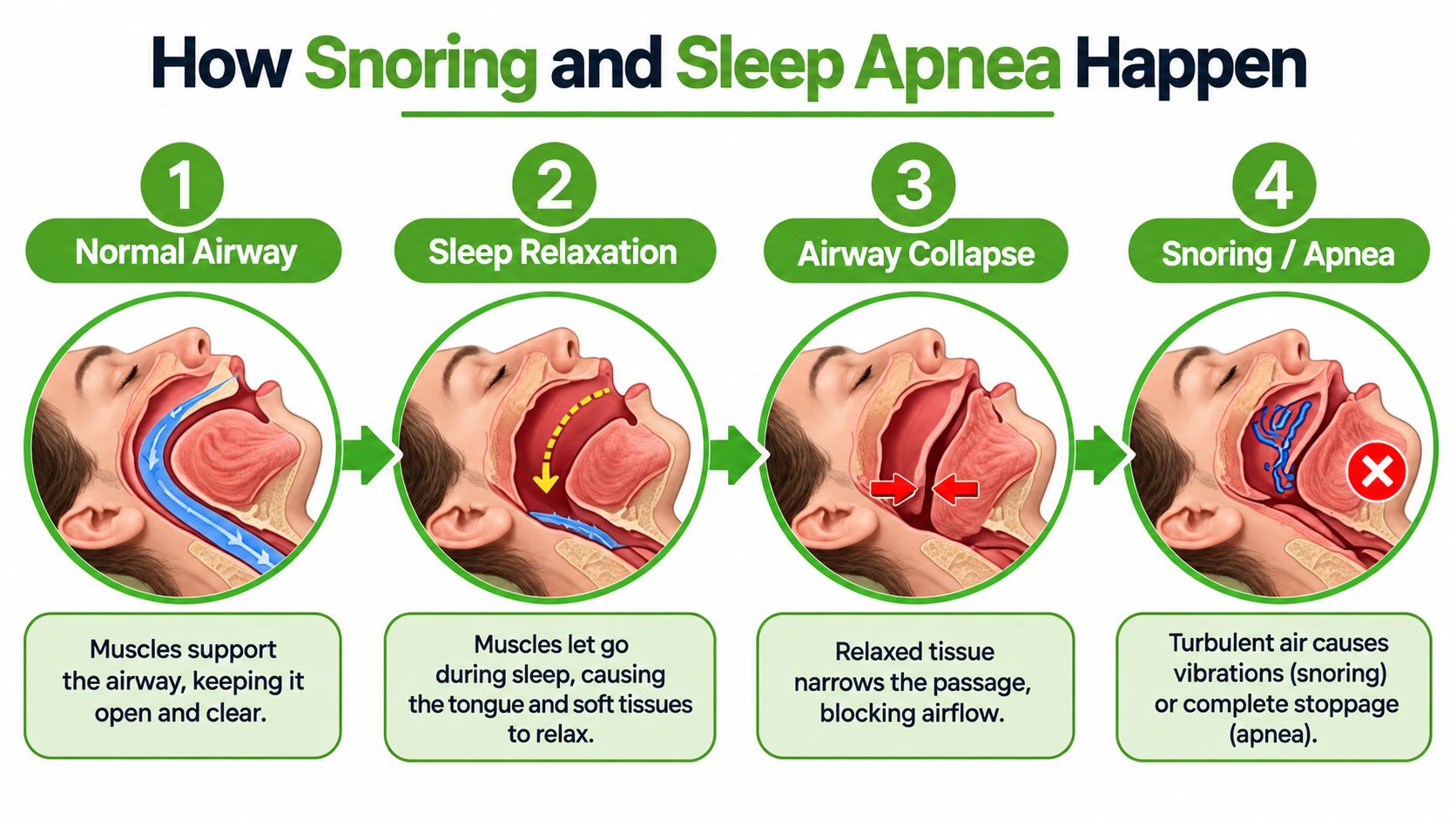
During wakefulness, muscles in the tongue, soft palate, and throat help support the upper airway. Sleep reduces that muscle activity. In some people, the tongue and soft tissues then move inward, narrowing the passage behind the mouth.
Air still moving through a narrowed passage becomes turbulent. That airflow makes relaxed tissues vibrate, producing snoring. If the airway narrows further or closes completely, breathing may pause. The brain can briefly increase alertness to restore airflow, but these micro-awakenings may happen without the person remembering them in the morning.
Obstructive sleep apnea is therefore more than loud breathing. Repeated obstruction can interrupt normal sleep and cause repeated oxygen fluctuations. A person may sleep for what seems like a full night and still wake unrefreshed, struggle with concentration, or feel excessively sleepy during the day.
The before-and-after airway picture
Think of the airway as a flexible corridor rather than a rigid pipe. Before sleep, the corridor may stay open because surrounding muscles provide support. After sleep begins, the walls can become less stable, while the tongue and soft palate occupy more of the available space.
A MAD advances the lower jaw and can draw the tongue base and related soft tissues forward. The result isn't identical in every patient, but the intended change is simple: less inward collapse and a more stable passage for airflow.
The distinction between snoring and apnea matters when choosing a treatment. Guidance about snoring solutions for better rest may help with bedroom habits and sleep comfort, but persistent gasping, witnessed pauses, or severe daytime sleepiness calls for medical assessment. You can also review the clinical overview of sleep apnea causes and symptoms before deciding whether a dental appliance is appropriate.
This animation provides another visual explanation of how airway obstruction can develop during sleep:
The device aims to improve airway mechanics, but better airflow during sleep doesn't automatically prove that apnea is controlled. A follow-up assessment is what connects the mechanical idea to your actual treatment result.
Who Is a Good Candidate for a MAD
A MAD tends to make the most sense for an adult with primary snoring or mild-to-moderate obstructive sleep apnea, especially when the person wants a quiet, portable treatment or has difficulty using CPAP. It may also suit someone whose lower jaw sits relatively far back, because advancing the mandible can provide a useful change in tongue and airway position.
The device can be considered for some people who cannot tolerate CPAP, but “alternative” doesn't mean “automatically equivalent.” Treatment choice should reflect the severity of the apnea, oxygen changes, anatomy, other health risks, and the likelihood that the person will use the therapy consistently.
A sleep study or appropriate sleep screening helps establish what kind of breathing problem is present. A dental assessment then checks whether the teeth, gums, bite, jaw joints, and range of mandibular movement can support an appliance.
Situations requiring more caution
A MAD may be less suitable when the problem is central sleep apnea, because central events aren't caused by the upper airway collapsing in the same way. It may also be a poor choice for someone with active gum disease, insufficient stable teeth, significant untreated jaw-joint symptoms, or an inability to move the lower jaw forward comfortably.
People with severe obstructive sleep apnea need particularly careful medical guidance. CPAP is often the stronger option for controlling airway events and oxygen desaturation, while a MAD may have a role only in selected circumstances, such as difficulty tolerating standard treatment or use alongside another therapy.
| Profile | Likely a Good Candidate | Consider Alternatives Instead |
|---|---|---|
| Primary snoring without confirmed apnea | A dental evaluation can determine whether jaw advancement may reduce vibration | Nasal, positional, or airway evaluation if symptoms suggest more than simple snoring |
| Mild-to-moderate obstructive sleep apnea | A custom, adjustable MAD may be considered after diagnosis | CPAP or another treatment if follow-up testing shows inadequate control |
| CPAP intolerance | A MAD may offer a more acceptable nightly format | Re-fitting the mask, changing pressure support, or reassessing the diagnosis may still be appropriate |
| Significant TMJ symptoms or unstable dental health | Treatment may need to wait until the underlying issue is addressed | Jaw care, periodontal treatment, or another airway therapy |
| Severe or complex sleep-disordered breathing | A MAD requires specialist oversight and objective verification | CPAP or a broader sleep-medicine plan may be more appropriate |
A screening questionnaire can help you decide whether to seek evaluation, but it can't confirm that a MAD will control your breathing. The decision belongs in a coordinated conversation between a sleep clinician and a qualified dental provider.
Custom Devices Versus Over-the-Counter Options
A custom device is built around your mouth, bite, and available jaw movement. The clinician uses dental impressions or a digital scan to choose an appliance that supports the teeth and jaw, then adjusts the lower-jaw position in stages. That process matters because symptom relief, such as quieter snoring, does not by itself prove that sleep apnea is controlled.
An over-the-counter “boil-and-bite” appliance softens in hot water and is molded at home. It may be a reasonable short-term trial for uncomplicated snoring when sleep apnea has not been diagnosed. It provides less control over bite forces, jaw advancement, retention, and follow-up. A poor fit can also leave you unsure whether the appliance failed or was never positioned correctly.
One-piece and two-piece designs
A mono-bloc device connects the upper and lower arches in one appliance. A duo-bloc, or two-piece device, has separate upper and lower components joined by an adjustment mechanism. The two sections can be advanced in small increments, giving the clinician more flexibility during titration.
Design can affect reported outcomes. One systematic review found a success rate of 0.821 for mono-bloc devices compared with 0.547 for duo-bloc devices in the studies it assessed. That finding does not mean every one-piece appliance suits every patient. Comfort, jaw movement, dental condition, the location of the obstruction, and the ability to adjust the device all influence the choice. The evidence is summarized in this review of mandibular advancement device evidence.
| Device Type | Fit and Adjustability | Best For | Typical Limitations |
|---|---|---|---|
| Custom titratable MAD | Precisely fitted and adjusted in small increments | Diagnosed sleep apnea, regular nightly use, or controlled jaw positioning | Requires dental assessment, fabrication, and follow-up |
| Custom mono-bloc MAD | One connected unit with a fixed or limited jaw position | Patients suited to a stable fixed design | Less convenient for incremental advancement |
| Custom duo-bloc MAD | Separate upper and lower sections allow progressive adjustment | Patients who need titration or greater flexibility | More components require careful fitting and maintenance |
| Over-the-counter boil-and-bite appliance | Home-molded with limited control | Short-term trial for simple snoring without diagnosed apnea | Fit, durability, retention, and airway effectiveness can be uncertain |
A low price or quick delivery cannot answer whether your breathing is controlled. If you have diagnosed apnea, gasping, or witnessed breathing pauses, professional fitting and follow-up are safer than treating the device as a generic sleep apnea retainer.
What Fitting and Titration Feel Like
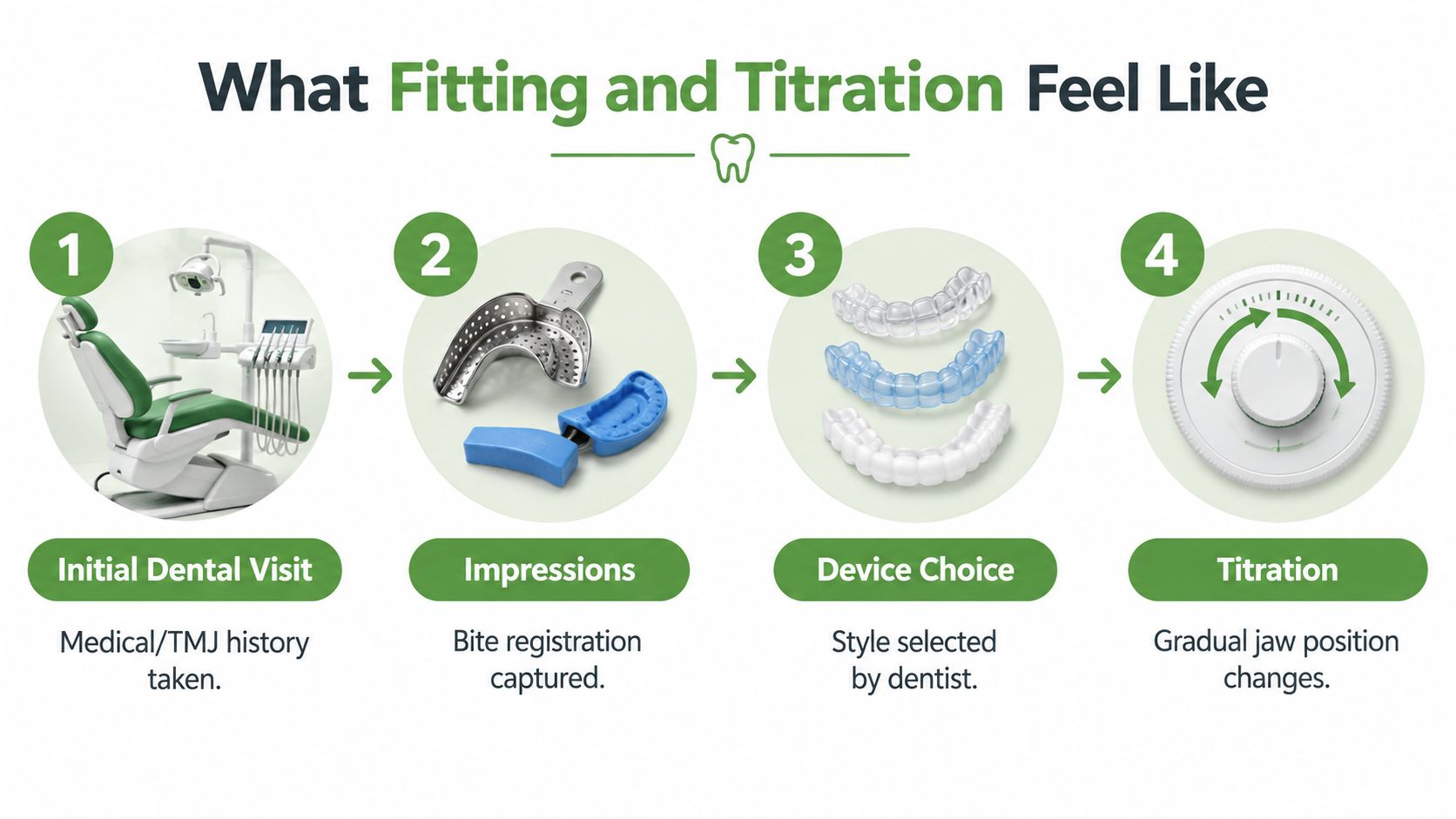
The first appointment is more investigative than dramatic. The dental provider reviews your sleep history, symptoms, medical conditions, current treatments, and any history of jaw pain or clicking. They'll examine your teeth, gums, bite, jaw movement, and the amount of forward movement available.
Impressions or a digital scan capture the shape of your teeth. The clinician also records how your upper and lower teeth meet, known as the bite registration. These details help the laboratory or practice create an appliance that stays in place without applying unnecessary pressure to the teeth or jaw joints.
The first nights
At the fitting visit, the appliance may feel bulky or unfamiliar. You'll notice that your lower jaw is being held forward, and your teeth may not come together normally when you remove it in the morning. Extra saliva, dry mouth, mild gum tenderness, or temporary jaw fatigue can occur while your mouth adapts.
The early aim isn't to push your jaw as far forward as possible. It's to find a position you can tolerate and wear for the whole sleep period. Advancement is usually adjusted gradually, guided by symptoms, comfort, snoring reports, and, when available, home sleep data.
A typical care rhythm looks something like this:
- Initial fitting: The provider checks retention, comfort, speech, jaw movement, and pressure points.
- Early adjustment visits: The appliance is reviewed and advanced only when the current position is tolerated.
- Objective confirmation: A sleep clinician may recommend repeat testing to determine whether breathing events and oxygen changes have improved.
- Long-term recall: The provider checks the appliance, teeth, gums, bite, and jaw joints. Clinical guidance describes a first post-titration dental recall at about six months, followed by annual reviews in a common workflow (clinical guidance on long-term MAD management).
Titration is collaborative. If you develop persistent pain, a major bite change, or worsening symptoms, don't keep advancing the appliance on your own. Contact the prescribing or fitting clinician.
How Well MADs Actually Work
You wake with less snoring, feel more rested, and assume the problem is solved. A follow-up sleep test may tell a more complicated story. A MAD can improve symptoms while leaving some breathing events untreated, and a device that controls those events is only useful if you can wear it consistently. Symptom relief, disease control, and adherence must be considered together.
For snoring, many suitable users notice a clear reduction in noise. Obstructive sleep apnea is less predictable because response depends on airway anatomy, disease severity, how far the jaw can move, device design, and the titration process. One multicenter prospective study reported reduced AHI in 93% of patients and at least a 50% AHI reduction in 69%, with reported success rates of 50% in mild OSA, 81.6% in moderate OSA, and 73.3% in severe OSA (evidence review of MAD treatment). These figures describe study groups, not a guaranteed result for one person.
Longer-term research also found meaningful improvement for some users. A meta-analysis covering 22 studies and 546 patients found that MAD therapy reduced Epworth Sleepiness Scale scores by 3.99 points and AHI by 16.77 events per hour. In a 5-year follow-up study, overall treatment success was 52%, while 75.5% of patients had an Epworth Sleepiness Scale score below 10 (long-term MAD evidence). These results support MADs as ongoing therapy, not a one-time mouthpiece swap.
MADs and CPAP answer different strengths
CPAP generally lowers AHI and oxygen desaturation more effectively. MADs may be easier for some users to wear because they are quiet, portable, and less intrusive. The practical comparison is therefore about effective use, not just laboratory performance. A stronger treatment cannot help on nights it is not used, while a comfortable MAD still needs objective testing to confirm adequate control.
| Outcome | Custom MAD | CPAP |
|---|---|---|
| Airway event control | Can work well for selected patients, but response varies | Usually stronger physiologic control of obstructive events |
| Oxygen desaturation | May improve when obstruction responds | Generally more effective at preventing desaturation |
| Nightly acceptance | Often easier for some patients to tolerate and travel with | Masks, pressure, noise, and dryness can create barriers |
| Daytime sleepiness | Can improve when treatment is effective and used consistently | Can improve when treatment is used consistently |
| Quality of life | May improve with successful use | May improve with successful use |
| Verification | Follow-up sleep testing helps assess control | Device data and clinical follow-up help assess control |
Quieter snoring and a better morning are useful signs, not proof that apnea is controlled. Follow-up testing shows whether the device is doing enough for your breathing and risk profile. If it is not, your clinician can reconsider the settings, device, or wider sleep-care plan.
Side Effects, Bite Changes, and Long-Term Care
You may wake after the first few nights with a sore jaw, tender teeth, extra saliva, dry mouth, or a bite that feels unfamiliar. These sensations are often temporary, but they are useful feedback. The appliance may need a small adjustment, slower advancement, a different design, or a short pause rather than simple endurance.
A MAD works on the airway while it is in your mouth, so its effects on the teeth and jaw also deserve ongoing attention. Over time, some people develop changes in how the teeth meet or in incisor position. One meta-analysis measured lower incisor proclination of 1.54 degrees, overjet reduction of 0.89 millimeters, and overbite reduction of 0.68 millimeters (systematic review of oral and dental effects). These are study measurements, not a prediction of what will happen to every wearer. They do show why a MAD is long-term therapy, not a mouthpiece that can be fitted once and ignored.
The appliance needs care in the same way that orthodontic treatment needs review. Comfort and breathing results matter, but protecting the teeth, gums, jaw joints, and appliance matters too.
What monitoring should include
A dental sleep provider can compare your bite at follow-up visits, examine your teeth and gums, assess the jaw muscles and joints, and confirm that the device still fits correctly. A recent meta-analysis reported that adjustable devices may place less stress on the temporomandibular joint and chewing muscles than nonadjustable designs (review of adjustable appliance effects).
Simple routines help identify changes early:
- Check your morning bite: See whether your teeth return to their usual position after you remove the appliance.
- Track jaw symptoms: Note soreness, stiffness, clicking, locking, or muscle fatigue, especially when a pattern continues.
- Clean and store the device: Follow the provider's instructions to maintain hygiene and limit unnecessary wear.
- Keep recall visits: Regular reviews give the clinician a chance to adjust or replace the device before discomfort persists.
- Report warning signs: Increasing pain, a lasting bite change, loose teeth, gum irritation, or less treatment benefit warrants prompt attention.
Your clinician may suggest gentle morning jaw movements. Aggressive stretching is not appropriate for everyone, particularly with active jaw-joint symptoms. A side effect calls for assessment, not just pushing through it.
A MAD is a long-term therapy with a maintenance plan. Good care protects both the airway and the structures that support the appliance.
Where MADs Fit in Your Sleep Care Plan
A MAD addresses one part of sleep-disordered breathing, the position and stability of the upper airway during sleep. It doesn't replace a diagnosis, and it won't correct every factor that contributes to snoring or apnea.
Your broader plan may include positional therapy if breathing worsens on your back, nasal-breathing work when congestion or poor nasal habits interfere, and allergy management when inflammation contributes to obstruction. Alcohol close to bedtime can worsen airway relaxation for some people, so discussing evening habits with a clinician may be useful. Weight management, when relevant, may also form part of a medically supervised plan.
Myofunctional therapy can address the coordination and resting posture of the tongue, lips, and facial muscles. It may complement an appliance, but it shouldn't be presented as a substitute for treatment that your sleep clinician considers necessary. A MAD may also be useful as a travel option for someone otherwise treated with CPAP, provided the clinician agrees and the device's effectiveness has been established.
A practical decision framework
- Start with diagnosis. Confirm whether the problem is snoring, obstructive sleep apnea, central sleep apnea, or another sleep disorder.
- Match treatment to severity. Consider CPAP, a MAD, positional care, surgery, or combined treatment according to the clinical picture.
- Choose for real-life adherence. The treatment you can use consistently matters, but comfort must not be confused with adequate disease control.
- Verify the result. Persistent symptoms, witnessed apneas, worsening daytime sleepiness, rising blood pressure, or a stalled home AHI should prompt reassessment.
- Plan maintenance. Dental reviews, sleep follow-up, and device adjustments keep the therapy responsive to changes in your mouth and airway.
People often search for information about oral appliances versus CPAP because they want a simple winner. The more useful question is which treatment provides sufficient control and fits your health needs well enough that you'll use it consistently. Sleep quality can also be supported by routines that include structured mental wellness support, especially when stress and poor sleep reinforce each other, but mental wellness tools don't replace evaluation for suspected apnea.
Common questions
Can a MAD stop snoring without treating sleep apnea?
It may reduce snoring, but quieter breathing doesn't prove that apneas have stopped. If you have risk factors or witnessed pauses, seek testing rather than relying on sound alone.
Will a MAD change my bite?
It can. Changes may be mild and manageable, but the possibility is one reason for dental monitoring, especially with long-term nightly use.
Can I buy one online and use it for apnea?
An over-the-counter appliance may be reasonable for a limited trial of uncomplicated snoring, but diagnosed apnea calls for a properly assessed and fitted treatment plan.
How do I know whether it's working?
Look beyond comfort and reduced snoring. Your clinician may use symptom review, device data, or follow-up sleep testing to assess breathing control.
What if my jaw already hurts?
Tell the dental provider before fitting. Existing TMJ or masticatory muscle symptoms may affect candidacy, design, advancement, and monitoring.
Pain and Sleep Therapy Center evaluates snoring, obstructive sleep apnea, TMJ concerns, and related airway factors, including custom oral appliance therapy and breathing-focused care. Visit Pain and Sleep Therapy Center to request an evaluation and discuss whether a mandibular advancement device fits your diagnosis, dental health, and long-term sleep plan.