Waking with jaw pain doesn't automatically mean you spent the night grinding your teeth. A night guard may protect enamel, but it can't diagnose poor sleep, airway resistance, stress-related muscle activity, or a nervous system that has become unusually sensitive to normal jaw loading. If your jaw feels fine at bedtime and painful by morning, the problem may be how you breathe and sleep, not what your teeth are doing.
Temporomandibular disorders, or TMDs, affect about 5% to 12% of the population, and symptoms can include headache, bruxism, pain around the TMJ, ear pain, and jaw clicking or popping. These symptoms often overlap, which is why treating only the most visible sign can leave the underlying driver untouched. Clinical data on TMD symptoms and nighttime jaw activity supports a broader view of jaw pain at night, especially when symptoms are strongest on waking.
Rethinking the Night Guard Approach to Jaw Pain
A sore jaw in the morning is weak evidence that grinding caused the problem. A night guard can separate the teeth and limit dental wear, but it does not identify why the jaw muscles became active. Sleep fragmentation, airway resistance, repeated arousals, and pain sensitization may all increase jaw activity without sustained, forceful grinding.
TMD is a multi-factor condition. Background chewing-muscle activity, emotional stress, poor sleep quality, repeated awakenings, and sleep-related breathing problems can change the load reaching the jaw. Bruxism may contribute, but treating it as the complete diagnosis can leave the main driver unaddressed.
What a night guard can and cannot do
A properly designed occlusal appliance can protect teeth from contact and provide a more controlled environment for an irritated joint. It may also reduce symptoms when tooth contact is adding to muscle overload. The appliance does not correct nasal obstruction, airway resistance, fragmented sleep, or stress-related muscle activity.
Fit and design affect the outcome. A generic soft mouthguard may feel bulky, change how the jaws meet, or prompt some patients to chew against it. A device that worsens muscle activity or alters the bite requires adjustment, reassessment, or replacement rather than indefinite use.
The distinction between a protective splint and a basic night guard matters clinically. Patients comparing appliances can review TMJ splint versus night guard options to see why the terms are not interchangeable and why the device should reflect the joint, muscle, and airway findings.
Practical rule: Use an appliance to protect vulnerable structures while continuing to investigate the cause of the symptoms.
One population study reported TMJ pain in 29.4% of participants and nocturnal parafunction in 31.6%. Those findings show that nighttime jaw activity and pain often coexist, while leaving causation open. The Dunedin cohort study supports interpreting these symptoms together rather than assigning every case to sustained tooth grinding.
Look beyond the teeth
A root-cause assessment asks whether you snore, wake unrefreshed, breathe through your mouth, have nasal blockage, or wake repeatedly without knowing why. It also examines daytime clenching, neck tension, tongue posture, medication effects, stress physiology, and jaw movement.
If a night guard has not resolved morning pain, the appliance may have addressed tooth contact while sleep disruption, airway resistance, or muscle triggers remained active. That result calls for better diagnosis, not automatic escalation to a stronger guard.
Why Your Nervous System Amplifies Pain During Sleep
Some patients go to bed comfortable and wake with a stiff, aching jaw. The change can seem disproportionate to anything that happened during the night, especially when there's no obvious evidence of prolonged, forceful grinding. Sleep-related pain sensitization offers one explanation.
Poor sleep can alter how the nervous system evaluates incoming signals. Expert reviews associate inadequate sleep with lower pressure-pain thresholds, greater temporal summation, and reduced conditioned pain modulation. In practical terms, the body becomes less effective at dampening pain while becoming more reactive to repeated sensory input. The review of sleep, pain processing, and TMD describes this as a pro-nociceptive state.
Why ordinary jaw loading can hurt
Your jaw muscles don't need to contract forcefully for hours to create symptoms in a sensitized system. Brief nocturnal parafunction, swallowing, repositioning the mandible, or maintaining a tense resting posture may be enough to provoke soreness when the muscles and joint have lost some of their normal tolerance.
This helps explain why morning pain doesn't always match the amount of tooth wear or the amount of grinding detected during testing. The issue may involve how the brain and spinal pathways process muscle and joint signals, not just how much mechanical force the teeth experience.
Stress can intensify this pattern. A person who falls asleep with increased muscle tension may not consciously clench, yet the jaw may remain active during repeated arousals. If the person also sleeps poorly, the nervous system may begin treating ordinary pressure as threatening. The result is a familiar pattern, minimal symptoms at bedtime followed by tenderness, headache, or restricted opening in the morning.
A more useful pain question
Instead of asking only, “Did I grind my teeth?”, ask:
- How restorative was my sleep?
- Did I wake with a dry mouth, headache, or blocked nose?
- Does the pain improve as the day progresses?
- Do chewing, talking, or stress make it worse?
- Is the discomfort in the joint, the cheek muscles, the temples, or all three?
Those answers help separate mechanical tooth protection from treatment aimed at sensitivity, muscle recovery, and sleep quality. Patients who want a clearer explanation of this mechanism can explore pain neuroscience education for jaw symptoms, particularly when pain persists despite limited findings on a dental examination.
The aim isn't to dismiss bruxism. It's to stop using bruxism as a convenient explanation for every case of TMJ pain at night.
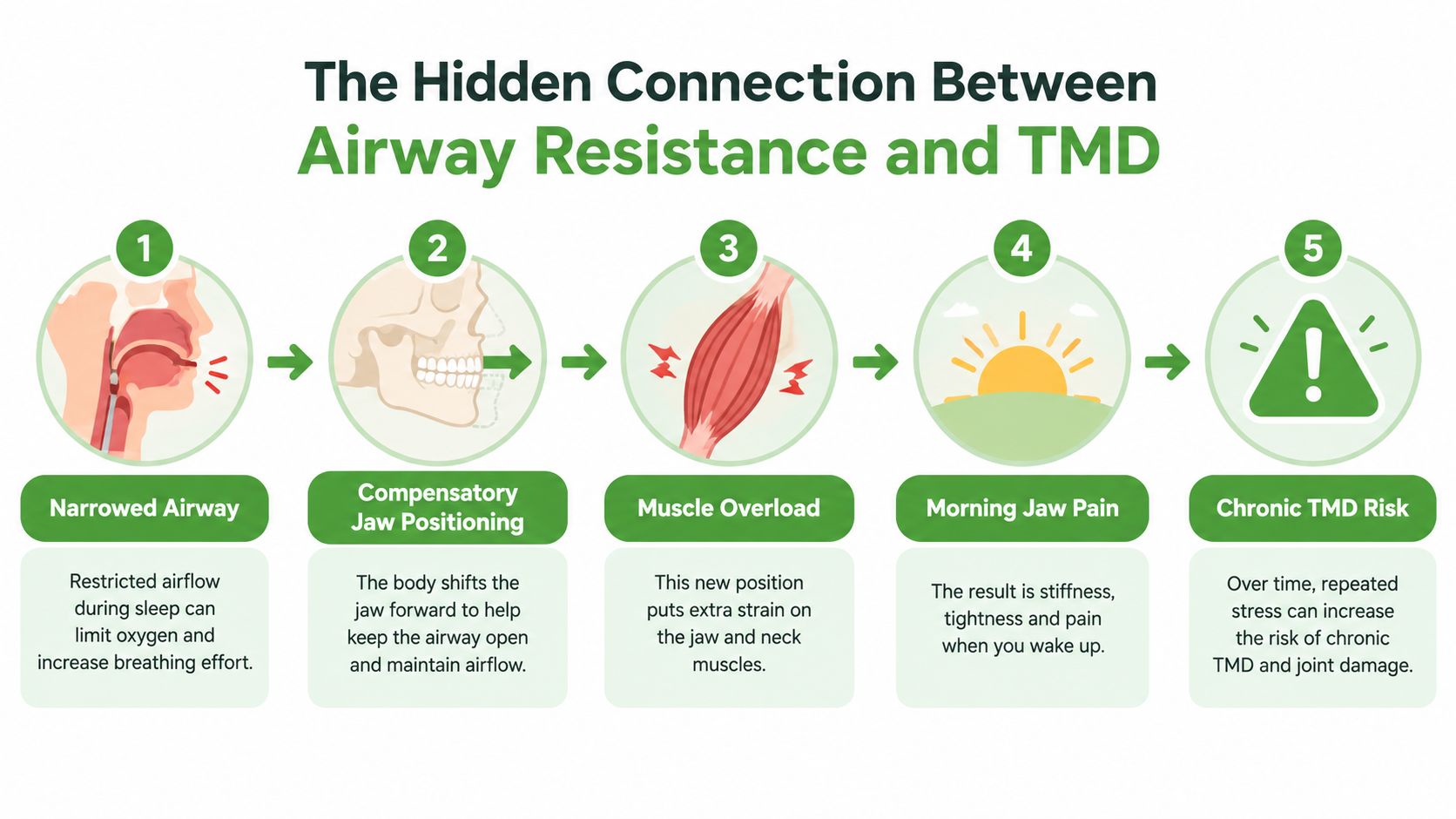
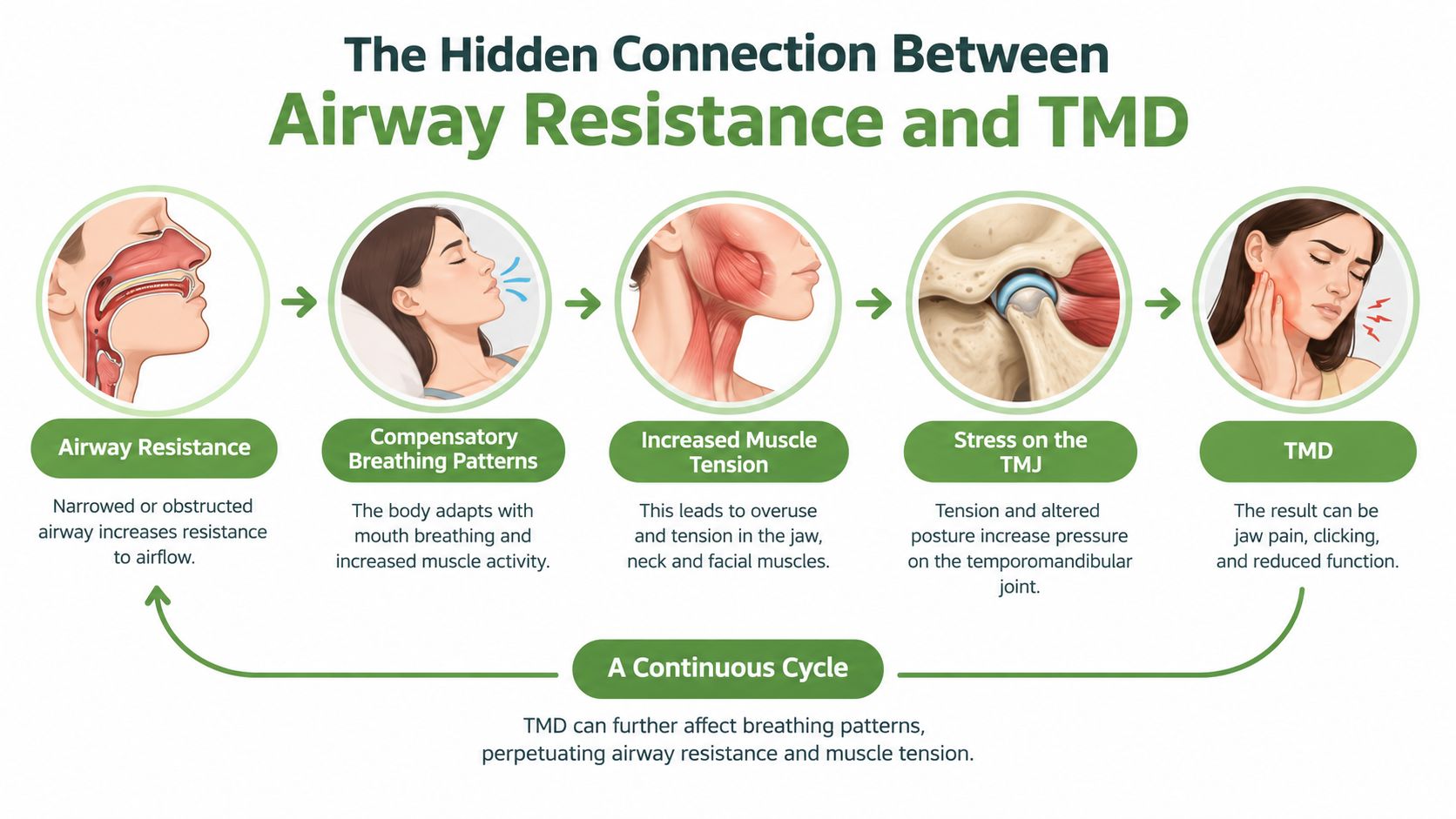
The Hidden Connection Between Airway Resistance and TMD
A night guard may protect teeth, but it cannot correct restricted breathing. In some patients, TMJ pain at night begins with airway resistance, repeated arousals, and a nervous system that becomes increasingly sensitive to normal jaw pressure. The jaw may then stiffen or shift repeatedly as the sleeper works to maintain airflow.
Restricted airflow can alter the position of the head, neck, tongue, and lower jaw. Those adjustments recruit the jaw and neck muscles, while interrupted sleep limits the recovery that normally follows daytime loading. Pain can also become amplified when sleep is fragmented, so the intensity of morning symptoms may reflect both muscle activity and reduced pain tolerance.
This pattern does not establish that every patient with TMD has obstructive sleep apnea, and it does not show that every person with airway resistance grinds. The relationship is more complex. A systematic review found consistently poorer sleep quality among people with TMD, while sleep apnea symptoms were associated with greater odds of TMD. Evidence connecting sleep bruxism with obstructive sleep apnea remains conflicting. The review and patient-focused discussion of TMJ and sleep apnea supports screening without assigning every case to one cause.
Signs that breathing may be involved
Jaw pain deserves a sleep-breathing evaluation when it occurs with snoring, witnessed pauses, gasping, morning headaches, dry mouth, restless sleep, or daytime fatigue. Nasal obstruction and habitual mouth breathing also matter, particularly when the jaw feels tense on waking and gradually loosens during the day.
Sleep and pain can reinforce each other. Pain disrupts sleep, while fragmented sleep can lower pain tolerance and increase muscle reactivity. The same review found that longer sleep was associated with lower TMD-pain risk, and that TMD pain increased the risk of insomnia and obstructive sleep apnea. This bidirectional relationship makes grinding an incomplete explanation.
A dry or dusty bedroom can add nasal irritation, but environmental changes should not substitute for an airway assessment. A supportive mattress and a suitable sleep position may improve comfort. These Willis Furniture & Mattress buying tips offer general guidance for people considering side sleeping or airway-conscious positioning.
Persistent nasal or breathing symptoms may warrant evaluation for upper airway resistance syndrome. A clinician can determine whether airway resistance is contributing to nocturnal jaw loading instead of asking a night guard to compensate for an unexamined breathing pattern.
How Specialists Evaluate Nocturnal Jaw and Sleep Issues
A standard dental examination can identify tooth wear, tenderness, restricted movement, joint sounds, and obvious structural problems. Those findings are valuable, but they don't measure sleep architecture or prove that grinding caused the pain. A specialist evaluation connects the jaw findings with what happens during sleep.
Start with the symptom pattern
The clinician will ask when the pain begins, where it is located, and what changes it. Morning stiffness that fades with movement suggests a different diagnostic pathway from pain that escalates with chewing throughout the day. Ear pressure, headaches, neck pain, mouth breathing, snoring, insomnia, and daytime fatigue can add important context.
The examination should include the jaw joints, masseter and temporalis muscles, cervical muscles, range of motion, bite stability, and oral rest posture. The clinician may also inspect tooth wear, cracks, restorations, and signs of repeated loading. These findings can support a diagnosis, but they shouldn't be treated as a direct recording of nighttime behavior.
Measure activity when the question requires it
Self-reported grinding is useful, but patients often don't know what their jaws do during sleep. The evidence linking sleep bruxism with TMD pain is inconsistent. Instrument-based studies using polysomnography or electromyography often show a weaker, negative, or non-significant relationship than self-report suggests. The 2024 expert summary on sleep bruxism and TMD explains why objective recordings can produce a more reliable clinical picture.
A sleep study may assess breathing events, arousals, oxygen patterns, sleep stages, and related muscle activity. Electromyography can help measure jaw-muscle activity, but the test should answer a specific clinical question rather than be ordered just to confirm a preconceived diagnosis.
Add airway and myofunctional assessment
An orofacial myofunctional evaluation examines tongue posture, swallowing patterns, lip seal, nasal breathing, and the resting position of the jaw. These behaviors can influence muscle tone throughout the day and night. A sleep clinician, dentist, physician, physical therapist, or myofunctional therapist may each contribute different information.
A good evaluation ends with a working explanation and a plan to test it. That plan might involve an appliance, sleep testing, physical therapy, nasal-breathing work, behavioral changes, or referral to a medical specialist. It shouldn't begin and end with “you grind.”
Comparing Nighttime Management and Relief Strategies
There's no single nighttime treatment that fits every patient. A device that protects teeth may be appropriate for one person, while another needs breathing evaluation, positional changes, muscle rehabilitation, or a combination. The central trade-off is simple: symptom protection can be useful, but root-cause care determines whether the nightly trigger changes.
| Intervention | Primary Mechanism | Best For |
|---|---|---|
| Professionally fitted occlusal splint | Separates the teeth and manages contact forces | Patients with tooth wear, painful loading, or a need for dental protection |
| Generic over-the-counter mouthguard | Provides temporary cushioning with limited personalization | Short-term protection when professional care isn't immediately available, not a substitute for diagnosis |
| Sleep-breathing evaluation | Identifies airway restriction, arousals, and sleep-disordered breathing | Patients with snoring, gasping, dry mouth, unrefreshing sleep, or morning headaches |
| Positional changes | Uses body position to support more comfortable breathing and reduce strain | Patients whose symptoms vary with sleeping position |
| Sleep hygiene and arousal reduction | Supports more stable sleep and lower nighttime muscle tension | Patients with irregular sleep, insomnia symptoms, or stress-related activation |
| Physical therapy and myofunctional exercises | Addresses muscle coordination, posture, breathing, and movement | Patients with muscle tenderness, neck involvement, or dysfunctional oral rest patterns |
Match the intervention to the finding
A splint may be worthwhile when the teeth need protection, but it won't treat obstructive breathing. Treating airway symptoms without checking the joint and muscle response can also leave pain unresolved. Similarly, relaxation exercises may reduce daytime tension, yet they won't correct a locked joint or unexplained hearing change.
Avoid repeatedly buying soft guards because each one feels different or wears quickly. If an appliance increases soreness, changes your bite sensation, or causes you to chew against it, stop and ask the prescribing clinician to reassess it. More coverage isn't automatically better.
Sleep position deserves a practical trial rather than a rigid rule. Some people breathe more comfortably on their side, while others develop shoulder and neck strain that transfers tension to the jaw. Adjust pillows gradually and monitor whether you wake with less jaw compression, fewer headaches, and easier nasal breathing.
Air quality may matter if congestion disrupts your sleep. Guidance on indoor air quality that can worsen at night can help you consider dust, dryness, and ventilation as part of a broader sleep routine, though persistent congestion still calls for medical assessment.
The most effective plan is usually the one you can tolerate consistently and that targets a documented contributor. A night guard may be one component, not the entire answer.
Advanced Therapies for Long-Term Joint and Muscle Healing
Persistent pain sometimes continues after basic protection, sleep adjustments, and home exercises. That doesn't automatically mean surgery is necessary. It means the clinician should revisit the diagnosis, identify which tissues remain irritated, and decide whether in-clinic therapy adds value.
Regenerative and light-based options
Specialized centers may offer Prolotherapy, Platelet-Rich Fibrin, or cold laser therapy as part of a conservative plan for selected joint and muscle presentations. Prolotherapy is intended to stimulate a healing response in targeted tissues. PRF uses a patient's own blood-derived material, while cold laser therapy is used to deliver light-based treatment to selected areas.
These therapies shouldn't be presented as universal cures. The appropriate choice depends on the joint examination, imaging, medical history, pain pattern, and the clinician's assessment of whether the target is the joint, ligamentous support, muscle, or a combination. Patients should ask what finding the treatment is intended to address, what alternatives exist, and how progress will be measured.

Rehabilitation keeps the result functional
In-clinic treatment works better when the patient restores the movement and breathing patterns that load the jaw every day. A rehabilitation program may include controlled jaw opening, neck and shoulder exercises, tongue-posture training, nasal-breathing practice, and swallowing coordination.
Buteyko breathing techniques may be included when a clinician identifies dysfunctional breathing, mouth breathing, or poor nasal-breathing habits. The purpose isn't to force the jaw into a position. It's to build a quieter oral rest posture and more efficient breathing pattern that the patient can maintain outside the clinic.
A patient with muscle tenderness may also benefit from guidance on easing muscle knots and managing muscle tension, provided the discussion includes medication interactions, product quality, and the fact that symptom relief doesn't identify the cause. Supplements and topical products should remain adjuncts, not replacements for sleep or joint evaluation.
Long-term improvement is judged by function. Can you open comfortably? Is chewing easier? Do you wake with less stiffness? Has sleep become more restorative? Those questions are more meaningful than just asking whether a treatment felt soothing on the day it was provided.
When to Seek Interdisciplinary Care for Facial Pain
Occasional jaw fatigue after an unusually demanding day may settle with rest. Persistent TMJ pain at night, especially when it repeatedly disrupts sleep or appears with breathing symptoms, deserves a broader evaluation. A general dentist can be an appropriate starting point, but some patterns call for coordinated dental sleep medicine, medical, neurological, physical therapy, or myofunctional care.
Red flags that warrant escalation
Arrange an assessment if you notice:
- Persistent morning headaches: Head pain on waking can accompany jaw-muscle overload or disrupted sleep and shouldn't be explained away without context.
- Unexplained ear pain or pressure: Jaw and ear symptoms can overlap, so persistent symptoms need appropriate dental and medical review.
- Unrefreshing sleep or chronic fatigue: These symptoms raise the importance of screening for sleep fragmentation and breathing disorders.
- Snoring, gasping, or witnessed pauses: These signs justify sleep-breathing assessment rather than relying on a mouthguard alone.
- Jaw locking or restricted opening: A joint that catches, locks, or suddenly becomes difficult to open requires prompt clinical attention.
- Pain that keeps progressing: Increasing pain, swelling, trauma, fever, drainage, or sudden hearing changes require medical or urgent evaluation rather than routine self-care.
Ask prospective clinics how they diagnose the problem. Do they assess sleep and breathing? Can they coordinate with an ENT, sleep physician, neurologist, physical therapist, or myofunctional therapist when needed? Do they explain the trade-offs of appliances, medications, injections, and regenerative procedures instead of offering one intervention to every patient?
You don't need to prove that you grind your teeth before seeking help. A careful clinician can investigate the relationship among sleep quality, airway function, muscle activity, joint mechanics, and pain sensitivity, then build treatment around the findings.
Pain and Sleep Therapy Center evaluates TMJ disorders, facial pain, and sleep-related breathing concerns with technology-driven diagnostics and interdisciplinary care, including dental sleep medicine, myofunctional therapy, breathing programs, and selected regenerative treatments. Visit Pain and Sleep Therapy Center to request an evaluation focused on why your jaw hurts at night and how to restore more comfortable, restorative sleep.