
You've tried medication, physical therapy, imaging, specialist appointments, and careful rest. Yet your jaw still aches, your neck feels guarded, or your headaches return after a short break. Sometimes you're told that the scan looks normal, even though the pain is affecting sleep, concentration, movement, and confidence. Pain neuroscience education offers a way to understand that experience without dismissing it. It explains how the nervous system detects possible danger, how the brain interprets those signals, and why education works best when it supports active rehabilitation rather than replacing it.
When Pain Persists Despite Treatment
Maria had followed the usual path. She tried anti-inflammatory medication, attended physical therapy, and saw more than one specialist about daily facial and neck pain. Her tests didn't show a new injury that explained the intensity of her symptoms. Each appointment ended with a variation of the same message: “Nothing serious is showing up.”
That message didn't reassure her. It made her question herself. If the pain was real, why couldn't anyone find the thing causing it?
A clinician using pain neuroscience education would begin differently. The first step wouldn't be to argue with Maria's pain or suggest that it was imaginary. It would be to explain that pain is a protective experience produced by the nervous system, based on the brain's assessment of threat. Tissue irritation can contribute to pain, but pain intensity isn't always a direct measurement of current tissue damage.
Validation matters: A nervous system explanation should make a patient feel understood, not blamed.
This distinction can change the conversation. A healed strain, a sensitive jaw muscle, poor sleep, fear of movement, stress, or repeated protective bracing may all influence how the brain evaluates danger. The pain remains genuine even when the original tissue problem has improved or when imaging doesn't reveal a clear cause.
Traditional care can fall short when it focuses only on structure. Medication may reduce symptoms without changing movement fear. Manual treatment may help temporarily without building confidence. Rest can protect an injured area early on, but prolonged avoidance may teach the nervous system that ordinary movement is dangerous. A multidisciplinary approach to pain management can address these interacting factors more completely.
PNE doesn't promise that a lecture will erase chronic pain. It gives patients a more useful map. With that map, a therapist can pair reassurance with graded movement, a dentist can explain jaw loading without catastrophizing, and a patient can test safe activity instead of waiting for perfect symptom relief.
Understanding How Your Nervous System Processes Pain
A light touch on the jaw, a familiar movement, or a tense muscle can sometimes produce a surprisingly strong pain response. To understand why, separate the information entering the nervous system from the pain experience the brain creates.
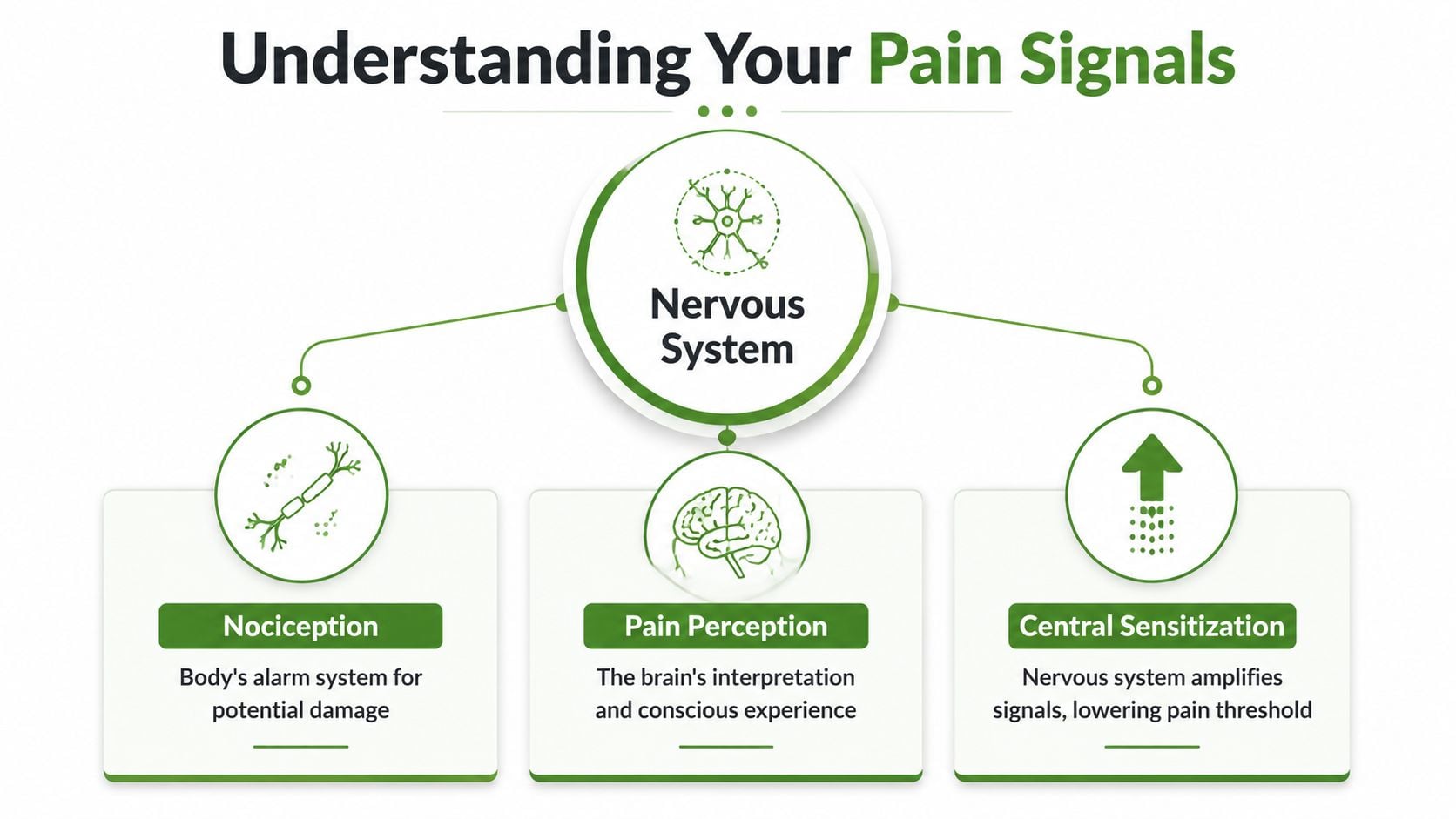
Nociception is the detection of signals that may indicate danger, including pressure, heat, chemical irritation, or mechanical stress. Pain perception is the conscious experience that follows. The brain evaluates incoming information alongside context, memory, attention, emotion, expectations, and current signs of safety.
A car alarm can sound when wind or heavy rain shakes the vehicle. The alarm is real, and it reflects a protective system doing its job. It does not prove that the car has been damaged. Pain can work in a similar way when the nervous system has become more watchful after repeated pain, injury, illness, or sustained stress.
Clinicians often describe this increased responsiveness as central sensitization. It can lower the threshold at which ordinary sensations feel threatening, so touch, movement, or muscle tension may trigger a stronger response than expected. This concept does not identify the sole cause of every persistent pain condition, and it should be applied alongside the person's symptoms, examination, and medical history.
Three layers of the pain experience
- Nociception: Sensors and nerve pathways report potentially threatening information from the body.
- Interpretation: The brain weighs that information against previous experiences, current stress, sleep quality, and perceived safety.
- Output: The brain creates a protective response that may include pain, muscle guarding, altered movement, or heightened attention to the body.
This model does not mean symptoms are imaginary. The brain produces the conscious experience of pain, the same way it produces vision, as an output built from incomplete information. A clinician can make this process easier to understand and connect it with practical care. Patients may also find neurorehabilitation support when pain has affected movement, confidence, or daily function.
Neuroplasticity describes the nervous system's ability to change with repeated experience. That change can increase sensitivity, but it can also support recovery. Safe movement, accurate information, restful sleep, gradual exposure, and meaningful activity can provide new evidence that a previously feared sensation is not necessarily dangerous.
The biopsychosocial model adds context without reducing pain to any single category. Biology includes tissue health, nerve sensitivity, hormones, and other physical factors. Psychology includes fear, attention, beliefs, and coping responses. Social factors include work demands, family support, healthcare experiences, and access to treatment. These influences interact, so education may help one patient participate in rehabilitation while another still needs treatment for jaw loading, sleep disruption, or other contributing factors.
The explanation does not guarantee relief. It can, however, reduce fear and create a clearer basis for deciding what to try next.
What the Research Actually Shows About PNE Effectiveness
The research on pain neuroscience education has grown beyond early pilot work. A 2016 systematic review of randomized controlled trials found support for PNE in chronic musculoskeletal disorders, including benefits related to pain, patient knowledge, disability, movement, and healthcare utilization. A later review identified 12 randomized controlled trials involving 755 participants, along with four qualitative studies involving 50 participants, showing that researchers had begun testing PNE across a broader program of care. A 2023 meta-analysis included 17 studies and 1,078 participants, while a 2024 chronic pain review identified 71 articles, according to the review history summarized in the systematic review record.
Those figures show an expanding evidence base, not a guarantee for every patient. The most useful question is not “Does PNE work?” It's “For which outcomes, in which conditions, and alongside which treatments?”
Where the signal is strongest
A 2023 meta-analysis found that adding PNE to exercise reduced short-term pain by about 1.14 to 1.15 points compared with exercise alone. PNE combined with physiotherapy showed a similar short-term pain reduction, and disability improved with standardized effect sizes of about -0.80 to -0.85. These findings came from 17 studies and 1,078 participants, as reported in the meta-analysis of PNE with active rehabilitation.
Another review of 15 randomized controlled trials found improvements in pain, disability, and psychosocial factors across fibromyalgia, chronic low back pain, chronic fatigue syndrome, and chronic spinal pain. The results were stronger when education was delivered one-to-one and reinforced over time, according to the 2023 PNE review. This pattern supports a practical conclusion: PNE is usually more useful as an adjunct to exercise, physiotherapy, and behavior change than as a standalone intervention.
Where uncertainty remains
Chronic neck pain illustrates the limits clearly. A review of seven randomized trials involving 422 participants found improvements in fear, avoidance beliefs, kinesiophobia, catastrophizing, anxiety, pain knowledge, disability, self-efficacy, and perceived overall improvement in at least some studies. Pain intensity benefits were inconsistent across trials, as summarized in the review of PNE for chronic neck pain.
That distinction matters. A patient may understand pain better and feel less afraid of movement without experiencing immediate, dramatic pain relief. Those changes can still support rehabilitation, but clinicians should measure more than pain intensity. Function, activity tolerance, sleep, confidence, movement quality, and participation may offer a fuller picture.
Evidence-based expectation: PNE can change the meaning of symptoms and support active recovery. It cannot promise that education alone will remove pain.
The biomarker question remains open, too. A 2025 trial found improvements in pain intensity and psychological variables but no change in BDNF, which means popular claims about proving “neuroplasticity” through that biomarker should be treated cautiously. The recent trial report reinforces the need to separate a helpful clinical model from claims that exceed the available evidence.
Practical Scripts and Visual Tools for Patient Education
A patient sitting across from you may be wondering whether the explanation will help their particular condition. They rarely need a long lecture on brain regions. They need answers to three immediate questions: Why does this hurt? Is the pain real? What can I do next? The clinician's language should reduce threat, protect dignity, and lead to an action the patient can safely practise.
Start with validation
Try: “I believe that you're in pain. Your symptoms are real. The fact that your scan doesn't show ongoing damage doesn't mean nothing is happening. It may mean your nervous system is protecting you more intensely than the current situation requires.”
This wording avoids two common errors. It does not suggest that the patient is imagining symptoms, and it does not claim certainty about the mechanism before an assessment.
For central sensitization, describe the nervous system as a security system with a faulty motion sensor: “After repeated danger signals, the system may respond to movement or pressure too readily, even without a new injury. We are not ignoring the signal. We are helping your nervous system distinguish situations that require urgent protection from sensations that can be approached calmly.” The example should support examination and treatment, rather than become a diagnosis by itself.
A cup drawing helps patients understand why symptoms vary from day to day. Label the contents sleep loss, jaw clenching, worry, workload, muscle tension, and painful input. When the cup overflows, pain may increase. The clinical aim is to reduce the combined load while gradually expanding what the patient can tolerate. This model leaves room for uncertainty because it does not force one factor to explain everything.
Turn the explanation into a visual plan
A take-home sketch can show three boxes:
- Body information, such as pressure, movement, or irritation.
- Safety assessment, including context, memory, attention, and expectations.
- Protective response, including pain, guarding, and avoidance.
Ask the patient to add one example to each box. The exercise makes the conversation collaborative and can reveal beliefs that interfere with treatment. Someone who writes “movement equals damage” in the second box has identified a target for graded exposure and reassurance.
Use plain language, then check understanding: “Can you explain this back in your own words?” If a patient prefers pictures, draw the pathway. If conversation works better, use a short analogy. If the patient needs action, connect the explanation immediately to breathing practice, gentle movement, or a functional goal. Mindfulness and relaxation may fit a broader plan, including the strategies described in meditation for chronic pain. Present them as options, not as a test of attitude.
A short educational video can reinforce the discussion after the clinician has established context and answered questions.
Avoid saying, “Your brain is causing the pain,” as if the brain were an opponent. Say instead, “Your brain and nervous system are trying to protect you. We're going to give them repeated experiences of safe, controlled movement.” This keeps the pain real while showing how education can support the specific treatment plan.
Integrating PNE with TMJ and Sleep-Breathing Treatments
Temporomandibular disorders create a particularly important setting for pain neuroscience education. The jaw is used constantly for speaking, eating, swallowing, and facial expression, so patients may become highly attentive to clicking, pressure, muscle tension, or small changes in movement. A threatening interpretation can lead to guarding, reduced jaw use, and more worry, which may increase the protective response.
Orofacial pain also involves a complex sensory system. The trigeminal nerve carries much of the facial and jaw sensation, while the brain integrates signals from muscles, joints, teeth, the neck, and the broader body. That complexity makes a single structural explanation insufficient for many patients. PNE can help a person understand why a painful jaw doesn't automatically mean that every movement is damaging the joint.
A clinician might say: “Your jaw may be sensitive, but sensitivity isn't the same as fragility. We'll identify movements and loads you can perform safely, then build capacity gradually.” That message should accompany an examination, not replace one. Dental pathology, inflammatory disease, trauma, neurological conditions, and other causes still require appropriate evaluation.
Sleep changes the treatment context
Poor sleep can leave the nervous system less able to regulate threat and discomfort. Pain can then make it harder to settle at night, creating a cycle that affects daytime concentration, muscle tension, and tolerance for rehabilitation. Sleep-breathing problems add another clinical concern because snoring, disrupted breathing, and obstructive sleep apnea require proper assessment rather than reassurance alone.
PNE can support treatments such as oral appliances, myofunctional therapy, nasal-breathing work, and airway-focused care by explaining why consistent participation matters. A patient who sees an appliance as one part of a broader plan may be more prepared to report fit problems, follow instructions, and continue exercises. A patient who fears that jaw movement will cause irreversible damage may need graded practice before accepting myofunctional exercises.
Interdisciplinary care should keep the plan coherent. A dental sleep clinician may address appliance therapy and airway concerns. An orofacial myofunctional therapist may work on tongue posture, swallowing, and breathing patterns. A physical therapist may address cervical movement, jaw control, and graded loading. A neurologist or physician may evaluate headaches, nerve symptoms, or medical contributors.
Specific treatment choices must follow an individual assessment. PNE doesn't establish that a particular appliance, injection, laser treatment, or exercise will work for every person. Its role is to help patients understand the plan, reduce fear-based avoidance, and notice meaningful outcomes such as easier chewing, more comfortable speaking, improved sleep routines, or greater confidence with movement.
Sample Protocols for Different Patient Populations
PNE delivery should match the patient's needs, language, attention, and readiness. A person with a new explanation for persistent jaw pain may need a concise orientation. Someone with long-standing pain, disrupted sleep, and strong movement fear may need repeated conversations connected to carefully graded activity.
Initial consultation
A brief first conversation can follow this sequence:
- Ask for the patient's model. “What do you think is causing the pain?” Listen for beliefs about damage, weakness, instability, or danger.
- Validate the experience. Confirm that the symptoms are real and clinically important.
- Offer one central metaphor. Use the alarm system or smoke detector rather than several competing analogies.
- Connect education to one action. Choose a tolerable movement, breathing exercise, sleep habit, or activity goal.
- Check understanding. Ask the patient to explain the model in their own words.
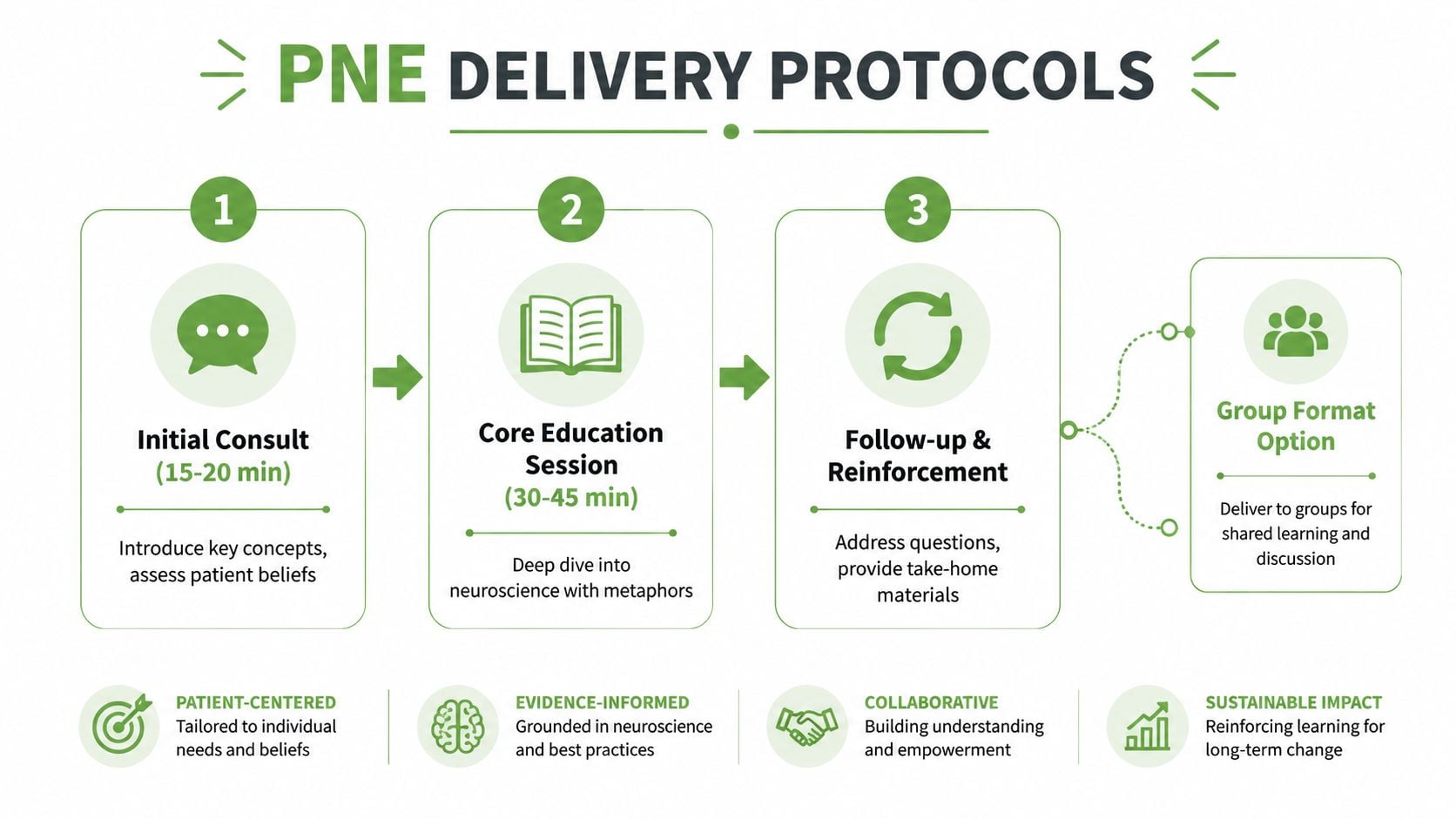
The plan infographic describes an initial consultation as 15 to 20 minutes, a core education session as 30 to 45 minutes, and follow-up with reinforcement. Those durations can be adapted to the setting and the patient's concentration.
A deeper series for complex cases
A broader course of care can revisit the same model without repeating a speech.
- Session one: Establish the patient's goals, explain protection and sensitivity, and identify feared activities.
- Session two: Link education to movement, pacing, breathing, or jaw function. Practice a task in a controlled way.
- Session three: Review the response, adjust the load, and address setbacks without labeling them as failure.
- Session four: Consolidate self-management, warning signs, follow-up needs, and a plan for flare-ups.
Clinicians should document the patient's explanatory model, the concepts discussed, the chosen functional goal, and the response to the intervention. Follow-up can assess pain, disability, confidence, sleep, movement tolerance, and participation rather than relying on one symptom score.
Reinforcement might include a one-page drawing, a short audio explanation, a movement log, or a question for the next appointment. The best format is the one the patient will use. Education becomes clinically meaningful when it changes a decision, such as resuming a valued activity, practicing a feared movement, or seeking timely help for a new symptom.
Common Misconceptions and Realistic Expectations
PNE doesn't mean the pain is psychological. Thoughts and emotions can influence pain processing, but acknowledging that influence doesn't erase biological factors. A patient can have muscle tenderness, joint irritation, nerve sensitivity, poor sleep, and fear of movement at the same time.
PNE isn't a cure delivered through information alone. The evidence is most consistent when education accompanies exercise, physiotherapy, or broader biopsychosocial care. Reviews report improvements in pain, disability, knowledge, and psychosocial factors, but effects vary by condition, protocol, outcome, and patient. A 2023 review found better results when PNE was delivered one-to-one and reinforced over time, as described in the evidence on pain management without medication.
PNE doesn't replace diagnosis or necessary treatment. A new injury, progressive neurological symptom, infection, dental disease, inflammatory condition, or significant sleep-breathing problem may require medical, dental, or specialist care. Education should improve informed participation, not encourage patients to ignore warning signs.
Patients who feel frightened by movement, blame themselves for persistent symptoms, avoid important activities, or have difficulty understanding why symptoms fluctuate may benefit from PNE integrated into care. Patients may need a different priority first when they have untreated medical problems, severe distress, unsafe medication use, or an urgent diagnostic concern. A broader overview of alternative pain therapies at Atlanta Hyperbaric Center can provide additional context, but every option still needs individual clinical evaluation.
The most honest expectation is practical: PNE may help you understand your symptoms, reduce threat-based fear, and participate more effectively in rehabilitation. Whether it changes your pain, function, sleep, or confidence depends on your condition and the rest of your treatment plan.
Pain and Sleep Therapy Center evaluates TMJ disorders, facial pain, headaches, and sleep-related breathing concerns through individualized, interdisciplinary care. If persistent pain or poor sleep is limiting your recovery, visit Pain and Sleep Therapy Center to learn how education can be combined with movement-based, airway-focused, and sleep treatments suited to your needs.