You wake with a dull ache pressing into one temple. By afternoon, chewing, talking, or concentrating has made it worse. Perhaps you've treated it as a migraine, taken pain medication, or blamed stress, yet the same pain keeps returning. That pattern can be exhausting, especially when nobody has tested whether your jaw is provoking the headache.
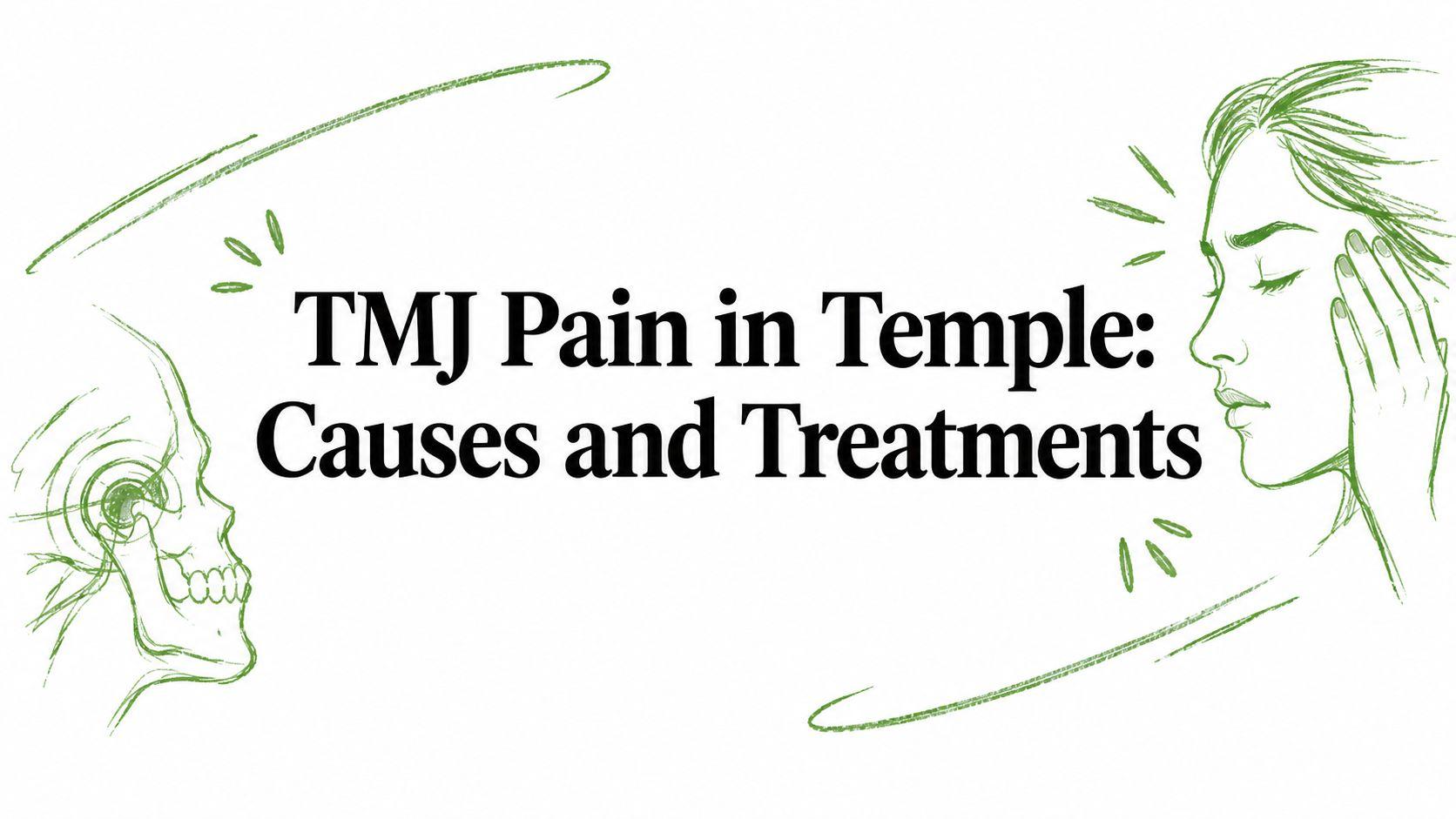
TMJ pain in the temple often comes from the temporalis muscle or other jaw structures, not from the temple itself. The important question isn't just where you hurt. It's whether jaw movement, clenching, chewing, or muscle pressure reproduces the pain you recognize.
Why Your Temple Pain May Originate in Your Jaw
A patient may report waking with pressure in one temple, gaining brief relief from medication, then feeling the pain return during lunch. If chewing or holding the teeth together reproduces that familiar symptom, I examine jaw function before labeling the problem a primary headache disorder.
The temporomandibular joint, commonly called the TMJ, connects the lower jaw with the skull. The surrounding muscles coordinate chewing, speaking, swallowing, and jaw stability. Sustained activity from clenching, grinding, or prolonged concentration can refer pain into the temple, forehead, ear region, or behind the eye.
Temple pain may therefore feel severe even when the joint itself is only mildly tender. Sensory signals from the jaw, face, and head converge within the trigeminal system, allowing irritation in the temporalis muscle to be experienced as a headache. That referral pattern makes temple pain a specific diagnostic problem, not just a symptom to suppress.
The overlooked jaw connection
TMDs are a common source of pain in the temple region. A 2023 evidence review published by the American Academy of Family Physicians reported that temporomandibular disorders affect between 5% and 12% of the population. Its summary of a retrospective study involving 4,528 patients reported headache in 79% and pain at the temporomandibular joint in 54%.
These figures do not establish the jaw as the cause of every temple headache. They support asking about clenching, clicking, facial fatigue, restricted opening, and changes in pain during chewing.
Practical rule: If jaw activity reliably changes your familiar temple pain, request a targeted jaw and muscle examination.
Location alone cannot establish “temple pain caused by TMJ.” A stronger finding is reproducible symptom change with jaw use or pressure on the relevant muscles. That distinction helps avoid treating every temple ache as migraine and prevents jaw sounds from being mistaken for proof of serious joint disease. Root-cause assessment should guide treatment, rather than relying only on temporary symptom relief.
The Anatomy of TMJ Pain in Temple Regions
The temporalis muscle is a broad, fan-shaped muscle covering much of the side of the skull. Its lower fibers converge toward the jaw and help lift and stabilize the mandible, particularly when you close your mouth or hold the jaw against resistance.
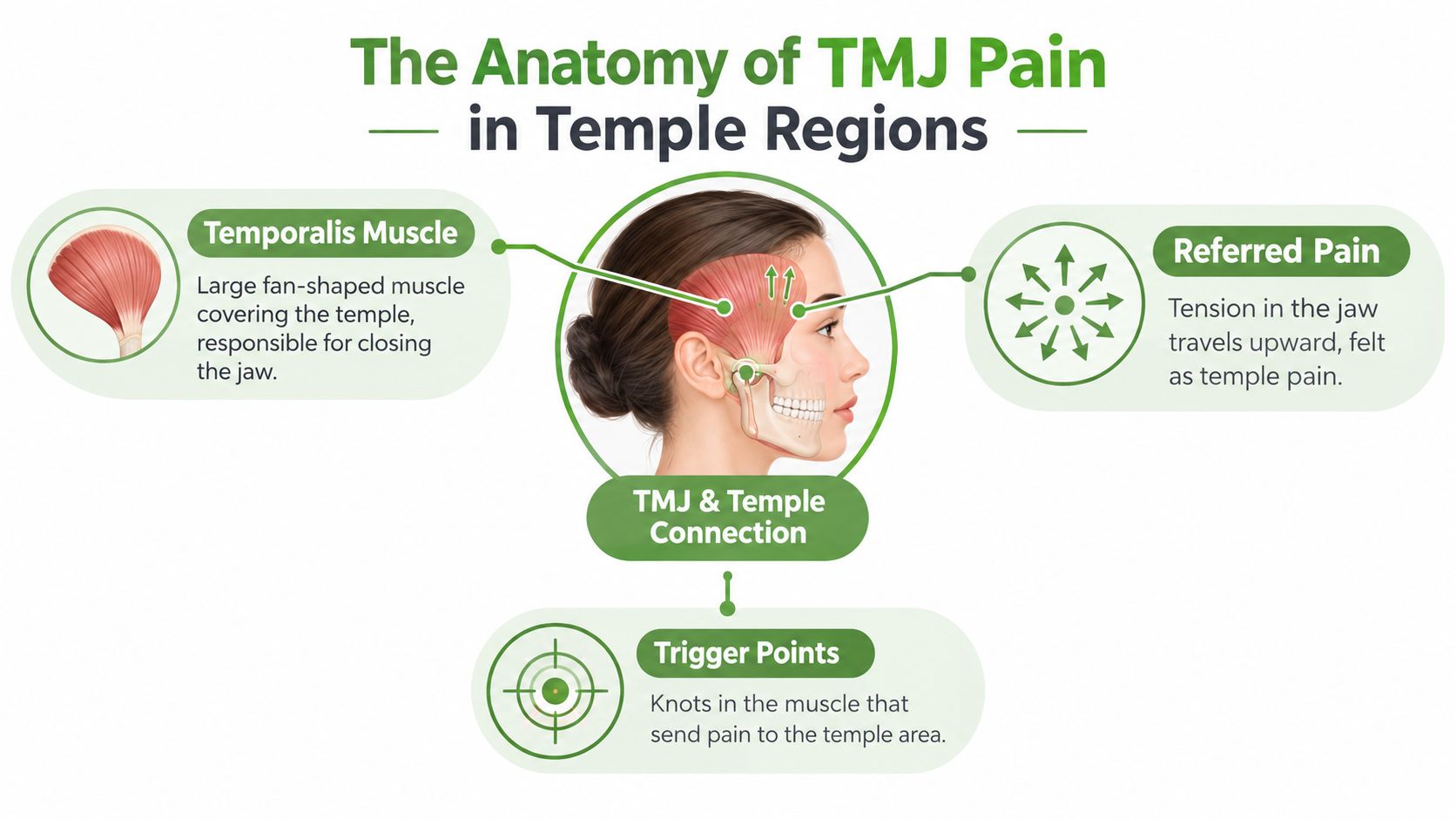
Everyday jaw use normally activates this muscle briefly and intermittently. Clenching, grinding, prolonged concentration, gum chewing, or keeping the teeth together at rest can extend that workload. The muscle may then become tender, fatigued, and capable of referring pain into the temporal region.
How referral creates a headache-like symptom
Myofascial pain doesn't always stay at the point of muscle irritation. Sensory information from the temporalis, jaw joint, teeth, ear region, and nearby facial structures enters related pathways in the trigeminal system. Because those signals converge, the brain can locate the pain away from the original tissue.
This is why pressing a tender part of the temporalis may reproduce a patient's familiar headache rather than causing only local tenderness. Clinical guidance from the AAFP on temporomandibular disorders describes TMD pain as potentially occurring in the preauricular, masseter, or temple region, often in association with jaw movement.
The joint itself can also contribute. Irritation, altered movement, disc-related mechanics, or instability may cause the surrounding muscles to increase their activity. The temporalis then acts as a stabilizer, often without the patient consciously noticing the effort.
The movement test that matters
A clinician doesn't diagnose the source from an anatomical diagram alone. During an examination, the jaw may be opened, closed, moved side to side, or gently resisted. The temporalis and other chewing muscles are palpated to determine whether pressure reproduces the patient's familiar temple pain.
The key feature is modification by jaw activity. If chewing, clenching, opening wide, or sustained talking predictably worsens the symptom, a myogenous TMD pattern becomes more plausible. If the temple hurts independently of jaw function, the clinician must keep primary headache and other medical causes in the differential diagnosis.
Differentiating TMD Headaches from Migraines
Temple pain can resemble several headache disorders. The most useful distinction is not whether the pain feels dull, sharp, or throbbing. It's whether the symptom is linked to jaw function and whether an examination can reproduce it.
The Diagnostic Criteria for Temporomandibular Disorders formalized headache in the temporal region as a relevant pain-related TMD symptom. Under this approach, a headache attributed to TMD is supported when the temporal pain changes with jaw activity and familiar pain can be reproduced through jaw movement or temporalis palpation.
| Feature | TMD Temple Pain | Migraine / Tension Headache |
|---|---|---|
| Main trigger | Chewing, clenching, talking, yawning, or sustained jaw use may alter the pain | Migraine symptoms may occur independently of jaw movement; tension-type pain may relate more to general muscle tension |
| Associated findings | Jaw soreness, muscle tenderness, clicking, stiffness, or pain near the ear can occur | Migraine may include nausea or light sensitivity; tension-type headache may feel like steady pressure |
| Examination | Temporalis or jaw palpation may reproduce the familiar symptom | Head and neck examination may not reproduce the pain through jaw provocation |
| Timing | Morning pain can suggest overnight jaw loading, though timing alone doesn't diagnose TMD | Migraine and tension patterns can occur at different times and follow their own triggers |
| Treatment clue | Jaw rest and targeted rehabilitation may help when the jaw is the driver | Headache-specific care remains important when jaw testing is negative |
Ask the right provocation questions
Track what happens during a normal day. Does the temple pain increase after a chewy meal? Do you notice your teeth touching while driving or working? Does a wide yawn produce the same ache? Does gentle pressure over the temporalis recreate the symptom?
These questions don't replace a clinical diagnosis. They help separate pain attributed to TMD from pain that merely happens to be located near the jaw.
If your symptoms behave more like a migraine, you can review general comfort measures in these practical tips for migraine relief. If jaw tension remains part of the pattern, headaches from jaw tension offers a more focused explanation of that connection.
A person can also have both conditions. Jaw treatment shouldn't replace neurological assessment when symptoms include a consistent migraine pattern, and migraine care shouldn't end the investigation when chewing clearly provokes the pain.
Diagnostic Approach and Red Flags to Watch
A patient may arrive with temple pain that feels like a headache, yet chewing, clenching, or pressing the temporalis reproduces it. Diagnosis should begin with that pattern, not with an appliance prescription. The clinician should establish where the pain starts, how it travels, what changes it, when it appears, and whether the patient notices daytime clenching or nighttime grinding.
What a focused examination includes
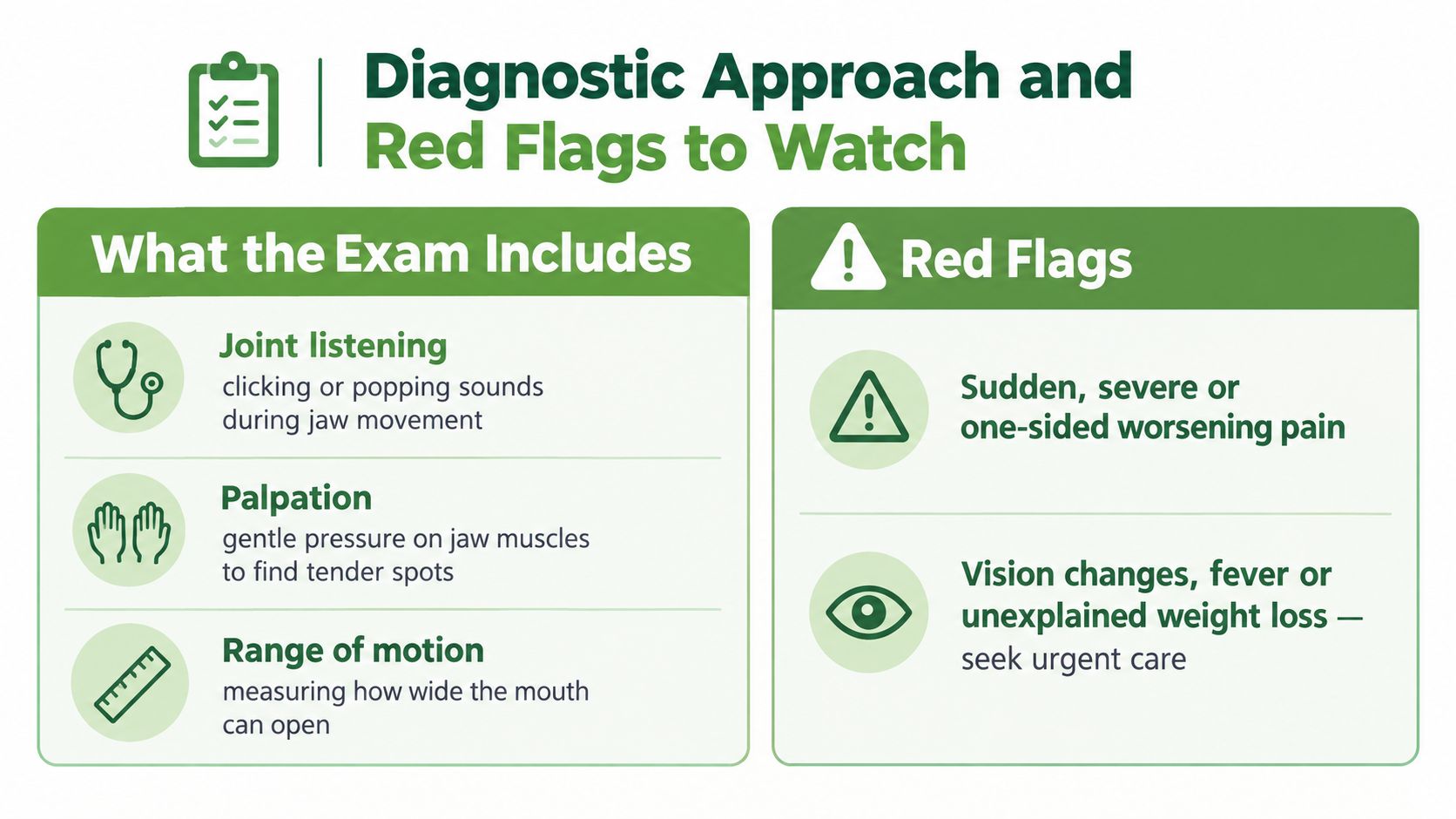
TMD includes disorders affecting the jaw joint and chewing muscles, so an assessment must examine both structures and the neurological referral pattern from the temporalis. A specialist commonly combines these observations:
- Pain history: The clinician records the exact temple location, quality, duration, and relationship to chewing, clenching, posture, or jaw movement.
- Muscle palpation: Pressure over the temporalis and other chewing muscles tests for tenderness and reproduction of the patient's familiar pain.
- Jaw movement: Opening, closing, protrusion, and side-to-side movement show whether function changes the symptom.
- Joint sounds and mechanics: Clicking, popping, deviation, locking, or restricted movement may indicate joint involvement. A sound alone does not identify the pain source.
- Neck and neurological screening: The examination looks for cervical contributors and findings that point away from a jaw diagnosis.
Panoramic imaging, magnetic resonance imaging, or cone-beam computed tomography may be considered when the history and examination suggest structural joint disease, disc behavior, degeneration, trauma, or another reason to view the anatomy. Imaging should support clinical testing, not replace it. A visible joint finding may be unrelated to the tissue producing today's temple pain.
Symptoms that need urgent medical attention
Seek urgent evaluation for sudden severe pain, new neurological deficits, fainting, confusion, sudden vision changes, fever with significant illness, or rapidly worsening one-sided symptoms. New temple pain with scalp tenderness, visual symptoms, or systemic illness needs prompt medical assessment rather than a routine TMJ appointment.
Temple location is a clue, not a diagnosis. Safety comes before jaw treatment.
A careful clinician will say when the pattern does not fit TMD. Primary care, emergency medicine, neurology, ophthalmology, or another specialty may need to assess the patient before dental or physical therapy treatment begins. This protects against masking a neurological, vascular, infectious, or eye-related problem while treating the jaw as the presumed source.
Conservative Therapies for Lasting Relief
Once the examination supports a jaw-related source, treatment usually begins by reducing overload and restoring coordinated function. The aim isn't to silence the temple temporarily while the same clenching, breathing, or movement pattern continues. It's to give the joint and temporalis a workable environment for recovery.

Start by lowering mechanical demand
A short period of relative jaw rest can help. That means choosing easier-to-chew foods, avoiding gum, limiting extreme mouth opening, and practicing a relaxed rest position with the lips together and the teeth apart. Warmth may reduce muscle guarding, while gentle movement helps prevent a cycle of fear and stiffness.
Medication can reduce soreness for some people, but it has limits. It doesn't teach the jaw to move efficiently, identify nighttime loading, or correct a breathing and oral-posture problem. Medication should be used according to a qualified clinician's advice, especially when symptoms are persistent or other health conditions are present.
A custom oral appliance may be appropriate when bruxism, muscle overactivity, or joint loading contributes to the pain. The design and adjustment matter. A poorly selected appliance can feel uncomfortable, interfere with movement, or fail to address the actual driver, so an appliance should follow an examination rather than replace one.
Retrain the system, don't chase the symptom
Orofacial myofunctional therapy can address tongue posture, swallowing coordination, lip function, and habitual jaw position. These factors influence how the muscles share work throughout the day. Exercises should be individualized, because forcing range of motion or repeatedly stretching an irritable joint can aggravate symptoms.
Nasal breathing and airway-focused work may also matter when a patient mouth-breathes, snores, or shows signs of sleep-disordered breathing. Buteyko-based breathing instruction is one approach some clinicians use to develop quieter nasal breathing and more controlled respiratory habits. It isn't a substitute for medical evaluation of suspected obstructive sleep apnea.
For practical information about nighttime grinding, this guide by DentalHealth.com can help you recognize common habits, but persistent morning temple pain still warrants professional assessment. Targeted myofascial release techniques may complement therapy when muscle tenderness is part of the diagnosis.
A rehabilitation plan should include clear boundaries. The patient needs to know which exercises are appropriate, which movements to avoid temporarily, and how progress will be judged, such as easier chewing, less morning tightness, or reduced reproduction of temple pain during examination.
A guided session may look like this:
The trade-off is time and participation. Conservative care is less dramatic than an injection or surgery, but it can address the behavior and mechanics that keep reloading the temporalis. Passive symptom relief may feel faster, while active retraining offers a better path when the pain is maintained by repeated function.
Advanced Regenerative and Non-Surgical Options
Some patients continue to hurt after appropriate jaw rest, appliance management, physical therapy, and habit retraining. Before considering surgery, a clinician may investigate whether persistent inflammation, ligament-related instability, joint tissue irritation, or focal myofascial pain is limiting progress.
Match the procedure to the tissue
Platelet-rich fibrin, or PRF, is prepared from the patient's own blood and contains a fibrin matrix with concentrated biologic components. Clinicians may use it in selected joint or soft-tissue cases to support a healing response. It isn't a universal treatment for temple pain, and it won't correct clenching, poor jaw mechanics, or an untreated airway problem by itself.
Prolotherapy uses an injected irritant solution to stimulate a local repair response in selected tissues. The intended rationale is to improve support around a painful or unstable joint, potentially reducing the compensatory workload placed on the chewing muscles. Patient selection matters, and the procedure should follow a diagnosis that identifies tissue instability or another plausible target.
Cold laser therapy, also called low-level light therapy, is used by some practices as an adjunct for localized pain and inflammation. Its value depends on the treatment target, dosing approach, and the rest of the rehabilitation plan. A laser cannot determine whether the temple pain is coming from the temporalis, the joint, a primary headache disorder, or a medical condition outside the jaw.
Questions to ask before an injection
Ask what structure the clinician is treating, what examination finding supports that choice, how the procedure fits with exercise or appliance therapy, and what alternatives remain. You should also understand possible discomfort, expected recovery, and circumstances that would prompt reassessment.
For patients comparing blood-derived treatments, this explanation of PRF versus PRP injections provides useful terminology. The central principle remains simple: a regenerative procedure should support a root-cause plan, not serve as a replacement for one.
These options can be reasonable when a well-defined tissue problem persists. They're less convincing when the diagnosis is based only on temple location or when the patient hasn't received a functional jaw examination.
When to Seek Specialized Interdisciplinary Care
A general dental checkup may identify tooth wear, a sore jaw, or a clicking joint, but complex temple pain often needs a broader assessment. The clinician must distinguish temporalis myalgia from headache attributed to TMD, assess joint mechanics, review sleep and breathing, and recognize neurological or medical symptoms that require another referral.
Signs that a broader team may help
Seek specialized care when temple pain is persistent, repeatedly returns after temporary treatment, or occurs with morning jaw fatigue, snoring, witnessed breathing pauses, facial muscle tenderness, or poor-quality sleep. An airway problem can encourage nighttime mouth opening or clenching, but the relationship must be evaluated rather than assumed.
An interdisciplinary team may include an orofacial pain clinician, dental sleep medicine provider, physical therapist, orofacial myofunctional therapist, breathing specialist, and neurologist when the headache pattern calls for it. Each professional answers a different question. The joint exam identifies mechanical contributors, sleep evaluation examines breathing and nighttime physiology, and neurological assessment protects against mislabeling a primary headache disorder as TMD.
How to evaluate a specialist
Ask whether the consultation includes temporalis palpation, jaw movement testing, a review of headache features, and a discussion of alternatives. Ask what the clinician will do if the examination doesn't reproduce your familiar temple pain. Be cautious of any plan that recommends permanent bite changes, repeated procedures, or long-term symptom suppression without explaining the diagnosis and conservative options.
Pain and Sleep Therapy Center in Charlotte provides evaluation and non-surgical care for TMJ disorders, facial pain, and sleep-related breathing concerns, with services that include orofacial myofunctional therapy, Buteyko breathing, dental sleep medicine, PRF, prolotherapy, and cold laser therapy. It's one example of an interdisciplinary model that connects jaw function, muscle rehabilitation, and airway assessment.
The best treatment isn't the most aggressive treatment. It's the one that matches the tissue and behavior responsible for your pain, while keeping other causes in view. If chewing reproduces your temple ache, request a focused TMD examination instead of accepting another cycle of temporary headache treatment.
Pain and Sleep Therapy Center evaluates TMJ-related temple pain, jaw mechanics, muscle function, and sleep-related contributors, then builds non-surgical care around the findings. Visit Pain and Sleep Therapy Center to explore a focused evaluation and discuss a plan for lasting relief rather than repeated symptom masking.