
Two vials can look almost identical on a counter. To a patient, they often feel like a forced choice between two things that sound technical, expensive, and heavily marketed. In real consults, the question is usually much simpler: which one fits the problem I want to fix?
That matters in TMJ care because people rarely arrive with just one concern. Someone may have jaw pain, clicking, limited opening, and the tired under-eye look that comes from poor sleep and chronic facial tension. When they ask about PRF vs PRP injections, they usually aren't asking for a lecture on centrifuges. They want a straight answer about what each option is likely to do in their joint, soft tissue, or skin.
Sitting in the Chair With Two Vials
A common consult goes like this. A patient has read that PRP means platelet-rich plasma and PRF means platelet-rich fibrin. She has also read that PRF is “newer,” which online often gets translated into “better.”
That's where the confusion starts.
In practice, the better question is not which acronym wins. The better question is which treatment matches the main goal. If the goal is joint pain and mouth opening, I think about the joint environment first. If the goal is under-eye texture or crepey tissue, I think differently. If the patient cares most about avoiding additives, that matters too.
What patients usually hear online
Patients often come in with one of these assumptions:
- “PRF is just the upgraded version.” Sometimes that's too simplistic.
- “PRP is older, so it must be outdated.” Older doesn't mean ineffective.
- “They both do the same thing.” They overlap, but they don't behave the same way in tissue.
- “If one works for skin, it must work the same way for TMJ.” Different tissues respond differently.
The history helps put the hype in perspective. PRP entered medical use decades before PRF. The term PRP was first used in 1954, and it began appearing in maxillofacial surgery about a decade later. PRF was later developed by Choukroun in 2000 as a second-generation platelet concentrate, notable for not requiring anticoagulants during preparation, according to this review of platelet concentrates in oral and maxillofacial surgery.
Clinical reality: Neither option wins every case. The right choice depends on the symptom, the tissue being treated, and how the product is prepared.
Four issues decide most consults. First, what each product is biologically. Second, what comparative studies show. Third, how well it matches the patient's specific goal. Fourth, the practical side, including time, sessions, and cost.
How PRP and PRF Are Actually Made
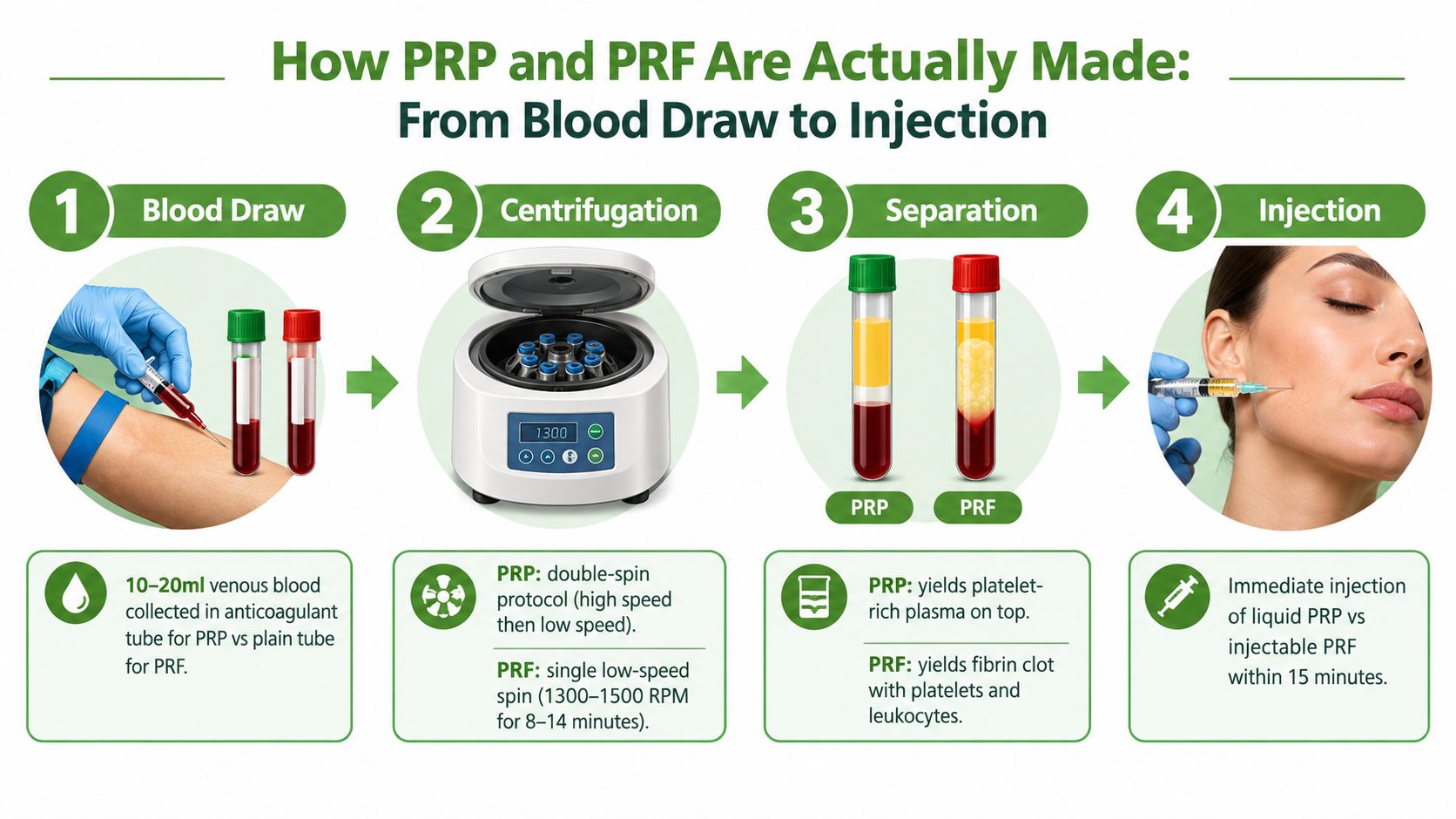
Both treatments start the same way. We draw your blood and process it so the useful fractions can be returned to the area we're treating. What changes is how the blood is handled in the tube.
How PRP is prepared
With PRP, the blood is collected in a tube that includes an anticoagulant. That additive keeps the sample from clotting too early. The tube is then spun so the blood separates into layers, and the platelet-rich plasma portion is drawn off for injection.
What patients usually notice is that PRP stays more fluid. It can be loaded into a syringe as a liquid and used promptly once it's prepared.
How PRF is prepared
With PRF, the blood is processed without anticoagulants. The spin is gentler, and the result includes a fibrin-rich component that begins forming a scaffold rather than remaining only a free-flowing plasma fraction.
That changes the feel of the product and the workflow in the room. PRF requires tighter timing because once the blood is drawn, the natural clotting process is part of the point. For patients comparing natural autologous options, that distinction often matters more than the acronym itself.
A related comparison for facial volume questions appears in this discussion of PRF vs fillers.
Here's a visual walkthrough for patients who like seeing the workflow before they commit to treatment:
What this means in the chair
From the patient's side, both involve a blood draw and a same-visit injection. The difference is mostly in the handling.
- PRP feels more because the final product is a liquid plasma concentrate.
- PRF feels more time-sensitive because the sample is prepared without anticoagulant and used in a narrower window.
- Both are autologous. They come from your own blood, not a synthetic filler or donor product.
What Changes in the Vial Translates to in the Tissue
The tube matters because the product's structure changes what happens after injection. In the orofacial and TMJ setting, that's the part that counts.
Biological Differences Between PRP and PRF
| Feature | PRP | PRF |
|---|---|---|
| Clot control | Prepared with an anticoagulant to keep the sample fluid | Prepared without anticoagulant, allowing natural fibrin formation |
| Physical form | More liquid suspension | Fibrin-rich scaffold or matrix |
| Tissue behavior | Spreads more like an injectable fluid | Tends to stay more locally organized within a fibrin mesh |
| Signal pattern | More immediate biologic pulse | More gradual local release pattern |
| Cell profile | Often designed around platelet concentration, with variation by protocol | Commonly includes fibrin and leukocyte-rich components, depending on protocol |
Anticoagulant versus no anticoagulant
This is not just a lab detail. If a product is prepared with an anticoagulant, it remains more fluid at the time of injection. That can be useful when the goal is to place a liquid concentrate into a joint or soft tissue target with minimal resistance.
PRF behaves differently because the lack of anticoagulant allows the formation of a fibrin architecture. That gives the material more of a scaffold-like character once placed.
Liquid suspension versus fibrin scaffold
A liquid product and a fibrin-based product don't interact with tissue in the same way. In broad terms, PRP behaves more like a biologic signal delivered in plasma. PRF behaves more like a signal delivered within a matrix.
That distinction often matters more in soft tissue remodeling than patients expect. For delicate facial tissue, the scaffold effect can be part of the appeal. For an intra-articular TMJ injection, some clinicians prefer the predictability of a more fluid product, while others like the local retention characteristics of PRF variants.
A useful way to think about it is this. PRP acts more like a pulse. PRF acts more like a slow local drip.
Release kinetics and leukocytes
Comparative discussions of platelet concentrates often focus on how quickly biologic signals are released. PRF is generally discussed as having a slower, more sustained local release pattern because of the fibrin matrix, while PRP is usually described as a quicker release product.
Leukocyte content also varies. Some PRP protocols aim for purer plasma with fewer white blood cells. PRF preparations often retain more leukocyte content along with fibrin. Whether that helps depends on the tissue and the treatment goal.
The practical takeaway is simple. Fibrin architecture affects how long the signal stays local. Release kinetics affect whether tissue gets a quick pulse or a slower feed.
Side by Side on the Criteria That Matter at the Consult
Most patients don't need a molecular biology lecture. They need a comparison they can use when deciding what to do next.
PRF vs PRP at a Glance
| Criterion | PRP | PRF |
|---|---|---|
| Chairside workflow | Usually simpler to inject once prepared | More timing-sensitive because natural clotting is part of the process |
| Product structure | Liquid plasma concentrate | Fibrin-rich matrix |
| Tissue feel | Better suited to situations where a fluid injectate is preferred | Better suited to situations where a scaffold effect may help |
| Additives | Uses an anticoagulant during preparation | No anticoagulant during preparation |
| Early biologic behavior | Faster, more immediate signaling pattern | More gradual signaling pattern |
| White blood cell profile | Protocol-dependent, often lower in pure forms | Often includes more leukocyte content |
| Facial soft tissue use | Often chosen for broader rejuvenation protocols | Often chosen for under-eye and texture-focused work |
| Joint use | Commonly used where fluid placement in the joint is desired | Can also be used, with outcome depending on indication and technique |
What patients tend to feel from those differences
A shorter, simpler workflow can matter for needle-averse patients. If someone is already anxious about the blood draw and joint injection, a more efficient process may make the day easier.
PRF often appeals to patients who want the most “natural” preparation possible because there's no anticoagulant in the tube. That preference is legitimate. It just shouldn't be confused with guaranteed superiority.
The consult version
In plain language, this is how I frame it:
- If you want a fluid injectate for a joint target, PRP often fits that conversation naturally.
- If you care most about scaffold-like behavior in soft tissue, PRF often becomes more attractive.
- If your main concern is under-eye skin quality, crepiness, or texture, PRF often gets more attention.
- If your main concern is broad protocol familiarity and a longer clinical track record, PRP usually has the advantage.
What the Comparative Evidence Actually Shows
A patient with TMJ pain is asking about chewing, opening, and whether the relief will last. Another is focused on under-eye crepiness and pigment. Those are different problems, so the evidence has to be read by endpoint, not by acronym.
A 2025 systematic review across medical uses reported that 72% of included studies favored injectable PRF over PRP, while 24% found no meaningful difference, according to this systematic review of i-PRF and PRP. That sounds strong for PRF at first glance. In practice, it still does not justify treating PRF as the default winner for every tissue, diagnosis, and injection plan.
In TMJ and joint-related use
The joint literature is encouraging, but it is still narrow and protocol-sensitive. One preliminary intra-articular study found better pain reduction, improved mouth opening, better lateral and protrusive movement, and more favorable disc-position findings with i-PRF over a 9-month follow-up, as summarized in this comparative review of PRF and PRP studies.
That matters if the patient's main goal is function.
It matters less if the actual complaint is under-eye pigment or fine surface texture, where the target tissue and the success metric are completely different. This is why I am careful with patients who come in asking which product is “better.” Better for what is the question.
In facial aging and under-eye concerns
Facial studies are mixed in a way that is clinically useful. Outcomes tend to be more convincing for tissue quality measures such as thickness and elasticity than for every visible cosmetic concern at once. Wrinkles, pigment irregularity, crepey texture, and skin laxity do not move together, and they should not be treated as if they do.
A split-face facial rejuvenation trial, also summarized in the comparative review above, found only slight and short-lived PRF advantages in some wrinkle measures, with no meaningful difference in side effects, pain, or satisfaction. That is a good reminder that a small edge on one scale does not always translate into a clearly better patient experience at the mirror.
Evidence filter: Ask which outcome improved. Pain, opening, pigment, elasticity, texture, and wrinkles are different endpoints, and patients usually care about one or two of them more than the rest.
The honest read is straightforward. Results depend on the indication, the preparation method, the injection technique, and the quality of the tissue being treated. In clinic, those variables often matter as much as whether the label on the vial says PRP or PRF.
Which Therapy Fits Which Patient Goal
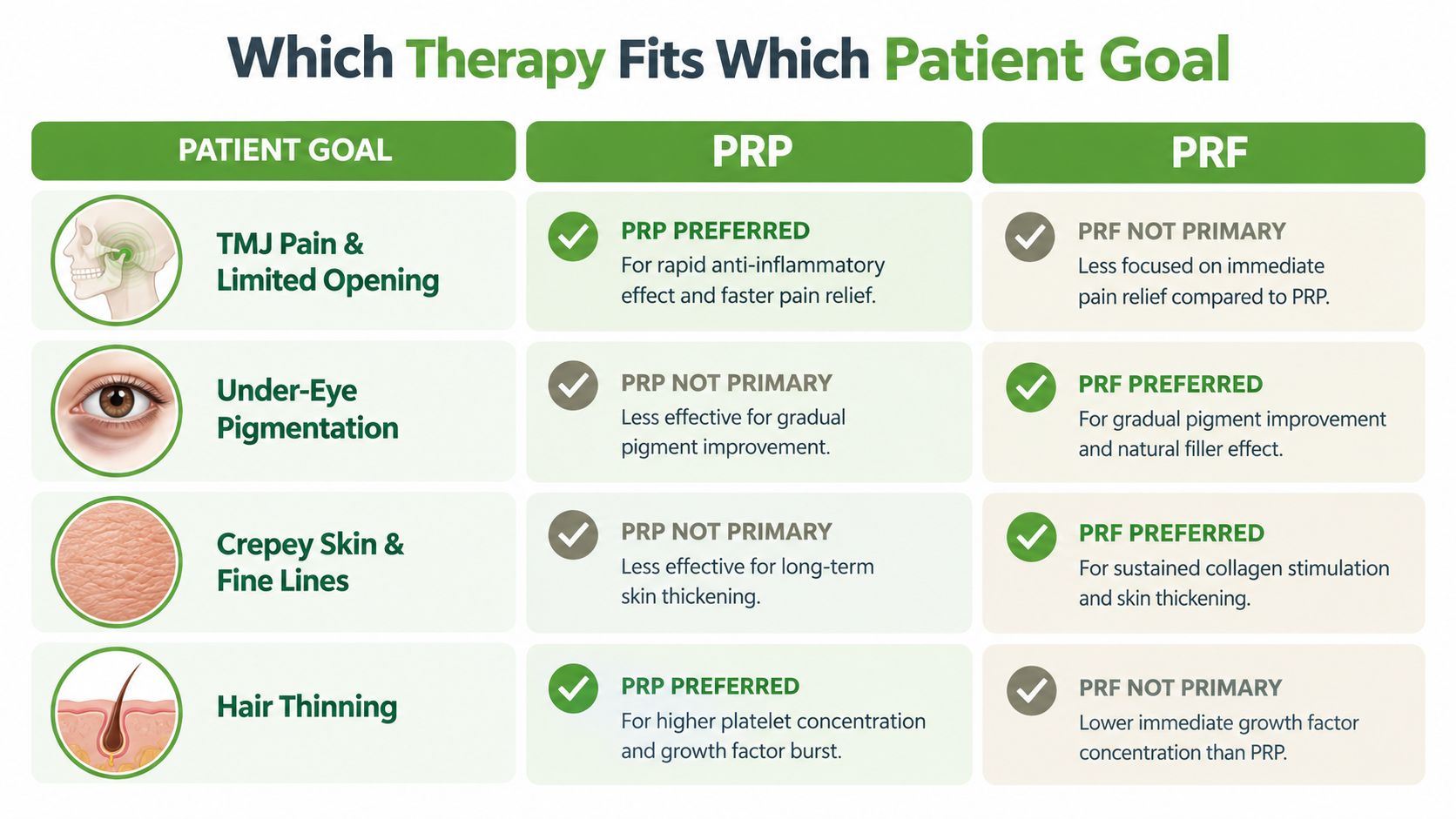
Most patients aren't trying to choose the “best” injectable. They're trying to choose the one that fits the symptom that bothers them most. The decision usually becomes clearer in this context.
If the main goal is TMJ pain and function
When someone's top complaint is joint pain, chewing fatigue, or limited opening, I tend to think first about what will work best inside the joint environment and how precisely the product can be delivered there. PRP often fits that discussion well because of its fluid behavior and its long clinical history as a platelet concentrate.
That doesn't mean PRF is excluded. It means the treatment choice should follow the dominant symptom, not the trendiest acronym.
If the main goal is under-eye change
For under-eye concerns, the comparison gets more nuanced. A 2025 systematic review found that PRF tended to outperform PRP for texture, fine lines, and crepiness, while PRP appeared stronger for hyperpigmentation, and the review concluded that superiority depends on the indication rather than a universal winner. A June 2026 randomized split-face trial then reported that both PRP and PRF improved periorbital hyperpigmentation, fine wrinkles, and mild hollowness with comparable overall efficacy, safety, and satisfaction, according to this review and trial summary on PRF versus PRP for facial indications.
That's exactly the nuance most patient pages miss.
A practical matching guide
- TMJ pain and limited opening: Lean toward the product and protocol best suited to joint delivery and the clinician's specific TMJ experience.
- Crepey under-eye skin or texture concerns: PRF often makes sense because scaffold behavior can be clinically relevant.
- Pigment-first complaints: Don't assume PRF automatically wins. Comparative evidence is more mixed.
- Scar support or procedures where tissue scaffolding matters: PRF often becomes more appealing.
- Patients who want no anticoagulant in the preparation: PRF has a clear procedural advantage there.
For broader regenerative joint care options, some patients also review regenerative medicine for joint pain.
A Simple Decision Framework for Choosing Between Them
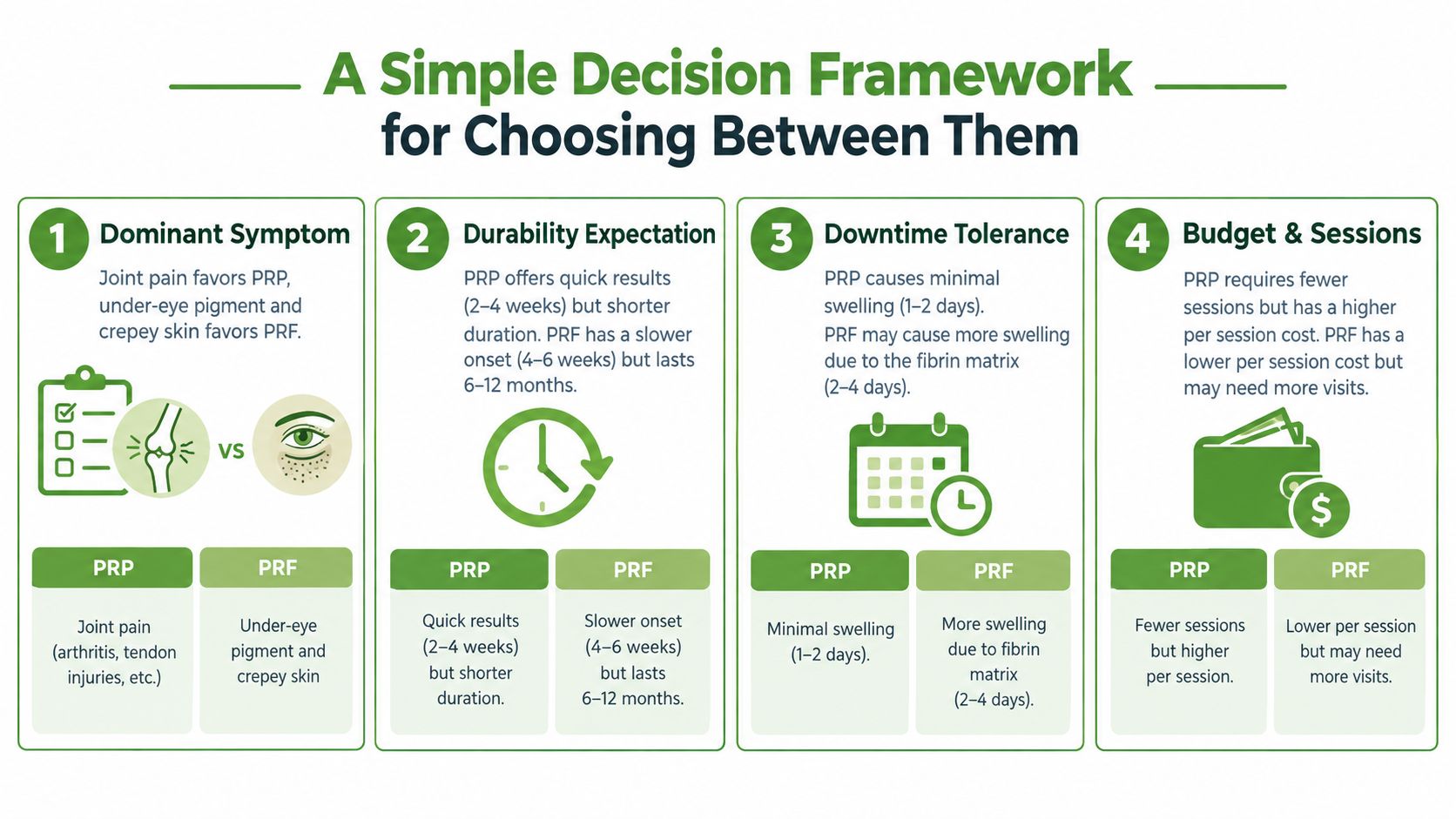
A good consult needs a framework, not a slogan. I use four practical axes.
Start with the dominant symptom
If the problem is mostly joint pain, clicking, or restricted opening, the conversation should center on TMJ diagnosis, joint targeting, and whether the intended product suits intra-articular use. If the problem is mostly crepey skin, fine lines, or tissue quality, the framework shifts toward scaffold behavior and remodeling.
If the problem is pigment, don't let anyone answer too quickly. Pigment behaves differently from texture.
Weigh speed versus tissue support
Some patients care most about a treatment that feels straightforward and familiar in joint practice. Others are willing to accept a more specific preparation workflow because they want the biologic profile of PRF.
This is also where I discuss expectations. Neither treatment works well when the patient expects one injection to solve every source of pain, airway strain, clenching pattern, and soft tissue change at once.
Consider commitment and context
A regenerative injection should fit into the broader care plan. In a TMJ case, the injection may be only one part of treatment alongside bite evaluation, airway factors, sleep issues, parafunction control, and home exercises.
If a clinic can't explain where the injection fits in the whole TMJ plan, that's a bigger concern than whether they prefer PRP or PRF.
A useful overview of these categories appears in orthobiologic therapy.
A practical rule of thumb
- For intra-articular TMJ cases: choose based on diagnosis, delivery plan, and clinician experience with that exact joint indication.
- For under-eye and skin-quality cases: choose based on whether the main target is texture, crepiness, pigment, or hollowness.
- For patients focused on avoiding additives: PRF usually aligns better with that preference.
- For patients who want less theory and more predictability: ask which protocol the clinician performs most consistently for your indication.
Cost, Sessions, and the Questions Worth Asking
The least helpful part of many PRF vs PRP injections pages is cost advice that sounds exact but isn't grounded in the clinic evaluating you. Pricing varies widely by region, indication, kit, whether imaging guidance is used, and whether the procedure is facial, scalp, or joint-based.
So instead of pretending there is one standard price, I think patients should ask better questions.
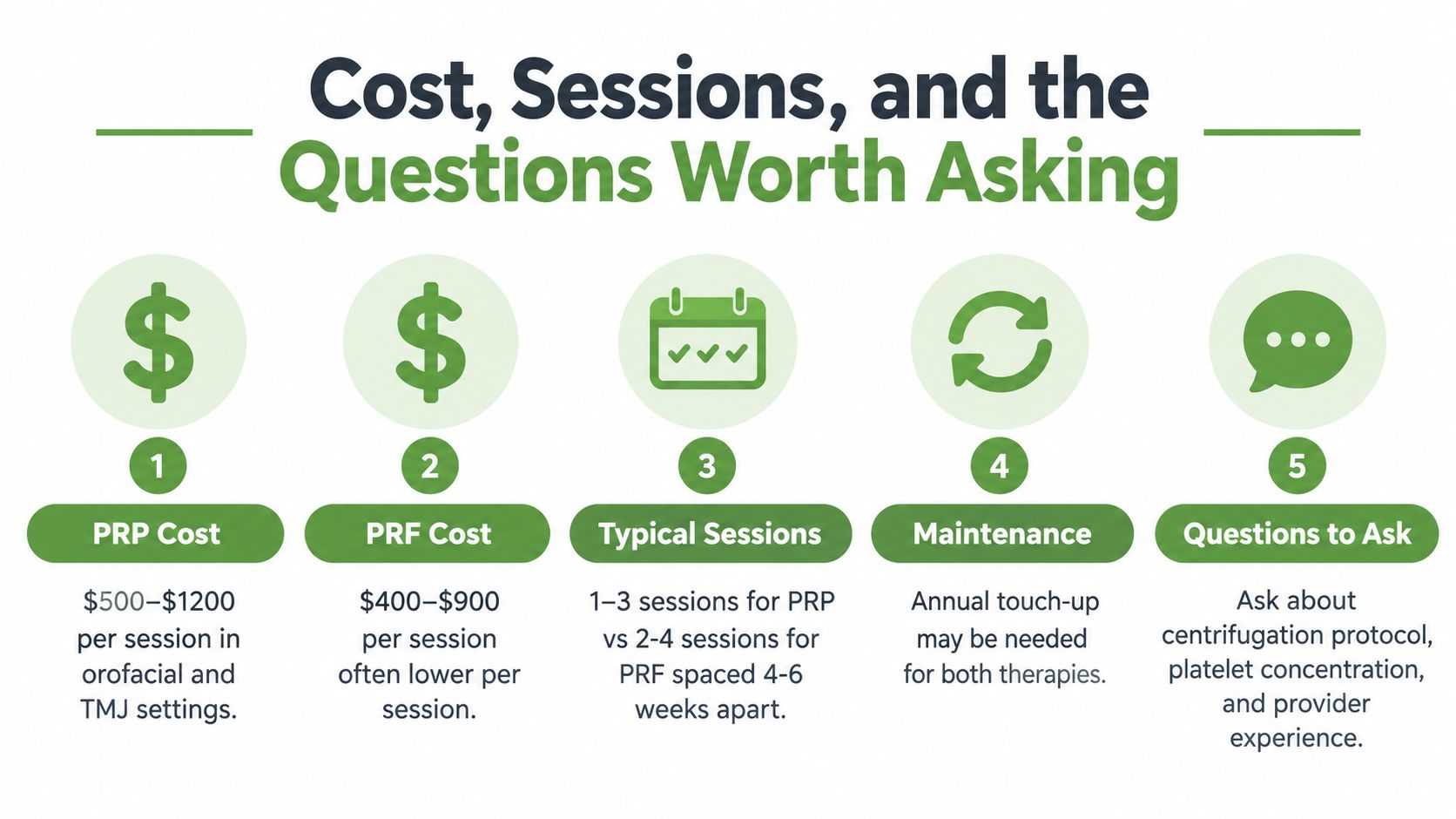
What to ask before you book
- Ask how they prepare it. The anticoagulant protocol, tube system, and centrifuge method affect what you're receiving.
- Ask who performs the injection. A beautifully prepared vial won't make up for poor targeting in the TMJ or poor plane selection in the face.
- Ask what condition they treat most often. Experience with cosmetic PRF does not automatically translate into TMJ injection skill.
- Ask whether the treatment is stand-alone or part of a plan. In orofacial pain, injections usually work best when they fit a larger diagnostic picture.
- Ask how outcomes are tracked. Pain level, jaw opening, chewing tolerance, clicking, skin texture, and pigment should be followed in a structured way.
Questions that reveal real experience
I'd ask the clinician these directly:
- Do you use PRP, PRF, or both for TMJ, and why for my specific diagnosis?
- How do you decide between joint injection and soft tissue treatment?
- What outcome are you expecting to improve first in my case?
- If this helps only partly, what is the next step?
- What other factors could be keeping my jaw pain active, even if the injection goes well?
A clinic that uses these therapies thoughtfully should be able to answer without sales language. Pain and Sleep Therapy Center, for example, offers PRF within a broader TMJ and facial pain evaluation model rather than presenting regenerative treatment as a one-size-fits-all procedure.
The best consult leaves you with a reasoned recommendation, not just a branded vial name. That's the standard to look for.
If you're sorting through PRF vs PRP injections because of TMJ pain, facial tension, or related tissue concerns, Pain and Sleep Therapy Center evaluates those treatments in the context of the whole problem, including joint function, bite factors, and sleep-related contributors. If you want a clearer recommendation based on your specific symptoms rather than generic marketing, visit Pain and Sleep Therapy Center.