
You wake with a headache above one eye, a dull ache in your cheek, and tenderness around several upper teeth. By lunchtime, chewing feels uncomfortable. You may wonder whether you need a dentist, antibiotics, an ENT appointment, or treatment for migraine. The difficulty is that headache and upper jaw pain can come from several overlapping systems, and the location of pain doesn't always identify its source.
Pain may begin in the forehead, temple, cheek, upper teeth, or behind the eye, then spread to another area. A jaw joint, tooth, sinus, facial nerve, or primary headache disorder can produce a similar pattern. The safest approach isn't to pick the most familiar label. It's to study how the pain behaves, what triggers it, and which accompanying symptoms change the urgency.
When Headache and Upper Jaw Pain Happen Together
A patient might first visit a dentist because one upper molar feels sore. If the tooth looks healthy, the patient may then receive treatment for presumed sinus pressure after reporting facial fullness. When the pain returns with light sensitivity and nausea, a migraine diagnosis may follow. None of those evaluations necessarily means someone made a careless mistake. The symptoms can naturally overlap.
A useful way to describe this cluster is pain that appears simultaneously or sequentially across the forehead, temple, upper cheek, upper teeth, or area behind the eye, sometimes with tenderness when biting, clenching, yawning, or opening wide. One person may feel pressure in the upper jaw before a headache begins. Another may develop a headache first and notice jaw soreness after hours of clenching.
The practical question isn't only “Where does it hurt?” Ask, “What makes the familiar pain appear or worsen?”
The pattern matters because upper-jaw discomfort paired with head or facial pain isn't always a standalone dental problem. The temporomandibular joints and chewing muscles can refer pain toward the temple and face. Sinus inflammation can create pressure near the upper teeth. A dental infection can irritate nearby tissues. Migraine can sometimes be felt mainly in the face and may resemble tooth or sinus disease.
Population data also show that jaw and facial pain is common rather than unusual. The National Institute of Dental and Craniofacial Research overview of TMD and jaw pain reports that TMD affects about 5% of adults in the United States, while survey estimates vary according to how symptoms are defined and measured.
Why a single label can mislead
A clicking jaw doesn't prove that the joint causes every headache. A normal dental X-ray doesn't prove that the pain is migraine. Nasal congestion doesn't automatically mean a bacterial sinus infection.
The diagnostic task is triage. You need to identify whether jaw movement reproduces the pain, whether one tooth is the clear center of symptoms, whether a headache pattern includes nausea or sensory sensitivity, and whether urgent signs such as swelling, fever, neurological changes, or sudden severe pain are present. The shared nerve pathways between the face and head explain why these clues can be more useful than location alone.
The Shared Wiring Behind Face, Jaw, and Head Pain
The trigeminal nerve, also called cranial nerve V, carries much of the sensation from the face, teeth, jaw, and portions of the head. Think of it as a three-branch cable rather than a single wire.
- Ophthalmic branch, V1: forehead, eye region, and nasal bridge.
- Maxillary branch, V2: cheek, upper jaw, upper teeth, and part of the sinus region.
- Mandibular branch, V3: lower jaw, chewing muscles, lower teeth, and nearby joint structures.
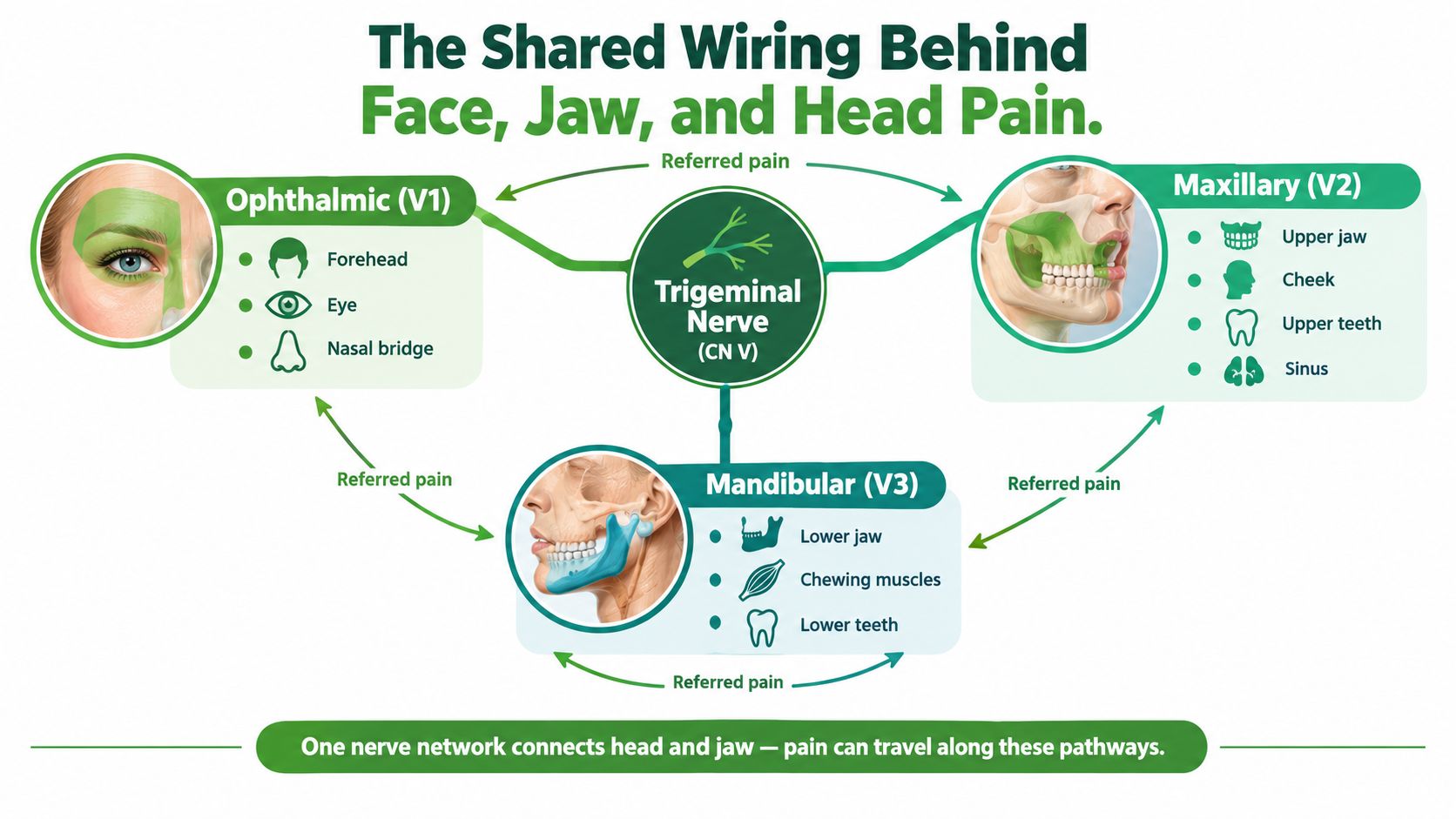
When one branch carries a strong pain signal, the brain can have difficulty identifying the exact starting point. This is called referred pain. Irritation around an upper tooth or maxillary sinus may be perceived near the eye or temple. Conversely, a primary headache disorder may be felt in the upper teeth even when the teeth themselves are healthy.
The explanation involves convergence in the brainstem, including the trigeminocervical region. Sensory information from the face, meninges, and upper neck arrives in closely connected processing areas. Those signals can influence one another, so the brain may interpret pain as coming from a nearby but uninvolved structure.
That doesn't mean the pain is imaginary, and it doesn't necessarily mean the nerve has been damaged. A referred signal is different from a cut, compressed, or permanently injured nerve. The sensation is real, but its perceived location can be misleading.
Where clenching fits
Clenching adds another layer. Repeated loading can make the chewing muscles tender and can increase stress around the jaw joints. If you suspect grinding or clenching, a patient-friendly explanation of bruxism relief from Amanda Family Dental may help you understand common contributors and questions to raise with a clinician.
The same wiring also explains why a facial pain evaluation may involve more than a dental inspection. A clinician may need to compare jaw mechanics, tooth findings, nasal symptoms, cranial nerve function, and the behavior of the headache. A video demonstration of trigeminal anatomy can provide another visual introduction:
What Causes Headache and Upper Jaw Pain to Overlap
Several conditions can create a similar map of pain while behaving differently. The most useful clues usually involve movement, timing, associated symptoms, and whether examination reproduces the familiar discomfort.
Temporomandibular disorders
TMD affects the jaw joints, chewing muscles, and related structures. Pain may increase with chewing, clenching, yawning, prolonged talking, or opening wide. Morning jaw stiffness, tender temples or cheek muscles, reduced opening, or a jaw that deviates during opening can support a jaw-related contribution.
A 2022 systematic review and meta-analysis found that headache occurred in 61.58% of people with TMD, while TMD occurred in 59.42% of people with headaches, according to the published review and meta-analysis. These figures show a substantial association, but they don't prove that TMD caused every headache. The formal diagnosis of headache attributed to TMD requires a painful temporomandibular process plus features such as a temporal relationship, worsening with jaw movement, or reproduction during examination.
Sinus disease
Sinus-related pain often accompanies nasal blockage, drainage, reduced nasal airflow, or facial fullness. Pressure may become more noticeable when bending forward or during changes in congestion. Several upper teeth may feel uncomfortable at the same time because the upper jaw and maxillary sinus sit close together.
Sinus symptoms can still mislead. A facial migraine may resemble sinus pressure, and a tooth problem can contribute to one-sided nasal or facial symptoms. Repeated treatment for presumed sinus disease without lasting improvement should prompt a broader assessment.
Dental infection or a cracked tooth
A dental source becomes more plausible when one tooth is clearly the epicenter. Pain with biting, strong hot or cold sensitivity, gum tenderness, swelling, a bad taste, or pain that persists after the stimulus ends deserves dental evaluation.
An infected tooth can cause nearby facial pain and may trigger protective jaw tension. A cracked tooth may hurt unpredictably, especially when releasing a bite. A panoramic image alone may not identify every crack or early inflammatory change, so the history and focused dental examination matter.
Migraine
Migraine can produce throbbing or pressure-like pain in the temple, cheek, upper jaw, or teeth. Light sensitivity, sound sensitivity, nausea, worsening with ordinary activity, or recurring attacks with a recognizable pattern make a primary headache disorder more likely.
A 2024 review of orofacial migraine describes migraine pain that can localize to the maxillary sinus, jaw, ear, or teeth and resemble dental or sinus disease. That possibility matters when dental findings are minor or absent but the headache repeatedly includes sensory symptoms.
Neuralgia and cluster headache
Trigeminal neuralgia typically causes brief, electric-shock-like or knife-like bursts along one facial nerve branch. Light touch, tooth brushing, chewing, or a breeze may trigger an attack. The pain is usually sharply different from the sustained pressure of sinus disease or the aching of an overworked jaw muscle.
Cluster headache produces severe one-sided pain around or behind one eye, often with tearing, nasal congestion, eyelid changes, or marked restlessness. Because these attacks can be confused with dental or sinus pain, recurring severe one-sided attacks deserve medical assessment.
Less common referred sources
Pain in the jaw can rarely be referred from the heart, particularly when it appears with exertion or chest, shoulder, breathlessness, sweating, or nausea. That pattern is an emergency rather than a dental problem. If the pain feels new, severe, exertional, or medically unusual, don't use a home checklist to rule out a dangerous cause.
| Cause | Hallmark feature | Most reliable clue |
|---|---|---|
| TMD | Jaw, temple, or chewing-muscle pain | Familiar pain reproduced by jaw movement or palpation |
| Sinus disease | Facial pressure with nasal symptoms | Congestion and pressure occurring together |
| Dental infection or crack | Localized tooth-centered pain | One tooth reacts predictably to biting or temperature |
| Migraine | Recurrent head or facial attacks | Light or sound sensitivity, nausea, or a consistent attack pattern |
| Trigeminal neuralgia | Sudden electric facial jolts | Brief attacks triggered by touch or chewing |
| Cluster headache | Extreme one-sided pain near one eye | Tearing, nasal symptoms, and repeated severe attacks |
For readers considering a jaw-focused assessment, jaw pain treatment in Katy from The Dental Retreat offers an example of the type of dental and TMD service patients may ask about. The right destination still depends on the symptoms and examination findings.
Matching Your Symptoms to the Most Likely Cause
Pattern recognition doesn't replace diagnosis, but it can help you describe the problem accurately. Start with four observations: where the pain starts, how long it lasts, what triggers it, and what happens alongside it.
| Cause | Pain character | Key triggers | Tip-off feature |
|---|---|---|---|
| TMD | Dull ache, pressure, or muscle soreness near the jaw and temple | Chewing, yawning, clenching, long conversations, or wide opening | Limited or deviated opening, joint tenderness, or familiar pain with palpation |
| Sinus disease | Pressure or fullness across the cheek and upper teeth | Bending forward, congestion, coughing, or nasal pressure | Blocked nose, drainage, and discomfort across more than one upper tooth |
| Dental infection or crack | Persistent, localized ache or sharp bite pain | Biting, hot or cold drinks, or pressure on one tooth | One tooth is clearly the center, with gum tenderness or swelling |
| Migraine | Throbbing, pulsing, or intense pressure | Activity, bright light, sound, missed sleep, or other personal triggers | Nausea, light sensitivity, sound sensitivity, or recurring attacks |
| Cluster headache | Very severe pain around one eye | Attacks that recur in a recognizable pattern | Tearing, nasal congestion, eyelid changes, or agitation on the same side |
| Trigeminal neuralgia | Sudden electric, stabbing, or shock-like bursts | Touching the face, brushing teeth, speaking, or chewing | Short triggered jolts along a specific nerve distribution |
A person whose pain worsens every time they chew hard food, clench during concentration, or open for a long dental visit should record those mechanical triggers. Clicking alone isn't enough to establish causation, but clicking combined with restricted motion and reproduced pain is more informative.
Someone with a recent cold, blocked nose, facial pressure, and several aching upper teeth may need an assessment of the nasal and sinus pattern. A single tooth that reacts sharply to temperature or biting points more toward a dental examination, especially if the gum is swollen.
Migraine deserves consideration when facial pain arrives in recurring attacks with nausea or sensitivity to light and sound. The absence of obvious tooth disease doesn't prove migraine, but it should prevent repeated dental treatment without a clear dental target.
A brief, shock-like pain has a different meaning from an ache that lasts through the day. Severe pain around one eye with tearing or nasal symptoms also belongs on a medical pathway rather than being treated as routine jaw tension.
Don't let one symptom decide the diagnosis. Let the combination of triggers, timing, examination findings, and associated symptoms guide the next appointment.
A jaw-tension headache resource from TMJ Sleep can help you organize questions about clenching, muscle tension, and headache patterns before speaking with a clinician. Bring a short diary rather than relying on memory. Record the side, location, onset, triggers, nasal or dental symptoms, sensory sensitivities, and what relieved or worsened the pain.
Red Flags and When to Seek Specialized Evaluation
The right response depends on urgency. Mild, familiar symptoms may allow time for a scheduled appointment, while swelling, fever, sudden neurological changes, or a rapidly escalating headache can require immediate care.
Seek emergency evaluation now
Go to emergency care for a sudden, severe headache that reaches maximum intensity abruptly, especially if it is unlike anything you've experienced before. The same applies to headache with weakness, slurred speech, confusion, loss of vision, new neurological symptoms, neck stiffness, or high fever.
Eye symptoms also change the triage pathway. Severe pain around the eye with vision change, a painful eye movement, or sudden visual disturbance shouldn't be managed as ordinary sinus or jaw pain.
Chest pressure, breathlessness, sweating, faintness, or exertion-related jaw pain also warrants emergency assessment. A dental explanation shouldn't be assumed when symptoms could involve the heart or nervous system.
Arrange same-day dental care
Contact a dentist promptly for severe localized tooth pain with facial swelling, fever, spreading tenderness, or difficulty opening the mouth. A tooth that feels unusually high when biting, marked gum swelling, or a persistent bad taste can indicate a problem that needs direct examination.
Don't wait for home care to resolve swelling around the upper jaw. Dental infections can extend into surrounding tissues, and a clinician needs to determine whether drainage, dental treatment, medication, or another intervention is appropriate.
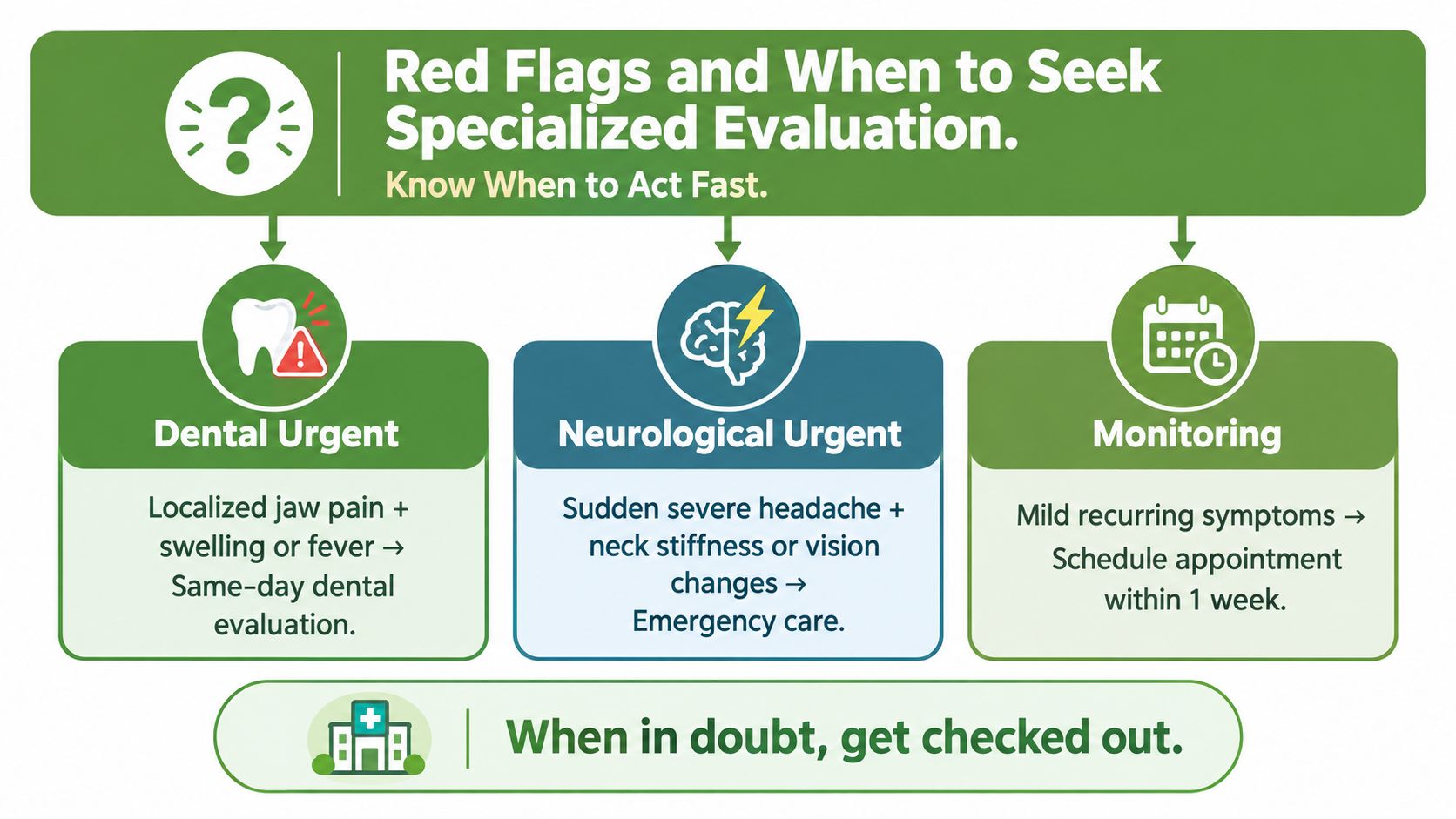
Choose the right specialist pathway
An ENT evaluation may make sense when one nostril remains blocked, drainage smells foul, or one-sided facial pressure continues rather than resolving with an ordinary respiratory illness. A primary-care clinician can help coordinate the assessment when the source isn't clear.
Neurology becomes important for recurrent one-sided throbbing attacks, severe episodes around one eye, brief electric facial shocks, neurological symptoms, or headaches that are new, changing, or difficult to classify. A dentist or orofacial-pain clinician is a sensible starting point when jaw use consistently reproduces the familiar pain.
Persistent or function-limiting symptoms deserve evaluation even without an emergency warning sign. A facial pain specialist pathway from TMJ Sleep may be relevant when dental, jaw, and headache features continue to overlap after an initial examination.
Safe Self-Management Before Your Appointment
Self-care can reduce discomfort while you arrange an assessment, but it shouldn't be used to repeatedly postpone evaluation. The safest measures depend on a stable pattern without red flags.
For short-term pain, some adults use an over-the-counter anti-inflammatory such as ibuprofen or naproxen with food, if those medicines are safe for them. They can irritate the stomach, affect the kidneys, interact with other medicines, and create risks during certain medical conditions. Acetaminophen may be an alternative for some people, but medication labels and personal medical advice matter.
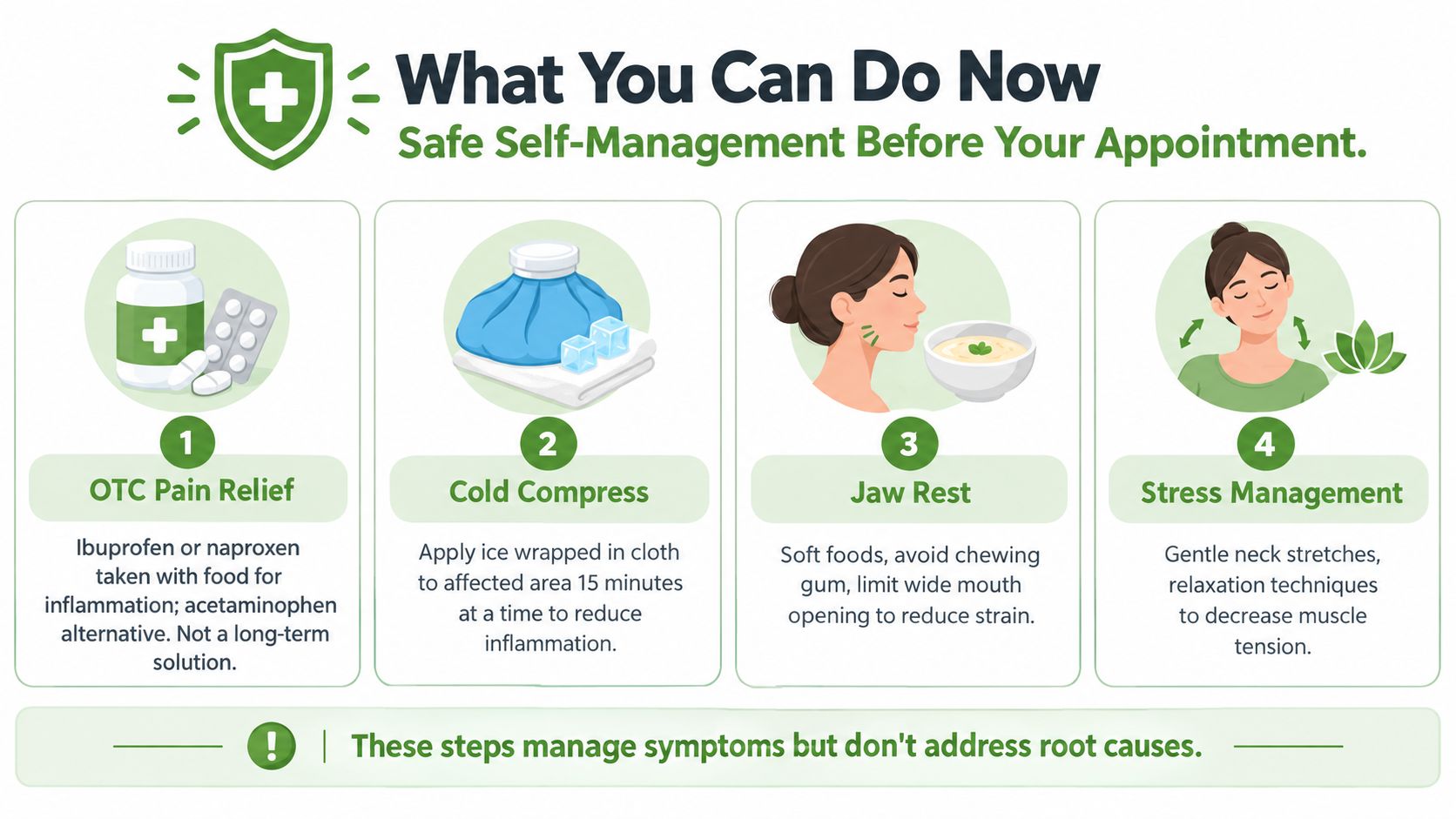
Moist heat may relax tight chewing muscles. A wrapped cold pack can provide short-term comfort for acute facial soreness. Neither measure identifies whether the source is a tooth, sinus, joint, muscle, or headache disorder.
If jaw use aggravates the pain, choose softer foods temporarily and avoid gum, hard crusts, chewy meat, and very wide yawning. Keep your teeth slightly apart when you're not eating, and notice whether you clench while driving, working, or sleeping.
Nasal saline irrigation and warm steam may soothe congestion and pressure when nasal symptoms are present. Use safe water practices for irrigation, and remember that symptom relief doesn't establish the cause or clear an infection.
Sleep, hydration, regular meals, and a simple trigger diary can help reveal patterns linked with migraine or muscle tension. Write down the time symptoms begin, the side affected, foods or activities involved, nasal changes, tooth sensitivity, nausea, light sensitivity, and any medication taken.
New, worsening, unexplained, or recurring symptoms need professional assessment rather than repeated home treatment. Self-management should buy time safely, not replace a diagnosis.
What a Root-Cause Evaluation Actually Looks Like
A thorough evaluation begins with a conversation that maps the pain rather than merely naming it. The clinician may ask when it began, whether it starts in the jaw or head, what chewing does, whether attacks recur, and whether nausea, light sensitivity, nasal symptoms, tooth sensitivity, or neurological changes occur.
The examination then tests the structures implicated by the history. It may include the teeth and gums, jaw opening and side-to-side movement, joint loading, chewing-muscle palpation, bite behavior, cranial nerve function, and the neck. The key question is whether the examination reproduces the same pain you experience, not merely whether a joint clicks or an image looks unusual.
Testing should answer a specific question
Imaging is most useful when it resolves uncertainty or investigates suspected structural disease. Depending on the findings, a clinician may consider a panoramic dental radiograph, cone-beam CT, or MRI. Imaging should complement the history and examination rather than substitute for them.
A dentist may identify a cracked tooth or infection. An ENT clinician may assess persistent nasal or sinus disease. A neurologist may classify a primary headache, neuralgia, or another neurological condition. An orofacial-pain specialist may integrate jaw mechanics, muscle pain, dental findings, and headache behavior.
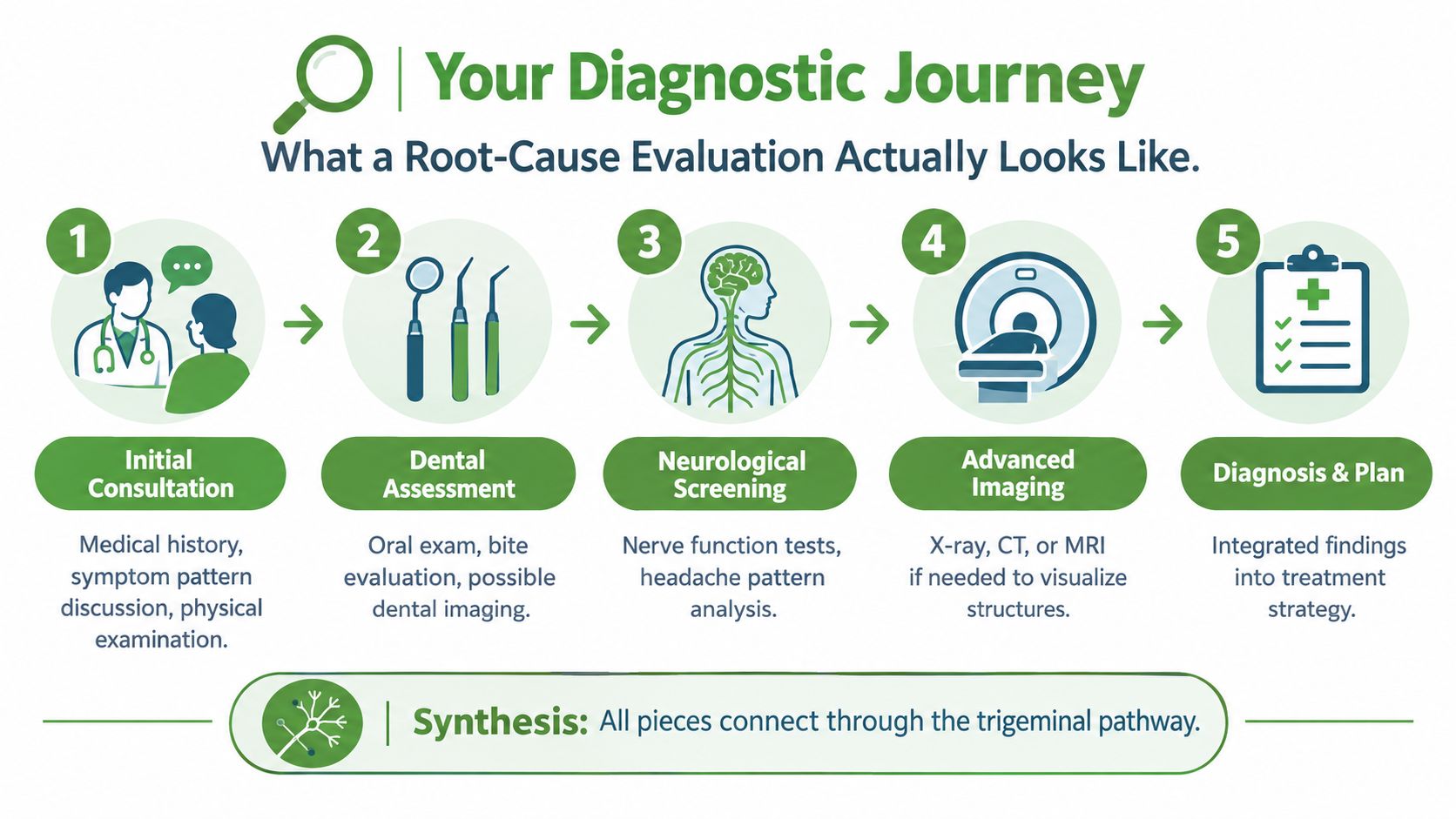
This coordinated approach is more useful than repeatedly suppressing whichever symptom is most noticeable that day. Treating only a sore tooth, congested nose, or tight jaw muscle may leave another active source unexamined. A facial pain diagnosis guide from TMJ Sleep can help patients prepare for the questions and assessments involved in this type of evaluation.
The purpose isn't to force every symptom into one diagnosis. It's to determine which condition is present, which findings are incidental, and whether more than one problem needs treatment.
Pain and Sleep Therapy Center evaluates TMJ disorders, jaw dysfunction, facial pain, and headache patterns to determine whether the jaw, joints, or facial muscles contribute to your symptoms. Visit Pain and Sleep Therapy Center to learn about its non-surgical assessment and treatment options and request guidance for your next step.