
Which facial pain specialist should you see first when the pain could come from your teeth, jaw, nerves, sinuses, muscles, or even sleep-related strain? The usual advice is to “see a doctor,” but that answer leaves out the decision patients need most: which clinician is equipped to investigate the layer causing the pain?
Facial pain can be sharp, aching, burning, pressure-like, or linked to movement. It can appear in the cheek, jaw, teeth, temples, ears, or around the eyes. The right starting point depends less on the location alone and more on the pain's pattern, triggers, and associated symptoms.
Why Finding Relief Feels Like a Maze
Persistent facial pain can turn ordinary healthcare into a series of disconnected appointments. You may begin with a dentist because your teeth hurt, see an ENT because your face feels congested, and then visit a neurologist when the pain continues. Each clinician may examine a different body system, yet no one may assemble the complete picture.

Research into orofacial pain patterns indicates that patients often experience significant diagnostic delays and may move between multiple specialties before receiving an effective treatment plan. A qualitative study describes this experience as “bouncing from one doc to the next,” a phrase that captures the frustration of repeated consultations without a clear direction. Research on referral delays in orofacial pain also highlights the importance of collaboration between dental, medical, neurological, and pain professionals.
Why the delay happens
Facial structures sit close together and share nerve pathways. Pain from a jaw muscle can feel like a headache. A tooth problem can resemble sinus pressure. A nerve disorder can feel as though one particular tooth is responsible.
That overlap creates a diagnostic trap. Patients often describe where they feel pain, while clinicians also need to know how it behaves:
- Does chewing bring it on?
- Does light touch trigger it?
- Does bending forward increase pressure?
- Does jaw movement cause clicking, locking, or limited opening?
- Is the pain constant, or does it arrive in brief attacks?
Practical rule: The more precisely you can describe the pattern, the easier it becomes to choose the right first specialist.
The aim isn't to diagnose yourself. It's to avoid treating the wrong layer for too long. A thoughtful first evaluation can identify whether you need dental care, jaw-focused assessment, neurological investigation, sinus evaluation, pain management, or coordinated care across several disciplines.
Understanding the Layers of Facial Pain
Facial pain isn't one condition. Think of the face as a house with several connected systems and a shared alarm network. If an alarm sounds in the hallway, the alarm itself may be working correctly. The cause could be smoke in the kitchen, faulty wiring, or water entering through a window.
The same principle applies to facial symptoms. Pain felt near the ear may involve the jaw joint. A headache may involve chewing muscles or nighttime clenching. Pressure around the cheek may involve the sinuses, while electric facial shocks point toward a nerve pathway. This overview of facial pain can help patients see why location alone rarely identifies the source.
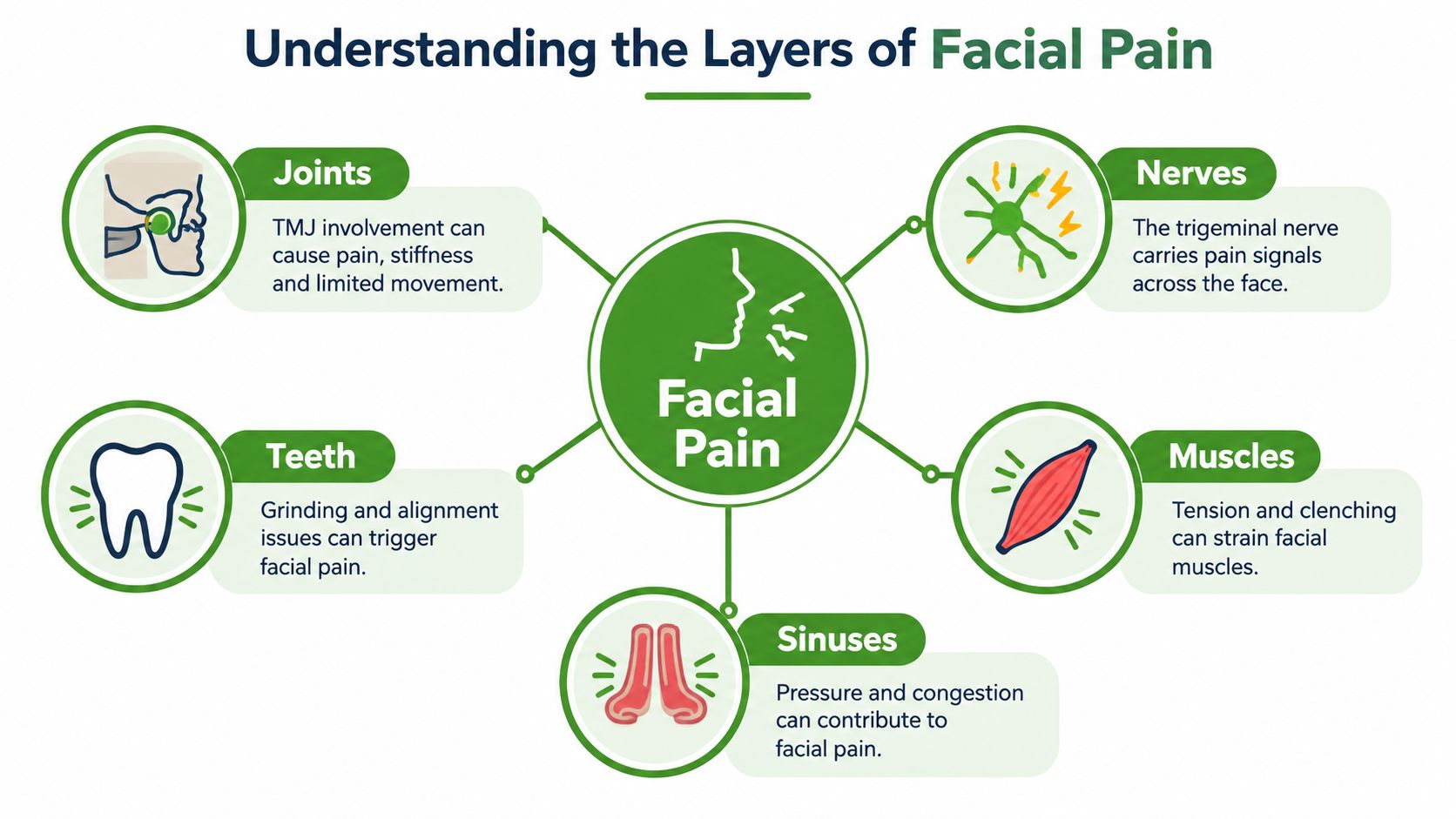
Five connected sources
- Joints: The temporomandibular joints guide jaw movement. Irritation may cause pain near the ear, clicking, stiffness, or difficulty opening.
- Nerves: The trigeminal nerve carries much of the face's sensory information. Irritation can create sudden, stabbing, burning, or shock-like sensations.
- Muscles: Chewing and neck muscles can become overloaded by clenching, grinding, posture, or sustained tension. They may send pain into the temples, face, or head.
- Sinuses: Congestion or inflammation can create pressure around the cheeks, forehead, eyes, and upper teeth.
- Teeth: Decay, infection, cracks, bite-related strain, and grinding can produce localized or referred pain.
These layers can also interact. A person who clenches because of stress may overload the jaw muscles, disturb the joint, and develop morning headaches. Someone with facial pain may change how they chew, which can place additional strain on the opposite side.
A specialist therefore starts with a structured history and examination rather than assuming that the most painful spot is the source. The key question is not just “Where does it hurt?” but “What activates the pain, and what other systems are involved?”
Types of Facial Pain Specialists Explained
Different clinicians manage different layers of the problem. Understanding their roles can make a referral feel purposeful rather than random.
Orofacial pain specialists
An orofacial pain specialist is a dentist with advanced training in complex pain involving the jaw, face, mouth, and head. This clinician commonly evaluates temporomandibular disorders, jaw muscle pain, headaches with an orofacial component, and persistent facial pain that hasn't responded to routine dental care.
Orofacial pain became an officially recognized dental specialty on March 31, 2020, when the National Commission on Recognition of Dental Specialties and Certifying Boards approved it as the 12th ADA-recognized specialty. The American Academy of Orofacial Pain history explains how the field developed from a multidisciplinary focus into a formally recognized specialty with defined standards and referral pathways.
A specialist may coordinate with neurology, ENT, physical therapy, sleep medicine, or pain medicine when symptoms cross boundaries. Learn more about an orofacial pain specialist if your symptoms involve several connected systems.
TMJ and dental sleep specialists
These providers focus on the relationship between the jaw, bite, oral muscles, and airway. They may evaluate jaw dysfunction alongside snoring, disrupted sleep, mouth breathing, or other signs that nighttime breathing and oral posture are contributing to muscular strain.
If you wake with sore jaw muscles or notice nighttime grinding, practical guidance on how to stop jaw clenching at night may complement a professional assessment. The goal isn't to assume that clenching explains every symptom. It's to recognize when sleep-related behavior may be one part of a larger pattern.
Neurologists
Neurologists assess pain caused by the nervous system. They're particularly important when facial pain arrives as brief, severe, electric, stabbing, or shock-like attacks.
Trigeminal neuralgia is a key condition to rule out. The International Classification of Headache Disorders describes recurrent unilateral attacks in a trigeminal distribution, lasting from a fraction of a second to 2 minutes, with severe electric shock-like, stabbing, or sharp pain and triggers such as light touch. The clinical criteria for trigeminal neuralgia help distinguish this pattern from muscle or joint pain.
ENTs
An otolaryngologist, commonly called an ENT, evaluates the ear, nose, and throat. This may be appropriate when facial pressure accompanies nasal obstruction, congestion, changes in smell, ear symptoms, or pain that varies with pressure and position.
Pain medicine specialists
Pain medicine clinicians help people manage persistent pain that requires medication planning, procedures, rehabilitation, or coordination among multiple providers. They may become involved when pain remains complex after dental, neurological, sinus, or musculoskeletal causes have been assessed.
Who Should You See First?
Start with the symptom pattern, not just the body part that hurts. The following guide can't replace an examination, but it can help you choose a sensible first conversation.
| Main pattern | Reasonable starting point | Why |
|---|---|---|
| Clicking, locking, stiffness, or pain during chewing | Orofacial pain or TMJ specialist | These symptoms point toward jaw joints, muscles, or movement mechanics |
| Brief electric shocks triggered by touch, talking, or chewing | Neurologist or facial pain specialist | The pattern may involve trigeminal nerve pathways |
| Facial pressure with congestion or nasal symptoms | ENT | The clinician can assess nasal, sinus, and ear-related causes |
| A clearly localized toothache, sensitivity, swelling, or pain on biting | Dentist | Dental infection, decay, cracks, and bite-related problems need direct evaluation |
| Persistent pain involving several systems | Orofacial pain specialist or multidisciplinary clinic | A coordinated assessment can reduce disconnected referrals |
A jaw-focused evaluation often includes questions about chewing, movement, tenderness, and range of motion. The National Institute of Dental and Craniofacial Research notes that clinicians assess features such as pain-free opening, tenderness, clicking, crepitus, and restricted movement. A validated TMD screening score of 3 or higher is considered positive and calls for more in-depth evaluation, according to NIDCR guidance on TMD.
Use the trigger as your clue
Pain triggered by light touch deserves a different pathway from pain triggered by chewing. Pain that worsens when bending forward suggests a different line of questioning from pain that appears after waking with tight jaw muscles.
If headaches dominate your experience, ask how the provider distinguishes migraine, tension-related pain, neck-related pain, and pain referred from the jaw. A practical resource on vetting a headache specialist can help you prepare for that conversation.
Before booking: Write down the pain quality, side, duration, triggers, associated symptoms, and treatments you've already tried. This record can prevent the same history from being reconstructed at every appointment.
When symptoms overlap, look for a clinic that communicates across disciplines. You shouldn't have to act as the messenger between every provider while also trying to manage pain.
The Cost of Delayed Diagnosis
Consider a representative patient with morning jaw soreness, temple headaches, and poor sleep. A dental examination may find no obvious tooth problem, while a headache consultation may focus on symptom control. If nobody asks about clenching, jaw movement, breathing during sleep, and muscle tenderness together, each appointment can produce a partial answer without identifying the pattern.

The problem isn't that any one clinician has failed. Each specialist may be looking through a legitimate clinical lens. The problem is that a narrow lens can miss interactions between the jaw, muscles, airway, sleep, and nervous system.
What gets overlooked
A person who clenches may develop sore chewing muscles and altered jaw movement. A person with nasal obstruction may breathe through the mouth and hold the jaw and neck differently. A person with nerve pain may undergo repeated dental procedures because the pain feels as though it comes from a tooth.
These are examples of why masking symptoms doesn't always address the source. Medication may reduce discomfort, but it won't by itself explain whether the pain is mechanical, muscular, sinus-related, dental, or neurological.
Over 3 million people in the United States seek treatment for chronic orofacial pain each year, according to a review indexed by the National Library of Medicine. That scale makes clear why patients need referral pathways that are easier to understand.
A multidisciplinary approach can change the sequence. One clinician gathers the full history, another evaluates a specific system, and the team compares findings before recommending invasive care. This process can also reveal when a symptom doesn't belong to the first suspected category.
This video provides another visual resource for understanding facial pain and related care:
Seek urgent medical attention for new facial weakness, major swelling, fever, vision changes, or neurological symptoms. Those signs require prompt evaluation rather than routine referral planning.
Questions to Ask Your Specialist
A first consultation should give you more than a label. It should clarify what the clinician thinks may be involved, what has to be ruled out, and how the next step will be chosen.
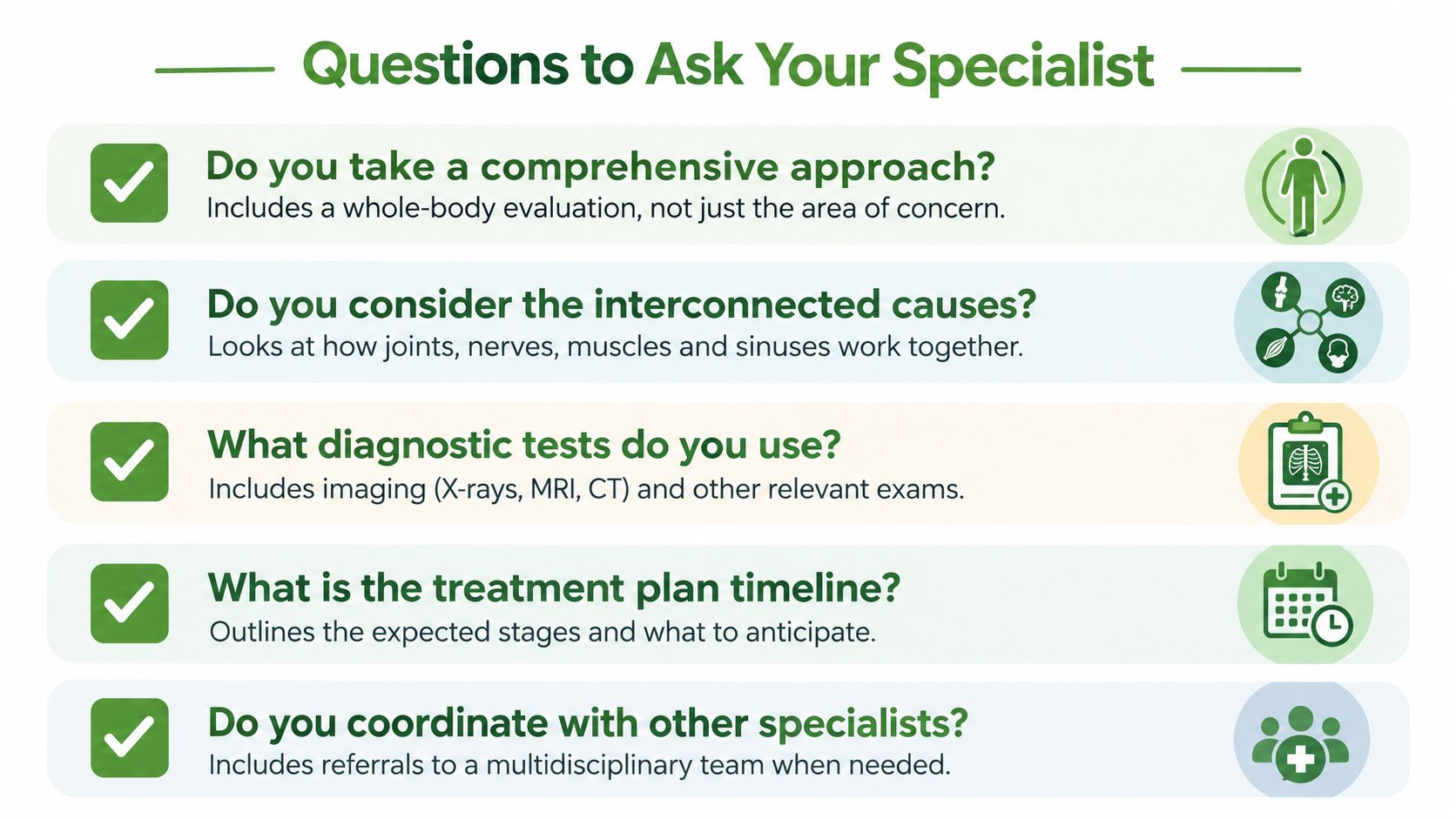
Use questions like these:
- Do you use a thorough approach? Ask whether the evaluation includes the jaw, teeth, muscles, nerves, sinuses, neck, sleep, and breathing when relevant.
- Which causes are you considering? A thoughtful clinician should explain why a symptom pattern fits or doesn't fit a particular diagnosis.
- What examination or imaging is appropriate? Ask what the test is meant to clarify. Imaging should answer a clinical question, not just be ordered because pain is difficult to explain.
- What happens if the first treatment doesn't help? You deserve a plan for reassessment rather than an open-ended series of unrelated treatments.
- How do you coordinate referrals? Ask whether the office communicates with dentists, neurologists, ENTs, physical therapists, sleep clinicians, or pain specialists when needed.
Signs to slow down
Be cautious if a provider dismisses your symptoms without taking a detailed history, treats every facial pain complaint as a dental problem, or recommends an invasive procedure before explaining alternatives and uncertainty.
You can also ask whether the proposed treatment targets a suspected cause or mainly reduces symptoms. There are situations where symptom relief is appropriate and important, but you should understand what the treatment can and can't address.
Good consultation: You leave knowing what your clinician suspects, what remains uncertain, and what evidence will guide the next decision.
Taking the Next Step Toward Relief
The best first step isn't always the most specialized test or the most aggressive treatment. It's a careful evaluation that matches the pain pattern to the right clinical layer.
An orofacial pain specialist may be a useful starting point when jaw movement, chewing, headaches, muscle tension, or several overlapping symptoms are involved. A neurologist may need to lead when the pattern resembles trigeminal neuralgia. An ENT may be the right entry point for pressure and nasal symptoms, while a dentist should promptly evaluate localized tooth pain, swelling, or sensitivity.
The chronic facial pain treatment guide can help you understand why treatment planning often needs to consider more than one structure. A complete plan may include education, jaw and muscle assessment, breathing or sleep evaluation, exercises, conservative therapies, medication coordination, or referral to another specialist.
Pain and Sleep Therapy Center is one example of a clinic that evaluates TMJ disorders, facial pain, and sleep-related breathing concerns through a root-cause framework. Its services include technology-assisted assessment, dental sleep medicine, orofacial myofunctional therapy, breathing-focused care, and non-surgical treatment planning, with referrals when a different discipline is needed.
You don't have to accept an endless chain of disconnected appointments. Bring a symptom timeline, list your triggers, gather previous imaging and dental records, and ask each provider how their findings connect to the wider picture. That preparation gives your care team a clearer starting point and helps you take part in decisions about testing and treatment.
Visit Pain and Sleep Therapy Center to explore detailed evaluations for TMJ-related facial pain, jaw dysfunction, and sleep-related breathing concerns. Their team can help connect symptoms across the jaw, muscles, airway, and sleep so you can begin with a more focused care plan.