You wake with a headache before the day has started. Your temples feel bruised, your cheeks are tired, and your teeth seem tender, as if you spent the night chewing something tough. When you notice that your jaw is stiff and your teeth were pressed together, the morning pain starts to make sense. Nighttime clenching can overload the jaw muscles and joints, then send pain into the head.
That pattern is real, but “jaw-tension headache” isn't always a single diagnosis. The jaw, chewing muscles, neck, and trigeminal nerve can all contribute, while migraine or another headache disorder may be present at the same time. Temporomandibular disorders, or TMD, affect about 5% to 12% of people, and headache is one of their most common associated symptoms, according to a systematic review and meta-analysis of TMD and headache prevalence.
If you have chronic morning headaches, jaw tightness, ear pressure, or face pain that has been labeled “sinus” or “migraine,” the useful question isn't just, “Is this my TMJ?” It's, “Which combination of jaw, neck, nerve, sleep, and headache factors is producing this pain?”
Why Your Jaw Could Be Behind Your Headaches
Consider a familiar morning. The alarm rings, and before you sit up, you rub both temples. Your jaw feels tired near the cheeks, the area in front of your ears is sore, and opening your mouth produces a faint click. You may not remember clenching during sleep, but the soreness is evidence that the chewing system worked while you were supposed to be resting.
The temporomandibular joint, or TMJ, connects the lower jaw to the skull. It works with the masseter, temporalis, and deeper chewing muscles every time you speak, swallow, yawn, or eat. These structures also share pain-processing pathways with parts of the face, head, and neck, so the brain may register irritation near the jaw as pain in the temple, forehead, ear, or behind the eye.
That's why a painful jaw doesn't always feel like a painful jaw. A tense temporalis muscle can make the side of your head ache. A sensitive joint can create pressure near the ear. A tight neck can add an ache at the base of the skull and increase the workload around the jaw.
The jaw-headache connection in context
Evidence shows a substantial overlap between TMD and headache disorders. In the cited meta-analysis, headache occurred in 61.58% of people with TMD, while TMD occurred in 59.42% of people with headache. Those figures show an important association, not proof that every headache in someone with jaw symptoms comes from the jaw.
A U.S. evidence review estimated that 4.8% of adults, or about 11.2 to 12.4 million people, had pain around the temporomandibular joint that could relate to TMD. The same evidence review on TMD reports that pain in front of the ear and pain while chewing have been documented in population studies.
Practical rule: Jaw symptoms make the jaw worth evaluating, but they don't eliminate migraine, neck-related pain, dental disease, or urgent medical causes.
The multi-source model matters because treatment aimed at only one structure may provide only partial relief. A night guard may reduce tooth contact, yet daytime clenching can continue. Jaw exercises may help, while neck stiffness keeps feeding the same pain network. Migraine medication may reduce one component but leave chewing-muscle overload untouched.
The aim isn't to force your symptoms into one label. It's to recognize the pattern accurately enough to choose the right next step.
How Jaw Tension Turns Into Head Pain
You finish a stressful workday with sore temples, a tired jaw, and pain that seems to sit behind one eye. The jaw may be part of the pattern, but it is rarely the only possible source. Jaw muscles, the neck, and the trigeminal nerve can all feed signals into the same head-pain network.
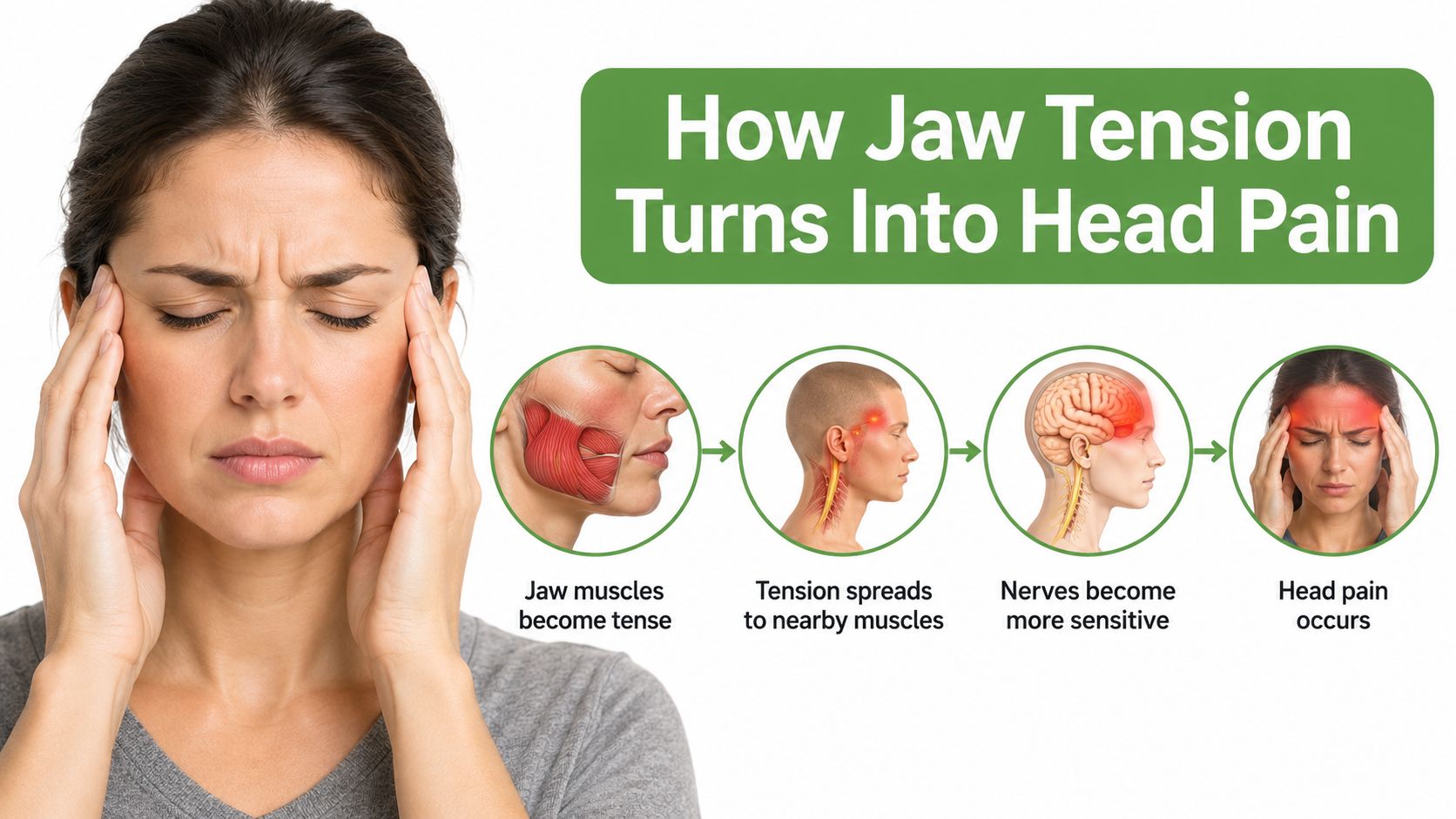
First pathway: muscular overload
The masseter lies over the cheek and closes the jaw. The temporalis spreads across the side of the skull, including the temple area. Deeper pterygoid muscles guide and stabilize jaw movement. Clenching, grinding, prolonged chewing, or repeated wide opening can keep these muscles active much longer than normal eating does.
A controlled study of low-level tooth clenching found fatigue sensations, fatigue-related muscle pain, and headache-like symptoms, together with greater resting electrical activity in the masseter. The clinical study on jaw clenching and headache-like pain supports a practical explanation: repeated loading increases nociceptive input, meaning sensory signals that the nervous system may interpret as pain.
Referral can follow a useful pattern:
- Temporalis overload may feel like pressure or aching in the temple.
- Masseter sensitivity may spread into the cheek, teeth, or side of the head.
- Pterygoid irritation may produce deeper facial or frontal discomfort.
- Suboccipital tension may create an ache at the back of the skull and add to jaw-related pain.
Second pathway: the trigeminal nerve
The trigeminal nerve carries sensation from much of the face, teeth, jaw, and head. Its branches meet in processing areas in the brainstem. Repeated signals from one region can then become difficult for the nervous system to locate precisely, much like overlapping phone lines that make it hard to identify the original caller.
That process is called referred pain. An irritated jaw muscle may send pain to the temple, forehead, or area behind the eye. The pain is real, even when the place you feel it is not the structure producing the signal.
Third pathway: posture and the neck
A forward head position, raised shoulders, or long periods at a screen can alter how the jaw rests and moves. Neck muscles work harder to support the head, while jaw muscles may brace to steady the lower face. The result is shared strain across the neck and chewing system.
This pattern is why jaw tension should be treated as one possible contributor rather than a single diagnosis. Pain that changes with chewing or jaw movement may include a jaw component. Pain that changes with neck movement or sustained posture may also involve the cervical muscles and joints. Before focusing only on self-care, screen for unfamiliar, sudden, severe, or progressively worsening headache symptoms and seek medical assessment when they are present.
Types of Headaches That Mimic Jaw-Tension Headaches
Several headache disorders occupy the same territory as jaw-referred pain. Location alone can't separate them. The more useful clues are duration, associated symptoms, movement sensitivity, and whether jaw function changes the pain.
| Headache Type | Typical Location | Duration & Pattern | Common Triggers | Jaw Clue |
|---|---|---|---|---|
| Tension-type headache | Forehead, temples, or both sides of the head | Steady pressure or tightness | Stress, neck strain, prolonged posture | Jaw and neck muscles may be tender, but chewing isn't always the main trigger |
| Migraine | Often one side, temple, forehead, or behind the eye | Episodic pain that may throb | Routine activity, light, sound, sleep disruption, individual triggers | Jaw clenching can coexist, but nausea, light sensitivity, or aura point toward migraine features |
| Cluster headache | Severe one-sided pain around or behind one eye | Repeated attacks rather than a continuous ache | Attacks may follow a distinctive pattern | Jaw soreness may appear from bracing, but the eye-centered attack pattern is more characteristic |
| Sinus-related pain | Face, forehead, cheeks, or around the eyes | Often changes with congestion or posture | Infection or nasal inflammation | Facial pressure can resemble jaw pain, but bite and chewing usually don't control it |
| Cervicogenic headache | Back of the head, upper neck, or one side | Linked to neck movement or sustained neck loading | Posture, neck restriction, shoulder tension | Neck stiffness may alter jaw function and create a mixed pattern |
| Trigeminal neuralgia | Usually one side of the face | Brief, sudden, electric-shock-like bursts | Touch, brushing teeth, speaking, or chewing | Chewing may trigger pain, but the shock-like quality differs from muscle ache |
The headache and migraine symptom guide can help you organize symptoms, but it can't establish the cause by itself.
The distinctions patients often miss
A migraine commonly worsens with ordinary physical activity, while jaw-related pain often increases when you chew, talk for a long time, yawn, or open widely. A sinus complaint may feel heavier when posture changes, while jaw pain may shift when your bite changes or when the muscles work.
Cervicogenic pain can overlap with jaw pain because the neck and jaw influence one another. Trigeminal neuralgia can be mistaken for dental or jaw trouble because chewing and touch may trigger it, but its brief, sharp electrical bursts are different from the deep fatigue of an overworked chewing muscle.
Why the confusion is understandable
The brain doesn't use a separate map for every millimeter of the face. Shared trigeminal processing and overlapping referral zones make the temple, cheek, ear, eye, and forehead common destinations for pain from different sources. A person can also have more than one source at once, such as migraine plus nighttime clenching or neck dysfunction plus TMD.
The right question isn't which label sounds closest. It's which features appear together, what reliably triggers the pain, and what symptoms demand a medical assessment before self-care.
Clues That Point to the Jaw Instead of the Brain
A patient may try several migraine medicines and still wake with the same temple pain. During an appointment, someone finally asks whether the patient clenches during concentration, wakes with a sore jaw, or feels tired after eating. That question can change the direction of the evaluation.
No single symptom proves that TMD causes a headache. A cluster of jaw, ear, and neck signs, especially when neurological red flags are absent, makes the masticatory system more relevant.
Four useful clues
Morning jaw soreness suggests that the muscles may have remained active during sleep. It becomes more meaningful when it appears with tooth sensitivity, cheek tenderness, or a headache present on waking.
Ear fullness without an ear infection can occur because the TMJ sits close to the ear and shares nearby sensory pathways. Pressure, ringing, or discomfort doesn't automatically mean the ear is the source.
Bite fatigue after meals points toward muscle overload or joint irritation. Notice whether solid or chewy foods make your jaw tired, whether talking worsens the ache, or whether wide opening produces pain.
Neck stiffness alongside jaw tension suggests a combined head-jaw-neck pattern. The neck may be contributing directly, changing jaw mechanics, or amplifying sensitivity in the same pain network.
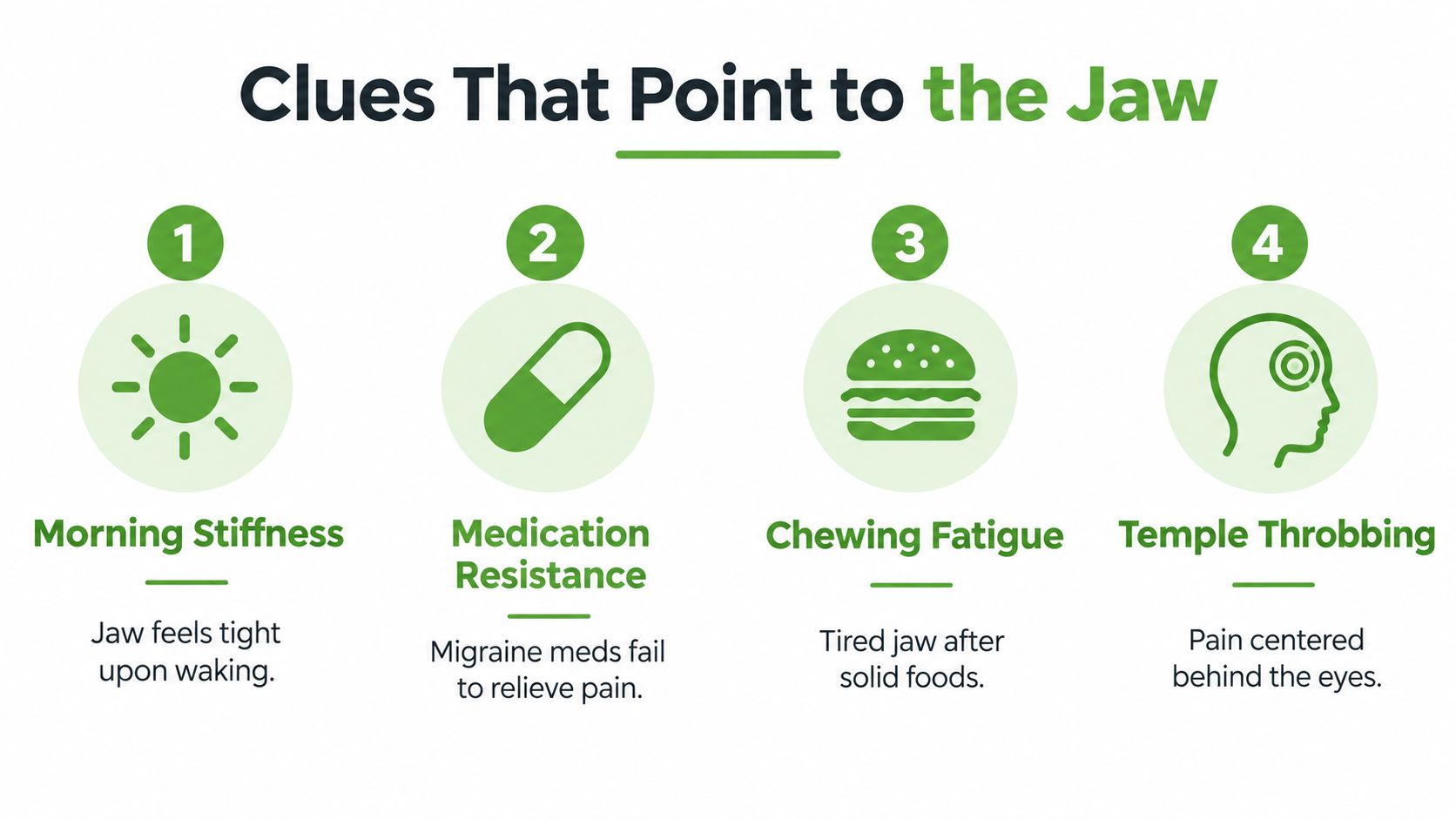
Features that shift suspicion elsewhere
Aura, strong light or sound sensitivity, nausea, and pain that predictably worsens with routine activity are more suggestive of migraine features than isolated jaw-muscle fatigue. Brief, stabbing, electric-shock pain triggered by a light touch or tooth brushing deserves a different neurological discussion.
Jaw clicking can be present without being the pain source. Likewise, a headache can occur with jaw tension without being caused by it. The value comes from the combination and timing.
A simple screening checklist can make your appointment more productive:
- Timing: Is the pain present on waking, after work, after meals, or at random?
- Jaw function: Does chewing, talking, yawning, or opening change it?
- Muscle signs: Are the temples, cheeks, or jawline tender?
- Ear and neck signs: Do fullness, ringing, or neck stiffness occur with the headache?
- Migraine signs: Do nausea, aura, or light and sound sensitivity appear?
- Safety signs: Is the headache sudden, rapidly worsening, or accompanied by neurological symptoms?
The following video provides a visual explanation of jaw-related symptom patterns:
Non-Surgical Treatments Worth Trying
Treatment works best when it lowers the total load reaching the pain system. That load may come from the jaw joint, chewing muscles, neck, sleep-related clenching, or trigeminal nerve sensitivity. Start with the least invasive measures, then adjust the plan according to the pattern your examination reveals.
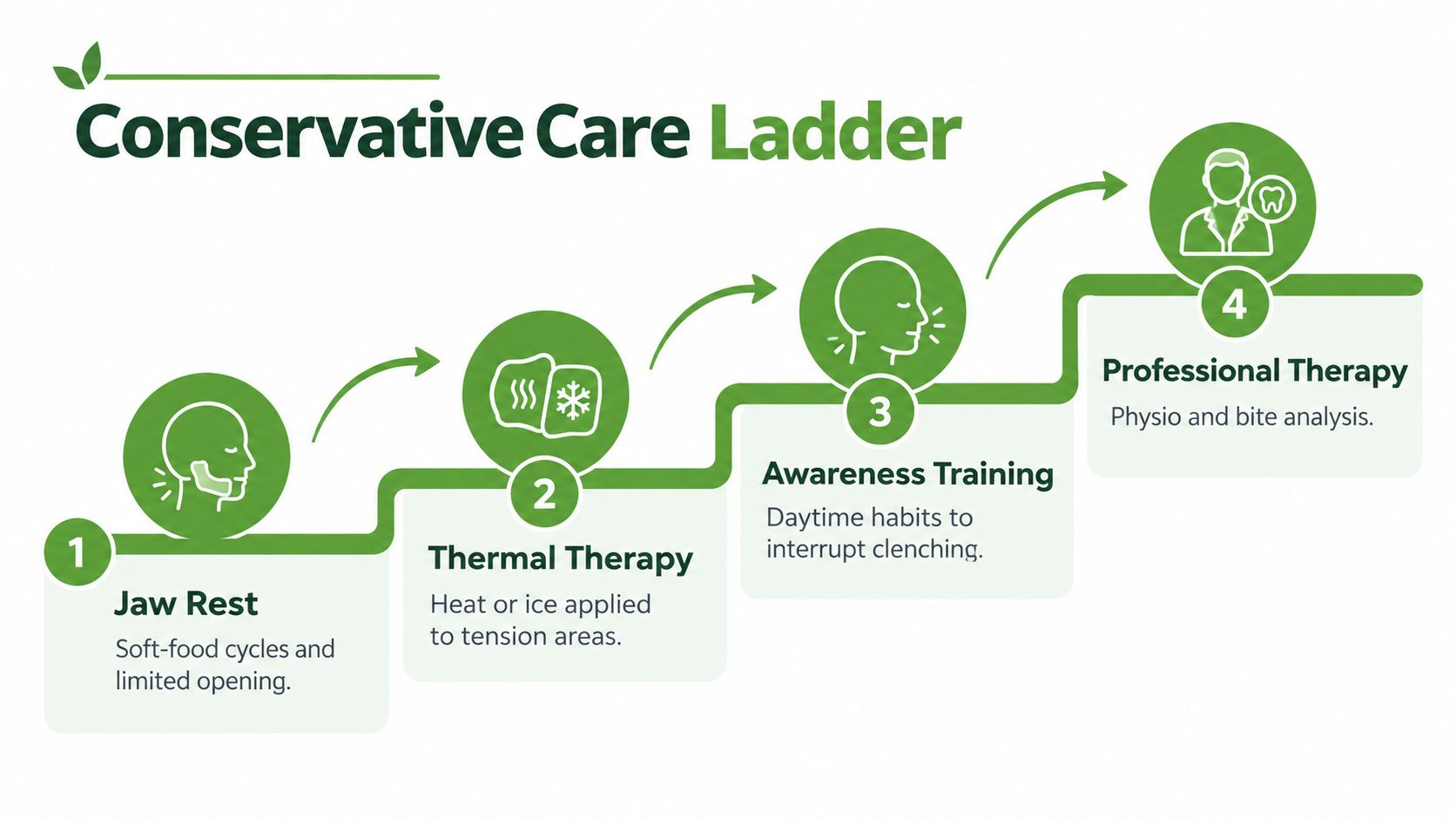
Start with load reduction
During a flare, choose softer foods and avoid gum, tough meat, hard candy, and deliberately wide yawning. Short-term jaw rest can reduce repeated mechanical input, but keeping the jaw still for long periods may increase stiffness without professional guidance.
Heat can relax a tight muscle. Cold may feel better when the area feels acutely irritated. Use whichever helps without increasing pain, and keep pressure gentle. At rest, let the lips meet while keeping the teeth slightly apart. This reduces the signal that keeps the chewing muscles switched on.
The jaw headache relief exercise guide offers movement ideas. Stop any exercise that produces worsening pain, forced clicking, locking, or a more restricted opening.
Address the neck and chewing muscles
A physical therapist familiar with TMD can assess jaw opening, neck movement, posture, and coordination between these areas. Treatment may include external or intraoral soft-tissue work, gentle mobility, posture retraining, and exercises for the pterygoids, temporalis, masseter, and suboccipital muscles.
The goal is controlled improvement, not harder stretching. The therapist should identify which movement or load reproduces the headache, then build tolerance gradually. If moving the neck changes the pain, the neck is part of the pain pattern. The headache may be receiving input from several connected regions rather than one faulty structure.
Retrain habits and sleep-related loading
Stress management can help if it reduces unconscious bracing. Stress alone, however, does not explain physical triggers such as driving, screen work, chewing, or poor sleep. Habit-reversal methods and cognitive behavioral approaches can help you notice tooth contact and release it before the muscles stay active for hours.
Medication may have a role, including clinician-directed anti-inflammatory medicines, short-term muscle relaxants, or low-dose tricyclic medicines. The appropriate choice depends on your medical history, other medicines, headache type, and whether inflammation or nerve sensitivity is present.
Consider devices and procedures carefully
A stabilization splint may protect teeth and change how force is distributed. An anterior repositioning device serves a different purpose and should not be selected casually. The 2024 NHS guideline for painful TMD management states that splints may be used for myofascial TMD or headache attributed to TMD, but not alone.
Injections, including trigger-point treatment or masseter Botox, are more involved options. Evidence for injections and other procedures remains limited in clinical reviews of TMD management. Before proceeding, ask a clinician to explain the expected benefit, alternatives, risks, and limits.
Why a Night Guard Alone Usually Falls Short
A night guard can be useful, but it isn't a complete explanation or treatment plan. It may protect enamel, reduce direct tooth-on-tooth force, and modestly unload the joint. It won't stop you from clenching during the day, correct forward head posture, relax an overactive neck, or remove a migraine disorder that happens to coexist with jaw tension.
Think of the appliance as a seatbelt, not a mechanic. A seatbelt can reduce injury during impact, but it doesn't repair the engine. Similarly, a guard may reduce some consequences of grinding while the muscle, sleep, stress, bite, and neck drivers remain active.
What the appliance can and can't address
The NHS guideline permits splints in selected painful TMD patterns, but specifically advises against using them alone. That recommendation fits the biology. A device changes contact between the teeth, while headache may also be receiving signals from the temporalis, masseter, cervical muscles, and trigeminal system.
A night guard can be one tool in an integrated plan. It shouldn't become a substitute for finding out why the jaw is working so hard.
Combined care may include daytime clenching awareness, physical therapy, sleep assessment, behavioral treatment, and a review of headache features. If the neck remains restricted or a person continues to brace while working, a nighttime appliance can't address those daytime inputs.
Common appliance mistakes
Over-the-counter boil-and-bite guards may feel convenient, but an uncomfortable or poorly fitting device can increase awareness of the bite and aggravate symptoms. Even a custom splint needs adjustment and follow-up if it changes comfort, jaw movement, or morning symptoms.
Don't keep wearing a device that causes new pain, changes how your teeth meet, increases locking, or makes headaches worse without contacting the prescribing clinician. A TMJ splint and night guard comparison can help clarify why different appliances aren't interchangeable, but the final choice belongs in an individualized assessment.
The most useful question is not, “Which guard should I buy?” It's, “What problem is this device intended to address, and what other source of pain still needs attention?”
Your Next Steps Toward Lasting Relief
Use your symptom pattern to choose the next level of care. Mild, intermittent pain that clearly follows clenching, chewing, or posture can justify a short period of conservative self-management. Persistent, changing, or complex pain deserves an evaluation rather than an endless cycle of products and exercises.
A practical three-tier plan
For mild and occasional symptoms, reduce jaw loading, avoid gum and hard foods during flares, and use comfortable heat or cold. Set reminders during work or driving to check for tooth contact, drop your shoulders, and return to a relaxed jaw position. Gentle movement should feel controlled, not forced.
For persistent or function-limiting symptoms, arrange an assessment with a dentist, physician, or orofacial pain clinician who evaluates headaches alongside the jaw and neck. Seek help sooner if you have morning jaw fatigue, painful clicking, locking, limited opening, ear symptoms, or headaches that don't respond as expected to your usual care.
For warning signs, seek urgent medical evaluation. A sudden severe headache, weakness, numbness, vision changes, slurred speech, fever, marked neck stiffness, confusion, fainting, or pain after trauma should not be treated as routine jaw tension. In adults over 50, new headache with scalp tenderness, visual symptoms, or jaw pain while chewing can indicate giant cell arteritis and requires prompt medical attention, as outlined in headache guidance on cervicogenic and tension-type patterns.
Keep a short symptom record
Before an appointment, record your symptoms for two weeks. This isn't a diagnosis, but it can reveal relationships that are hard to remember in conversation.
- Time: Note whether pain appears on waking, during work, after meals, or at night.
- Location: Record temple, forehead, eye, ear, cheek, jaw, neck, or back-of-head pain.
- Jaw activity: Mark chewing, talking, yawning, tooth contact, clicking, or locking.
- Associated symptoms: Include nausea, light sensitivity, aura, ear fullness, tooth sensitivity, and neck stiffness.
- Relief: Write down whether rest, heat, posture changes, jaw relaxation, or medication helped.
- Safety: Record any sudden change, neurological symptom, fever, injury, or visual problem.
Bring the record to your clinician and ask for a head-jaw-neck assessment rather than a jaw-only answer. Headaches from jaw tension are often a pattern of overlapping pain sources, and lasting relief usually comes from matching each source with the appropriate treatment.
Pain and Sleep Therapy Center evaluates TMJ disorders, facial pain, headaches, and sleep-related breathing concerns with individualized, non-surgical care. If jaw tension and morning headaches are affecting your comfort or sleep, visit Pain and Sleep Therapy Center to learn about assessment and treatment options.