Why do patients search for cold laser therapy before and after photos when a photograph can't show pain, jaw mechanics, or whether another treatment caused the improvement? People with TMJ disorders and facial pain understandably want a timeline before committing to care. The available examples, however, don't form one standardized TMJ photo gallery. They document different evidence types across photobiomodulation and therapeutic-laser care, including pain ratings, wound images, functional changes, treatment schedules, protocol details, and patient narratives.
A useful comparison asks five questions: What was measured before treatment? What device and protocol were used? When was the result recorded? Was there a control group? Did the patient receive other care at the same time? Those questions matter because short-term symptom relief doesn't automatically prove tissue healing or correction of the underlying cause. The low level laser guide provides broader background, while an individualized assessment at Pain and Sleep Therapy Center can help determine whether photobiomodulation fits a person's diagnosis and treatment plan.
1. Erchonia
Erchonia is a U.S.-based low-level laser therapy company with a substantial emphasis on clinical research, FDA clearances, and defined pre-treatment and post-treatment outcomes. Its materials cover devices such as the FX-635, Verjú, and Lunula, which serve different clinical purposes. For patients researching cold laser therapy before and after results, that distinction matters. A result from a musculoskeletal pain trial shouldn't be treated as evidence for every device or every TMJ diagnosis.
The strongest feature of Erchonia's evidence presentation is its focus on measurable clinical endpoints, especially pain scales such as the visual analogue scale. Those measures are more useful than a generic statement that someone “felt better” because they establish a baseline and a later score. They still don't tell a patient whether jaw opening, chewing, headaches, or sleep changed unless those outcomes were recorded separately.
Practical rule: A pain score can show symptom change, but it can't establish that a displaced disc, arthritic joint, or muscular trigger point has been corrected.
For TMJ referrals, ask whether the cited study involved temporomandibular disorders or a different body region. The 2018 systematic review of LLLT for TMD found short-term pain relief in pooled analyses, but substantial heterogeneity and no statistically significant long-term benefit. That makes protocol details and follow-up just as important as the brand name. A clinic should document wavelength, power, treatment time, session count, and outcome measures in its cold laser therapy protocols.
Erchonia's public evidence is more useful for understanding how controlled before-and-after measurement works than for finding dramatic TMJ photographs. Patients should look for inclusion criteria, comparison groups, and follow-up timing rather than assuming that an FDA clearance guarantees a particular result.
Erchonia offers the manufacturer's device and research information.
2. THOR Photomedicine
THOR Photomedicine shows a different kind of before-and-after evidence. Its educational and clinical resources often emphasize time-stamped progress, wound images, scar photography, case reports, and protocol information. These records can make biological change easier to visualize than a pain score. A wound that looks smaller or a scar that changes over time gives the reader a direct visual comparison.
That visual strength has a clear limitation for TMJ and facial pain. A wound image documents surface appearance. It doesn't measure tenderness in the masseter, pain during chewing, maximum mouth opening, joint sounds, headache frequency, or facial nerve symptoms. The tissue type, diagnosis, treatment objective, and healing timeline differ substantially from those in TMD.
THOR's materials also span human clinical care, dental applications, and other areas. Patients and referrers should confirm that a cited case involves human participants and a relevant diagnosis, rather than assuming that every example transfers to jaw pain.
What the images can and can't establish
A photo series can help answer:
- Was the same area photographed? Consistent views reduce misleading comparisons.
- Was the interval documented? A result immediately after treatment means something different from a result recorded weeks later.
- Was another intervention used? Dressings, surgery, medication, exercise, or natural healing may contribute to the outcome.
- Is the endpoint relevant? Surface closure doesn't equal improved jaw function.
The 2012 review of LLLT for TMD illustrates why protocols need careful interpretation. Differences in wavelength, power, dosage, application site, session number, and outcome measurement prevented definitive conclusions. THOR's practical protocols can help a clinician describe treatment, but they don't replace a diagnosis-specific controlled study.
For TMJ patients, the most responsible use of THOR's examples is to understand documentation quality, not to predict a personal result. Ask whether the provider will combine visual records with numerical pain ratings and objective jaw measurements.
Explore THOR Photomedicine for its research and clinical education resources.
3. OrthoLazer Orthopedic Laser Centers
How much can a structured orthopedic treatment record tell a patient with TMJ or facial pain? OrthoLazer Orthopedic Laser Centers presents care through protocolized sessions, treatment timelines, patient expectations, and package information. This makes its material most useful for evaluating how treatment is organized, rather than predicting an individual jaw-pain outcome.
Its documented focus is orthopedic pain, post-operative recovery, and rehabilitation. Those conditions do not map directly onto muscle-based TMD, disc displacement, degenerative joint disease, or mixed facial pain. A standardized protocol may improve consistency between appointments, but it does not make an orthopedic result interchangeable with an orofacial diagnosis.
The site also gives a provider-specific pricing example in which six sessions cost less than $500. That information can help patients ask about budgeting, but it is not a general cold-laser price benchmark or evidence that treatment works. Location, diagnosis, treatment duration, and clinical goals may change the total cost.
Read the timeline as a measurement plan
A treatment schedule becomes meaningful when each visit has a defined outcome. Ask:
- Which problem is being measured? Pain, inflammation, mobility, or post-operative recovery?
- What occurs between visits? Exercise, physical therapy, medication, splint use, and behavior changes may affect the result.
- What qualifies as improvement? A lower pain score does not show that chewing is easier or jaw movement has improved.
- When will reassessment occur? Immediate comfort and durable change are different endpoints.
A systematic review of randomized controlled trials found overall improvements in pain and mandibular function, with the most consistent effects in articular TMD. It also reported substantial variation in wavelength, dose, session number, and outcome measures. That evidence supports recording the protocol and measuring TMJ outcomes directly, while limiting conclusions from general orthopedic testimonials.
For patients and referrers, the practical questions are specific: Will the clinician record pain ratings, mouth opening, chewing tolerance, and symptom duration? Will other treatments be documented? Those details determine whether a before-and-after record shows a clinical change or only a treatment sequence.
4. LightForce Therapy Lasers
LightForce Therapy Lasers, part of Enovis, illustrates the value of session-by-session functional documentation. Its case materials and brochures discuss acute pain, rehabilitation, and neuropathic pain with narratives that may include changes in movement or activity. Functional outcomes often give a more practical picture than a visual image. A patient wants to know whether they can chew, turn the neck, sleep, or return to activity, not just whether a treatment area looks different.
For TMJ care, the relevant parallel is objective jaw function. A provider can record maximum mouth opening, protrusion, and right and left lateral excursions before treatment and again afterward. The 2025 LED photobiomodulation trial used red 660 nm and infrared 850 nm LED clusters over masticatory and cervical muscles. After six sessions, the active group had a statistically significant reduction in VAS pain, while functional changes were narrower. Left lateral mandibular movement increased, but no between-group differences were found for mouth opening, right lateral movement, cervical flexion, or extension.
That finding changes how a before-and-after claim should be written. “Pain decreased” may be supportable when the study design and outcome measure justify it. “Jaw function was restored” is a much broader claim and may not be.
Measure the task that brought the patient to care. If chewing hurts, record chewing comfort. If opening is limited, measure opening.
LightForce materials can help clinicians explain treatment timelines and functional tracking, but public case summaries may be more promotional than peer-reviewed. Ask for the original study, the diagnosis, and the exact outcome definition before using a case to set expectations.
Review LightForce Therapy Lasers for its clinical materials and product information.

5. Multi Radiance Medical
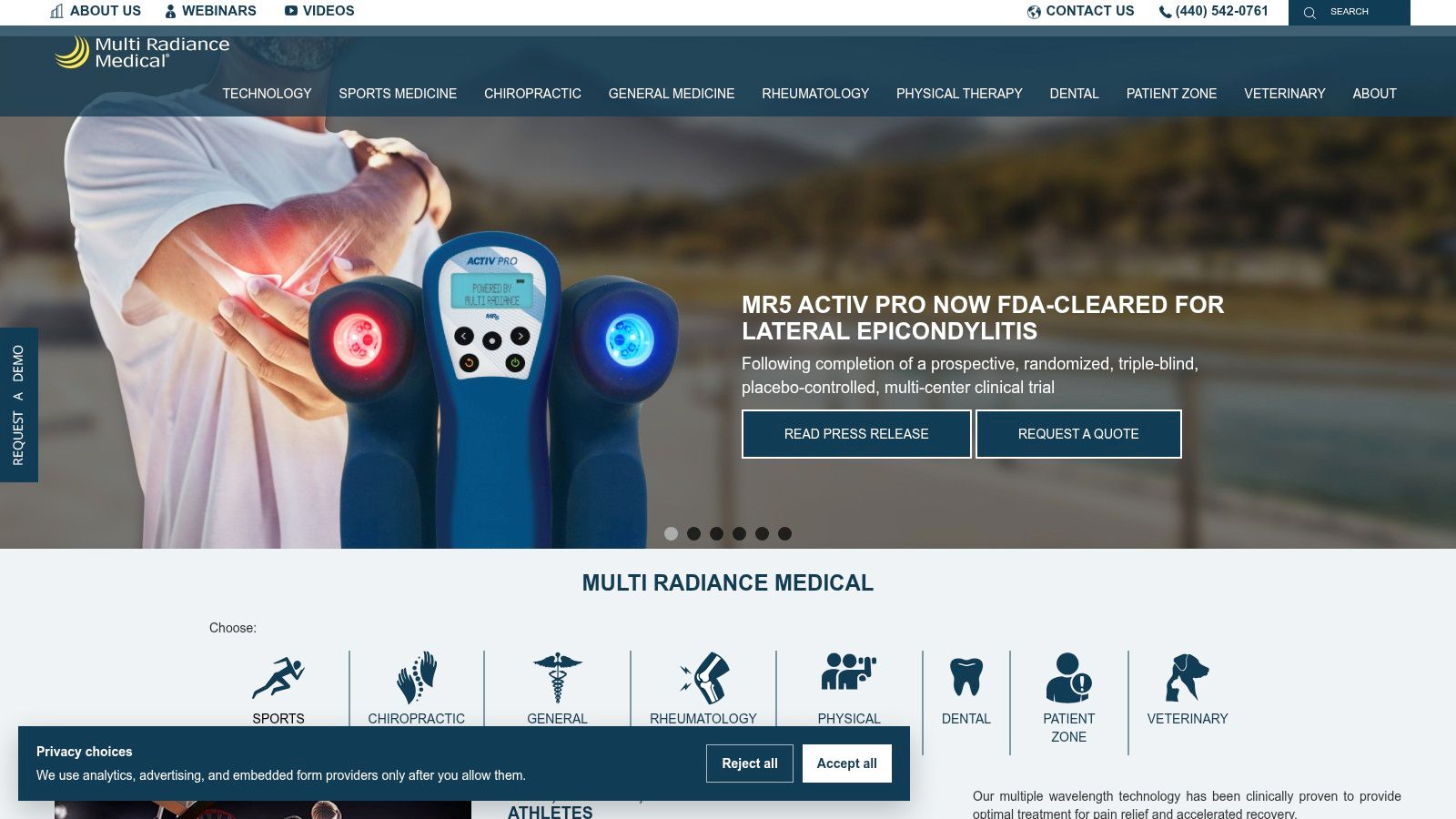
A Multi Radiance Medical before-and-after record can show several different outcomes, and those outcomes should not be treated as interchangeable. The company describes super pulsed, multi-wavelength systems used in chiropractic, physical therapy, sports medicine, and other clinical settings. Its materials bring together human research references, clinician feedback, and patient testimonials. That range is useful for identifying what kind of evidence a reader is reviewing.
Human research that names the device and reports measurements before and after treatment provides more structure than an anonymous testimonial. It may document pain, movement, function, or a treatment timeline. A study involving gait, sports injury, or another body region still offers limited guidance for TMJ or facial pain, because diagnosis, tissue target, and outcome measure differ.
A testimonial answers a narrower set of questions:
- The patient's starting problem, such as pain, stiffness, or activity limitation.
- The perceived timeline, including whether relief seemed immediate or gradual.
- The practical burden, including appointment frequency and concurrent rehabilitation.
- The patient's definition of success, which may differ from a clinical endpoint.
It cannot establish causation on its own. In a randomized study of people with TMD, participants receiving low-level laser, placebo, and standard treatment all improved, with no significant difference between groups at the endpoint. Natural recovery, expectations, attention, and other treatments could have contributed to the change.
For TMJ, a useful record should connect the claimed improvement to a measurable problem. Pair a pain rating with maximum mouth opening, lateral excursions, chewing comfort, and notes on splints, exercises, medication, or behavioral changes. Ask whether the record shows a clinical measurement, a photograph, a personal account, or a controlled comparison.
The explanation of how cold laser therapy works gives patients context for discussing photobiomodulation as one part of care, rather than evidence of a universal cure.
Review Multi Radiance Medical for device, clinical, and educational materials.
6. Summus Medical Laser
The Summus Medical Laser material is most useful for examining functional recovery and real-world evidence collection, rather than treating a testimonial as a clinical endpoint. Public cases may describe athletes, post-surgical patients, or people recovering from injury. Their outcome is often practical, such as returning to an activity, which gives readers more context than a general statement that symptoms improved.
Its Real-World Evidence program also illustrates how clinics can collect outcomes across multiple patients before and after treatment. That design can reveal patterns in routine care, provided the diagnosis, protocol, follow-up, and analysis remain consistent. It still does not show whether laser treatment caused the change. Without a comparison group, concurrent care, natural recovery, regression to the mean, and activity changes remain possible explanations, particularly for fluctuating TMD symptoms.
For TMJ and facial pain, translate “return to activity” into a jaw-specific outcome. A useful record might document whether the patient can:
- chew a normal diet with less discomfort,
- speak for longer periods,
- open the mouth for dental care,
- sleep without waking from facial pain,
- reduce headache-related limits on daily activity.
These examples measure function, not structural repair. A referrer should ask what prevented the activity beforehand, how the change was recorded, and whether splints, exercises, medication, or other treatment occurred at the same time.
A 2025 review of 44 randomized trials involving 1,816 participants reported lower pain and improved mandibular function, with treatment lasting more than four weeks associated with more sustained benefits. This supports reviewing the entire treatment schedule and follow-up, rather than judging the result from the first comfortable appointment. The finding does not establish a universal protocol or show that every TMJ diagnosis responds similarly.
Summus' materials can help set a functional goal, while clinical assessment must still separate muscle pain from joint-based disease and include jaw measurements. Treatment and education information is available from Summus Medical Laser.
7. BioFlex Laser Therapy
What does a BioFlex before-and-after record measure? Its value depends on whether it documents a pain score, functional change, treatment timeline, or only a patient impression. BioFlex Laser Therapy presents structured treatment pathways and testimonials that often identify the starting complaint, session count, and reported changes in daily activities. That narrative can clarify treatment experience, but it remains testimonial evidence rather than controlled clinical evidence.
The evidence does not transfer automatically to TMJ or facial pain. BioFlex materials discuss osteoarthritis, postoperative recovery, and nerve pain, while partner clinics may describe orthopedic or orofacial applications. Such examples may help patients ask how a treatment series is delivered. They cannot show that the same result will occur with TMJ inflammation, muscle tenderness, disc displacement, or degenerative joint disease.
Protocol details provide a more useful comparison point. A systematic review of human randomized controlled trials reported improved pain and mandibular movement with infrared diode laser protocols typically using wavelengths from 780 to 980 nm, output power no greater than 500 mW, energy density below 100 J/cm², and at least six sessions. The review did not establish one superior dose or schedule. These parameters describe studied approaches, not a guaranteed prescription.
A credible before-and-after record names the diagnosis, the protocol, the baseline, and the follow-up. If any of those are missing, the result is harder to interpret.
For TMJ and facial pain, ask whether the provider will record pain and function separately. A lower pain score may occur alongside limited opening, while greater opening does not prove that joint mechanics changed. Airway outcomes require separate assessment. Less jaw pain does not demonstrate improved nasal breathing, snoring, airway stability, or sleep-apnea severity. For broader context, review this overview of cold laser therapy for pain relief.
See BioFlex Laser Therapy for treatment pathways and provider information.
Cold Laser Therapy Before vs After, 7 Providers
| Provider | 🔄 Implementation complexity | ⚡ Resource requirements | 📊⭐ Expected outcomes | 💡 Ideal use cases | ⭐ Key advantages |
|---|---|---|---|---|---|
| Erchonia | Moderate, clinical protocols, trained providers | Moderate–High, FDA‑cleared devices, clinician training; provider sales only | Strong evidence for musculoskeletal pain; RCTs showing VAS improvements and pre/post endpoints | Neck/shoulder pain, plantar fasciitis, clinics needing validated outcome data | Multiple FDA clearances and peer‑reviewed trials; extensive clinician & patient resources |
| THOR Photomedicine | Moderate, protocolized wound and clinical workflows | Moderate, devices + clinician resources; some materials clinician‑facing | Good case series and time‑stamped wound/photo documentation; research digests available | Wound care, dental/TMJ, TBI case series, circulation indications | Practical protocols, standardized documentation and academic ties |
| OrthoLazer | Low–Moderate, franchise standard protocols, simple patient flow | Moderate, Class IV MLS lasers across centers; transparent pricing examples | Patient‑facing outcomes mainly testimonials/metrics; consistent before/after expectations | Orthopedic pain reduction, pre‑/post‑op adjunct, high‑volume clinics | Consistent protocols across centers and publicly posted package pricing |
| LightForce (Enovis) | Moderate, HILT integration in rehab workflows | Moderate, widely distributed, easy local access via rehab clinics | Functional, session‑by‑session measurable changes (ROM, neuropathic improvements) | Sports medicine, PT, chiropractic, neuropathic pain cases | Strong adoption in rehab/sports settings; clear session narratives for clinicians |
| Multi Radiance Medical | Moderate, clinician‑directed protocols; portable deployments | Low–Moderate, portable multi‑wavelength systems for field/clinic use | Documented use in human studies with pre/post reporting; testimonials for real‑world response | On‑field sports care, PT/chiro, acute strains, pilot stroke rehab | Study‑specified device use and portability for practical care |
| Summus Medical Laser | Moderate, Class IV implementations plus clinic RWE workflows | Moderate, clinic installations and RWE data collection tools | Case videos and timelines showing functional improvement; RWE program to aggregate outcomes | Athlete recovery, post‑surgical rehab, clinics seeking outcome data | Focus on return‑to‑activity narratives and standardized outcome collection |
| BioFlex Laser Therapy | Moderate, structured, condition‑specific protocols | Low–Moderate, provider network; partner clinics publish expectations | Patient testimonials with session counts and functional improvements; clinic before/after pages | Osteoarthritis, post‑op recovery, nerve pain, common MSK conditions | Condition‑specific pathways and rich patient‑language narratives across providers |
How to Use These Cases Before Treatment
The seven sources don't provide one universal answer to the question, “What will my cold laser therapy before and after result look like?” They show why the answer depends on what was measured, where the treatment was applied, which protocol was used, and how long the patient was followed. A wound photograph, a pain score, a jaw-opening measurement, and a testimonial are all different forms of evidence. None should stand in for the others.
Start by identifying the condition being treated. Is the clinician addressing muscle-based TMD, articular TMD, nerve pain, post-procedure inflammation, headache, or another diagnosis? The 2025 review found the most consistent effects in articular TMD, while other evidence shows that protocol variation and study quality remain important. A patient with muscle tenderness and a patient with degenerative joint disease shouldn't assume they need the same treatment plan.
Before treatment, ask the provider to document:
- The diagnosis: Confirm whether the evidence applies to TMJ or to a different body area.
- The baseline: Record pain intensity, maximum mouth opening, protrusion, lateral excursions, chewing comfort, headache frequency, and relevant daily activities.
- The protocol: Ask for the wavelength, power, fluence, treatment time, application sites, and planned session count.
- The timeline: Clarify when the first reassessment will occur and whether later follow-up will test durability.
- Concurrent care: Note splints, exercises, medication, injections, behavioral changes, or other therapies that could affect the result.
Photos can document swelling, bruising, posture, or surface healing, but they can't establish pain relief or causation. A controlled study can improve confidence in an observed effect, but it still may not match an individual's diagnosis or treatment settings. A testimonial can describe a meaningful personal experience, but it shouldn't be presented as a predictable clinical outcome.
Pain and Sleep Therapy Center offers individualized care for TMJ disorders, facial pain, and sleep-related breathing concerns, including cold laser therapy as part of a broader assessment when appropriate. A root-cause evaluation can help determine whether photobiomodulation belongs alongside movement retraining, orofacial myofunctional therapy, airway-focused care, or another treatment rather than being used as a standalone promise.
Pain and Sleep Therapy Center evaluates TMJ pain, facial pain, jaw dysfunction, and related sleep and airway concerns with individualized diagnostic planning. Visit Pain and Sleep Therapy Center to discuss whether cold laser therapy and complementary care fit your symptoms, goals, and clinical findings.