You may feel a strange pressure sitting at the crown of your head, then notice that it appears after a long meeting, a stressful commute, or a night of clenching your teeth. Because the pain isn't centered over the jaw or temple, it can seem impossible that the temporomandibular joint, or TMJ, could be involved. Yet pain from the jaw, chewing muscles, and upper neck can travel through shared nerve networks and emerge far from its starting point.
The phrase TMJ pain top of head describes a symptom pattern, not a diagnosis. Crown pain can be jaw-related, but it can also reflect migraine, tension-type headache, neck dysfunction, or more than one condition at the same time. The most useful question isn't where the pain is located. It's whether jaw use, clenching, muscle tenderness, or restricted movement can reproduce or change it.
When the Crown of Your Head Hurts and the Culprit Is Your Jaw
By late afternoon, a patient may feel as if someone is pressing directly on the crown. The discomfort might have started during long video meetings, worsened with gum chewing, and arrived with sore jaw muscles after sleep. A wide yawn may briefly increase the pressure, while relaxing the jaw may ease it.
That pattern does not prove that the TMJ caused the headache. It gives a clinician a reason to test the jaw instead of dismissing the connection. If pressing the temporalis or masseter reproduces the familiar pain, jaw movement changes the headache, and reducing clenching or muscle overload gradually reduces episodes, the jaw becomes a more plausible contributor.
Vertex pain can be genuine and jaw-related even when the crown is not the source of the dysfunction. The location is only one clue. A clinician evaluates a headache attributed to TMD by examining its relationship to jaw movement, jaw function, or parafunction, then checking whether the familiar pain can be reproduced.
If the pain sits at the top of your head, test the connection rather than forcing a diagnosis. Ask whether the symptoms change with:
- Jaw use: chewing, clenching, prolonged talking, or opening wide
- Muscle load: tenderness or tightness in the temporalis and other chewing muscles
- Neck involvement: stiffness or irritation in the upper cervical muscles and joints
These regions share parts of the pain-processing system. A signal from the jaw can therefore be interpreted as discomfort in the scalp or crown, much as one warning circuit can be triggered by problems in more than one connected room.
Practical rule: Crown pain deserves a closer look for jaw involvement when chewing, clenching, prolonged talking, or wide opening reliably changes it.
Headache is common among people with TMD. A review in American Family Physician reported headache in 79% of 4,528 patients seen over 25 years (American Family Physician review). A later meta-analysis estimated headache prevalence among people with TMD at 61.58%, with a 95% confidence interval of 45.26% to 76.66%. These figures show substantial overlap, not that every headache in someone with jaw symptoms originates in the jaw.
A focused evaluation helps separate the painful location from its likely driver, so treatment does not target only the spot that hurts. For a visual explanation of how jaw-related pain may reach the temple and upper head, see this overview of TMJ pain in the temple.
Three Pathways From Jaw to Vertex
The jaw doesn't need to be directly underneath the painful area to influence it. Think of the nervous system as a shared electrical panel. Several body regions send signals into overlapping processing centers, so the brain can sometimes interpret a jaw signal as pain in the temple, scalp, ear, or crown.
Trigeminal convergence
The trigeminal nerve carries much of the sensory information from the face, teeth, jaw, and chewing muscles. Within the brainstem, incoming signals from nearby regions can converge, much like several roads merging into one interchange. When the jaw sends repeated danger signals through that interchange, the brain may have difficulty identifying the exact starting point.
Branches such as the auriculotemporal and zygomaticotemporal pathways help carry sensory information from jaw and temple regions toward the cranial pain network. This doesn't mean a single nerve travels in a straight line from the TMJ to the vertex. It means the nervous system can link signals from those areas and produce referred pain.
Myofascial referral
The temporalis muscle spreads across the side of the skull and attaches near the jaw. When it works excessively during clenching, chewing, or sustained concentration, sensitive points in the muscle may project discomfort upward toward the scalp. The masseter, located over the cheek and jaw angle, can add facial or temple pain, while the temporalis can make the complaint feel higher.
A useful analogy is an overlapping highway system. The muscle may be irritated in one location, but the perceived pain exits at another. A tender spot in the temporalis doesn't guarantee that every crown headache is muscular, but familiar pain reproduced by palpation strengthens the working hypothesis.
Cervicogenic contribution
The upper neck can act like a faulty ground wire in the same electrical system. Muscles beneath the skull, upper cervical joints, and postural muscles can become overloaded by prolonged screen use, forward-head positioning, or restricted neck movement. Cervical input can then amplify signals arriving from the jaw and head.
These pathways often coexist. A person may clench because of stress, tighten the temporalis, hold the head forward during work, and develop a headache that no single structure explains. Expert reviews describe TMD-related headache as commonly temporal and jaw-sensitive, while also emphasizing overlapping trigeminal pain processing rather than a simple one-way cause (expert review of TMD and headache).
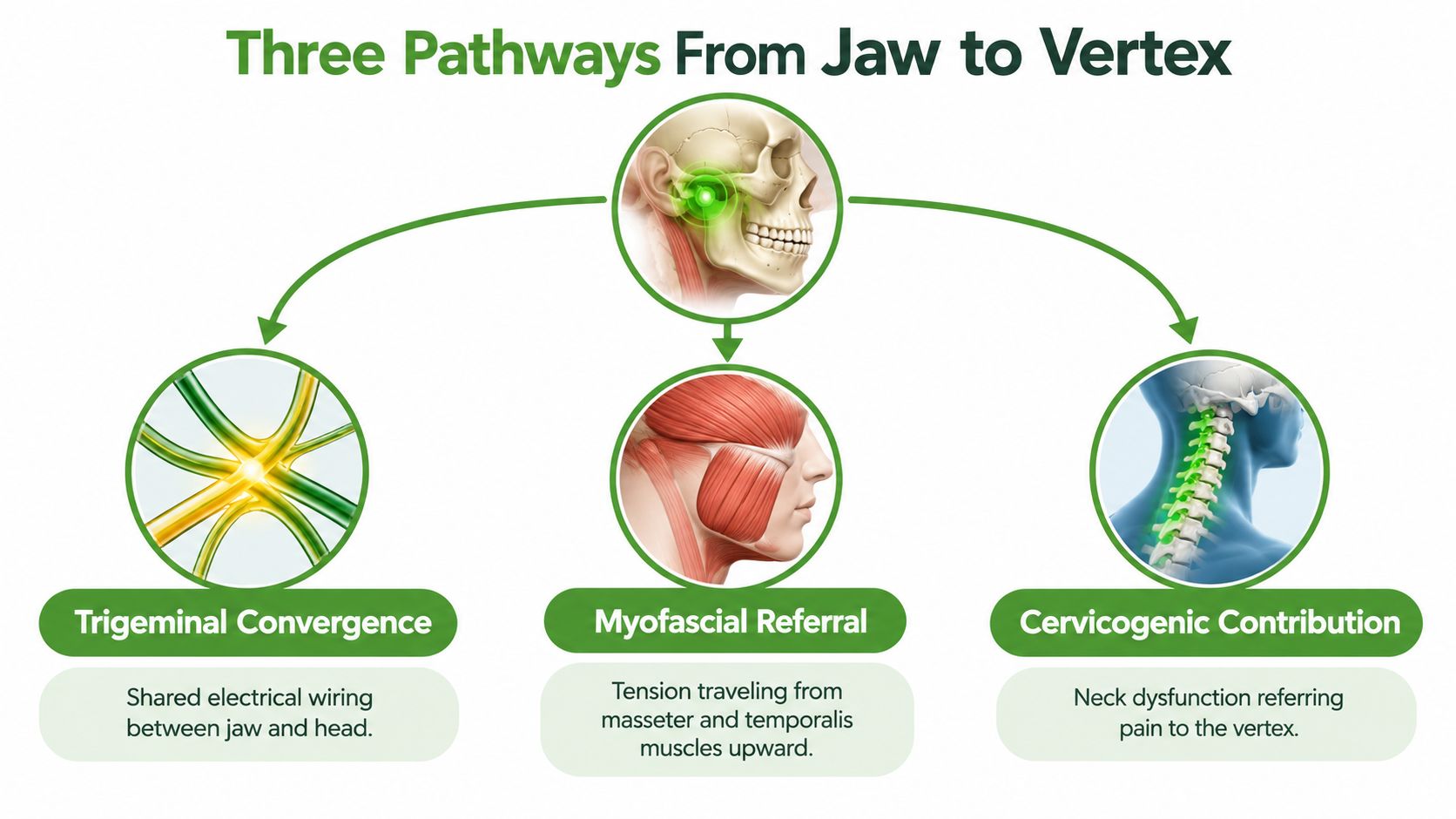
The practical implication is simple. A clinician should examine the jaw, chewing muscles, and neck together when the symptom pattern suggests a connected system.
How Clinicians Confirm a Jaw-Driven Headache
A patient may arrive describing pressure at the crown, yet the examination begins with a more useful question: what changes the pain? A scan can show joint or bone changes, but it cannot decide by itself whether those findings drive the headache. Clinicians first take a detailed history and perform a physical examination, then order imaging when a structural concern needs investigation.
The DC/TMD criteria use a reproducible pattern: the familiar headache should change with jaw movement, function, or parafunction, and the examination should recreate that pain. The published executive summary reports 89% sensitivity and 87% specificity for the relevant diagnosis (DC/TMD criteria and executive summary). The numbers describe a structured tool, not a diagnosis based on crown location alone. A vertex headache becomes more suspicious for jaw involvement when its behavior follows the jaw.
What the appointment usually covers
- History: The clinician asks whether chewing, talking, yawning, gum use, or clenching changes the headache.
- Timing: Morning pressure can prompt questions about sleep-related clenching or breathing problems. Evening symptoms may reflect muscle use accumulated through the day.
- Jaw function: The examiner watches opening, closing, deviation, clicking, locking, and painful movement.
- Palpation: The masseter, temporalis, and joint areas are checked for tenderness and reproduction of the patient's familiar pain.
- Provocation: Gentle loading or movement tests challenge the chewing system while the clinician observes whether the headache changes.
One tender spot is only a clue. The jaw becomes a stronger working explanation when several findings align, such as familiar crown pain during temporalis palpation, worsening with clenching, and improvement after jaw loading decreases. This pattern is like testing a faulty switch: changing one input and seeing the same symptom respond offers more information than just locating the symptom.
Imaging helps when trauma, joint degeneration, disc problems, or another structural condition is suspected, but it does not replace the examination. In selected cases, a diagnostic nerve block or carefully monitored response to jaw-focused treatment adds evidence. Persistent, unusual, or concerning headache features may also require neurological assessment.
TMD Headache vs Migraine vs Tension vs Neck Pain
A patient may feel pain at the crown after chewing, during a migraine, with sustained muscle tension, or because of the neck. The location is a starting point, not a diagnosis. Triggers, pain quality, associated symptoms, and examination findings help separate these possibilities.
| Symptom Cluster | TMD-Related | Migraine | Tension-Type | Cervicogenic |
|---|---|---|---|---|
| Typical triggers | Chewing, clenching, wide opening, prolonged talking | Light, sound, routine activity, hormonal or dietary triggers | Stress, fatigue, sustained concentration, muscle tension | Neck movement, posture, restricted upper-neck motion |
| Pain quality | Pressure, aching, or referred pain | Often throbbing or pulsating | Tightening, pressing, or band-like | One-sided or neck-linked aching that can spread upward |
| Radiation | Jaw or temple toward the scalp or vertex | Often one-sided, with variable head distribution | Across the forehead, temples, or whole head | From the neck or occiput toward the head |
| Associated clues | Tender jaw muscles, joint symptoms, limited or painful opening | Nausea, light or sound sensitivity, activity aggravation | Pressure without prominent neurological features | Neck stiffness, reduced rotation, suboccipital tenderness |
| Features supporting TMD | Familiar headache reproduced by jaw movement or palpation | Jaw tension may coexist but does not establish cause | Clenching may contribute without being the sole driver | Neck and jaw findings may overlap |
The crown pattern deserves specific testing because jaw-driven pain is often discussed as temple pain. TMD becomes more plausible when clenching, chewing, or jaw movement reliably changes the familiar headache, especially when examination findings reproduce it. A tender jaw alone does not prove causation. Several matching clues provide a stronger explanation.
Migraine becomes more likely when nausea, marked light or sound sensitivity, or worsening with ordinary activity dominates. Migraine and TMD can occur together, so one diagnosis does not automatically exclude the other. A 2024 review reported an odds ratio of 2.76 for migraine among people with TMD (review of TMD and headache relationships).
Neck pain can create a similar upward route. Restricted rotation, tenderness beneath the skull, or worsening mainly with head turning points toward a cervical contribution. Symptoms that change more with chewing than with neck movement support the jaw as a possible driver. Jaw and neck sources can also overlap.
For a broader view of headache-focused evaluation, see this guide to headache relief for Utah adults. For jaw-related patterns, headaches from jaw tension offers another way to track triggers and symptom changes before an appointment.
A jaw finding can explain part of the headache without explaining all of it.
Comparison charts cannot replace medical assessment. Seek prompt evaluation for a sudden severe headache, new neurological symptoms, fainting, vision changes, weakness, or confusion.
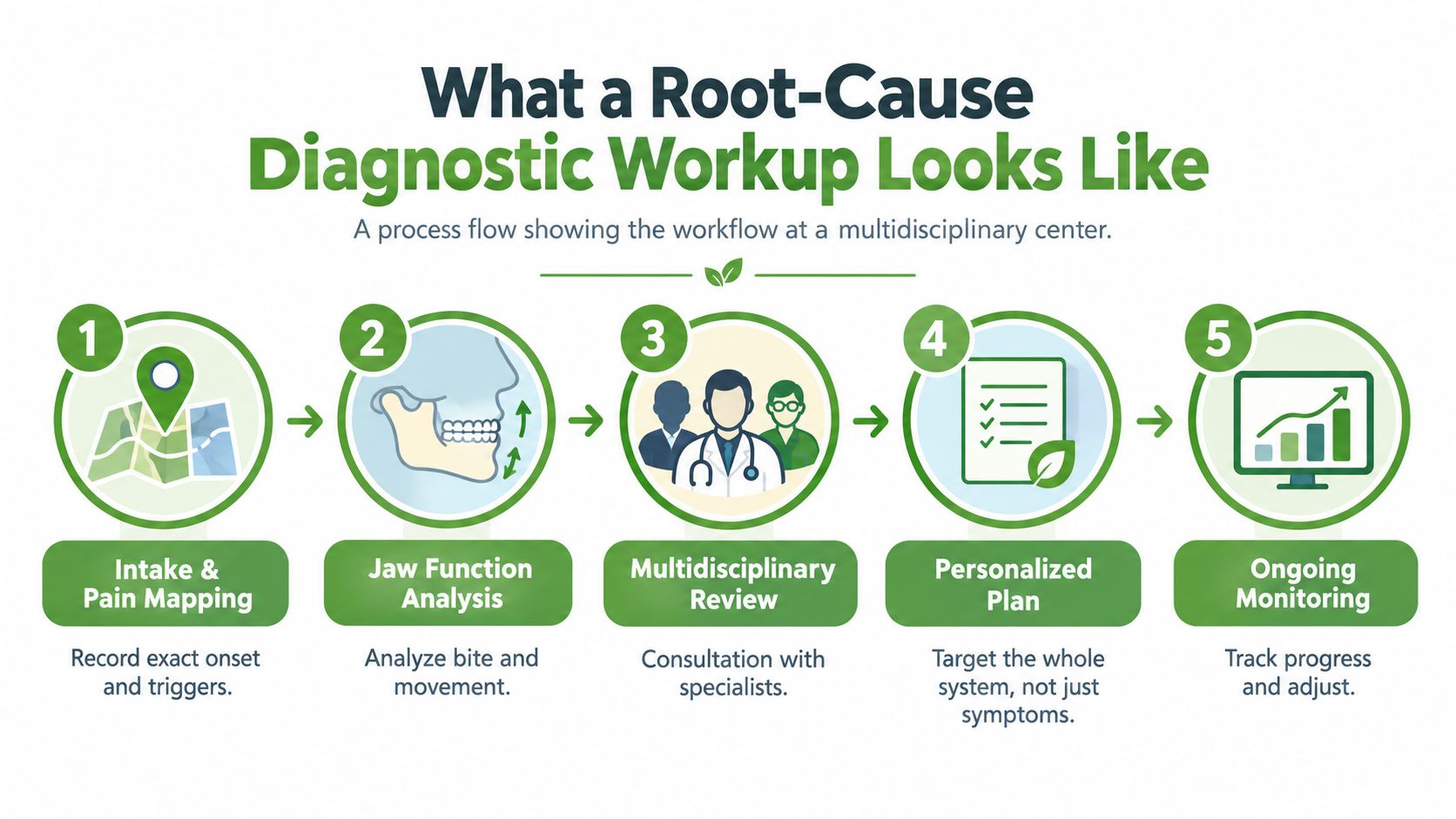
What a Root-Cause Diagnostic Workup Looks Like
A thorough workup starts with a map, not a machine. The clinician needs to know when the pain began, what changed around that time, and which actions increase or decrease it. Bring details about dental procedures, facial injury, orthodontic treatment, sleep quality, snoring, morning headaches, chewing habits, and daytime clenching.
History and movement testing
The examination usually combines jaw and neck assessment. The clinician observes the opening path, listens for joint sounds, checks whether the jaw deviates, and measures whether movement is painful or restricted. They may palpate the masseter and temporalis, assess deeper chewing muscles when appropriate, and examine the suboccipital group for tenderness.
Neck screening adds another layer. C1-C2 rotation, posture, cervical muscle endurance, and the relationship between head position and jaw movement can reveal a contributor that a jaw-only exam misses. A patient whose crown pressure increases during prolonged forward-head posture may need cervical rehabilitation alongside jaw care.
When imaging earns a place
A panoramic image can provide a broad view of the teeth and jaw structures. Cone-beam computed tomography can help assess bone, while magnetic resonance imaging can evaluate soft-tissue structures such as disc position. Each tool answers a different question, and none should be treated as a stand-alone explanation for pain.
Bringing in other disciplines
A neurologist can assess migraine, neuralgia, and other primary headache disorders when the pattern doesn't fit TMD alone. Sleep evaluation matters when morning pain, snoring, disrupted sleep, or suspected airway resistance accompanies nocturnal clenching. The aim isn't to label every symptom as jaw-related. It's to identify which systems are maintaining the pain.
A useful plan should include measurable observations, such as headache frequency, jaw opening comfort, tenderness, sleep quality, and the activities that trigger symptoms. Those markers help the team decide whether the working diagnosis is becoming more or less convincing.
Multidisciplinary Treatment Options That Target the Whole System
Treatment works better when it follows the findings. A person whose crown pain is driven mainly by temporalis overload needs a different starting point from someone with migraine biology, joint inflammation, sleep-related bruxism, or cervical restriction.
Rehabilitating the jaw and neck
A physical therapist or orofacial specialist may use gentle manual treatment, intraoral muscle work, cervical mobilization, postural retraining, and coordinated jaw exercises. The purpose isn't to force the bite into an ideal position. It's to reduce unnecessary loading, improve movement control, and help the muscles share work more efficiently.
An occlusal appliance may help selected patients with parafunctional loading, but it should be fitted and monitored for the person's symptoms and jaw function. A device shouldn't be presented as a universal correction for every bite or headache pattern.
Addressing headache sensitivity
Headache care may include trigger-point treatment, relaxation and breathing strategies, sensory modulation, and collaboration with neurology. If migraine features are prominent, the headache plan may need to address migraine biology rather than relying on jaw treatment alone. Overlapping diagnoses become clinically useful rather than confusing in such cases.
Treatment principle: Match the intervention to the driver, then reassess the whole pattern instead of judging success by one painful spot.
Considering regenerative and supportive options
Some practices offer treatments such as platelet-rich fibrin, prolotherapy for selected ligament problems, cold laser therapy, or microcurrent approaches. These interventions are intended to support tissue healing or reduce local irritation, but suitability depends on the diagnosis, examination findings, risks, and evidence for the specific problem. They shouldn't replace evaluation for migraine, sleep-disordered breathing, or neurological warning signs.
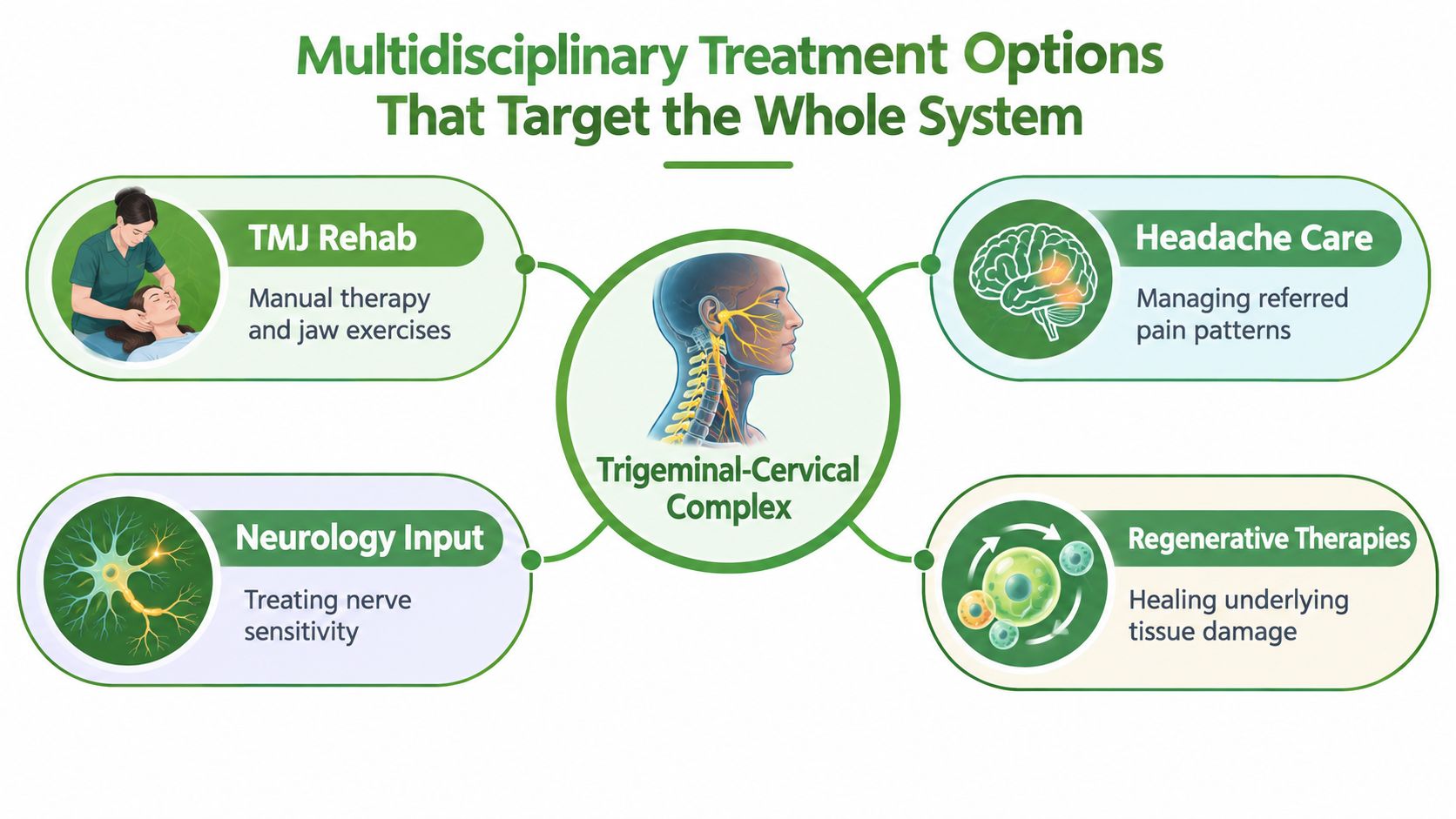
Care often begins conservatively, then becomes more targeted if symptoms persist. A jaw-focused plan may be combined with headache management, cervical therapy, and sleep or airway care when the findings support those steps. Longitudinal treatment data have found headache intensity and frequency can decrease alongside improvements in facial pain, mouth opening, and pressure pain threshold, supporting the value of tracking both headache and jaw measures during care (temporomandibular disorder treatment and headache follow-up data).
Self-Care Strategies and When to See a Specialist
You can test whether your jaw is contributing without provoking it aggressively. For a short period, reduce gum chewing, avoid very wide bites, and use softer foods during a flare. Keep your lips gently together, teeth apart, and tongue relaxed, unless a clinician has given you different instructions.
Reduce the daily load
Adjust your workstation so the screen sits at a comfortable eye level. Let your chin draw slightly backward rather than pushing the head forward, and take brief movement breaks during long periods of sitting. A gentle chin-tuck drill can help you notice head position, but stop if it increases neck or head pain.
Heat over tight jaw muscles may feel soothing, while a cool pack can be more comfortable after an irritated joint flare. Use a comfortable temperature and short applications, protecting the skin. Don't press directly on a painful joint or perform forceful stretching.
Track the pattern
Keep a simple record of:
- Jaw triggers: Note chewing, clenching, yawning, talking, and dental work.
- Neck triggers: Record screen time, posture, turning the head, and sleeping position.
- Headache features: Mark pressure, throbbing, nausea, light sensitivity, and scalp tenderness.
- Sleep clues: Record snoring, unrefreshing sleep, morning jaw soreness, and waking with a headache.
Daytime awareness cues can interrupt unconscious clenching. Set a discreet phone reminder, lower your shoulders, let the teeth separate, and breathe gently through the nose if comfortable. Sleep hygiene may reduce overall arousal, but it can't correct an obstructed airway or diagnose sleep apnea.
Self-care won't realign a displaced disc, reverse degenerative joint changes, or resolve obstructive sleep apnea. Arrange an evaluation with facial pain specialists if the jaw repeatedly reproduces the headache, symptoms continue despite conservative care, the jaw locks, or morning headaches occur with snoring. Seek urgent medical attention for new weakness, numbness, confusion, fainting, vision loss, or a sudden severe headache.
A practical starting checklist looks like this:
- Pain changes with chewing or clenching: Prioritize a TMJ and masticatory muscle assessment.
- Pain changes with neck movement: Add cervical evaluation.
- Throbbing pain with nausea or light sensitivity: Discuss migraine assessment.
- Morning pain with snoring or poor sleep: Request sleep and airway screening.
- Several patterns appear together: Look for coordinated care rather than a single treatment.
Pain and Sleep Therapy Center evaluates TMJ pain, facial pain, headaches, and sleep-related breathing concerns with root-cause testing that may include jaw function, airway, sleep, and neurology-related factors. Visit Pain and Sleep Therapy Center to discuss a personalized assessment if your crown pain may be connected to clenching, jaw dysfunction, or poor sleep.