
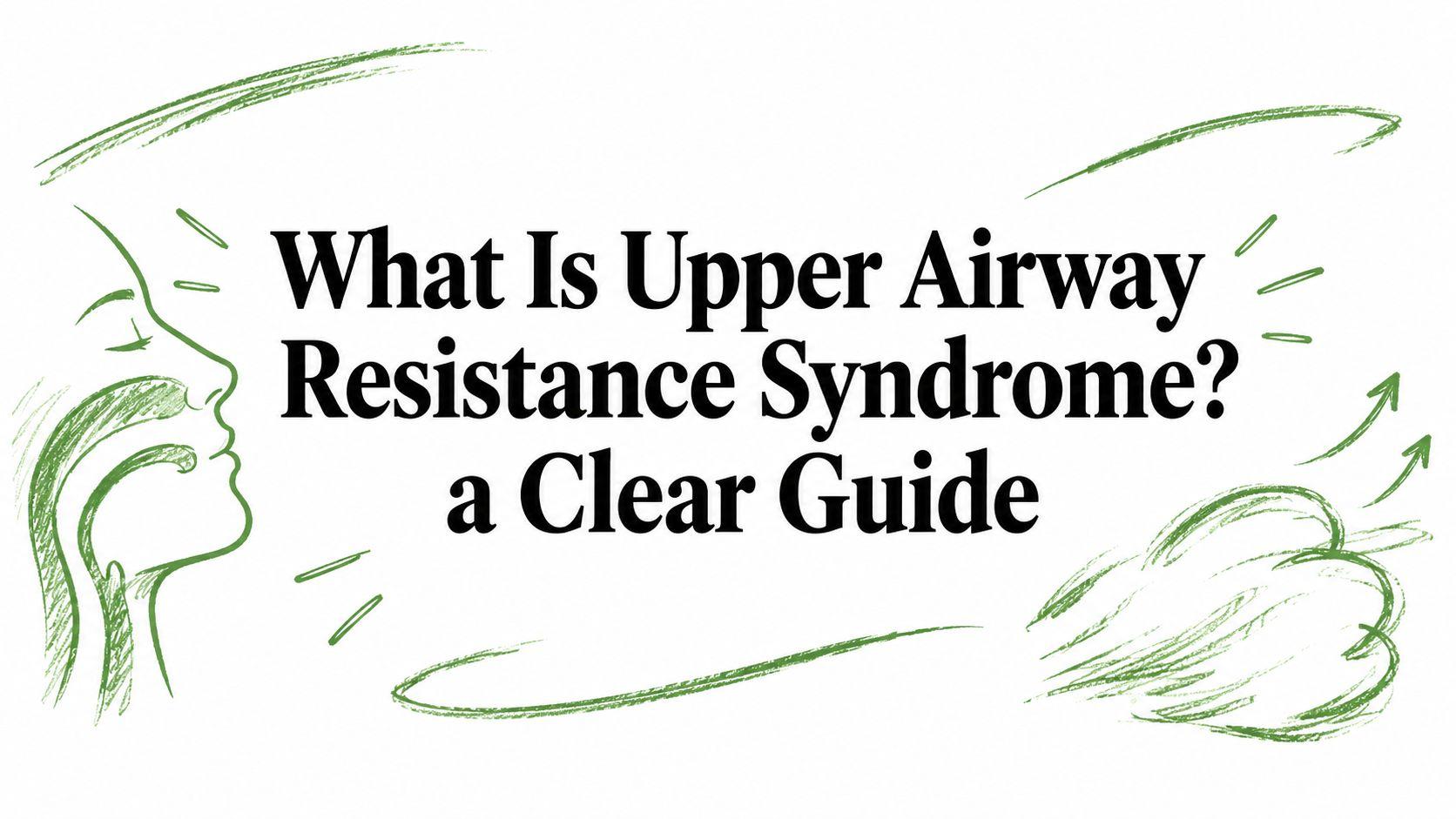
Upper airway resistance syndrome (UARS) is a sleep-related breathing disorder in which a narrowed upper airway raises breathing effort and fragments sleep, even when oxygen levels and the apnea–hypopnea index look normal. A commonly used research profile includes an apnea–hypopnea index below 5 events per hour and oxygen saturation maintained at or above 92%.
You may recognize the situation before you recognize the name: you spend a full night in bed, wake up exhausted, and struggle to concentrate through the afternoon. Then a sleep test comes back reassuring, leaving you wondering whether you're imagining the problem.
You aren't wrong to ask more questions. For someone seeking sleep care in Charlotte, NC, the next step may be understanding what the test measured, what it missed, and how your airway behaves during sleep.
Understanding Upper Airway Resistance Syndrome
There's a quiet kind of tired that doesn't look dramatic from the outside. You get through work, answer messages, and keep appointments, but waking up never feels like starting fresh. Spending enough time in bed doesn't necessarily mean you're getting uninterrupted, restorative sleep.
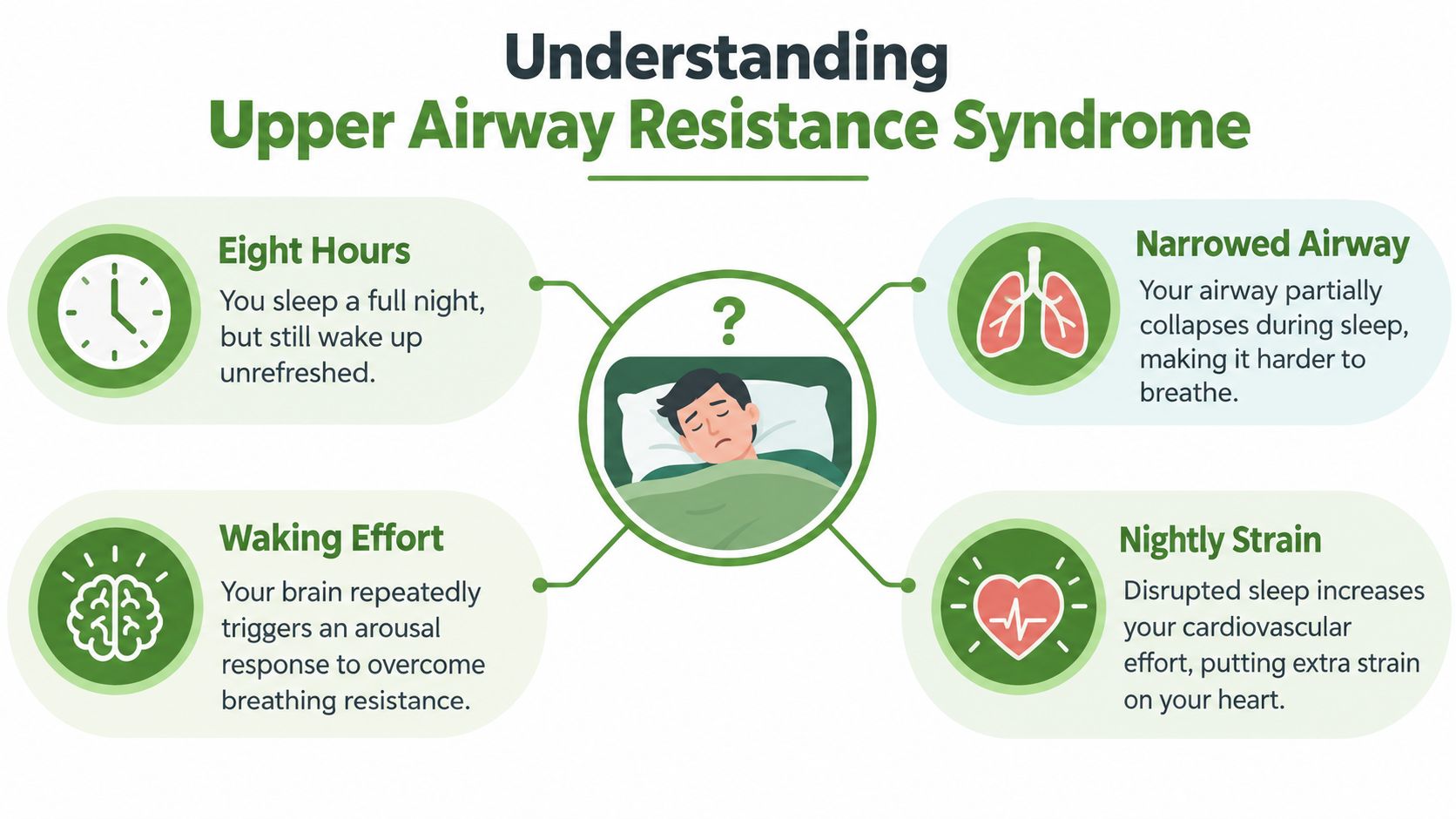
With UARS, air still passes through the upper airway, but the passage becomes narrower during sleep. Your body has to work harder to draw that air inward, and repeated effort can interrupt sleep without the oxygen drops usually associated with obstructive sleep apnea. These interruptions are called respiratory effort–related arousals, or RERAs, as described in this clinical discussion of UARS and its diagnostic boundaries.
Think of a Partially Compressed Garden Hose
A garden hose doesn't have to be completely blocked to restrict water flow. If someone steps lightly on it, water continues moving, but the opening is smaller.
That's a useful analogy for UARS, with an important difference: your respiratory muscles actively pull air through the restricted passage. Your brain briefly interrupts sleep to help restore easier breathing. You may not remember those interruptions the next morning.
The concept map below connects airway narrowing with the experience of waking unrefreshed.
Why the Distinction Matters
The practical question isn't whether you stopped breathing. It's whether breathing became difficult enough to repeatedly disturb your sleep.
A useful distinction: Time asleep and quality of sleep aren't interchangeable. A reassuring oxygen reading doesn't answer every question about breathing effort.
That doesn't mean every tired person has UARS. It means persistent exhaustion deserves an explanation that considers symptoms alongside the actual sleep-study signals.
An airway-focused evaluation asks about the breathing pathway, including nasal obstruction, jaw position, and other anatomical factors. Rather than dismissing the problem because one measurement looks reassuring, the clinician asks whether the measurements explain how you feel.
How UARS Differs from Obstructive Sleep Apnea
UARS and obstructive sleep apnea belong within the broader spectrum of sleep-disordered breathing. The distinction concerns what happens to airflow, how the body responds, and which events a sleep study counts.
In obstructive sleep apnea, clinicians look for qualifying episodes of stopped or reduced breathing, called apneas and hypopneas. UARS emphasizes flow limitation and effort-related sleep disruption that may not qualify for those categories.
UARS vs Obstructive Sleep Apnea
| Feature | UARS | OSA |
|---|---|---|
| Airway behavior | Narrowing increases resistance while airflow continues | Obstruction produces qualifying apneas or hypopneas |
| Oxygen impact | Oxygen can remain relatively preserved | Repeated oxygen drops are typically associated with obstructive events |
| Diagnostic thresholds | Research definitions combine a low AHI with evidence of effort-related disruption | Diagnosis relies on qualifying apnea and hypopnea events interpreted with clinical findings |
| Common patient profile | Fatigue or unrefreshing sleep may dominate; appearance alone can't establish the diagnosis | Symptoms and objective testing matter more than a familiar snoring stereotype |
| Risk of being missed | Greater when testing doesn't capture flow limitation or arousals | Qualifying obstructive events are the focus of conventional apnea testing |
The apnea–hypopnea index, abbreviated AHI, counts qualifying apneas and hypopneas per hour of sleep. It's useful, but it doesn't automatically account for every difficult breath or every interruption of sleep.
A report can therefore answer the question about conventional apnea events without fully resolving the question about respiratory effort. That's the source of much of the confusion: the patient hears that the study is normal, while the clinician may mean that the AHI didn't meet the conventional apnea threshold.
Similar Symptoms Don't Mean Identical Patterns
Fatigue, headaches, poor concentration, and unrefreshing sleep don't neatly identify one disorder over the other. Nor should someone be excluded from evaluation because they don't resemble the person they associate with sleep apnea.
The comparison table is a guide, not a self-diagnosis tool. Clinicians still need to examine the recorded events, symptoms, and airway findings together.
UARS is best understood as a non-hypoxic or minimally hypoxic form of sleep-disordered breathing, not as a mild version of OSA. Its importance comes from the disruption it causes, not from how dramatic an oxygen tracing looks.
What Happens During a UARS Night
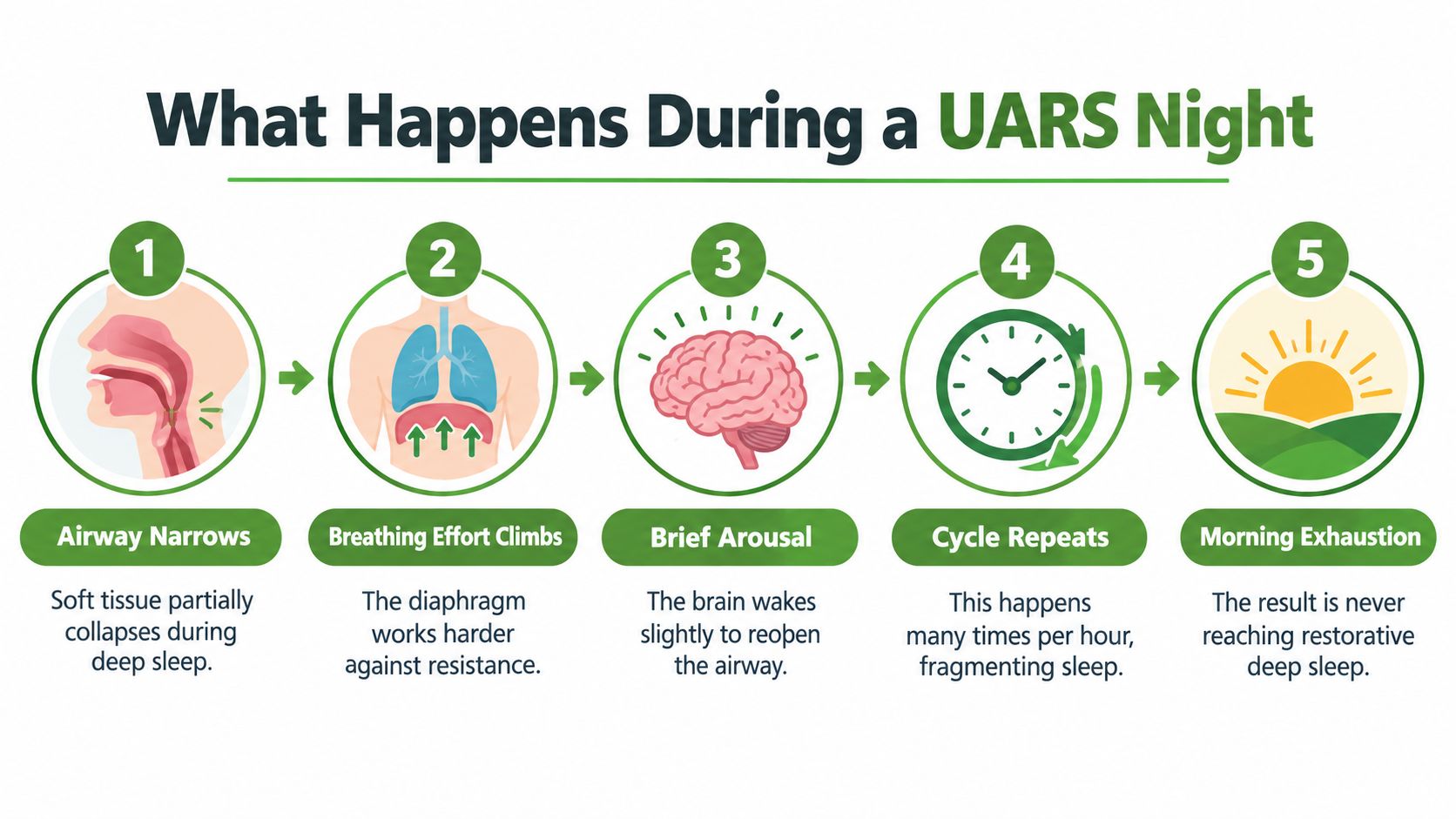
The nighttime sequence starts with restricted airflow. As the airway narrows, the sleeper increases the effort needed to inhale; eventually, a brief brain arousal helps restore easier breathing.
The illustration below shows that sequence. Its morning-exhaustion endpoint is a useful simplification, but UARS doesn't mean someone never reaches deep sleep.
What a RERA Means
A respiratory effort–related arousal is a stretch of increasingly difficult breathing that ends with a brief interruption of sleep, without qualifying as an apnea or hypopnea.
The American Academy of Sleep Medicine describes a RERA as at least 10 seconds of progressively increasing respiratory effort ending in arousal, without meeting apnea or hypopnea criteria, in its polysomnography practice parameters. The arousal is identified through brain-wave recording, not merely by whether the patient remembers waking.
On a nasal-pressure tracing, clinicians may see a flattened inspiratory waveform. In plain language, the shape of the signal suggests that airflow isn't increasing normally despite the sleeper's effort.
Esophageal pressure monitoring can measure that effort more directly. A small pressure-sensing catheter detects increasingly negative pressure inside the chest as the person works harder to inhale; it provides physiological detail, although it's invasive and isn't needed in every evaluation.
The video offers another visual reference for understanding sleep-related breathing.
Research Criteria Aren't a Universal Rule
A commonly cited research profile combines AHI below 5 events per hour, oxygen saturation at or above 92%, and a RERA index of at least 5 per hour, according to this overview of UARS diagnostic definitions. Another formulation requires airflow limitation during at least 5% of total sleep time, together with daytime sleepiness or fatigue, as the same overview explains.
Those differences matter. UARS thresholds aren't completely standardized, so a clinician should explain which definition and scoring approach were used.
The memorable version is this: the airway keeps needing help, and the brain keeps responding. Repeated interruptions can make sustained restorative sleep harder to maintain, even when the person doesn't recall a troubled night.
Symptoms and Why UARS Often Goes Undiagnosed
Consider a hypothetical patient who wakes with a headache, loses focus during meetings, and feels tired despite keeping a regular bedtime. They remember occasional nighttime awakenings but don't have a bed partner describing dramatic breathing pauses.
They may wonder about anxiety, depression, ADHD, or just getting older. Those concerns deserve attention, but they shouldn't automatically end the discussion about sleep.
Look at the Pattern, Not One Symptom
UARS symptoms can include persistent fatigue, unrefreshing sleep, morning headaches, difficulty concentrating, mood symptoms, and unexplained awakenings. No single symptom proves that breathing resistance is responsible, and loud snoring shouldn't be treated as a prerequisite for asking about an airway problem.
The strongest available population estimate comes from the São Paulo Epidemiologic Sleep Study, using a representative urban adult sample collected in Brazil in 2007 and reported in 2022. Under its specified research definition, researchers estimated UARS prevalence at 3.1% overall, 4.4% among women, and 1.5% among men, with greater frequency among younger adult women, as summarized in this clinical overview of UARS epidemiology.
That study establishes a population-level signal, not a universal global rate. Definitions vary, laboratories don't consistently score RERAs, and the syndrome's boundaries remain debated, as the same clinical overview explains.
When to Ask for an Airway-Focused Workup
Bring the pattern to a clinician if you recognize these concerns:
- Persistent fatigue after reassuring testing: Ask whether the report evaluated more than conventional apnea events.
- Snoring with mouth breathing: Mention nasal blockage and how you breathe during sleep, even if the snoring seems mild.
- Repeated nighttime awakenings: Describe the pattern rather than assuming every awakening is respiratory.
- Recurring morning headaches: Discuss sleep alongside other possible headache causes.
A helpful appointment starts with observations, not a demand for a particular diagnosis. Explain what mornings feel like, whether you struggle to stay awake or mainly feel depleted, and what your previous testing concluded.
The right response is neither to dismiss the symptoms nor to assume UARS explains everything. It's to investigate the mismatch between your experience and the reassuring result.
How UARS Is Diagnosed
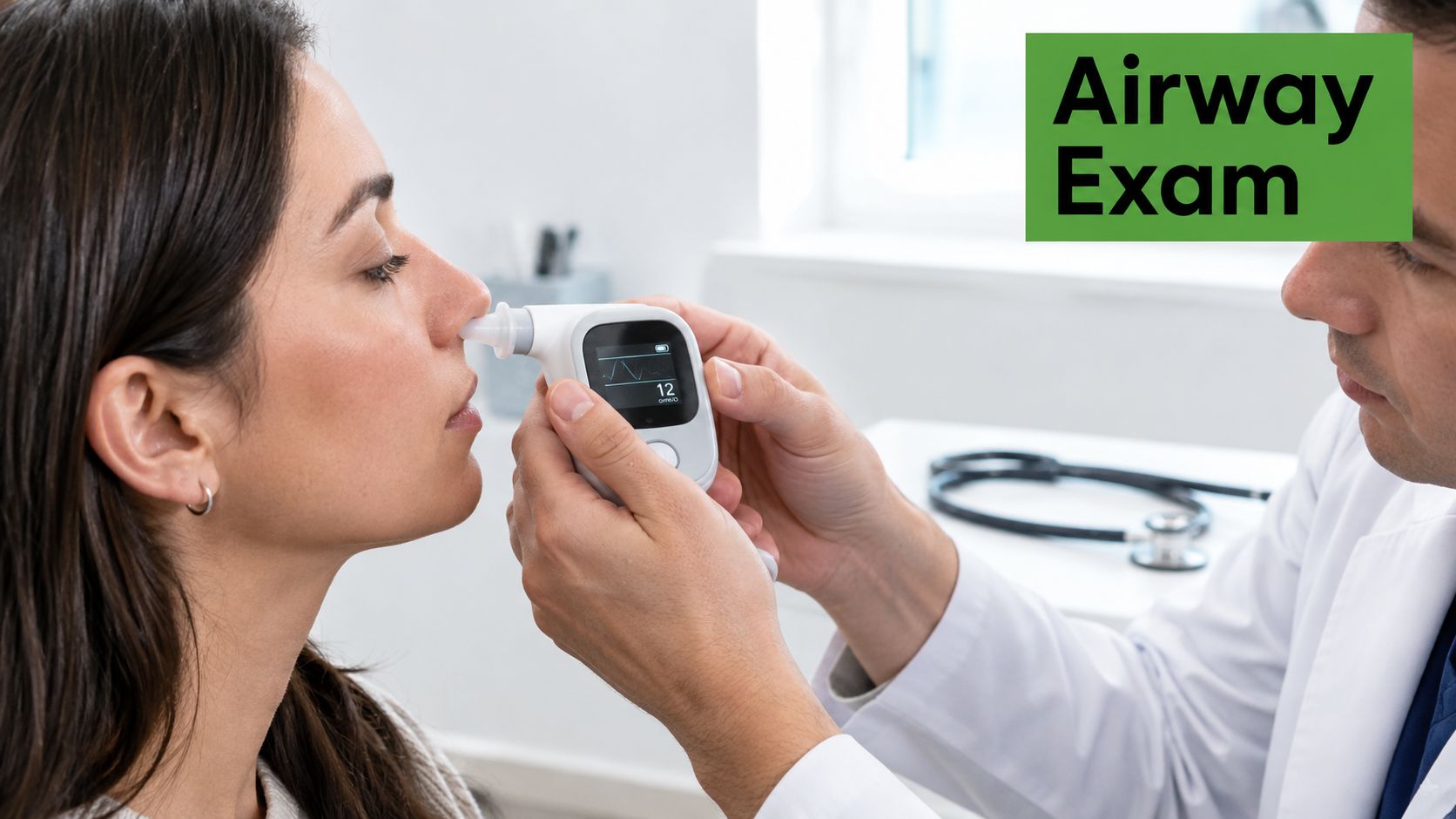
Diagnosis starts with a conversation about symptoms, sleep habits, prior testing, and medical history. An airway-focused examination then considers nasal obstruction, craniofacial anatomy, jaw position, and other findings that may help explain restricted breathing.
An examination can identify reasons for further investigation, but it can't establish the nighttime event pattern by itself. That requires appropriate sleep testing and interpretation.
Home Testing and Attended Polysomnography
A home sleep apnea test, or HSAT, can be useful in an apnea evaluation. However, it may miss subtle flow limitation and EEG-based arousals, producing a falsely reassuring result when UARS is the concern.
An attended polysomnogram can provide a more informative evaluation by combining airflow shape, thoracoabdominal effort, oxygen saturation, snoring, and arousal scoring. This review of UARS evaluation methods explains why respiratory workload may not track reliably with AHI and why esophageal manometry can sometimes add useful information.
The distinction isn't that every home test is inadequate. It's that the test must be capable of answering the clinical question. For background on the broader testing pathway, review this guide to obstructive sleep apnea diagnosis.
What to Ask About Your Report
Instead of stopping at the headline result, ask your clinician to review:
- Airflow shape and effort: Did the study capture inspiratory flow limitation and increasing breathing effort?
- RERAs and respiratory-disturbance index: Were effort-related events scored and included in interpretation?
- Arousal index and sleep stages: How fragmented was sleep, and were interruptions linked to breathing?
- Oxygen and airway findings: How do the oxygen profile, nasal obstruction, and anatomy fit your symptoms?
Practical rule: A low AHI isn't the same as low respiratory workload. Interpretation should explain the whole recording, not just one score.
Don't Assume the Airway Is Always the Answer
Fatigue and hypersomnolence require a broader assessment too. Your clinician should review sleep opportunity, medications, medical history, and other potential explanations rather than assigning every symptom to UARS.
Sometimes the next step is more detailed sleep testing; sometimes it's evaluation in another direction. A careful diagnosis leaves room for both possibilities and avoids treating an airway finding as proof that it caused all of your symptoms.
Airway-Focused and Non-Surgical Treatment Options
A sensible treatment plan matches the intervention to the documented problem. For someone seeking non-surgical UARS care in Charlotte, that means discussing conservative airway work without assuming it can replace treatment for objectively measured breathing disruption.
Positive-airway-pressure therapy, oral appliances, and upper-airway evaluation belong among the options considered in coordinated care. This clinical discussion relevant to sleep-breathing care planning62751-1/fulltext) supports considering treatment in the context of objective findings, anatomy, and symptoms.
Start With the Identified Airway Problem
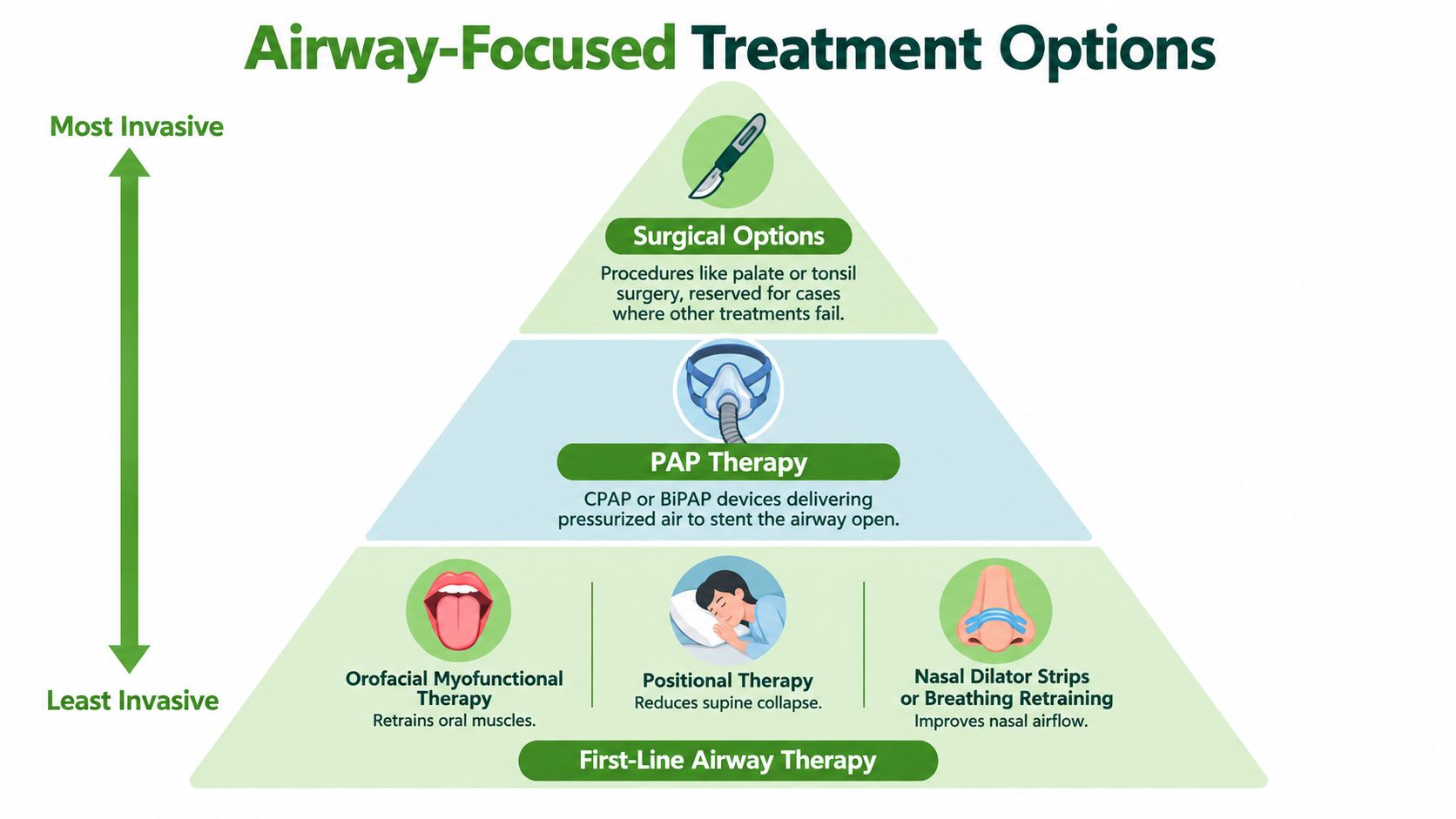
Orofacial myofunctional therapy addresses oral-function patterns such as tongue posture, lip closure, and swallowing. The breathing target is comfortable nasal breathing with an appropriate lip seal, not lips-apart breathing. It should be discussed as a targeted component of care, not a guaranteed stand-alone cure for UARS.
Buteyko and other breathing-retraining methods may be considered when habitual breathing patterns need attention. Ask what the exercises are intended to change and how the team will distinguish improved daytime breathing habits from improvement in nighttime respiratory events.
Nasal-breathing rehabilitation and allergy or congestion management deserve consideration when nasal obstruction is present. Exercises shouldn't substitute for assessing a blocked nose.
The hierarchy below organizes treatment categories by invasiveness, but it shouldn't be read as a mandatory sequence for every patient.
Match Support to the Sleep Findings
- Positional work: Ask whether the recording shows a meaningful difference between back sleeping and other positions before relying on positional therapy.
- Custom oral appliances: Discuss whether an appliance that advances the lower jaw is appropriate for your airway findings, dental health, and jaw comfort.
- PAP therapy: CPAP deserves consideration when sustained airway support is needed. It doesn't have to wait until every conservative option has failed.
- EPAP or surgery: These require a specific clinical rationale and specialist discussion, rather than an assumption that they're interchangeable with other treatments.
For context when comparing appliance-based approaches, Dental Professionals of Fair Lawn offers a resource on ways to treat sleep apnea without a machine. Information about OSA alternatives doesn't establish that every option is appropriate for UARS; a local guide to non-surgical sleep apnea treatment can help frame questions for your consultation.
Root-cause care means addressing identified contributors while checking the result. The desired outcome is better breathing and more restorative sleep, not merely quieter snoring or improved exercise technique.
Daytime Function, Comorbidities, and Finding Care in Charlotte
The daytime question is straightforward: can you think clearly, stay alert, and feel reasonably restored? When your nights are repeatedly interrupted, fatigue, concentration problems, headaches, and mood symptoms can become the concerns that finally bring you into care.
If you also have TMJ pain or facial muscle tension, mention those symptoms. Their coexistence doesn't prove that UARS caused the pain, but it gives the team important information when considering jaw-based treatment and coordinating care.
Keep the Connections Clinically Honest
Claims about UARS causing altered pain sensitivity, progressive illness, or long-term cardiovascular damage need more caution than a symptom checklist. Your clinician should discuss your individual health risks without assuming that evidence about obstructive sleep apnea applies identically to UARS.
The most useful care plan connects the findings that are present. It doesn't invent a single explanation for every symptom.
For patients in Ballantyne, Blakeney, and greater South Charlotte, an interdisciplinary evaluation may involve a sleep physician, dental sleep-medicine clinician, ENT, and primary-care provider. Depending on the problem, orofacial myofunctional therapy, Buteyko breathing instruction, or neurology input may be relevant.
Prepare for a Charlotte Consultation
Bring your complete sleep-study report, not just the result summary. Include information about nasal obstruction, headaches, jaw discomfort, medications, and what has or hasn't helped.
A clinic sleep quiz can help organize your concerns, but it isn't a diagnosis. Referring clinicians can use doctor-support resources to share findings and clarify whether the patient needs dental airway assessment, attended sleep testing, ENT evaluation, or coordinated follow-up.
Parents seeking pediatric oral-health care should request an age-appropriate assessment rather than apply adult UARS criteria to a child. Collaboration matters more than forcing everyone into the same pathway.
UARS has treatment options once the relevant breathing pattern is recognized. The useful next step isn't waiting for fatigue to disappear on its own, but finding a team that can connect symptoms, airway findings, and the right testing.
Pain and Sleep Therapy Center offers Charlotte, NC patients individualized care for sleep-related breathing issues, TMJ disorders, and facial pain, with interdisciplinary input that includes dental sleep medicine and airway-focused therapies. Visit the practice to use its sleep quiz and request a consultation, and bring any previous sleep-test results so the team can discuss whether your persistent fatigue warrants further UARS evaluation.