A Charlotte teacher wakes with sore jaw muscles, a morning headache, and a click every time she chews breakfast. She has already tried a night guard and over-the-counter pain relievers, but the relief never lasts. Her next question is understandable: What exactly does cold laser therapy treat, and can it correct the reason my jaw hurts?
Cold laser therapy, also called photobiomodulation (PBM) or low-level laser therapy, may help some people with jaw and facial pain. But the device itself isn't the diagnosis. At a Charlotte TMJ and sleep practice, the useful question is whether non-thermal light fits the specific pain pattern, the treatment target, and the rest of the care plan. Patients comparing regenerative options can also review this regenerative medicine resource for broader context.
What Cold Laser Therapy Is and Why Charlotte Patients Ask About It
The teacher in this example may have muscle overload from clenching, irritation inside the temporomandibular joint, poor oral posture, sleep-related breathing problems, or several contributors at once. Clicking alone doesn't identify the cause. A careful evaluation looks at jaw movement, tenderness, headaches, bite forces, breathing patterns, sleep symptoms, and whether the pain is primarily muscular, joint-related, or mixed.
Cold laser therapy uses red or near-infrared light at an intensity intended not to heat tissue. The goal isn't to cut, burn, or reshape the joint. Instead, photobiomodulation is used as a local biological signal that may influence pain sensitivity, inflammation, and tissue function.
A 2025 systematic review of 18 randomized controlled trials involving 1,038 people found that photobiomodulation improved pain and mandibular function in both muscular and articular temporomandibular disorders, with effects appearing more consistent for intra-articular disease (systematic review of photobiomodulation for TMD). That finding is encouraging, but it doesn't mean every patient needs laser or that every cause of jaw pain responds in the same way.
Practical rule: A credible provider should be able to explain what structure is being treated, what outcome will be measured, and what happens if the first treatment course doesn't help.
The word “laser” can make a treatment sound more powerful or precise than it is. The meaningful details are the wavelength, dose, treatment points, visit schedule, diagnosis, and how the therapy is combined with exercises, oral appliances, behavioral changes, or airway care. Those details determine whether a session is a thoughtful adjunct or a device applied to a painful area.
How Cold Laser Works at the Cellular Level
Think of a mitochondrion as a small battery inside a cell. When tissue is stressed by inflammation, overload, or injury, the cell's energy systems and signaling pathways may not function normally. Photobiomodulation uses selected light to influence those systems without relying on heat.
The proposed process begins when photons are absorbed by mitochondrial cytochrome c oxidase, a component of the electron transport chain. This mechanism is described in the discussion of PBM biology from Medicina Oral, Patología Oral y Cirugía Bucal. The resulting signaling may affect ATP production, mitochondrial membrane potential, reactive oxygen species, cyclic AMP, and inflammatory pathways.
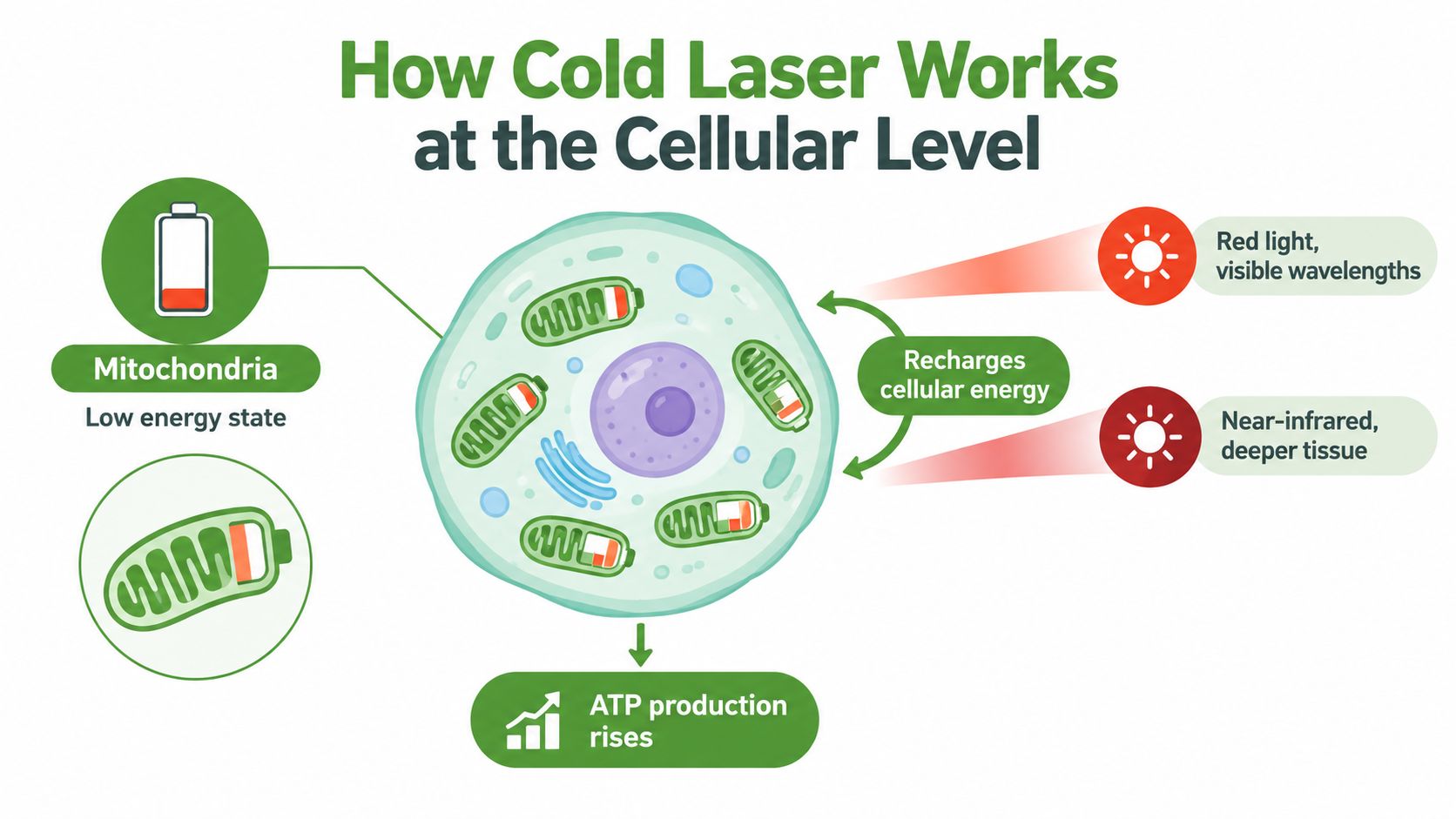
At the patient level, those cellular changes may translate into less sensitivity in irritated tissues and better tolerance for movement or rehabilitation. The International Association for the Study of Pain reports that the analgesic mechanism isn't fully understood, while describing possible relationships with reduced oxidative stress and lower inflammatory mediators, including prostaglandin E2, interleukin-1 beta, and tumor-necrosis-factor alpha.
The important distinction is signaling rather than heating. Cold laser therapy isn't intended to create a thermal injury, and it doesn't directly reposition a displaced disc, retrain tongue posture, eliminate bruxism, or treat obstructive sleep apnea. A useful patient-facing explanation of the mechanism is available in this guide to how cold laser therapy works.
The Main Clinical Uses for Cold Laser Therapy
Cold laser can have a role in several pain presentations, but its role changes with the diagnosis. In a Charlotte TMJ and facial-pain setting, treatment is usually considered after the clinician identifies the likely pain generator and decides what the light is expected to influence.
| Clinical Use | Typical Role | Evidence Strength |
|---|---|---|
| Joint-dominant TMD | Adjunct for pain and movement limitation when the joint is irritated | More consistent TMD response, though protocol variation matters |
| Masseter and temporalis tenderness | Supportive treatment for painful, overloaded chewing muscles | Promising, with results varying by dose and diagnosis |
| Post-procedure facial soreness | Short-term adjunct when local tissue irritation contributes to discomfort | Condition-specific and not a substitute for follow-up |
| Soft-tissue injury around the jaw or neck | May support pain and inflammatory management | Potential benefit, but evidence certainty varies by condition |
| Certain headache patterns | Considered only when muscular or jaw-related contributors are present | Adjunctive rather than a stand-alone headache treatment |
For temporomandibular joint pain, the purpose is to address local pain sensitivity and inflammation while the clinician also evaluates joint loading, movement, bite forces, and possible internal joint disease. For masseter or temporalis pain, light may be directed at tender muscles, but the underlying clenching, posture, stress response, or sleep-related muscle activity still needs attention.
Post-procedure soreness and soft-tissue injuries may be reasonable adjunctive targets. They shouldn't be presented as proof that the therapy repairs every wound or guarantees faster recovery. An umbrella review found potential benefits across pain, wound healing, tissue regeneration, and inflammatory responses, but rated certainty as low to moderate for most outcomes and called for more standardized protocols (umbrella review of PBM evidence).
Headache treatment requires particular caution. A laser session may help when jaw or facial muscle pain contributes to the headache, but it doesn't establish why the headache occurs or replace neurological assessment when symptoms warrant it. Patients who want a broader explanation of red and near-infrared light can review this overview of Sunridge Medical light therapy, while keeping in mind that evidence depends on the diagnosed condition and protocol.
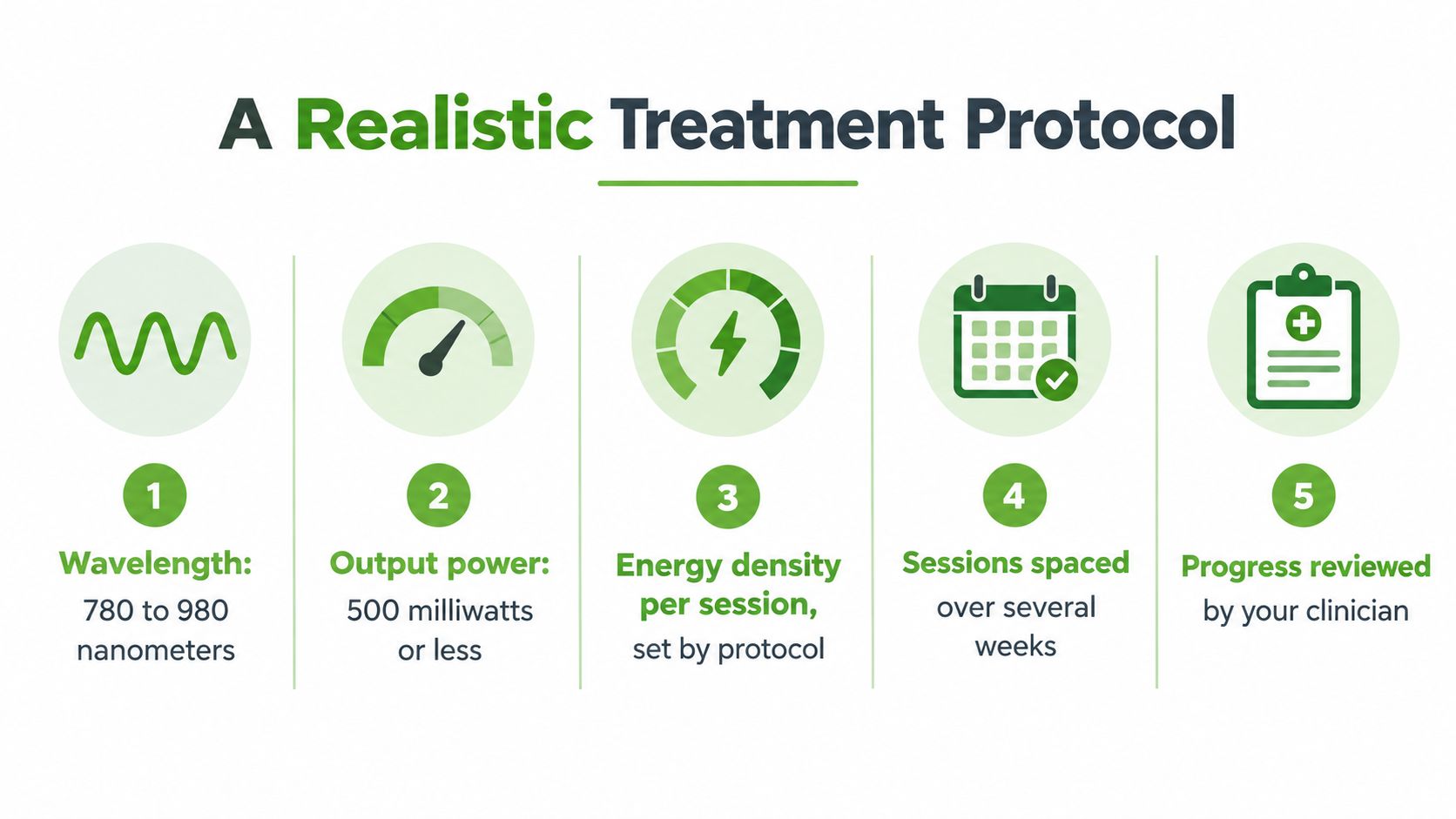
For TMD, commonly studied protocols used infrared diode lasers at approximately 780 to 980 nanometers, output power at or below 500 milliwatts, and at least six treatment sessions. Those values describe research patterns, not a universal prescription.
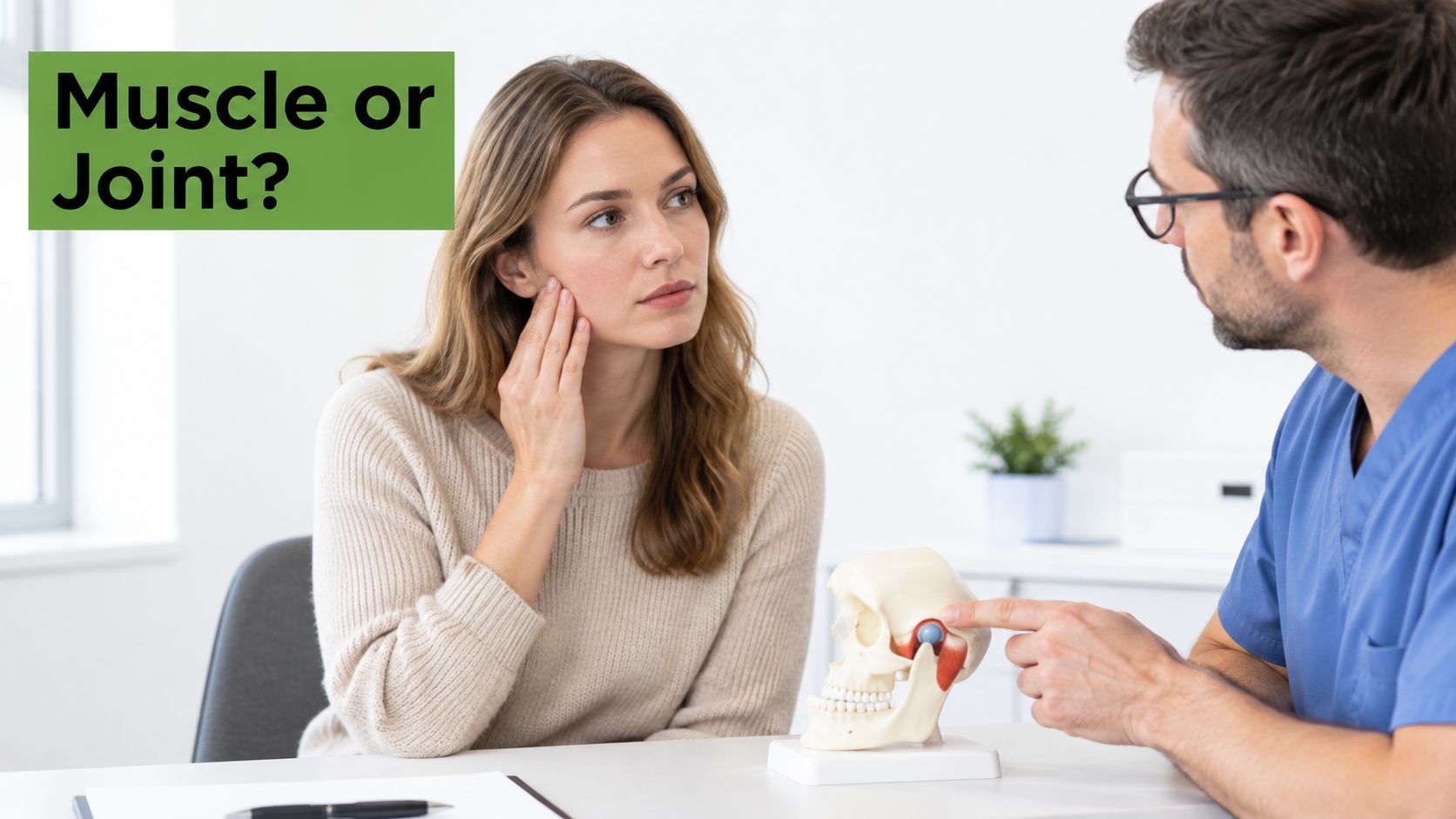
Muscular vs Joint-Dominant TMJ and Why the Difference Matters
Two patients may call it “TMJ pain” while needing different evaluations and treatment.
Muscular TMD centers on painful or overactive chewing muscles, commonly the masseter, temporalis, and nearby neck muscles. Patients may describe tenderness during chewing, morning tightness, fatigue, or pain spreading toward the temple and face. A useful plan can include behavior changes, therapeutic exercise, myofunctional rehabilitation, an oral appliance, and assessment of clenching or sleep-related muscle activity.
Joint-dominant TMD suggests irritation or dysfunction within the temporomandibular joint. Localized joint tenderness, painful opening, restricted movement, and mechanical symptoms warrant closer examination. Cold laser may help as an adjunct for symptoms, but it cannot identify or correct every internal joint problem.
The practical implication is diagnosis-led treatment. A laser series should be planned around the suspected subtype and treatment target, since the response may differ between muscle-driven and articular symptoms. The review also reported more consistent effects for intra-articular disease, while showing that improvement does not prove the underlying driver has been corrected (the review's findings).
In clinic, I look for what keeps loading the muscles or joint. Bruxism, altered oral posture, airway-related dysfunction, and structural joint concerns can all change the plan. A successful response may make movement more comfortable without removing those contributors, so cold laser works best as one part of a broader TMJ assessment rather than a standalone fix.
What a Realistic Treatment Protocol Looks Like
A responsible plan should specify what was treated, how it was treated, and how improvement will be judged. “Cold laser” alone does not describe a dose. Using the parameter ranges introduced earlier, the practical question is how they map to your diagnosis, target tissue, and treatment goal.
One evidence synthesis reported favorable results with 800 to 900 nanometers, 100 to 500 milliwatts, and energy density below 10 joules per square centimeter. Another review described research protocols using energy density below 100 joules per square centimeter (TMD protocol review, review of randomized trials). These findings describe studied approaches, not a universal prescription.
Before treatment, ask:
- Device and indication: Which device is being used, and is it intended for the condition being treated?
- Wavelength and power: What are the settings, and why do they suit the target tissue?
- Treatment points: Will the clinician treat the joint, masseter, temporalis, neck, or another site? What finding supports that choice?
- Schedule: How often will visits occur, and what would justify changing the frequency? Published protocols commonly use repeated visits across several weeks.
- Outcome measure: Will progress be tracked through pain ratings, jaw opening, chewing tolerance, headache frequency, or another defined measure?
A review of 44 randomized trials involving 1,816 participants reported pain reductions of roughly 60 to 70% and maximum-mouth-opening improvements of 10 to 20%. It also identified substantial variation in laser parameters and treatment protocols, limiting how directly those results can guide one patient (review of 44 randomized trials). The figures support careful selection, not a guaranteed response.
A documented plan should include a reassessment point. If pain, opening, headaches, or function remain unchanged, the clinician should reconsider the diagnosis, dose, treatment target, or need for another intervention. Patients can review these cold laser therapy protocols before an appointment.
What to Expect at a Cold Laser Appointment in Charlotte
A first visit at a Charlotte specialty clinic should begin with assessment, not immediate device placement. The clinician needs to determine whether the symptoms are muscular, joint-related, or mixed, and whether snoring, mouth breathing, poor sleep, or other airway concerns may be contributing to jaw loading and facial tension.
If cold laser is appropriate, the patient typically wears protective eyewear. The handheld applicator is placed against the skin over selected areas, such as the temporomandibular joint, masseter, or temporalis. The treatment is intended to be non-thermal, so patients generally shouldn't experience cutting, burning, or significant heat.
A session may feel uneventful. Some patients notice contact from the probe or mild warmth, and temporary fatigue can occur after a visit. The experience isn't a test of effectiveness. Feeling nothing doesn't mean the treatment failed, and feeling warmth doesn't prove that tissue is being repaired.
The schedule is often planned around two to three visits each week for roughly four weeks when following frequently studied TMD patterns. The exact plan depends on the diagnosis, treatment points, energy delivery, and response.
How the clinician decides whether to continue
Progress should be measured in practical terms. Can the patient chew with less discomfort? Is opening easier? Are morning headaches or facial tenderness changing? Is the patient tolerating exercises or an oral appliance better?
If the answer is no, the next step shouldn't be an automatic extension of the same series. The clinician may adjust the protocol, shift attention to muscle or joint care, investigate airway and sleep factors, or reconsider whether photobiomodulation is the right tool.
How Cold Laser Fits with Other Regenerative TMJ Therapies
Cold laser makes the most sense as one layer in a diagnosis-led plan. It may calm local pain and inflammatory sensitivity, while other therapies address the forces and habits that keep loading the jaw.
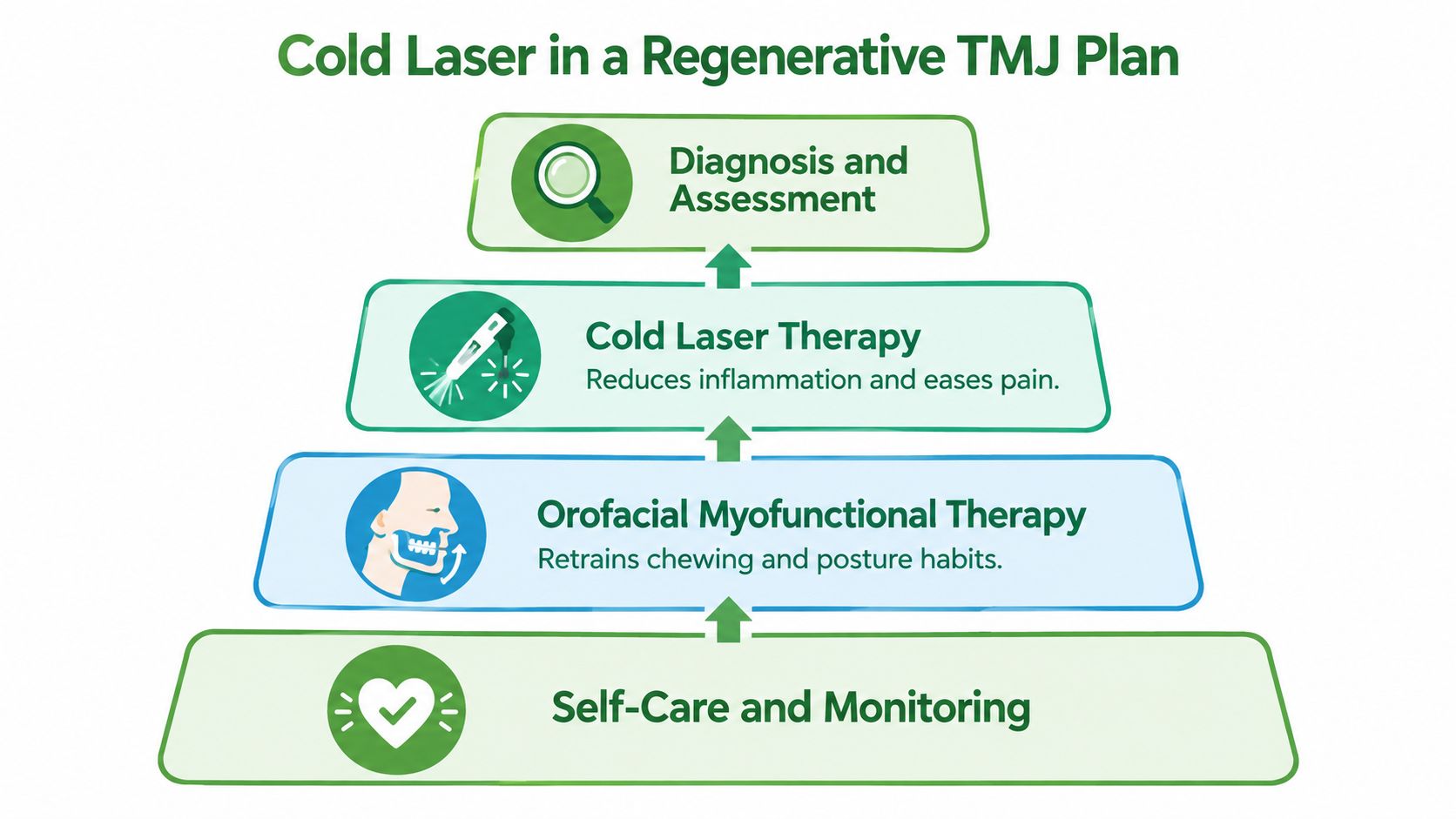
Orofacial myofunctional therapy may help retrain tongue posture, swallowing, nasal breathing, and the coordination of the jaw and surrounding muscles. Those changes matter when poor oral posture or inefficient muscle patterns contribute to repeated strain.
A custom oral appliance may be considered when bruxism or joint loading needs management. The appliance shouldn't be selected from a generic template without understanding the patient's joint status, bite, symptoms, and sleep pattern.
Regenerative options can include Prolotherapy or Platelet-Rich Fibrin injections when a clinician identifies a treatment target involving joint or ligament support. These procedures are not interchangeable with cold laser. They involve different tissues, mechanisms, risks, and selection criteria.
Airway-focused care also matters for patients with mouth breathing, snoring, or obstructive sleep apnea. A laser session may reduce local discomfort, but it doesn't open an airway or correct sleep-disordered breathing. The Charlotte model is therefore layered: assess the cause, use cold laser when it fits, and address muscle function, joint loading, oral posture, and breathing when indicated.
Pain relief can create a window for rehabilitation. It doesn't remove the need for rehabilitation.
Safety, Contraindications, and When to Ask Harder Questions
A laser session should begin with diagnosis, not a sales package. The FDA describes photobiomodulation devices as products that emit light at an irradiance intended to avoid heating while altering biological activity. New low-level laser therapy devices require a 510(k) submission for FDA clearance, but clearance does not establish that every device or protocol works for every condition (FDA information on PBM devices).
A responsible Charlotte provider should identify the device, wavelength, power, treatment points, intended indication, and eye-safety procedure. Protective eyewear matters because direct exposure to therapeutic light can injure the eyes. The applicator should follow the device instructions and be selected with the patient's medical history in mind.
Situations that need additional caution
- Active malignancy: Do not treat over an active tumor without input from the oncology team. Current human research using recommended parameters has not shown tumor promotion, including in some head-and-neck cancer exposure areas, but that evidence does not replace individualized oncology guidance.
- Eyes: The device should never be directed into the eyes. Patients should follow the clinic's eye-protection instructions throughout treatment.
- Thyroid and pregnancy: Some protocols avoid direct treatment over the thyroid or abdomen during pregnancy. Disclose pregnancy, thyroid concerns, photosensitivity, cancer history, and relevant medications before treatment.
- Unexplained symptoms: Severe swelling, fever, sudden bite changes, neurological symptoms, trauma, or rapidly worsening pain require diagnostic attention rather than a routine laser appointment.
Ask harder questions if a clinic cannot name the wavelength or power, explain the treatment points, or describe how the protocol relates to your diagnosis. Be cautious of promises that cold laser will permanently correct disc displacement or treat sleep apnea by itself. A provider who skips examination and immediately sells a series may be offering a device before establishing the cause of pain.
The evidence for TMD remains variable. An updated review reported pain improvement across many studies, while findings for maximum mouth opening were less consistent and changes in muscle electrical activity were often absent (systematic review of PBM for TMD). Patients can experience symptom relief without correcting bruxism, disc mechanics, airway dysfunction, or altered oral posture. Muscular TMD may respond differently from joint-dominant TMD, so the treatment target and outcome measure should be explicit.
For patients in Charlotte, Ballantyne, and South Charlotte, the sensible next step is a thorough evaluation at the Pain and Sleep Therapy Center rather than booking a stand-alone session. Cold laser is a non-thermal, light-based adjunct with a real but variable evidence base. Its value increases when the protocol is documented and coordinated with myofunctional therapy, oral appliances, airway care, or regenerative injections when indicated. Review these cold laser therapy contraindications before treatment.
Pain and Sleep Therapy Center evaluates TMJ disorders, facial pain, headaches, and sleep-related breathing concerns before recommending cold laser therapy or related care. Visit Pain and Sleep Therapy Center to schedule a diagnosis-led consultation in Charlotte and discuss whether photobiomodulation belongs in your personalized treatment plan.