
A little after midnight the sound carries down the hallway: a slow rhythmic scrape, a pause, then another scrape. You stand in the doorway long enough to be sure it's coming from your child, whose jaw is working while the rest of them is still. By breakfast there's no memory of it and no complaint beyond a yawn.
That scene is why so many parents end up searching for answers about kids grinding teeth at night at two in the morning. The habit has a clinical name, sleep bruxism, and it's common enough that most pediatric dentists hear about it every week. What parents rarely get is a straight answer about which grinding is a harmless phase and which deserves a closer look at the jaw and the airway together.
Treat the noise as a question rather than a verdict. The sound tells you the jaw muscles are active during sleep. It doesn't tell you why, and it doesn't tell you whether your child's breathing is fully settled overnight. Sorting those two questions apart is the whole job, and it starts with knowing how ordinary this is.
How Common Nighttime Grinding Is in Children
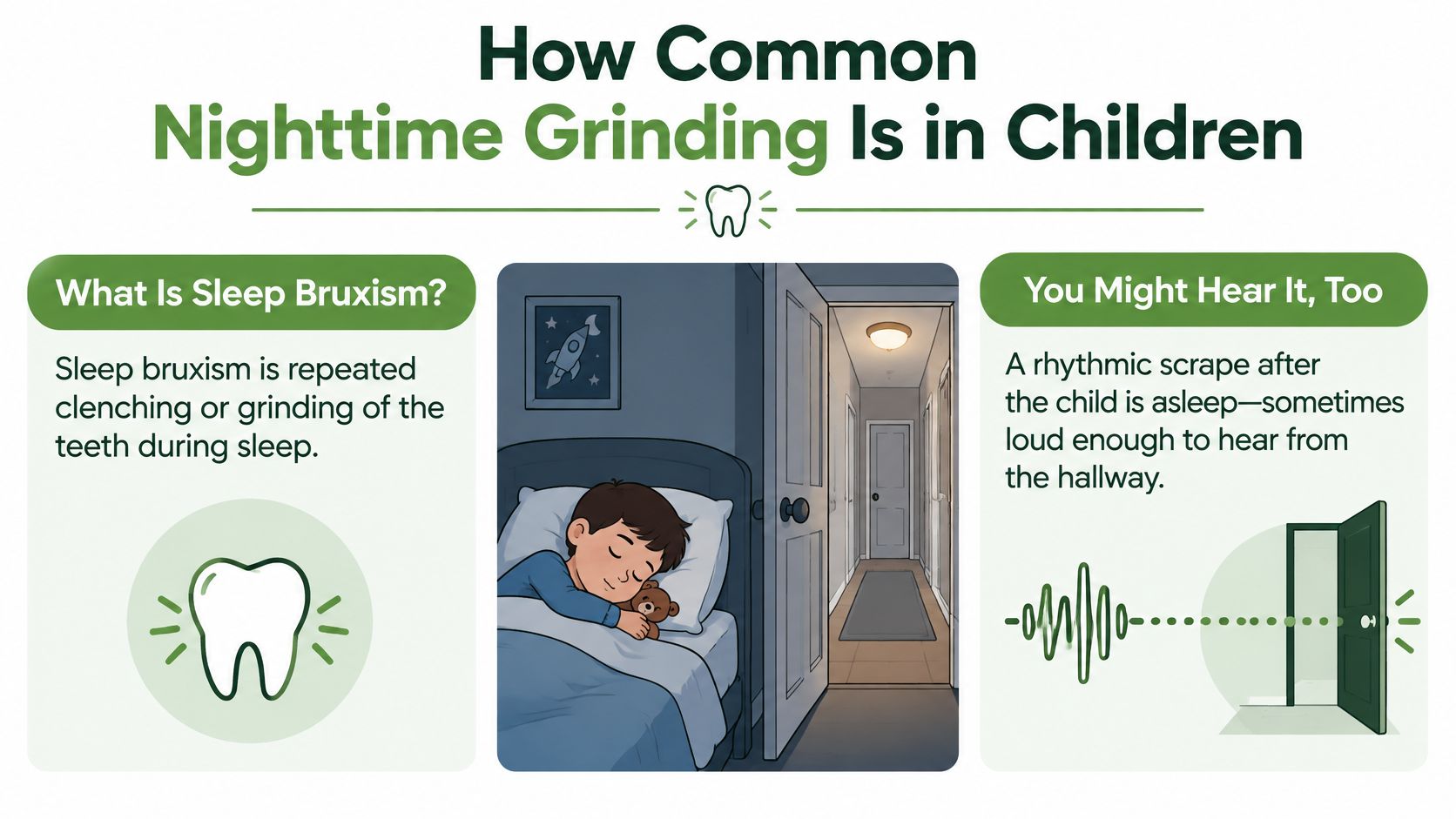
Sleep bruxism is repeated clenching or grinding of the teeth during sleep. The jaw muscles contract in short bursts, the upper and lower teeth scrape or press together, and the child sleeps through most of it. The noise sounds effortful, which is exactly why parents assume damage is already happening.
That assumption is worth correcting early. A loud night confirms muscle activity and nothing more. It doesn't confirm a jaw joint disorder, and it doesn't confirm sleep apnea.
A 2013 systematic review examined 22 publications and found that the eight studies meeting its sampling-quality criteria reported prevalence estimates from 3.5% to 40.6%, with every selected study relying on parent reports rather than polysomnography or electromyography (published review of pediatric sleep bruxism). Those figures describe grinding a parent heard or a child mentioned, not a machine-confirmed event.
The most reliable pattern in the data is age. A systematic review of pediatric sleep-bruxism studies reported weekly rates from 5.9% to 49.6%, with the heaviest numbers in younger children. 36.8% of preschool children were reported to grind at least one night per week, and 49.6% of first-graders were reported to do so. Grinding on more than four nights a week was much less common, at 6.7% of preschoolers and 10.7% of first-graders.
Those numbers aren't interchangeable, and the review said so plainly: definitions, thresholds, and reporting methods differed enough that the studies can't be lined up side by side.
| Group or measure | Reported figure | How it was identified |
|---|---|---|
| Reviewed studies meeting sampling criteria (22-publication review) | 3.5% to 40.6% | Mostly parent report, not polysomnography or electromyography |
| Pediatric studies, weekly grinding range | 5.9% to 49.6% | Parent report; definitions and thresholds differ |
| Preschool children, at least one night a week | 36.8% | Parent report |
| Preschool children, more than four nights a week | 6.7% | Parent report |
| First-graders, at least one night a week | 49.6% | Parent report |
| First-graders, more than four nights a week | 10.7% | Parent report |
No single percentage predicts what happens with your child. The frequency of episodes, whether there's pain, whether teeth are showing damage, and whether breathing sounds normal decide how quickly to act. That's the next thing to sort out.
Which Grinding Pattern Needs Care Now
The useful question isn't whether grinding is common. It's whether this child, this week, needs something done. Most parents can answer that by matching what they notice at night to one of six patterns.
| What parents notice | What it may suggest | Reasonable next step |
|---|---|---|
| Occasional grinding, quiet breathing, comfortable mornings | A common childhood pattern that often lessens with age | Count the nights and continue routine dental care |
| Grinding most nights with morning jaw soreness, chewing pain, or temple headache | Jaw-muscle strain that can overlap TMD | Dental or orofacial-pain evaluation |
| Chipped teeth, sensitivity, or wear that keeps progressing | Enamel damage worth monitoring; wear alone does not measure severity | Dentist exam rather than waiting on the sound |
| Grinding plus loud snoring, gasping, pauses, or open-mouth sleep | Possible sleep-disordered breathing; grinding is not proof of apnea | Medical airway or sleep evaluation, not a guard alone |
| Noisy breathing with restless sleep, daytime sleepiness, inattention, bed-wetting, or morning headache | Sleep quality may be affecting daytime function | Pediatric medical assessment plus dental monitoring |
| Jaw locking, swelling, or pain that limits opening | A problem beyond simple bruxism | Prompt dental or medical care |
When the jaw is the story
Grinding on most nights, followed by jaw soreness, pain while chewing, or a headache behind the eyes, points toward muscle strain rather than a mystery. That cluster overlaps with temporomandibular disorder, and it deserves an examination rather than a wait-and-see year. The jaw pain and headache patterns described on the practice's pages for TMJ and TMD and headaches and migraines give parents a vocabulary for what they're seeing.
Wear is a separate signal from pain. Chipped enamel, new sensitivity to cold drinks, or a flat, shiny spot on a front tooth means the dentist should look, even if the child feels fine. Grinding enough to damage a tooth can also produce the signs of a cracked tooth, which often include sharp pain on biting and sensitivity that lingers after the pressure is gone. Broken enamel is a reason to examine the teeth, not a score for how severe the bruxism is.
When the airway is the story
The pattern that shouldn't wait behind a dental appointment is grinding combined with habitual loud snoring, gasping, witnessed pauses, or open-mouth sleep. A systematic review on the overlap reports pediatric sleep-apnea prevalence of roughly 0.2% to 4.1%, peaking around ages 2 to 6, and cites studies in which 21% to 41.3% of children had sleep bruxism and sleep apnea/hypopnea syndrome at the same time (review of bruxism and sleep-disordered breathing). Shared signals include mouth breathing, loud snoring, gasping, restless movement, wheezing, and a head tipped back during sleep.
That overlap doesn't prove grinding causes airway obstruction. Airway resistance and fragmented sleep may drive arousal-related jaw activity, and both conditions may reflect the same anatomy. For parents, the practical point is simpler: noisy, labored breathing alongside grinding is a reason to ask a physician about sleep, and the child sleep apnea symptoms page lays out which daytime behaviors belong in that conversation.
The rule that resolves the confusion: the dentist watches enamel, jaw comfort, and bite development. The physician owns the breathing question. One visit rarely answers both.
What to Write Down for Two Weeks
Deciding what the notes mean comes later. Starting them takes about a minute a night, and it turns a vague worry into something a clinician can use.
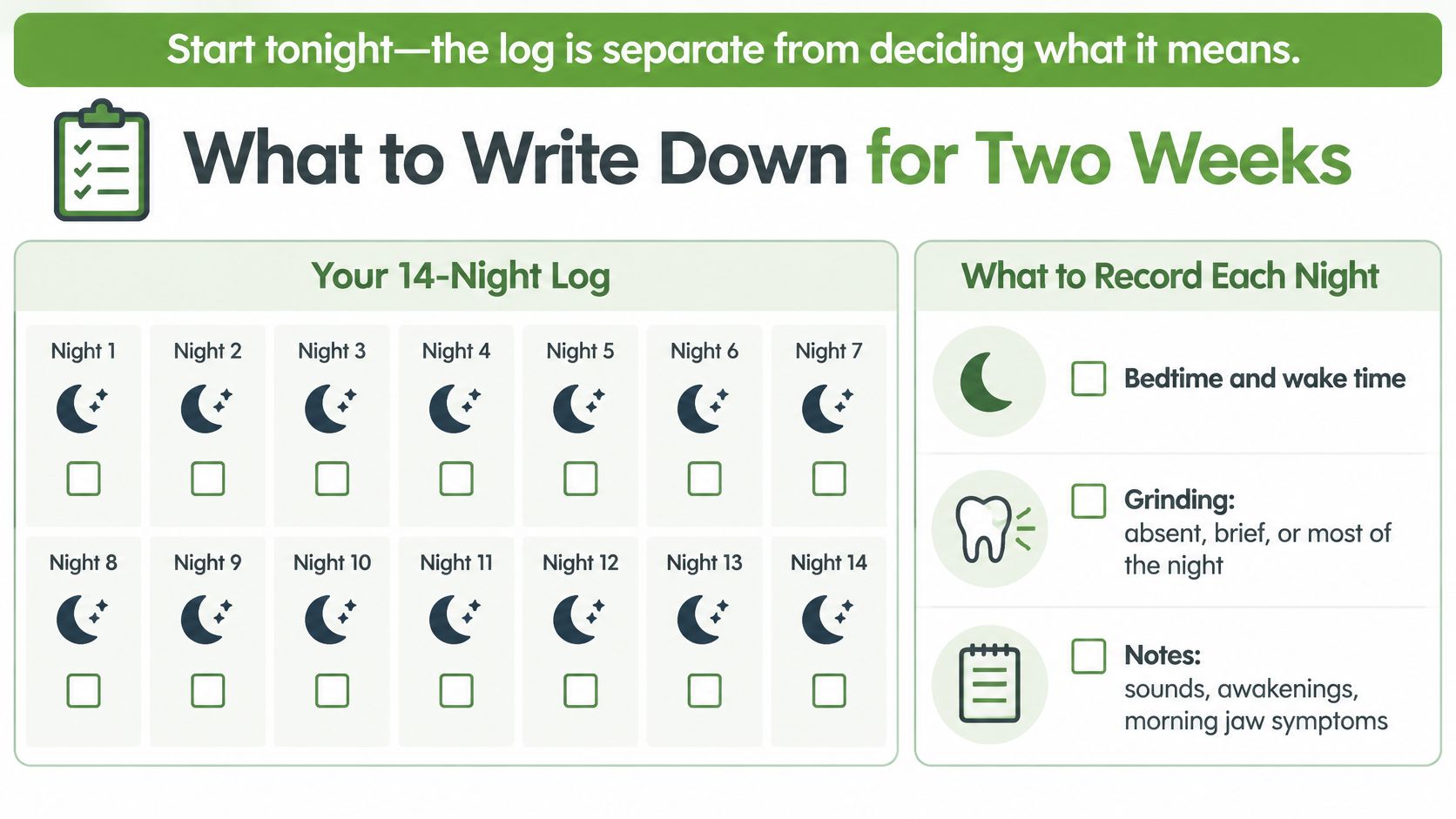
Fourteen nights is enough to show a pattern without turning the household into a sleep lab. A cheap notebook and a pen on the nightstand work better than an app, because the log lives where the observations happen.
- Bedtime and wake time, written down rather than estimated the next afternoon.
- Grinding level, marked as absent, brief, or most of the night.
- Grinding type, noted as a scrape you heard or a quiet clench your child describes in the morning.
- Breathing sounds, answered yes or no: loud snoring, gasping, witnessed pauses, open-mouth sleep.
- Body behavior, also yes or no: restless movement, unusual head or stomach position, drooling, bed-wetting.
- Morning check, covering jaw soreness, headache and where it sits, tooth sensitivity, and whether your child was hard to wake or seemed tired by mid-morning.
Once during the two weeks, not nightly, photograph any obvious chip or worn edge. A dentist can compare that photo to what the mouth looks like in the chair months later.
Background worth mentioning without calling it the cause
Secondhand smoke exposure, short sleep, and a child who runs anxious or highly reactive are all worth writing in the margin. One systematic review of factors associated with pediatric sleep bruxism reported an odds ratio of 3.3 for sleep disturbances (95% confidence interval 1.6 to 6.6) and 4.5 for secondhand-smoke exposure (95% confidence interval 2.2 to 9.4). Those are associations from observation. The log records them so a clinician can weigh them, not so parents can run a home experiment.
Skip anything that requires a camera running in the bedroom all night. Continuous video produces hours of footage nobody reviews and adds surveillance to a room that should feel calm.
Then use the pages twice. Bring the tally to the dental visit, and bring the same tally to the pediatrician if snoring, pauses, or daytime tiredness made it onto the list.
Why the Jaw Moves During Sleep
Think of a dim hallway where someone flicks a light on for two seconds at a time, every so often, all night. Sleep runs on similar brief brightenings, called arousals. Muscles twitch, breathing shifts, swallowing happens, and the jaw can clamp down as part of that moment. In one child the arousal follows a narrow or resistant upper airway. In another it tracks short or fragmented sleep. In a third, nobody ever finds a single cause.
That's why bruxism is best understood as a behavior pattern rather than one disease. Stress, sugar, screens, and a crooked bite all get blamed, and none of them is an automatic explanation for the sound in your hallway.
An odds ratio above 1 means a behavior showed up more often alongside reported grinding in the reviewed studies. It doesn't mean changing the behavior will stop the grinding.
What the odds ratios do and don't say
The same review pooled the data and reported odds ratios of 2.86 for snoring and 2.56 for inadequate sleep time, with smaller but still increased figures for four other behaviors listed below (meta-analysis of sleep behaviors and childhood bruxism).
| Behavior | Pooled odds ratio | How to read it |
|---|---|---|
| Snoring | 2.86 | Higher odds of reported bruxism; not proof that snoring causes grinding |
| Mouth breathing | 1.51 | A smaller association that still belongs in the sleep history |
| Restless sleep | 2.31 | Fits fragmented sleep or repeated arousals |
| Drooling | 1.79 | Higher odds of reported bruxism; not proof that drooling causes grinding |
| Sleeping on the stomach | 1.70 | A position association, not a diagnosis |
| Inadequate sleep time | 2.56 | Short sleep tracked with higher odds of reported grinding |
A high ratio is a prompt to look, not a verdict to act on. Snoring sits at the top of that list, which is why a child who grinds and snores needs the breathing question asked. Families can read more on the practice's pages about snoring and sleep apnea without treating either page as a self-diagnosis.
Where the strain shows up
Repeated grinding can wear enamel, chip a tooth, and load the jaw muscles night after night. Tenderness, morning headaches, and chewing discomfort are the usual ways that load announces itself, and facial or jaw-muscle pain of that kind fits the territory covered under orofacial pain when it persists.
Two mistakes sit at opposite ends of this. One is dismissing every scrape as a phase, which misses a genuine jaw or airway problem. The other is treating every scrape as apnea, which frightens families and leads to devices a child may not need.
How Dental and Airway Evaluation Works
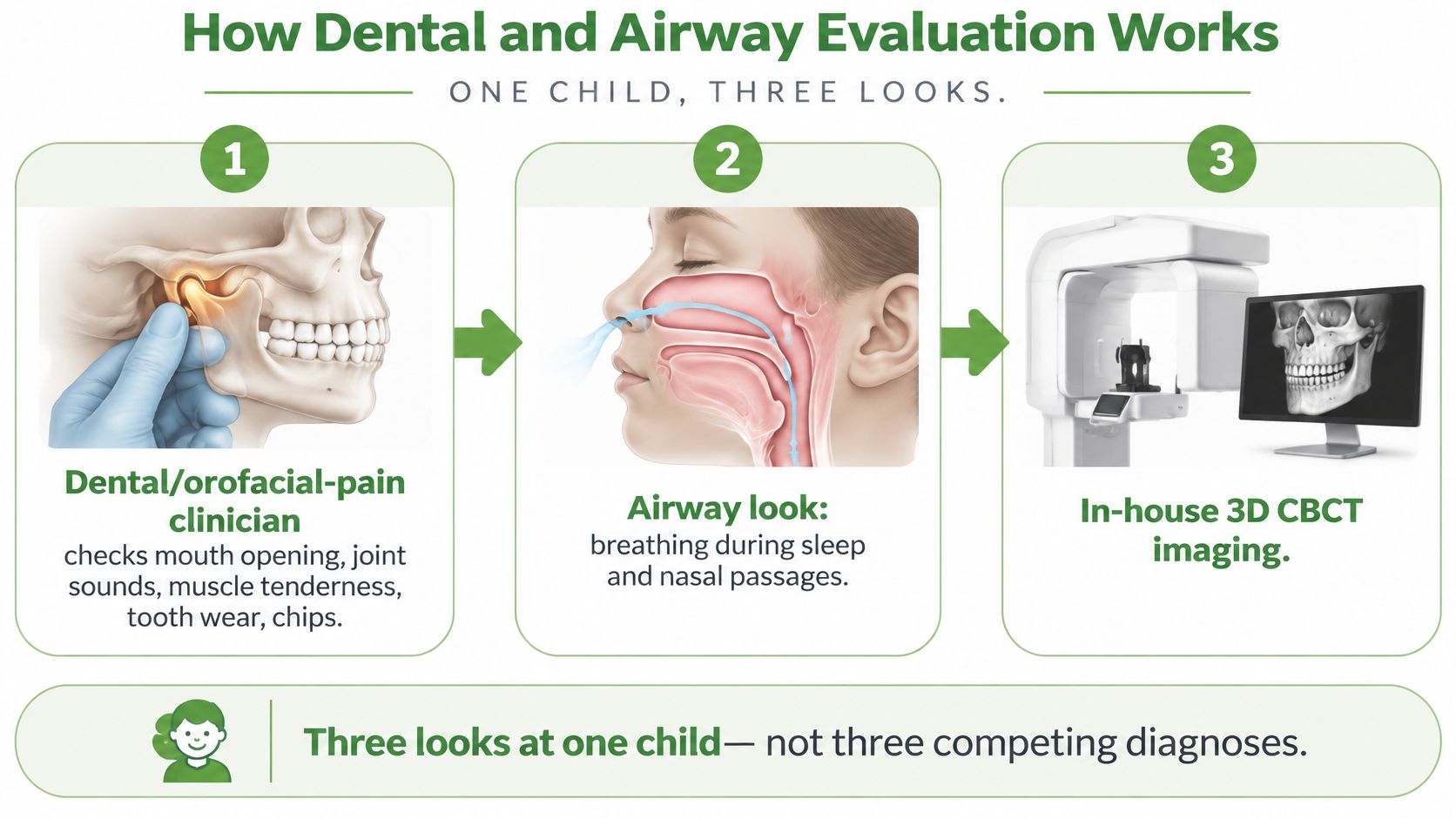
A child who grinds at night may have tooth wear, jaw strain, or signs of disrupted breathing. These clues call for related questions, but none alone identifies the cause. A dental and airway evaluation looks at how the jaw, mouth, and sleep-breathing patterns fit together.
The dental look
A dentist or orofacial-pain clinician checks how widely the child opens the mouth, listens for joint sounds, examines the chewing muscles, and notes tooth wear, chips, and bite development. This can show where strain or damage is present. A dental exam alone cannot confirm or rule out pediatric obstructive sleep apnea.
The airway look
The airway assessment considers snoring, nasal blockage, tonsil size, tongue position, jaw structure, growth, and daytime function. A sleep study report is only one part of the picture. Pain and Sleep Therapy Center considers jaw, facial-pain, and sleep-breathing concerns together, with an interdisciplinary team that includes dental sleep medicine, orofacial myofunctional therapy, Buteyko breathing, neurology, and pediatric oral health. The center's pediatric airway assessment explains what this evaluation covers.
What overnight testing adds
An office exam can identify features that merit further evaluation, but it cannot show every breathing event during sleep. When a physician considers it appropriate, overnight testing such as polysomnography can add information about sleep and breathing.
The American Academy of Pediatric Dentistry estimates that about one in four children has probable or possible sleep bruxism. Its guidance describes associations between bruxism and sleep-disordered breathing, while noting that the evidence does not establish a simple cause-and-effect relationship. A 2019 systematic review found no conclusive evidence that bruxism causes or reliably predicts obstructive sleep apnea. Grinding can prompt questions about breathing, but it is not an apnea diagnosis.
A child's physician or ENT can assess enlarged tonsils or adenoids, nasal disease, and reflux. The aim is to understand how the findings relate, rather than assume that one symptom explains them all.
Home Steps Versus Professional Treatment
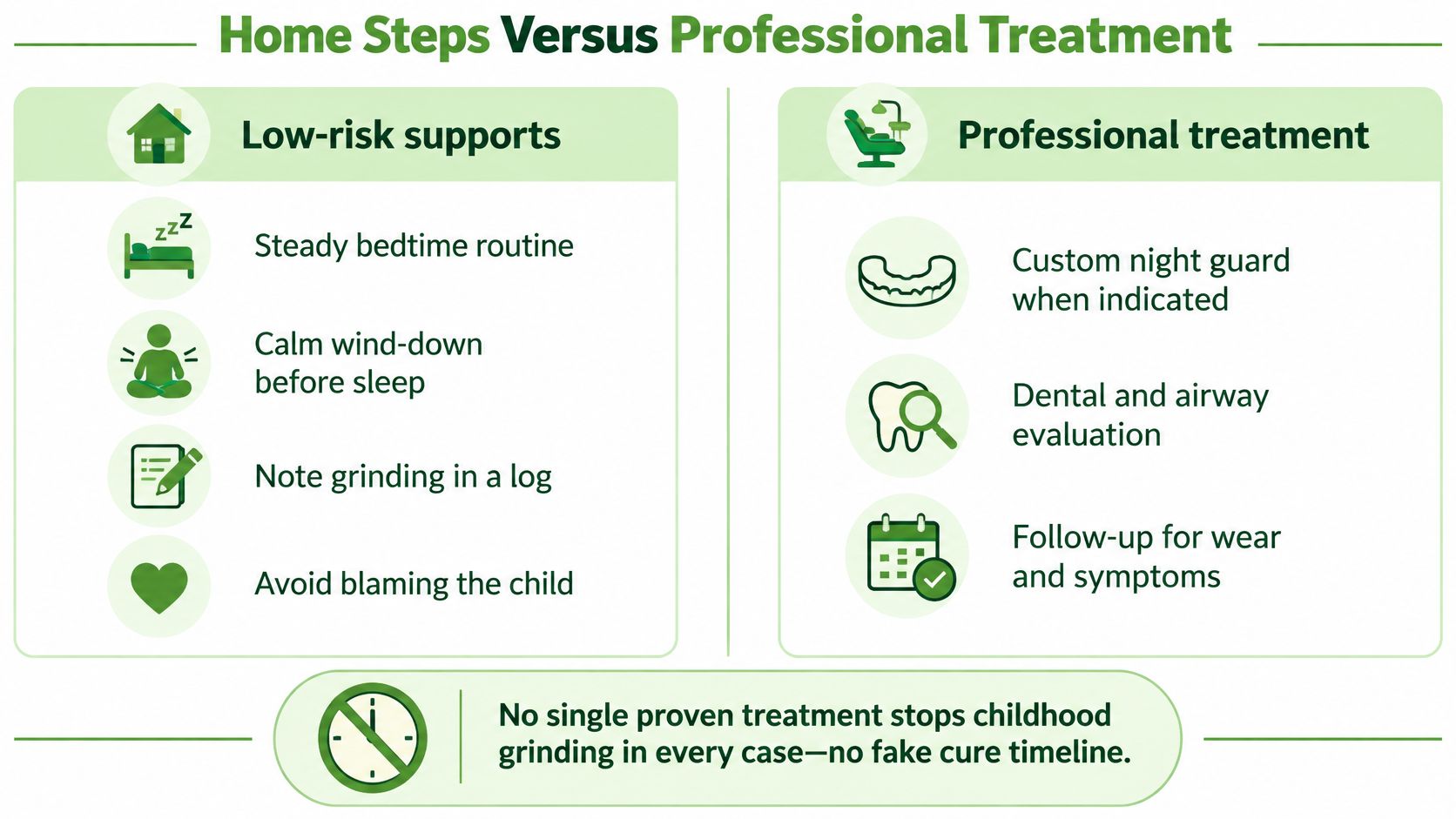
No single proven treatment stops childhood grinding in every case, and any clinic selling a guaranteed cure is selling something else. What follows is the honest split between what's reasonable to try and what needs a clinician.
A side-by-side makes that split easier to hold onto.
What's reasonable to try at home
- Anchor the sleep schedule. Same bedtime and wake time, including weekends, with enough hours for the child's age.
- Dim the last hour. Quiet, low-light activity before bed beats a screen in a dark room.
- Keep the room boring. Cool, dark, quiet, with devices charging somewhere else.
- Run the two-week log. Documentation is a home step, and it's the most useful one on this list.
- Treat the sore mornings. A warm compress on the jaw and softer food for a day or two eases muscle discomfort.
- Don't blame the child. Grinding happens during sleep. Nobody is doing it on purpose.
A pediatric study summarized in a systematic clinical review of sleep bruxism found screen time and added-sugar consumption statistically associated with possible sleep bruxism, with reported odds ratios above 2. Those findings are observational, so cutting screens or sugar is a reasonable experiment for other reasons, not a proven way to quiet the jaw.
What professional care can and can't do
Supplements, filing teeth down to change the bite, and promises to eliminate stress all outrun the evidence. So does the assumption that a night guard is the default answer for a growing child. A guard can protect enamel when wear is progressing, but it doesn't treat an airway problem, and fitting one is a decision made after an exam rather than a response to a sound.
Any appliance carries tradeoffs. Bite changes, jaw soreness, and temporomandibular discomfort are the recognized drawbacks, which is why a child isn't fitted on the strength of grinding alone. Conditions such as enlarged tonsils or adenoids, nasal disease, and reflux belong with the child's physician or ENT, and no dental device substitutes for that care.
Watchful waiting is legitimate when the log shows occasional noise, comfortable mornings, intact teeth, quiet breathing, and a child who is rested. Many children grind less as they get older. Stop watching and seek care sooner if pain appears, the jaw locks or swells, enamel breaks, snoring turns loud, gasping shows up, or your child is tired and inattentive during the day. Pain, tooth damage, development, and the suspected driver should decide treatment, not the volume of the noise.
When to Request Care in Charlotte
Request an evaluation when grinding is frequent or comes with jaw pain, headaches, tooth damage, mouth breathing, snoring, gasping, or unrefreshing sleep. These signs make it useful to consider jaw function and sleep-related breathing together. The pediatric sleep study process explains one way the sleep side may be assessed.
A single quiet episode in a comfortable child can remain on the two-week log and be mentioned at a regular dental visit. That is a proportionate response when there are no other concerns.
Pain and Sleep Therapy Center in Charlotte, NC, focuses on TMJ disorders, orofacial pain, and dental sleep medicine. Its interdisciplinary team evaluates jaw pain and related sleep or breathing concerns together, with an emphasis on individualized, non-surgical care.
For children, orofacial myofunctional therapy can guide jaw and facial growth and help establish healthy nasal-breathing habits. If the log shows a pattern that concerns you, contact the center through its website and bring the two-week log to the visit. Enlarged tonsils, nasal disease, and reflux should still be discussed with your child's physician.