You wake up, bring your teeth together, and notice that your jaw already feels tired. There's a dull headache near your temples, your teeth feel sensitive, and you're wondering how you managed to clench through another night without noticing. If you're searching for how to stop clenching jaw at night, start with a more useful question: what needs protection, and what needs investigation?
Waking Up With Sore Teeth and Tight Jaws
A sore jaw can make an ordinary morning uncomfortable before you've even eaten breakfast. You might assume yesterday's deadline caused it, try to relax before bed, then wake with the same symptoms after a relatively calm day. That doesn't mean you failed to relax properly.
Sleep bruxism involves repeated jaw-muscle activity during sleep, including clenching or grinding. A partner may hear grinding, but someone who clenches without much noise may only notice morning soreness or tooth discomfort. Those clues deserve attention, although they don't establish the cause on their own.
Recognize the pattern without self-diagnosing
Consider when the discomfort appears, whether it eases during the day, and whether anyone has noticed unusual sounds or breathing while you sleep. Bring those observations to an appointment rather than trying to label every headache or sensitive tooth as bruxism.
Useful details include:
- Morning symptoms: Note whether your discomfort affects the teeth, temples, jaw muscles, or joint area.
- Daytime behavior: Notice whether your teeth touch while you work, drive, or concentrate.
- Sleep observations: Ask your partner about grinding sounds and unusual breathing, not just whether you seem restless.
The distinction matters because nighttime jaw activity isn't a habit you can consciously switch off. You can change daytime behaviors, but you can't supervise your jaw throughout sleep.
Practical rule: Treat morning discomfort as information, not proof that stress is the only explanation.
For adults in Charlotte, NC, the sensible approach combines manageable home changes with dental or sleep assessment when symptoms persist. You don't need to choose between relaxation and professional care. Start reducing avoidable strain while determining whether your teeth, jaw joints, or sleep need closer attention.
Why the Jaw Clenches During Sleep
Your jaw can become active during brief changes in sleep even when you have no memory of waking. Sleep bruxism is classified as a sleep-related movement disorder, with activity associated with short arousals and changes in the body's autonomic activity.
Sleep arousals occur approximately 8–14 times per hour, and jaw-muscle activity can accompany the body's response, helping explain morning soreness or sensitivity without remembered grinding, as described in this clinical overview of bruxism. That figure describes sleep arousals, not the number of clenching episodes every person experiences.
Awake clenching and sleep clenching need different tools
During the day, you can notice tooth contact and release it. At night, a reminder on your desk can't interrupt an episode occurring while you're asleep. Daytime awareness remains useful, but it shouldn't be presented as a guaranteed way to eliminate nighttime muscle activity.
Stress management belongs in the discussion without becoming the entire explanation. For readers exploring that relationship, All Stars Dental oral health offers a focused resource on stress and the jaw. Use it as background, not as a substitute for investigating persistent symptoms.
Why estimates vary
Measuring sleep bruxism is difficult because many people don't know they do it, and researchers use different definitions and diagnostic methods. A systematic review of adult bruxism prevalence found frequently reported sleep bruxism affected approximately 12.8% ± 3.1% of adults, while broader definitions produced estimates of 8% to 31.4%.
Those differences have a practical consequence: self-report, a partner's observations, and dental findings provide different kinds of information. Tooth wear alone doesn't tell a clinician exactly what your muscles are doing tonight. The assessment should clarify whether your main problem is active sleep clenching, daytime muscle tension, a jaw-joint disorder, or a combination.
The Airway Connection Most Advice Misses
Calling nighttime clenching a stress problem can overlook a clinically important possibility: sleep-disordered breathing. A person may focus on sore teeth while a partner notices loud snoring or pauses in breathing. Both observations belong in the same assessment.
A 2022 review of sleep bruxism and obstructive sleep apnea reported that polysomnography studies found the conditions co-occurred in 5.28% to 50.84% of participants, with a median co-occurrence of 39.3%. The broad range reflects different study populations and diagnostic criteria, so it isn't a personal risk estimate for everyone who clenches.
Association isn't a diagnosis
Clenching doesn't prove you have sleep apnea, and sleep apnea doesn't explain every sore jaw. However, the NIDCR discussion of bruxism and airway function notes that sleep bruxism may help keep the airway open during sleep apnea. That possibility makes an airway-focused assessment more useful than assuming the jaw activity must be suppressed.
Bring these observations to a medical or sleep appointment:
- Breathing changes: Loud snoring, witnessed pauses, or waking with gasping.
- Unrefreshing sleep: Significant daytime sleepiness or repeated morning headaches.
- Other clues: Morning dry mouth or resistant hypertension, particularly alongside breathing symptoms.
A quieter mouth isn't proof of healthier breathing during sleep.
Choose the right next appointment
If breathing concerns are present, another round of relaxation exercises shouldn't be your only response. Charlotte patients can review the process for obstructive sleep apnea diagnosis and discuss whether a sleep evaluation is appropriate.
A dental appliance and a sleep assessment answer different questions. One may address tooth contact; the other investigates breathing and sleep disruption. When a breathing disorder is confirmed, the treatment plan should address that disorder rather than treating jaw activity in isolation.
An At-Home Protocol to Reduce Nighttime Clenching
Start with changes you can control while awake. The aim is to reduce unnecessary loading and evening triggers, not to promise complete control over sleeping muscles. If you already have significant dental damage, locking, or breathing concerns, arrange assessment alongside these steps.
Reset the daytime jaw position
Let your lips rest gently together, teeth apart, and tongue lightly against the palate. Don't press your tongue upward or hold your jaw rigid. The position should feel like rest, not another exercise in muscle tension.
Use a phone reminder or a small note beside your screen to check your jaw during ordinary activities. When you notice clenching, release the contact without forcing your mouth open. Reducing gum chewing is another practical way to avoid adding unnecessary jaw work.
Make the evening routine repeatable
Choose a sleep and wake schedule you can maintain, then build a wind-down routine around it. Progressive muscle relaxation can help you practice letting go of tension, but skip forceful jaw tightening if it aggravates symptoms.
For ideas about organizing bedtime when discomfort makes settling difficult, consider SunnyBay's sleep advice for pain sufferers. Treat general sleep advice as supportive, not as a bruxism treatment claim.
Focus your trigger review on:
- Evening substances: Reduce excess caffeine, alcohol, and nicotine rather than adding another bedtime product.
- Medication timing and changes: Tell your prescriber if symptoms began after starting or changing a medication. Don't stop prescribed treatment yourself.
- Reflux and smoke exposure: Mention reflux symptoms and second-hand smoke exposure during your clinical history.
Systematic-review evidence associates alcohol, caffeine, tobacco, certain psychotropic medications, esophageal acidification, and second-hand smoke with bruxism; NIDCR's bruxism guidance also describes behavior change, stress management, and mouth guards as treatment options.
Keep a simple record of morning discomfort, sleep quality, and the changes you make. That won't diagnose sleep bruxism, but it gives you and your clinician something more useful than a general impression that every night is bad.
Choosing the Right Mouth Guard for Your Situation
A mouth guard primarily separates teeth to help prevent damage. As NIDCR explains in its guidance above, it may reduce muscle activity, but it doesn't necessarily resolve the underlying cause. Judge an appliance by its purpose, fit, and follow-up plan rather than a promise to stop all clenching.
The comparison below shows the common options; the labels shouldn't be read as guarantees about durability or protection from bite changes.
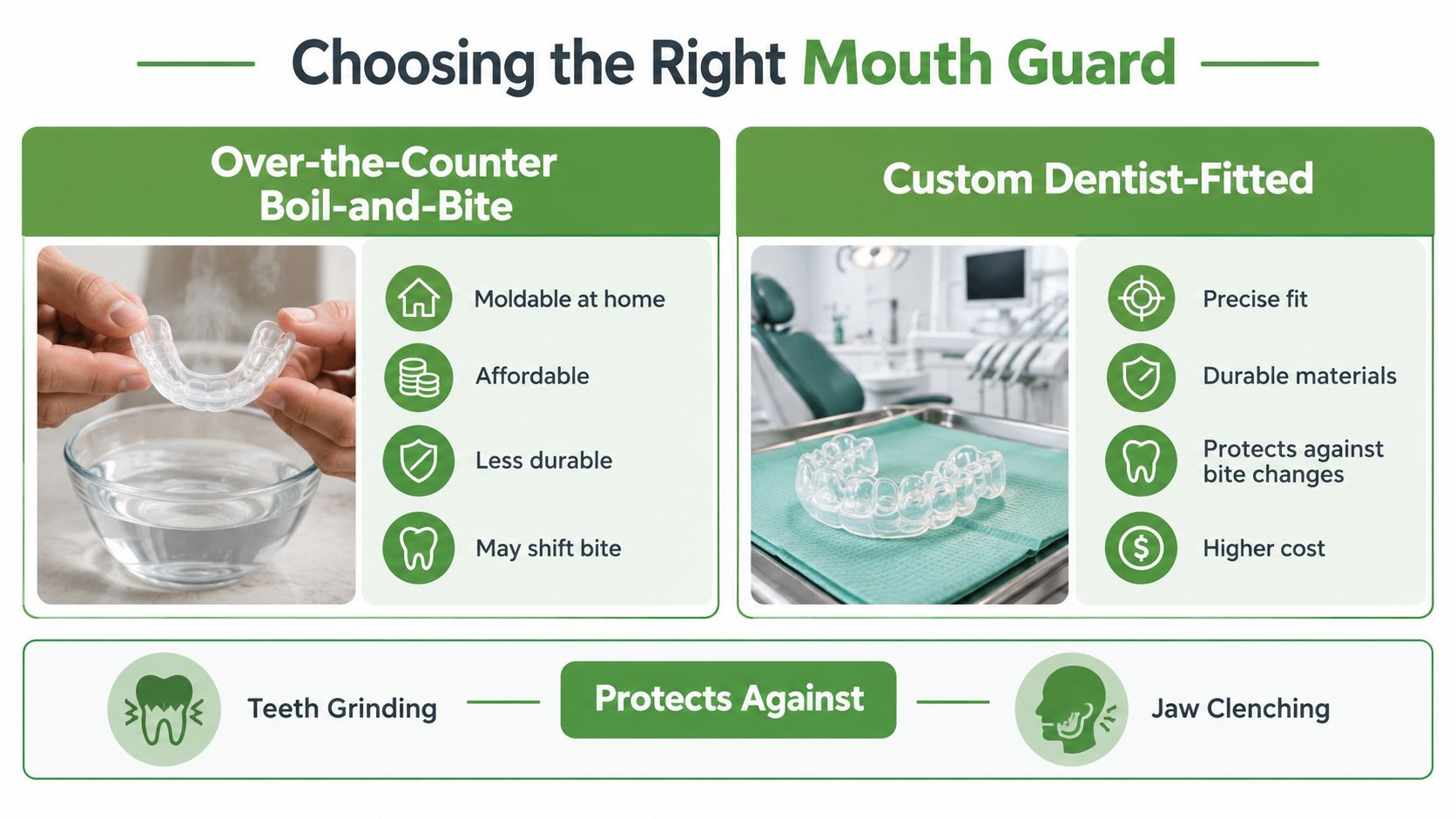
Compare the fitting process, not just the packaging
| Decision point | Over-the-counter boil-and-bite | Custom dentist-fitted |
|---|---|---|
| Fitting responsibility | You shape and assess the fit at home | A dentist fits and checks the appliance |
| Clinical context | Buying it doesn't include a jaw or sleep assessment | Selection can follow examination of your symptoms |
| Follow-up | You need to arrange professional review if concerns arise | Periodic checks can be included in the care plan |
| Main limitation | Comfortable fit doesn't establish that it's appropriate | Professional fitting still isn't a cure for every cause |
Ask about materials, expected wear, maintenance, and total cost rather than assuming all retail guards are alike or all custom appliances perform identically. A clinician should also explain whether the proposed device is intended mainly for dental protection or forms part of a broader jaw-treatment plan.
Know when an appliance needs reassessment
Don't keep wearing an appliance through worsening pain, altered tooth contact, or increasing muscle symptoms. A custom appliance also needs review; having it professionally made doesn't make follow-up optional.
For Charlotte patients comparing recommendations, this explanation of a TMJ splint versus a night guard can help frame questions for the appointment. Ask what problem the device targets, how improvement will be measured, and what happens if symptoms persist.
Before buying: Know what the guard is supposed to protect, and who will check it if your symptoms change.
Exercises and Breathing Retraining That Support the Jaw
Exercise should make your care more specific, not turn soreness into a test of how far you can stretch. A relaxed setting can support gentle practice, but meditation and jaw rehabilitation aren't interchangeable.
Match exercises to the examination
Orofacial myofunctional therapy addresses oral posture and functional patterns such as swallowing. In a supervised program, the clinician can evaluate how you use your tongue and jaw rather than prescribe the same drills to everyone with morning pain.
Starter cues should remain modest: notice whether your jaw is braced, release unnecessary effort, and avoid forcing movement through discomfort. Gentle jaw mobility may be considered after assessment, but a painful or restricted joint needs individualized guidance rather than aggressive stretching from an online routine.
Breathing retraining, including Buteyko-style work, is another service available within Charlotte airway-focused care. It should be selected according to your breathing pattern and clinical findings, not presented as a proven universal cure for nighttime clenching.
Keep breathing practice comfortable
If nasal breathing feels comfortable, practice quiet breathing without deliberately tightening your jaw. If your nose feels obstructed, seek evaluation rather than forcing nasal breathing or improvising prolonged breath holds. Breathing exercises don't replace investigation of suspected sleep apnea.
This video can be approached as general educational material, not an individualized prescription.
Ask your therapist what each exercise targets and how you'll judge whether it helps. Comfortable daytime movement, improved awareness, and better execution of a prescribed task are different outcomes from objectively reducing sleep bruxism. Keeping those goals separate prevents supportive exercises from being mistaken for definitive nighttime treatment.
When to Seek a TMJ and Sleep Evaluation in Charlotte
Arrange professional care when symptoms persist, function changes, or self-care becomes a cycle of trying different products without understanding the problem. People with sleep bruxism are more likely to report jaw pain and restricted jaw movement, and persistent locking, painful clicking, reduced opening, morning headaches, or suspected breathing pauses warrant evaluation, as discussed in this review of sleep bruxism and associated symptoms.
Fractured teeth and ongoing sensitivity also deserve dental assessment. Don't assume that an appliance purchase is enough, particularly when symptoms involve both the jaw and sleep.
What the evaluation should uncover
A useful appointment goes beyond identifying worn teeth. The clinician should connect the history, examination, and any indicated testing to a specific treatment decision.
Expect discussion of:
- Teeth and appliances: Existing damage, sensitivity, tooth contact, and any guard you already use.
- Muscles and joints: Tenderness, opening range, painful movement, clicking, or locking.
- Contributing factors: Medication changes, substance exposure, reflux, stress, and daytime clenching.
- Sleep and breathing: Your sleep history and whether referral or objective monitoring is appropriate.
Technology-driven diagnostics should answer a clinical question, not add equipment to the visit. If sleep bruxism remains uncertain, polysomnography or validated ambulatory monitoring may help clarify the pattern; suspected breathing disorders need appropriate sleep evaluation.
For Charlotte, NC residents, local pathways include dental or TMJ assessment and sleep-medicine services such as Atrium Health Sleep Medicine University City. The Blakeney Park Drive specialty practice led by Dr. Greg D. Larson offers another option for combined jaw and sleep concerns, with individualized assessment and exercise-based care. Review what to consider before choosing a TMJ treatment specialist in Charlotte, and bring relevant dental records or prior sleep-test results.
Escalate according to findings
For objectively confirmed sleep bruxism that hasn't improved with basic measures, clinician-supervised biofeedback may be considered. A systematic review of sleep-bruxism management describes supported biofeedback approaches, mixed appliance evidence, and limitations in the evidence for botulinum toxin, which shouldn't be treated as a routine first-line solution.
Track the outcome that matters: pain, jaw function, tooth protection, sleep disruption, or measured muscle activity. Improvement in one doesn't automatically establish improvement in all the others.
Keep your plan manageable:
- Daytime checkpoint: Practice jaw awareness without rigidly holding a posture.
- Evening checkpoint: Reduce avoidable triggers and maintain a repeatable bedtime routine.
- Protection checkpoint: Use a fitted, reviewed appliance when warranted.
- Evaluation checkpoint: Seek professional assessment when warning signs appear or progress stalls.
A sleep quiz can help organize concerns, while referring-doctor resources can support communication between your dentist, primary care clinician, and sleep team. Neither replaces diagnosis.
Pain and Sleep Therapy Center offers Charlotte patients assessment and nonsurgical care for TMJ symptoms and sleep-related breathing concerns, helping distinguish tooth-protection needs from problems that require broader evaluation. Visit Pain and Sleep Therapy Center to explore its sleep quiz or request an appointment for persistent nighttime clenching, jaw pain, or clenching accompanied by snoring and fatigue.