
Does a stressful week explain every sore jaw? Stress can add to jaw pain and make symptoms feel stronger, while the cause often involves several inputs at once. A 2025 systematic review and meta-analysis of 21 studies reported associations between temporomandibular disorders and psychological distress, including stress.
The more useful question is which inputs are active for you: clenching or grinding, poor sleep, breathing problems during sleep, muscle guarding, or joint irritation. That is what an exam should sort out.
Does Stress Really Cause Jaw Pain?
Stress can contribute to jaw pain without fully explaining it. The temporomandibular joint, or TMJ, works somewhat like a hinge guided by several muscles. Stress can act like a hand that keeps those muscles gripping longer than they need to.
Temporomandibular disorders, or TMDs, affect the jaw joints, chewing muscles, and related structures. TMJ names the joint; TMD names the group of disorders. Neither term establishes why someone hurts.
Reported prevalence of TMD and bruxism
| Measure | Reported figure | Context |
|---|---|---|
| TMD in the general population | About 10 to 15% | 2022 peer-reviewed study, which also found higher perceived stress among people reporting TMD and bruxism symptoms during social isolation |
| TMD in U.S. adults | About 5% | National Institute of Dental and Craniofacial Research; estimates vary by population and diagnostic method |
| Bruxism and TMD odds | 2.25 times higher odds | 2023 meta-analysis of 20 studies, discussed under clenching and sleep breathing below |
| Self-reported sleep bruxism | 8.0% to 31.4% | 2024 Dental and Medical Problems article, general adult population |
| Self-reported awake bruxism | 22.1% to 31.0% | Same 2024 article, general adult population |
These estimates describe different populations and methods, not competing answers to a single question. Association also isn't proof of causation: people with greater stress may have more symptoms, but that doesn't establish stress as the sole cause.
The social-isolation findings illustrate a clinically useful pattern. Stress, clenching, sleep disruption, and pain can occur together, making it important to assess more than the location of soreness.
Other contributors include trauma, inflammation, bite-related factors, sleep problems, mood disorders, and muscle overuse. A stressful schedule shouldn't distract from tenderness, restricted opening, painful clicking, or headaches. The useful distinction isn't stress versus a physical problem. It's which contributors apply to that person, and which require treatment.
Stress-Related Jaw Pain or a Problem That Needs an Exam
| Pattern | What it suggests | Next step |
|---|---|---|
| Pain that rises with tension, worse on stressful days, morning jaw soreness | Muscle-related pain, possibly with clenching or grinding | Track symptoms for two weeks and review with a dentist; seek care sooner if symptoms worsen |
| Clicking or popping, with or without mild pain | Possible joint involvement | Routine dental or TMD exam |
| Locking, or opening that is restricted | Joint or muscle problem needing assessment | Schedule an evaluation soon |
| Persistent one-sided pain, swelling, or fever | Possible infection or another cause | See a dentist or physician promptly |
| Numbness, or a sudden change in how the teeth fit | Possible nerve or structural cause | Seek prompt medical evaluation |
| Headaches on waking, snoring, witnessed breathing pauses | Possible sleep-breathing contribution | Ask about a sleep evaluation |
This table helps determine what needs attention, not establish a diagnosis at home. Morning soreness, for example, can fit nighttime muscle activity, but it doesn't confirm grinding or exclude a joint problem. Likewise, clicking alone doesn't reveal whether treatment is necessary.
A systematic review examining psychological factors and TMD supports considering emotional distress alongside physical findings. Persistent one-sided pain, swelling, fever, numbness, locking, or a sudden bite change shouldn't be managed with relaxation advice alone.
Read the pattern without dismissing the pain
Stress-leaning symptoms often fluctuate with demanding periods and include tenderness in the chewing muscles without swelling or locking. Joint-leaning symptoms more often involve movement difficulties or painful joint sounds. These patterns overlap, so neither is a reliable self-diagnosis.
The term somatization sometimes appears in discussions of stress and jaw pain. It describes how psychological distress can influence physical symptoms. It does not mean the pain is imaginary, exaggerated, or the patient's fault.
Practical rule: A symptom that feels stress-related still deserves an examination when it persists, changes, or interferes with jaw function.
A useful symptom log records when pain begins, how long it lasts, where it occurs, and what happened beforehand. Notes about a long drive, concentrated computer work, poor sleep, or waking with temple pain can help a clinician identify patterns.
The log should also record what becomes difficult: chewing, yawning, speaking, or opening comfortably. Tracking is preparation for care, not a reason to delay prompt evaluation for concerning symptoms.
How Stress Turns Into Tight, Sore Jaw Muscles
Stress and jaw pain interact through more than a single muscle contraction. A 2025 systematic review and meta-analysis of 21 studies found significant associations between TMD and stress, anxiety, depression, and somatization, while describing several possible biological pathways.
From alarm response to sustained muscle activity
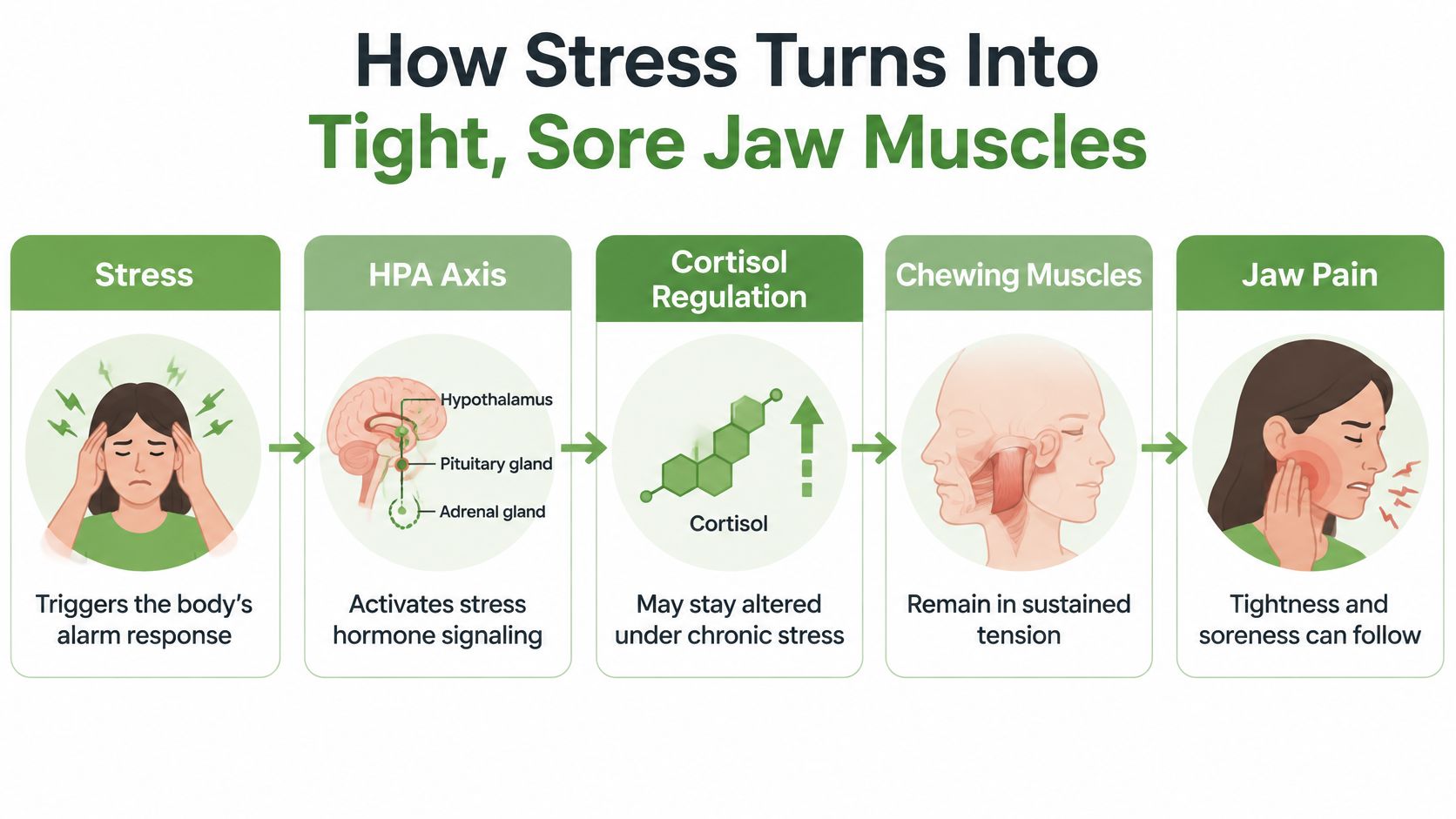
The hypothalamic-pituitary-adrenal axis, usually shortened to HPA axis, helps coordinate the body's stress response. Persistent stress may alter cortisol regulation and contribute to sustained tension in the chewing muscles. This is a proposed pathway, not a hormone test that diagnoses the cause of an individual's jaw pain.
During concentration or worry, a person may also hold the teeth together without noticing. Unlike chewing, that sustained contact doesn't have an obvious stopping point.
The infographic illustrates this possible sequence, rather than a guaranteed chain of events.
Why ordinary movement can start to hurt
Repeated loading and persistent pain may contribute to sensitization, meaning pain-signaling pathways become more responsive. Peripheral sensitization involves nerves near affected tissues; central sensitization involves processing within the brain and spinal cord.
One analogy is a volume knob turned too high: ordinary sensations feel unusually intense. Another is a sensitive smoke alarm that activates with a small trigger. Neither analogy means the tissues are irrelevant or that the pain isn't real.
The cycle can develop in recognizable stages:
- Pain increases vigilance. A person repeatedly checks whether opening or chewing will hurt.
- Vigilance encourages guarding. The jaw stays braced even between activities.
- Guarding adds muscular demand. Rest becomes less restful, allowing soreness to persist.
For example, someone might stop chewing on one side after a painful flare. Later, deadlines bring renewed bracing because jaw movement has become associated with danger. That scenario doesn't prove permanent joint damage; it shows why an assessment should include pain-related fear and activity changes.
When anger or frustration repeatedly triggers tension, Uptown Psychology's relaxation techniques for anger management offer a complementary educational resource. Significant emotional distress deserves support from an appropriate mental health professional.
Breaking this pattern generally means addressing muscle behavior, stress load, and fear of movement together, while checking for dental, joint, nerve, and sleep-related contributors.
Clenching, Grinding and Sleep Breathing
Grinding is the behavior most readers associate with a sore jaw, and research does connect it to joint problems. A 2023 systematic review and meta-analysis of 20 studies associated bruxism with 2.25 times higher odds of TMD, with a 95% confidence interval of 1.94 to 2.56. In separate analyses, awake bruxism was associated with 2.51 times higher odds, and sleep bruxism with 2.06 times higher odds.
Read those numbers carefully. They are odds comparisons across groups, not predictions for any one person, and they show association rather than proof that grinding caused a particular case of jaw pain. Some people grind for years without symptoms; others hurt without any sign of grinding. Nighttime jaw discomfort may be noticeable even when grinding itself isn't.
Awake clenching and sleep bruxism aren't the same
Awake bruxism may involve sustained tooth contact or jaw bracing while concentrating, driving, or feeling tense. Sleep bruxism happens during sleep and may only become apparent through symptoms or observations.
Useful details to note include:
- Daytime tooth contact: Teeth touching while the mouth isn't chewing, sometimes with the lips apart.
- Morning symptoms: Jaw soreness, fatigue, or a clenched-teeth sensation on waking.
- Dental changes: Flattened tooth edges or wear noticed during dental visits.
- Temple discomfort: Aching near the temples or a bed partner's report of grinding.
None of these signs independently confirms sleep bruxism. Tooth wear can reflect activity from years ago, and a partner's report of grinding isn't equivalent to an instrument-confirmed diagnosis. The practical question is simpler: which signs does your own day and night show? The center's information on how to stop clenching the jaw at night provides additional context for discussing nighttime symptoms.
When breathing deserves attention
A 2025 integrative clinical paper on sleep-disordered breathing and orofacial pain describes how breathing disturbances may trigger compensatory muscle responses, increased chewing-muscle activity, and nocturnal bruxism. It also discusses a possible feedback relationship in which jaw dysfunction further disrupts sleep-related breathing.
That possibility makes snoring, witnessed breathing pauses, dry mouth, unrefreshing sleep, daytime sleepiness, and morning headaches important parts of the history.
This video provides additional context for the discussion.
Jaw pain doesn't diagnose obstructive sleep apnea, and sleep apnea doesn't explain every TMD case. Sleep findings belong alongside jaw findings, and a sleep evaluation is worth discussing with a clinician when breathing symptoms are present. For patients already diagnosed with obstructive sleep apnea, Pain and Sleep Therapy Center provides oral appliance therapy and coordinates CPAP care.
Treatment needs objective follow-up
The American Academy of Sleep Medicine oral-appliance guideline identifies CPAP as the standard treatment for moderate-to-severe obstructive sleep apnea and supports a custom, titratable oral appliance for suitable adults who prefer an alternative or can't tolerate CPAP, prescribed by a sleep physician and fitted by a qualified dentist.
A quieter bedroom isn't proof the apnea is controlled. Response requires testing, not just less snoring. In its specific public-safety context, AASM guidance describes documenting objective improvement toward an AHI or REI below 5 events per hour and says oral appliances aren't acceptable at an AHI of 20 or more events per hour in that context. That restriction shouldn't be generalized into a universal prohibition for all patients.
A grinding guard and a sleep-apnea appliance have different purposes. Neither should be selected solely because someone wakes with a sore jaw.
What a Thorough Assessment Checks
A good evaluation works like an investigation: it gathers the history, examines the muscles and joints directly, and only then decides which extra information is worth collecting. No single finding, whether a stressful month, a bite irregularity, or a sleep report, explains the whole problem on its own.
The history and examination checklist
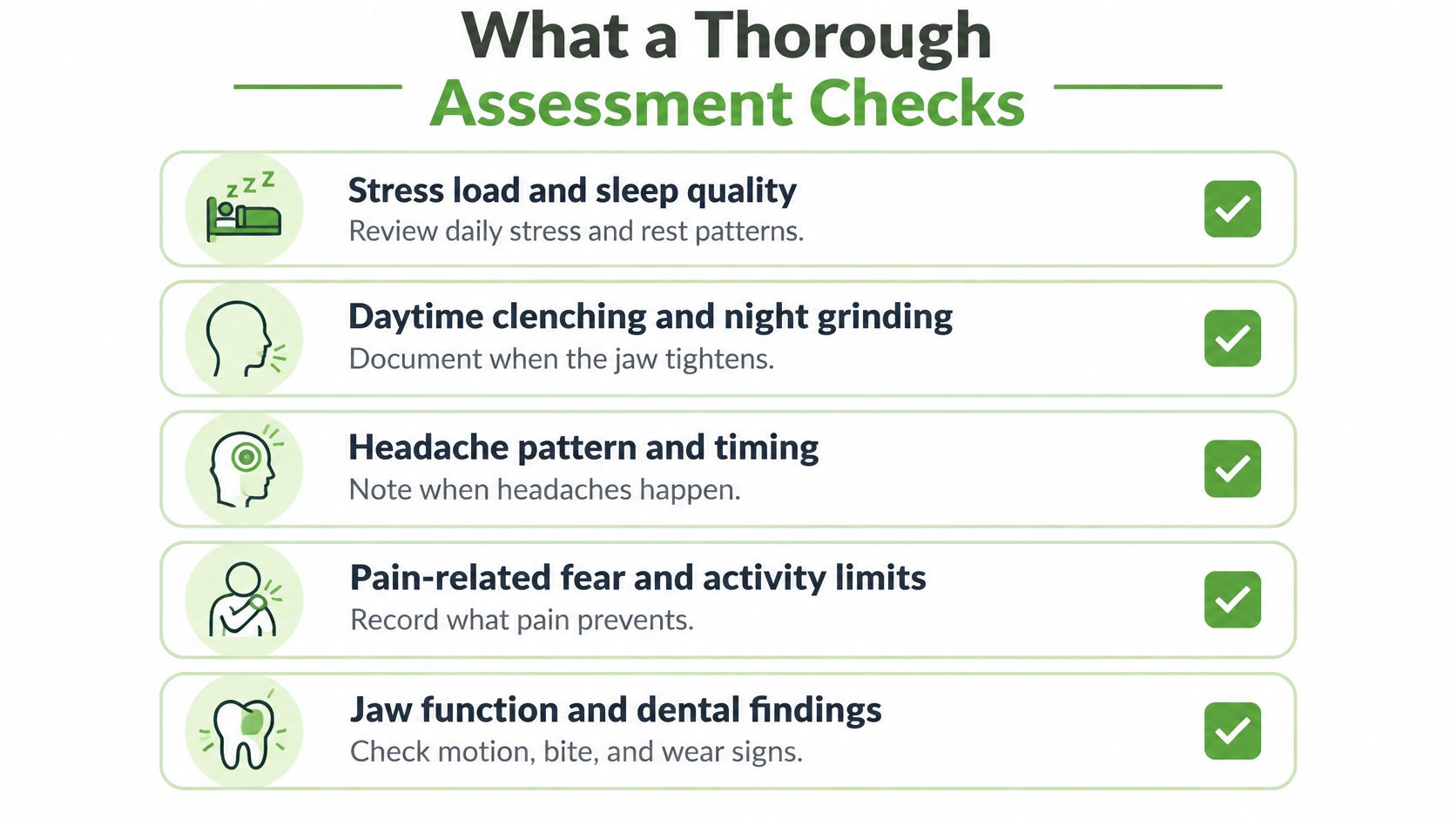
- Stress load and sleep quality: Daily demands, sleep interruptions, and waking symptoms help establish when problems occur.
- Daytime clenching and night grinding: The clinician separates habits you notice while awake from suspected activity during sleep.
- Headache pattern and timing: Temple pain, morning headaches, and migraine-pattern symptoms each need careful differentiation.
- Pain-related fear and activity limits: Avoided foods and guarded movements show how pain affects daily function.
- Jaw opening and joint sounds: Range of movement, locking, and painful noises point to functional difficulties.
- Muscle tenderness: Pressing on the chewing muscles checks whether your familiar pain can be reproduced.
- Bite and tooth wear: Dental findings provide context without automatically establishing the cause.
- Neck and posture: These observations can reveal muscular loading patterns that feed jaw symptoms.
- Medical history and medications: Previous injuries, diagnoses, and current medicines shape both interpretation and treatment planning.
The checklist below summarizes the main areas to document.
More than a sleep study report
A proper assessment also examines jaw structure, tonsil size, and tongue position, because each can influence breathing or jaw loading. A sleep study answers specific breathing questions; examining the mouth, muscles, and joints answers different ones.
Pain and Sleep Therapy Center evaluates TMJ pain, facial pain, sleep-breathing issues, and regenerative treatment options together rather than treating each complaint in isolation. Its facial pain diagnosis information explains why overlapping complaints need to be distinguished before treatment begins.
Imaging or sleep testing enters the picture only when the history and examination raise a question those tests can answer. Neither is automatic for every sore jaw. Coordination across dentistry and sleep medicine, with neurology or ENT involvement when needed, helps clinicians interpret jaw, headache, airway, and stress findings together. Broader orofacial pain symptoms can call for a different diagnostic approach than straightforward muscle tenderness.
Preparation makes the visit more useful. Bring a symptom log, a medication list, and any previous imaging or sleep reports. Describing your most limiting activity matters too: trouble finishing a meal sets different priorities than painless clicking or occasional morning tightness.
Stress Relief and Physical Treatments That Work Together
| Option | What it targets | Evidence and limits |
|---|---|---|
| Rest posture and behavioral down-training | Daytime clenching and habit | Part of standard self-management; best combined with other appropriate care |
| Therapeutic jaw exercises | Muscle guarding and range of motion | Part of biopsychosocial care; results differ between patients |
| Stress management and relaxation training | Stress load and arousal | Supports other care; doesn't replace a clinical exam |
| Biofeedback | Chewing-muscle activity | Inconsistent, low-certainty evidence for independent pain relief; an adjunct |
| Night guard | Grinding and tooth wear | Protects teeth; doesn't treat sleep-breathing disorders or necessarily resolve the cause |
| Custom oral appliance for sleep | Airway and jaw position during sleep | Requires sleep physician and dentist coordination; monitor jaw and bite changes |
| Cold laser therapy | Pain and tissue-healing goals | Discuss current evidence and individual suitability |
| Trigger point therapy | Tender muscle knots | Intended for symptom relief; often paired with exercise |
| Prolotherapy or PRF injections | Selected tissues, including ligaments around the jaw joint | Case-by-case consideration with discussion of suitability and risks |
| Botox for TMD | Overactive chewing muscles | Case-by-case consideration with discussion of suitability and risks |
Match the treatment to the finding
These options aren't interchangeable, and inclusion in the table doesn't mean they have equal evidence or suit every patient. A clinical review of bruxism and TMD-related factors emphasizes the uncertain stress-to-bruxism pathway and the inconsistent, low-certainty evidence for biofeedback's independent pain benefit.
For daytime bracing, behavioral down-training means learning to notice unnecessary muscle activity and release it. A comfortable resting position generally keeps the teeth apart, with the lips gently together when comfortable. The goal isn't to force the jaw into position or maintain constant attention to it.
Therapeutic exercises should match the examination findings. Someone with guarding may need a different movement plan from someone with locking or restricted opening; forceful stretching isn't a substitute for diagnosis.
Combine care without adding everything at once
Stress-management resources can complement physical care. Be Your Best Self & Thrive Counseling, PLLC explains body-based relaxation for stress relief, while the center's resource on meditation for chronic pain offers another educational starting point. Relaxation practice shouldn't require painful jaw tightening.
A dental guard may protect teeth without addressing breathing disturbances. A sleep appliance changes jaw position for an airway-related purpose and requires monitoring for soreness, bite changes, or temporomandibular discomfort.
Treatment priority: Choose an intervention because it addresses an identified problem, not simply because it appears on a list of jaw-pain treatments.
Procedures such as trigger point therapy, cold laser therapy, prolotherapy, PRF injections, or Botox require individual discussion of expected goals, evidence, alternatives, and risks. They shouldn't be presented as automatic next steps after a stressful week.
A practical plan starts with defined targets and reviews comfort, chewing ability, opening, headaches, and sleep symptoms over time. Dental and medical clinicians should coordinate when breathing treatment is involved. When distress is high, mental health support can help without replacing treatment of the jaw.
Choosing Your Next Step for Jaw Pain Linked to Stress
The next step is a clearer explanation of the pain, not more effort to relax.
- Keep a two-week symptom log. Record when jaw pain begins, stress levels, sleep quality, headaches, and noticed clenching. This is a practical observation period, not a diagnostic cutoff or a reason to delay care.
- Check for concerning changes. Swelling, fever, numbness, persistent one-sided pain, sudden bite changes, or significant restriction warrant timely professional evaluation.
- Arrange an integrated assessment. The examination should consider the joint, muscles, bite, sleep, and stress. Breathing symptoms may make sleep testing appropriate.
- Request a written plan. It should identify what's being treated, the order of care, and how progress will be reviewed.
Bring questions that separate stress as a contributor from stress as the sole cause. Does the pain track with sleep quality, or only with stressful days? Is there evidence of nighttime clenching? Could breathing during sleep be part of the picture? A provider who treats these possibilities together can answer them.
Care built around the individual
Pain and Sleep Therapy Center in Charlotte, NC evaluates TMJ pain, jaw dysfunction, headaches, and related sleep or breathing concerns with an individualized, non-surgical, root-cause approach. The practice is led by Dr. Greg Larson, who is triple board-certified and has more than 27 years of experience treating TMJ, facial pain, and sleep-breathing disorders.
A useful care plan doesn't require deciding in advance whether the problem is stress, the jaw, or sleep. It begins by examining those possibilities without assuming that any single explanation fits everyone.
Pain and Sleep Therapy Center offers coordinated evaluation of jaw pain, clenching, and related sleep-breathing concerns to help clarify what may be contributing. Patients can call the practice or ask their own physician for a referral.