You wake up and your jaw feels tight. Your temples ache. One ear feels oddly full, but you don't have a cold. By breakfast, chewing toast makes the ache sharper, and by midmorning you're wondering whether this is a tooth problem, an ear problem, a headache problem, or something in your jaw.
That confusion is common.
TMJ pain symptoms rarely show up as just one symptom in one spot. For many people, the pattern crosses the jaw, ear, head, face, and neck, and it often shows up most clearly during use. Talking a lot, chewing, yawning, clenching, or waking after nighttime grinding can all bring the pattern into focus.
Temporomandibular disorders, often shortened to TMD, affect a meaningful share of adults. Authoritative U.S. estimates put prevalence at about 5% to 12%, depending on how the condition is measured, with one national estimate finding 4.8% of U.S. adults, or roughly 11.2 to 12.4 million people, had pain in the TMJ region that could be related to TMDs, according to NIDCR prevalence data on facial pain and temporomandibular disorders.
That matters because many people dismiss early signs as stress, sinus pressure, or “just sleeping funny.” Sometimes that's true. Sometimes it isn't.
A root-cause evaluation looks beyond the joint alone. It asks what structure is irritated, what movements provoke symptoms, what muscles are overworking, and whether sleep, breathing, posture, or clenching are adding strain. If you're still sorting out the basics, this overview of what TMJ disorder means can help frame the bigger picture.
By the end, you should be able to recognize common TMJ pain symptoms, notice the triggers that make them worse, and know when the pattern points toward professional evaluation.
Introduction to TMJ Pain Symptoms You Should Not Ignore
Some symptoms are easy to brush off because they seem unrelated.
A sore jaw after a stressful day might not worry you. A dull temple headache might feel like normal tension. Ear discomfort without an infection might send you in the wrong direction. But when those symptoms travel together, especially when jaw movement provokes them, they start to form a more meaningful pattern.
Why the symptoms often arrive as a cluster
The jaw joint sits in a crowded neighborhood. It works with chewing muscles, facial muscles, nearby ear structures, and nerve pathways that can spread pain beyond one tiny point. So a person may say, “My jaw hurts,” when the main problem is overworked muscle. Another may say, “My ear feels blocked,” when the trigger is jaw loading.
That's one reason TMJ pain symptoms can be hard to describe. They don't always feel dramatic. They often feel mixed.
Practical rule: If pain gets worse with chewing, yawning, talking for a long time, clenching, or pressing on the area in front of the ear, jaw function deserves a closer look.
What people tend to miss
People often expect TMJ pain to feel like sharp joint pain only. In practice, it may feel more like:
- Morning tightness that eases a bit as the day goes on
- Aching near the ear when chewing dense or chewy foods
- A temple or facial headache that appears after clenching
- Jaw fatigue during long conversations
- A sense of stiffness when opening wide to yawn or take a big bite
The key idea is simple. Don't look at each symptom alone. Look for a pattern.
How Your Jaw Joint Works and Why It Causes Pain
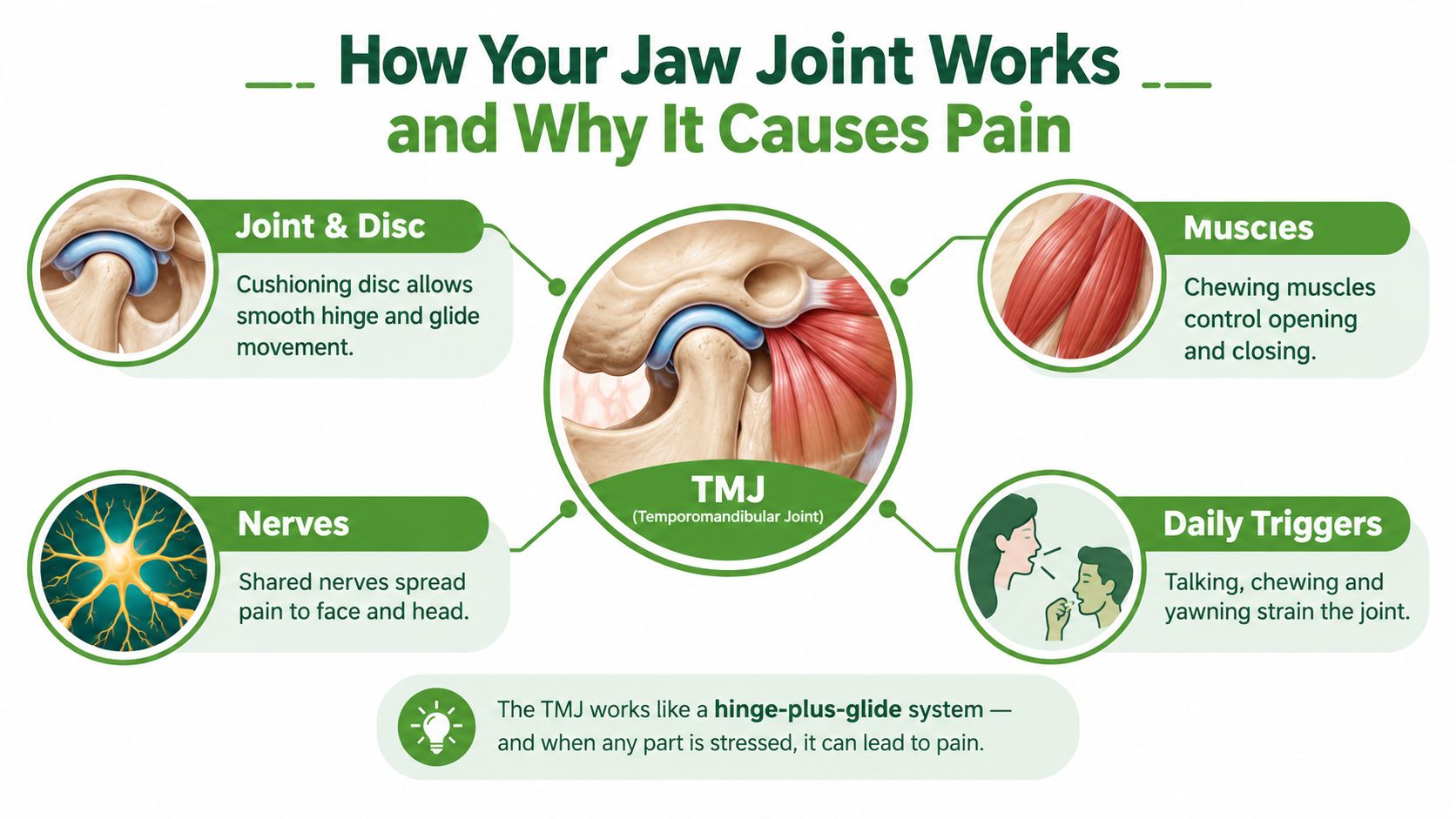
A jaw joint flare often starts with something ordinary. You bite into a chewy sandwich, talk through a long meeting, or yawn wide in the car. Then the area in front of the ear starts to ache, the temple joins in, and your neck feels tense by evening. That pattern happens because the jaw is not working alone. It is part of a small but busy system that shares load across muscles, a cushioning disc, nearby nerves, and the upper neck.
Your temporomandibular joint works like a hinge on a short track. As your mouth opens, the lower jaw first rotates, then glides forward. That combined motion lets you do small jobs all day, like swallowing and speaking, and bigger ones, like chewing tough foods or opening wide for a yawn.
The moving parts in plain language
A helpful way to picture it is a door with a padded slider and cables that pull it open.
- The joint surfaces guide opening and closing.
- The disc is the cushion between the moving parts.
- The chewing muscles generate force and control direction.
- The nerves carry signals from the jaw, face, temple, and nearby areas.
When the muscles are the main problem, clinicians often use the word myalgia, which means muscle pain. When the sore structure is the joint itself, they may say arthralgia, or joint pain. If the cushion is not moving in its usual way, you may hear disc displacement.
Those labels matter because they help explain why one person feels tired, tight muscles after clenching, while another feels sharper pain right at the joint with opening or biting.
Why jaw use can trigger symptoms
TMJ pain is often tied to function. In plain terms, the system complains when you load it.
Clinical guidance summarized in StatPearls on temporomandibular syndrome describes a common pattern: symptoms are provoked by chewing, yawning, prolonged talking, clenching, grinding, or pressing on the area. That is a useful clue because pain that reliably appears with jaw use points in a different direction than pain that comes out of nowhere.
This is also where people get confused. They expect one sore spot. The jaw more often behaves like an overloaded chain.
Why pain can spread beyond the joint
If a knee hurts, the pain often stays near the knee. The jaw is less tidy.
The chewing muscles can send pain into the cheek or temple. Joint irritation near the ear can feel ear based even when the ear itself is normal. Guarding in the jaw can make the neck work harder, especially during long conversations or when you hold tension in your shoulders and face.
That is why TMJ pain symptoms are better understood as a clustered, function-provoked pattern across the jaw, ear region, head, and neck, rather than as isolated jaw pain.
A simple way to sort the possibilities is this:
- Muscle-driven pain often feels like ache, tightness, fatigue, or tenderness after overuse, clenching, or stress.
- Joint-driven pain is more likely to feel localized near the joint, especially with opening, biting, or loading.
- Non-TMJ pain deserves a closer look when symptoms are not linked to jaw function, feel electric or burning, or follow a pattern that does not change with movement.
That distinction is not a diagnosis by itself. It is a starting map. When pain predictably flares with a bagel, a yawn, or an hour of talking, jaw mechanics move higher on the list of likely causes.
Common Jaw Centered TMJ Pain Symptoms
A common real-life pattern goes like this: breakfast is fine, lunch feels annoying, and by dinner the jaw feels tired, sore, or strangely stiff. That progression matters because jaw-centered TMJ symptoms often show up during function, not as one fixed pain point.
What jaw-centered symptoms often feel like
People describe this in different ways, but the symptoms usually fall into a small group. Some feel them right in front of the ear, where the jaw joint sits. Others feel them more in the chewing muscles along the cheek, jaw angle, or temple.
Common jaw-centered symptoms include:
- A dull ache near the joint just in front of the ear
- Muscle soreness or fatigue after chewing, clenching, or a long conversation
- Stiffness on first opening such as in the morning or after keeping the mouth closed for a while
- Pain with wide opening during yawning, dental work, or big bites
- Clicking or popping when the jaw opens or closes
- Grinding or grating sensations that feel rough rather than sharp
- Catching or brief locking where the jaw hesitates, shifts, or feels temporarily stuck
- Tenderness to touch over the joint or the chewing muscles
A useful way to picture it is like a door with both a hinge and a pull-cord. If the hinge is irritated, the pain often feels more focused near the joint. If the pull-cord muscles are overworked, the jaw may feel tired, tight, and sore with use.
The symptom cluster matters more than any single label
A click by itself does not always mean trouble. Many people have painless clicking. Pain, limitation, fatigue, tenderness, and noise together tell a more useful story than any one symptom alone.
That is why a symptom tracker often helps more than a symptom name.
Ask yourself:
- When does the pain show up after waking, during meals, after talking, or after clenching?
- What kind of jaw task brings it on chewing, opening wide, side-to-side movement, or biting into firm foods?
- Does the jaw feel tired, sore, or blocked and are those sensations always in the same spot?
- Are the sounds painful or painless and do they happen every time or only on some movements?
- Does the jaw open straight or does it swing to one side before it centers?
Those details help separate a muscle-driven pattern from a joint-driven one. Muscle symptoms often feel like ache, tightness, and fatigue. Joint symptoms are more likely to feel pinpointed, mechanical, or accompanied by catching and restricted opening. If the pain is constant, burning, electric, or unrelated to jaw use, the source may not be TMJ at all.
A short video can make these movement patterns easier to recognize in real life.
A simple symptom tracker to bring to an appointment
You do not need a long diary. A few notes across several ordinary moments can be enough. Write down one morning, one meal with light chewing, one meal with tougher chewing, and one longer conversation.
- Morning note Record jaw tightness, temple pressure, tooth soreness, or a sense that the jaw has to loosen up.
- Eating note Note which foods bring symptoms on. Chewy bread, raw vegetables, dense sandwiches, and wide bites are common examples.
- Talking note Track whether the jaw tires or aches during meetings, phone calls, teaching, or social events.
- Sound note Mark clicking, popping, or grinding, and whether it comes with pain, catching, or limited opening.
- Function note Write down any episode where the jaw locks, shifts, or does not open as smoothly as usual.
This kind of pattern log gives a clinician something more useful than "my jaw hurts." It shows whether the problem behaves more like an overworked muscle, an irritated joint, or something outside the TMJ pattern.
Beyond the Jaw How TMJ Symptoms Show Up in Ears Head and Neck
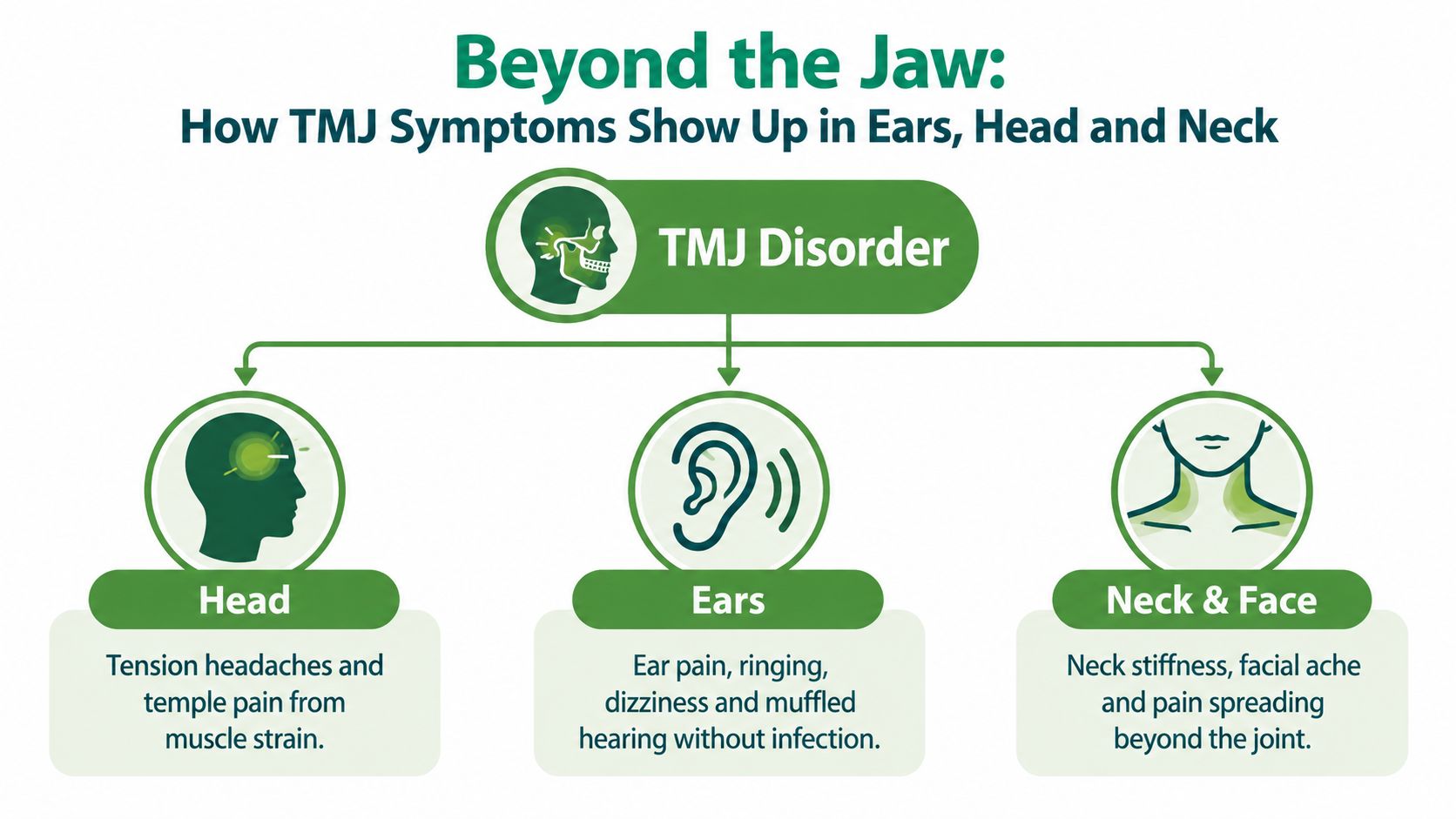
The most confusing part of TMD is that the pain may not stay centered at the joint. In family medicine guidance, TMD commonly presents with a cluster of symptoms rather than isolated jaw pain. Reported associated symptoms include headache (79%), bruxism (58%), pain at the TMJ (54%), otalgia (52%), jaw popping or clicking (51%), neck pain (51%), tinnitus (37%), dizziness (37%), decreased hearing (36%), and sound sensitivity (23%), according to the AAFP review of temporomandibular disorders.
That symptom mix explains why people often chase the wrong source first.
Ear symptoms without an ear infection
Many patients say, “It feels like an ear problem.” The ear may hurt, feel full, ring, or seem oddly sensitive to sound, even when an ear exam doesn't show infection.
That can happen because the jaw joint sits close to the ear, and because the muscles and nerve pathways in this region overlap. The sensation is real. It's just not always coming from the ear itself.
Headaches and neck tension that start with jaw strain
Temple headaches are especially common in people who clench or grind. The pattern often looks like this: you wake with a tight jaw, your temples feel sore by late morning, and your neck stiffens by afternoon. The longer the muscles stay overworked, the more the surrounding areas react.
Some people with jaw-related headaches wonder if they're having migraines. There can be overlap, and the distinction isn't always obvious without a careful exam. This discussion of TMJ and migraines may help if your pain repeatedly seems to bounce between the jaw and the head.
Pain around the jaw can be local, but the lived experience is often regional. Patients feel it in the face, temple, ear, scalp, and neck because those structures work together.
The pattern to pay attention to
Instead of listing symptoms separately, group them by timing:
- After sleep jaw tightness, temple pressure, ear fullness
- During chewing aching near the ear, fatigue, clicking
- During long conversations facial soreness, neck tightness, headache
- During stress clenching, tooth pressure, muscle tenderness
When these symptoms travel together, jaw function deserves attention even if the discomfort seems to “move around.”
Is It TMJ Muscle Joint or Something Else
Many readers get stuck. They want one label. Real life is messier.
Recent review literature highlights that myalgia is the most frequently reported TMD symptom at 37.2%, ahead of clicking or joint sounds at 29.8% and arthralgia at 16.8%, according to the systematic review summary on temporomandibular disorder symptom patterns. That means muscle-driven pain is often the dominant presentation, even though many people assume the joint itself must be the whole story.
Clues That Point to Muscle vs Joint vs Non TMJ Pain
| Feature | Myofascial Muscle Pain | Joint Related Pain | Consider Non TMJ Cause |
|---|---|---|---|
| Common location | Cheek, temple, jaw muscles, sometimes neck | In front of the ear, deep in the joint area | Tooth, sinus area, throat, nerve-like facial distribution, or diffuse unexplained pain |
| Typical trigger | Clenching, grinding, long talking, chewing fatigue | Opening wide, chewing, joint loading, jaw translation | Symptoms that don't change much with jaw use |
| How it feels | Ache, tightness, fatigue, soreness to touch | Sharp or deep ache with movement, catching, pressure in the joint | Burning, electric, throbbing, feverish, or other patterns outside classic TMD |
| Sounds | Usually no major joint sounds | Clicking, popping, crepitus, locking may occur | Variable, often not tied to the joint |
| Response to rest | Often eases when the jaw isn't working | May improve somewhat with reduced loading, but mechanical symptoms can persist | Less clearly linked to rest or jaw activity |
| What needs caution | Persistent muscle tenderness and headaches | Recurrent locking, major restriction, painful sounds | Swelling, fever, trauma, numbness, neurologic change, or unexplained persistent pain |
One clue matters a lot
Classic TMD is often provoked by function. Spontaneous pain that appears out of nowhere and doesn't change with talking, chewing, or yawning deserves a broader differential.
That doesn't mean it isn't serious if jaw movement hurts. It means the pattern helps narrow the possibilities.
If the pain predictably appears when the jaw works, muscle and joint causes move higher on the list. If it ignores jaw function, a clinician has to think wider.
Why self-diagnosis only goes so far
Some cases are straightforward. Many aren't.
A person can have muscle pain and a disc issue at the same time. Another may have headaches, ear symptoms, and a normal-looking joint but overloaded muscles. Another may think it's TMJ when the primary issue is dental, sinus-related, neurologic, or inflammatory. The point isn't to label yourself perfectly. It's to notice enough detail to guide a better evaluation.
When to See a Specialist and What Red Flags to Watch For
Many mild flare-ups settle with reduced strain, softer foods, better sleep habits, and less clenching. But some patterns shouldn't be left to guesswork.
If pain keeps recurring, function is getting worse, or the symptom cluster is affecting eating, sleep, or work, it's reasonable to seek care. Older review literature also noted that while symptom reporting varies widely, only 3% to 7% of the population seeks treatment for pain and dysfunction of the temporomandibular joint, based on findings summarized in this PubMed review on epidemiology of temporomandibular disorders. In other words, people often wait.
Signs that it's time to get evaluated
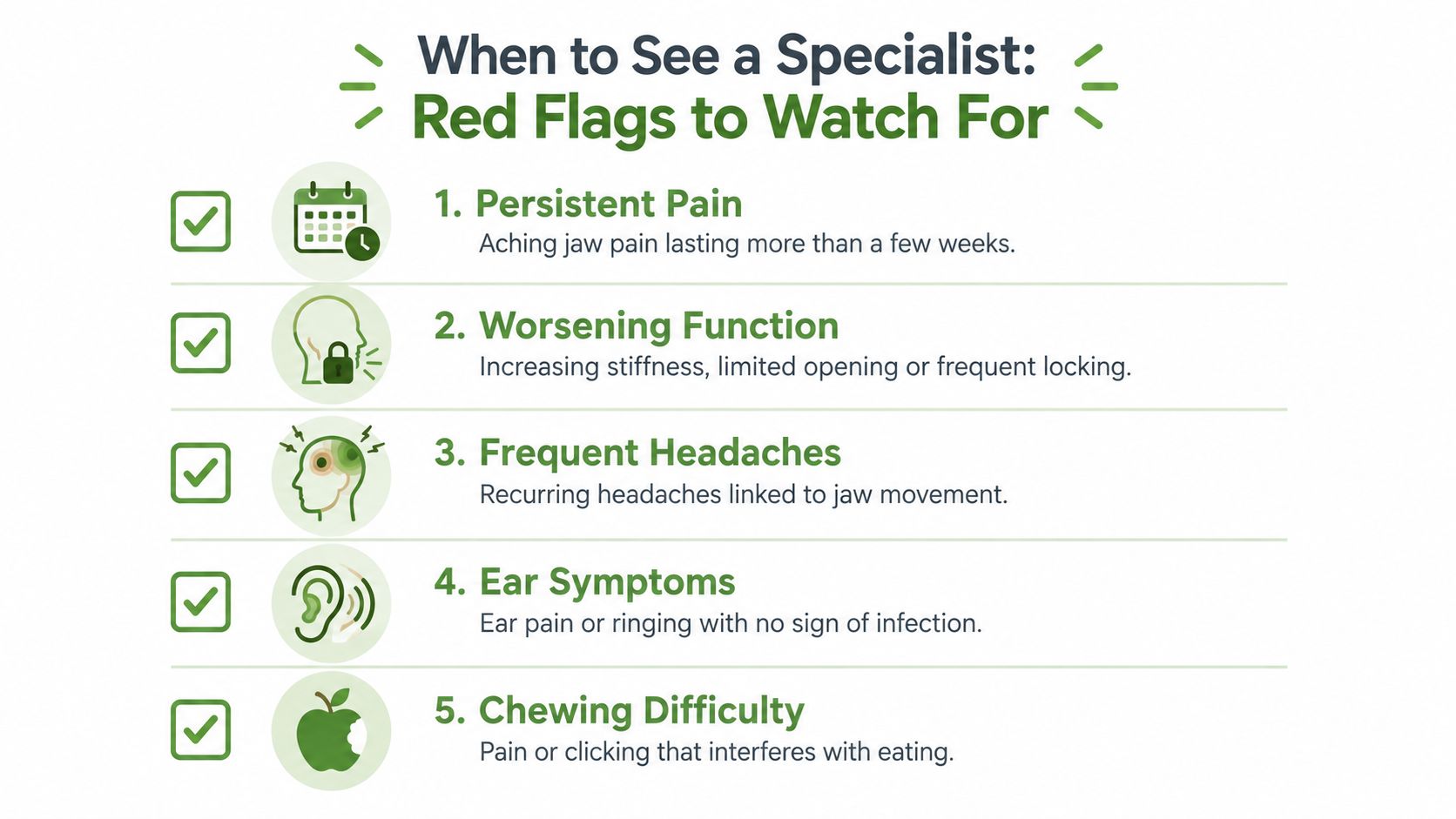
Consider an appointment if you notice any of these:
- Pain that persists If jaw, temple, or ear-area pain keeps returning for weeks, it's worth a closer look.
- Function that's declining Opening feels more limited, chewing is harder, or the jaw catches or locks more often.
- Headaches linked to jaw use The pattern repeats after chewing, clenching, or waking with jaw tension.
- Ear symptoms without infection Ringing, fullness, or ear pain continue but routine ear explanations don't fit.
- A known clenching or grinding pattern Especially if morning symptoms are building.
Red flags that need prompt medical attention
These features deserve quicker evaluation because they may point beyond a routine TMD picture:
- Recent trauma to the jaw, face, or head
- Fever or visible swelling
- Unexplained weight loss
- Numbness, weakness, or other neurologic symptoms
- Pain that feels unrelated to jaw function and keeps escalating
Who to see
A simple way to decide:
- Start with self-care for a brief, mild flare tied to overuse.
- See your dentist or primary care clinician if symptoms keep recurring or you're unsure what's driving them.
- See a TMJ or orofacial pain specialist when the pattern is complex, movement is restricted, or prior care hasn't clarified the cause.
Bring a symptom log, medication list, and notes about triggers. Those details save time.
How TMJ Pain Is Evaluated and What Happens Next
A good evaluation is usually more physical exam and history than technology. The first questions often matter most. When did it start? What triggers it? Is it worse in the morning? Does chewing increase it? Is there clicking, locking, or headache overlap?
A clinician may examine jaw opening, side-to-side movement, muscle tenderness, joint tenderness, bite pattern, and the quality of movement. Because symptoms can cross into sleep and breathing patterns, some evaluations also include airway, sleep, oral posture, and clenching history. If you want a fuller picture of the process, this guide to TMJ pain diagnosis walks through what clinicians look for.
What often happens during the visit
Most visits include a few practical steps:
- History review Symptoms, triggers, stress load, sleep quality, and past injuries
- Hands-on exam Palpation of muscles and joints, opening pattern, joint sounds
- Function check Chewing tolerance, locking history, range of motion
- Targeted next steps Conservative care first in many cases, with imaging only when the history or exam suggests it's needed
What treatment planning may include
The next step depends on what the exam shows. Options may include oral appliances, jaw-focused physical therapy, myofunctional therapy, breathing retraining, habit change around clenching, and selected regenerative approaches when appropriate.
At Pain and Sleep Therapy Center, evaluation may also include airway-focused and myofunctional factors when those appear relevant to jaw strain, sleep disruption, or chronic facial tension. That's one example of a broader root-cause approach rather than treating the joint in isolation.
The best treatment plan matches the pain generator. Muscle-driven pain, joint irritation, disc issues, and non-TMJ causes don't all need the same answer.
Before your visit, jot down when symptoms occur, what movements trigger them, any history of grinding or clenching, and what has or hasn't helped. That kind of simple tracking often shortens the path to a more targeted plan.
If your jaw pain seems to connect with headaches, ear symptoms, clenching, or poor sleep, a more complete evaluation can help sort out what's really driving it. Pain and Sleep Therapy Center evaluates TMJ disorders, facial pain, and related sleep and airway factors so patients can understand whether the source is muscle, joint, or a broader pattern. If you're tired of guessing, it's a practical next step.