
Someone searching for TMJ treatment before and after usually wants three answers: what changed, how long it took, and whether surgery or escalating medication could have been avoided. A useful comparison starts with a documented baseline, a clearly defined intervention, a realistic timeline, and measures such as pain, maximum mouth opening, headache frequency, sleep quality, feeding function, or daily energy. Without those details, a photo or a single symptom rating can make progress look more certain than it is.
The six pathways below are practical clinical scenarios for analysis, not promises of identical results or substitute case reports. They move from conservative functional care to regenerative therapies and coordinated specialty treatment. For a structured starting point, review TMJ assessment and treatment plans, then ask a qualified clinician which measurements fit your symptoms.
1. Chronic Migraine Relief Through TMJ and Airway Assessment
A patient with frequent migraines, jaw tension, forward head posture, and restricted nasal breathing may not improve by treating the head pain alone. The first task is to separate coincidence from contribution. A clinician should document headache frequency, intensity, duration, jaw tenderness, mouth opening, neck mobility, sleep quality, nasal breathing, and clenching habits before treatment begins.
The intervention logic is conservative and coordinated. Orofacial myofunctional therapy may address resting tongue position, swallowing mechanics, and nasal breathing patterns. Buteyko breathing exercises may be considered when a clinician determines that breathing habits contribute to tension or overbreathing. Posture correction and an ergonomic desk setup can reduce repeated loading through the neck and jaw. Prolotherapy or another regenerative procedure requires a diagnosis-specific discussion, because an injection is not a universal answer for migraine or TMJ pain.
A migraine diary gives the patient a more reliable before-and-after comparison than memory. Track headache days, severity, rescue medication use, jaw soreness on waking, sleep interruptions, and aggravating activities. Reassess at defined milestones instead of expecting a dramatic change after a single appointment.
Practical rule: Treat the jaw, neck, breathing pattern, and headache pattern as related findings, but don't assume one proves the cause of the others.
A 2022 scoping review found that pain, maximum mouth opening, jaw function, and jaw movement were the main endpoints across 172 studies, with pain measured in 161 articles and maximum mouth opening in 91. These measures provide a useful framework for documenting change, even when the patient's main complaint is migraine. Patients can also review information about TMJ migraine treatment, while understanding that a personal assessment is still necessary.

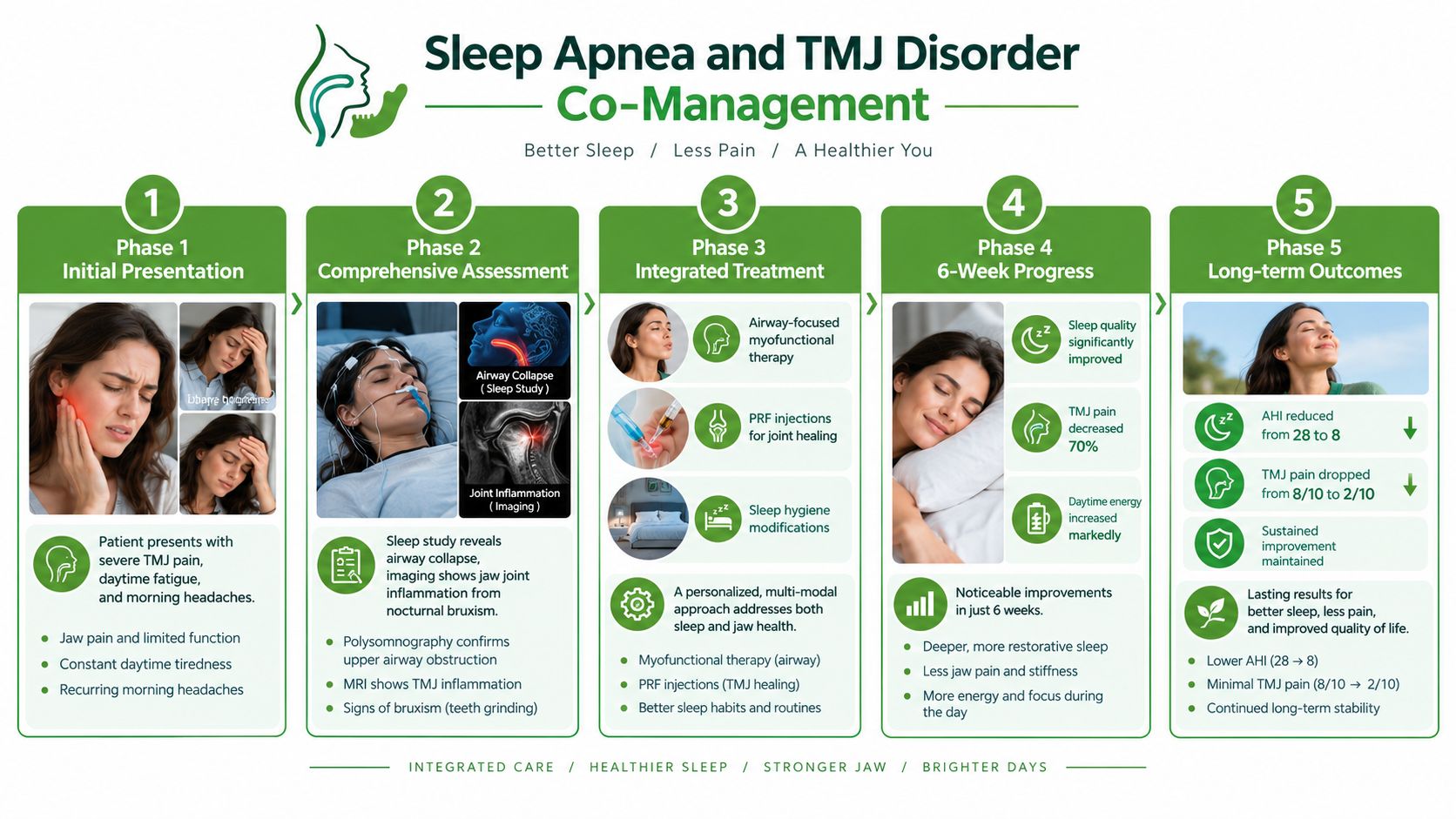
2. Sleep Apnea and TMJ Disorder Co-Management
Morning headaches, daytime fatigue, jaw pain, and tooth grinding can appear together, but they don't automatically share one cause. A patient who wakes with a sore jaw and unrefreshing sleep needs an assessment that considers both temporomandibular disorder and sleep-disordered breathing. A sleep study, medical history, examination of the jaw muscles and joints, and review of nighttime clenching can clarify which problems need immediate attention.
The before-and-after plan should track sleep and jaw outcomes separately. Record snoring, awakenings, morning headache severity, daytime alertness, jaw pain, chewing tolerance, and mouth opening. If obstructive sleep apnea is suspected, the patient should receive appropriate sleep evaluation rather than trying to manage airway symptoms with an untested dental device.
Treatment may include sleep medicine, a professionally selected oral appliance, airway-focused myofunctional therapy, sleep-position changes, and TMJ rehabilitation. PRF injections may be discussed for selected joint conditions, but the evidence doesn't justify presenting them as a guaranteed healing solution. A patient considering a retainer should first review sleep apnea retainer options with a qualified provider, because an appliance must suit the airway diagnosis, dental condition, and jaw symptoms.
A 2020 systematic review of manual therapy reported significant improvement in pain and maximum mouth opening in every included study, with immediate pain improvement averaging around 4/10 points in the analyzed studies. The review also found that longer-term results were more mixed, which matters when a patient feels better quickly but wants to know whether the improvement will last.
Sleep improvement and jaw improvement should be measured as two related outcomes, not collapsed into one success claim.
A sleep diary, validated questionnaire, clinician review, and follow-up testing can show whether the plan is improving sleep quality, airway stability, jaw comfort, or only one part of the problem. Expert TMJ relief and better sleep should involve this kind of coordinated reasoning rather than a device-first approach.
3. Pediatric Tongue-Tie and Feeding Function
An infant who struggles to latch, feeds inefficiently, or causes persistent nipple pain needs prompt evaluation by the pediatric care team. Poor feeding can have several causes, including positioning, milk transfer, oral-motor coordination, medical illness, and restricted tongue movement. A tongue-tie assessment shouldn't replace a pediatric examination, lactation support, or growth monitoring.
The baseline should include feeding duration, latch quality, swallowing coordination, maternal pain, wet diapers, weight trajectory, and the infant's general health. The clinician should explain what a frenulum procedure can and cannot address. A laser frenectomy may be appropriate in selected cases, but the decision depends on functional restriction and clinical findings, not on appearance alone.
After a procedure, age-appropriate oral exercises and feeding guidance may help the child develop more effective tongue movement. Parents should receive clear instructions and know which signs require follow-up. Feeding progress needs to be checked alongside growth, comfort, hydration, and general development. It isn't appropriate to promise that a procedure will normalize feeding or prevent later speech or airway problems in every child.
Parents researching laser frenectomy for infants should ask who performs the evaluation, how the pediatrician and lactation consultant coordinate care, and what follow-up includes. The before-and-after record should show functional change, not just a photograph of the frenulum.
A useful care sequence looks like this:
- Document feeding first: Record the specific difficulty rather than relying on a broad label such as “poor latch.”
- Coordinate specialists: Include the pediatrician and lactation consultant when feeding or growth is affected.
- Use targeted aftercare: Follow only the exercises prescribed for the infant's age and findings.
- Monitor development: Reassess feeding, growth, oral movement, and later speech as the child matures.
This timeline graphic can help families understand why assessment, treatment, and follow-up belong together.
Families may also find it helpful to watch an explanation of infant oral-function care before deciding what questions to bring to an appointment.
4. Post-Orthodontic TMJ Symptoms and Functional Restoration
Clicking, pain, or restricted opening after orthodontic treatment deserves an examination, but symptoms alone don't prove that braces or aligners caused joint damage. A patient may have muscle pain, disc displacement, clenching, airway concerns, an unrelated joint disorder, or several factors at once. The clinician should review orthodontic records, retention, bite changes, trauma, sleep, breathing, and the timing of symptoms.
The baseline should include pain during chewing, jaw opening, deviation on opening, joint sounds, muscle tenderness, bite comfort, and any relevant imaging. Imaging can help answer a focused diagnostic question, but it shouldn't be ordered or interpreted as proof of a predetermined cause. The treatment plan may include physical therapy, habit modification, a carefully selected appliance, myofunctional therapy, or coordination with the orthodontist.
Cold laser therapy and PRF injections are examples of treatments a provider may discuss in selected situations, but they shouldn't be presented as guaranteed cartilage regeneration or a substitute for diagnosis. Airway-focused therapy may help a patient who mouth-breathes, while posture work may address neck and jaw loading. Those interventions are distinct from orthodontic tooth movement and should be assessed on their own merits.
A three-month outcome study in myofascial orofacial pain found that jaw-pain severity decreased across all treatment arms, and jaw opening improved significantly in the bite-splint and home-exercise groups. About 70% of participants reported improvement in TMD pain severity, according to the study report. That evidence supports measurable conservative care, but it doesn't establish that every post-orthodontic patient needs a splint, injections, or orthodontic reversal.
The most useful post-orthodontic question is not “Which treatment caused this?” It is “What finding should the next treatment change?”
Patients can compare braces and aligners as part of a broader orthodontic discussion, but current TMJ symptoms require their own clinical assessment. Record changes at consistent intervals and avoid judging success by clicking alone, since a sound can persist without pain or functional limitation.
5. Chronic Tension Headache and Myofascial Pain
Daily tension headaches with neck stiffness and jaw pain often create a cycle of clenching, guarded movement, poor posture, and sleep disruption. A practical assessment examines the jaw joints, chewing muscles, cervical spine, breathing pattern, desk setup, stress response, and medication use. It should also screen for headache features that require medical evaluation rather than assuming every headache comes from the jaw.
The intervention should be staged. Breathing retraining may come before demanding tongue or jaw exercises if the patient struggles to maintain nasal breathing without increasing tension. Myofunctional therapy can address tongue posture and swallowing mechanics. Workplace changes, such as raising the monitor and supporting the back, are simple but important because treatment won't overcome hours of repeated forward-head loading.
Trigger-point treatment or Prolotherapy may be considered when the clinician identifies a suitable target, but injections should complement rehabilitation rather than replace it. Track headache days, headache intensity, jaw pain, neck pain, sleep quality, rescue medication use, and tolerance for work or exercise. A reduction in medication use is meaningful only when it occurs safely and under appropriate medical guidance.
A randomized clinical study of cervico-mandibular manual therapy used 10 treatment sessions and found significant improvements in jaw pain, maximum mouth opening, and cervical flexion in the intervention group. Benefits remained at a 4-week follow-up, while the control group showed a narrower pattern of improvement. This supports measuring neck function alongside jaw pain when the clinical picture includes both regions.
Actions patients can repeat
- Reset the workstation: Keep the monitor at a comfortable height and avoid prolonged chin-forward posture.
- Notice resting tension: Let the teeth stay apart when you're not chewing, unless your clinician gives different instructions.
- Progress gradually: Increase exercises according to symptoms and provider guidance, not according to pain tolerance alone.
- Keep a headache record: Note sleep, meals, stress, jaw activity, and medication so patterns become visible.
The strongest before-and-after comparison combines symptom change with function. A patient who reports fewer headaches but worsening mouth opening needs a different interpretation from one who improves across both measures.
6. Adolescent Malocclusion, Sleep Problems, and Daytime Function
An adolescent who snores, sleeps restlessly, breathes through the mouth, or struggles with daytime attention may have several contributing factors. Malocclusion and jaw function deserve assessment, but nasal obstruction, sleep-disordered breathing, mood, learning differences, medication effects, stress, and normal development can produce similar signs. Ask about morning headaches, night awakenings, daytime sleepiness, irritability, and difficulty sustaining attention before linking symptoms to the jaw or airway.
Baseline and treatment logic
Start with the teenager's report, parent observations, school functioning, orthodontic examination, nasal breathing assessment, and medical history. A sleep questionnaire can organize the baseline. If the pattern suggests airway obstruction, refer for sleep evaluation rather than treating the bite alone. In selected patients, myofunctional therapy may support tongue posture and nasal breathing. An orthodontist can assess whether palatal expansion fits the dental and skeletal findings. Both options require a clear functional rationale, not a promise of better grades or behavior.
Set a review point after the initial intervention and record sleep quality, daytime energy, concentration, mood, school participation, jaw comfort, snoring, and mouth-breathing frequency. Change one major variable at a time when practical. This makes the response easier to interpret, although coordinated care may require parallel medical, orthodontic, or sleep treatment. The prescribing clinician should manage medication changes.
Adolescents are still growing, so treatment should protect future options. Guidance from the U.S. National Institute of Dental and Craniofacial Research supports beginning TMJ care with simple, reversible measures and avoiding irreversible changes to the teeth, bite, or jaw unless they are necessary.
Actions the patient can repeat
- Record bedtime, awakenings, snoring, nasal or mouth breathing, and morning symptoms.
- Bring the log to the pediatrician, orthodontist, or sleep clinician.
- Practice prescribed nasal-breathing or tongue-posture exercises consistently.
- Keep the teenager involved in reviewing sleep, jaw comfort, and daytime function.
The outcome is better defined by sustained improvement across sleep, breathing, comfort, and participation than by a single change in behavior. Coordinate communication among the family, pediatrician, orthodontist, sleep clinician, and school when appropriate.
TMJ Before & After: 6-Case Comparison
| Case | Implementation Complexity 🔄 | Resources & Time ⚡ | Expected Outcomes 📊⭐ | Ideal Use Cases 💡 | Key Advantages ⭐ |
|---|---|---|---|---|---|
| Chronic Migraine Resolution Through TMJ and Airway Correction | Moderate, multi-modal non‑surgical program (assessment + therapy) 🔄🔄 | Orofacial myofunctional therapist, prolotherapy clinician, digital imaging; daily home exercises; 8–12 weeks ⚡⚡ | Reduced migraine days from 4–5/wk to 1–2/mo; ~80% reduction in days within 12 weeks 📊 ⭐⭐⭐⭐ | Patients with migraines linked to TMJ/forward head posture who want to avoid meds 💡 | Addresses root biomechanical causes; reduced medication reliance; durable functional gains ⭐ |
| Sleep Apnea and TMJ Disorder Co‑Management | High, integrated sleep and TMJ diagnostics + coordinated treatment 🔄🔄🔄 | Requires sleep study, PRF injections, myofunctional therapy, sleep hygiene coaching; 12–16 weeks typical (early gains in 6–8 wks) ⚡ | AHI reduction example 28→8; TMJ pain ↓ ~70%; improved daytime energy and sleep quality 📊 ⭐⭐⭐⭐ | TMJ patients with suspected/diagnosed OSA or chronic fatigue seeking airway‑focused care 💡 | Simultaneously improves sleep and joint health; treats airway collapse as root cause ⭐ |
| Pediatric Tongue‑Tie and Feeding Dysfunction Resolution | Moderate, surgical release + therapy, pediatric expertise required 🔄🔄 | Laser frenectomy, lactation consultant, infant myofunctional therapy; rapid recovery, follow‑up therapy for weeks; ~2 weeks to early gains ⚡⚡⚡ | Feeding efficiency restored within ~2 weeks; weight gain normalization by 12 months; maternal pain resolved 📊 ⭐⭐⭐⭐ | Infants with poor feeding, failure to thrive, or breastfeeding pain 💡 | Rapid, minimally invasive fix that prevents long‑term feeding/speech issues; high parental satisfaction ⭐ |
| Post‑Orthodontic TMJ Dysfunction and Restoration | High, diagnostic imaging and regenerative rehabilitation; interdisciplinary care 🔄🔄🔄 | Cold laser, PRF injections, myofunctional therapy, orthodontist coordination; 10–16 weeks ⚡⚡ | Pain resolution and elimination of clicking within ~8–10 weeks; improved jaw function and stabilized joint health 📊 ⭐⭐⭐⭐ | Patients developing TMJ symptoms after orthodontic treatment or aggressive tooth movement 💡 | Non‑surgical regenerative approach addressing iatrogenic causes and preventing progression ⭐ |
| Chronic Tension Headache & Myofascial Pain Syndrome Resolution | Moderate, multi‑site myofascial + breathing/postural program 🔄🔄 | Prolotherapy for trigger points, Buteyko breathing, myofunctional therapy, ergonomic changes; 8–16 weeks ⚡⚡ | Headaches reduced from daily to 2–3/wk by 8 weeks; up to 90% pain improvement by 16 weeks 📊 ⭐⭐⭐⭐ | Medication‑resistant chronic headache sufferers with postural/breathing contributors 💡 | Reduces medication dependence; treats multiple pain generators for sustained relief ⭐ |
| Adolescent Malocclusion, Sleep Issues, and Behavioral Improvement | Moderate, airway‑focused myofunctional therapy with ortho coordination 🔄🔄 | Myofunctional therapy, breathing retraining, possible palatal expansion evaluation; 12 weeks+; requires teen engagement ⚡⚡ | Improved sleep architecture, increased alertness, behavioral/academic gains within ~12 weeks; may reduce ADHD med needs 📊 ⭐⭐⭐ | Teens with behavioral/academic issues and suspected sleep‑disordered breathing or narrow palate 💡 | Targets root airway cause of cognitive/behavioral symptoms; preventive orthodontic benefits ⭐ |
How to Evaluate Your Own TMJ Treatment Progress
Start with a baseline that matches your complaint. If pain is the main issue, record its location, intensity, triggers, duration, and effect on chewing. If headaches dominate, count headache days and note severity, sleep, jaw tension, and medication use. For limited movement, measure maximum mouth opening and document deviation, locking, and chewing tolerance. For sleep-related symptoms, track snoring, awakenings, morning headaches, daytime fatigue, and any formal sleep-study findings.
Next, identify what the plan is addressing. A joint problem, muscle problem, airway concern, posture pattern, sleep disorder, and oral-function issue may overlap, but they aren't interchangeable diagnoses. Ask your clinician to explain which finding supports each treatment and what result should change if the intervention is working. That question can prevent a patient from collecting disconnected treatments without a clear outcome target.
Use consistent reassessment points. Compare the same measures under similar conditions, rather than relying on a particularly good or bad day. Evidence increasingly favors quantifiable pre-treatment and post-treatment outcomes, but the durability of improvement remains an important limitation. A 2026 systematic review of 51 randomized trials found that physiotherapy approaches often improved pain and jaw mobility or function, while also highlighting small samples, varied protocols, subjective outcomes, and limited long-term follow-up. The review's findings support cautious optimism, not permanent-result guarantees.
Ask whether the plan is reversible, what alternatives exist, and when surgery or long-term medication is appropriate. U.S. NIDCR guidance favors simple, reversible care at the start for many TMJ problems. In selected TMJ osteoarthritis cases, arthrocentesis combined with biologic adjuvants showed improvements from baseline, but the evidence still doesn't establish universal superiority over conservative care. Treatment should follow the diagnosis, not the marketing label.
A root-cause, interdisciplinary evaluation may be useful when jaw pain, headaches, breathing, sleep, and oral function interact. Pain and Sleep Therapy Center is one example of a clinic combining TMJ, sleep, breathing, myofunctional, and pediatric oral-health services. Visit tmjsleep.com for current information, and verify that any provider you choose offers an individualized examination, measurable goals, and appropriate coordination with other clinicians.
Pain and Sleep Therapy Center evaluates TMJ disorders, facial pain, sleep-related breathing concerns, headaches, and pediatric oral-function issues through individualized, interdisciplinary care. If your symptoms involve jaw pain, breathing, sleep, or headaches, visit Pain and Sleep Therapy Center to learn about assessment and treatment options.