
You're lying awake because the snoring has started again. Your partner nudges you, you turn onto your side, and the room goes quiet for a few minutes before the sound returns. By morning, you may have a dry mouth, a heavy head, or no clear memory of how often your breathing disturbed the night.
Buteyko breathing can be useful in this situation, but it's easy to misunderstand what it does. It isn't a guaranteed cure for every snoring problem, and it won't remove enlarged tissue, correct a severely blocked nose, or replace an evaluation for obstructive sleep apnea. Its practical role is narrower and more useful: retrain quiet nasal breathing, reduce habitual overbreathing, and support an airway-focused plan.
The guide below will help you understand whether your snoring pattern is suitable for gentle breathing retraining, how to practice safely, and which signs mean you should seek airway assessment first. If your nighttime breathing is uncomfortable because of nasal blockage, start with guidance on how to breathe through your nose, and consider other sleep-support options such as melatonin alternatives explained if sleep disruption has become part of the wider problem.
Introduction to Quieter Nights With Buteyko Breathing
A quieter night usually comes from consistent practice, not from forcing the breath or expecting an overnight transformation. Some people notice that their daytime breathing feels calmer before their partner notices a change in nighttime noise. Others need assessment and treatment for an underlying airway problem before breathing exercises can make a meaningful difference.
Buteyko breathing was developed by Russian medical student Konstantin P. Buteyko in the late 1940s. By the 1980s, it had been formally accepted in the Soviet Union as a mainstream management system for breathing disorders, and Alexander Stalmatski introduced the method to Australia in 1990. Its central idea is to reduce overbreathing and encourage quieter nasal breathing, a principle later connected by Buteyko-linked sources with snoring and sleep apnea. (Buteyko Airways history)
What this approach can and can't do
A person who habitually sleeps with an open mouth may benefit from learning to keep the lips together and breathe gently through the nose during the day. That practice may support better oral posture and less turbulent airflow at night. It makes most sense when the nose is usable and the snoring is not accompanied by clear signs of repeated airway collapse.
The evidence needs a careful reading. A 2012 report found no prior clinical trials specifically examining the Buteyko Method or other breathing-retraining approaches for sleep apnea at that time. The same report included practitioner estimates, not randomized-trial outcomes, in which over 80% of course attendees were estimated to stop snoring, while 60% of practitioners reported that estimate and another quarter estimated a 60% to 80% success range. (2012 breathing retraining report)
Those figures describe historical practitioner experience, not a promise for an individual patient. Use the exercises as one part of airway care, track changes carefully, and arrange an evaluation if the snoring is loud, persistent, or associated with daytime symptoms.
Why Buteyko Breathing May Help Reduce Snoring
Snoring occurs when soft tissues in the upper airway vibrate as air passes through a narrowed or unstable passage. Mouth breathing can increase dryness and alter the position of the tongue, lips, and jaw. If the nose is congested, a person may default to mouth breathing without realizing it, especially during sleep.
Buteyko retraining takes the opposite approach to forceful “deep breathing.” The practitioner teaches the patient to breathe lightly and through the nose, with a smaller breathing volume and a relaxed pause after exhalation. The purpose isn't to create a dramatic sensation. It's to reduce unnecessary respiratory effort and make nasal breathing more familiar.
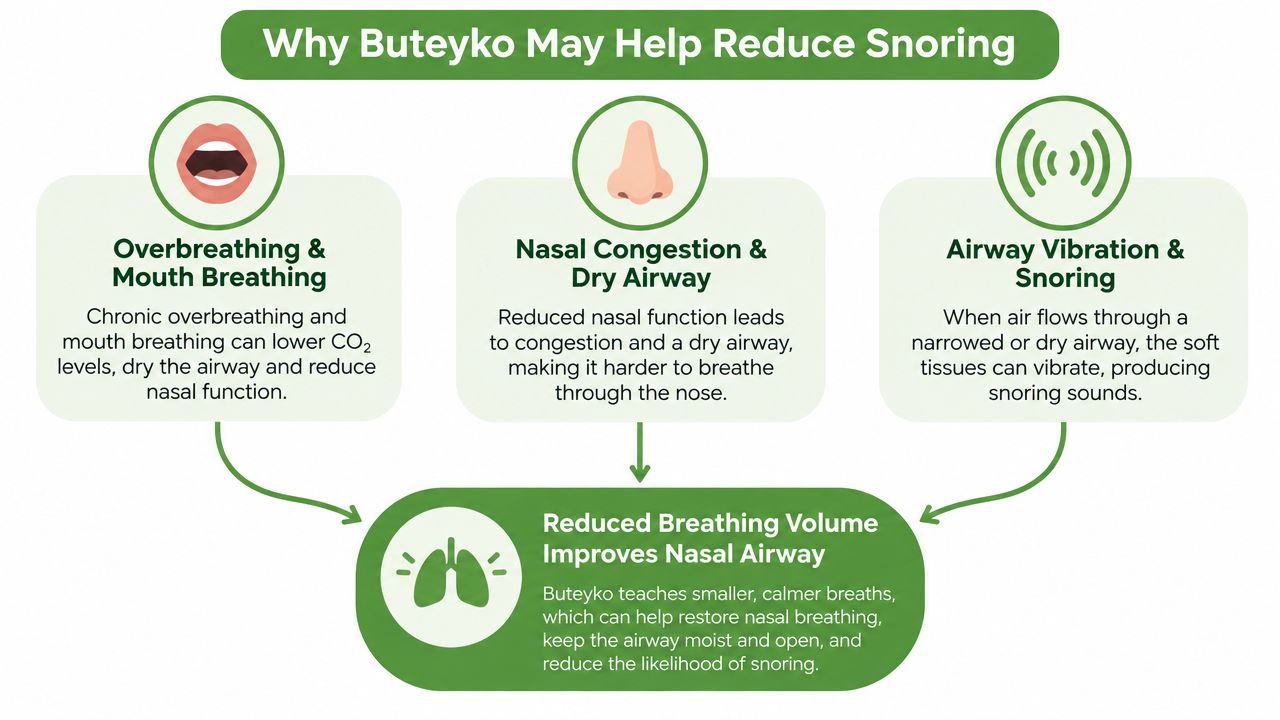
The pathway from breathing habit to nighttime noise
A useful clinical sequence looks like this:
- Overbreathing or heavy breathing can make the breath noisy and effortful.
- Nasal congestion or learned mouth breathing shifts airflow away from the nose.
- An open mouth and altered tongue posture can reduce upper-airway stability.
- Airway vibration produces snoring.
Buteyko addresses the breathing habit in that sequence. It doesn't directly resolve a structural blockage, and it isn't clearly superior to every other breathing intervention. Neutral reviews note that Buteyko-specific protocols for sleep patients remain unestablished, while comparisons with slow breathing, diaphragmatic breathing, and yoga haven't established a clear advantage for Buteyko. (Sleep and Breathing review)
What the evidence supports
The independent review literature remains preliminary. Snoring-specific evidence consists mainly of small studies and survey-style reports rather than large controlled trials. A 2021 review describes improved quality of life when nocturnal nasal breathing improved in snoring men, which supports nasal airway optimization and reducing mouth breathing, but it doesn't establish strong cure rates. (Review of breathing re-education in sleep apnea)
That distinction matters in practice. If nasal breathing is comfortable and snoring is mild, Buteyko may be a reasonable retraining tool. If the airway repeatedly closes, exercises alone may leave the core problem untreated. More detail on the limits of the method appears in this explanation of whether Buteyko breathing works.
Core Buteyko Exercises You Can Practice at Home
Practice these exercises while seated or standing comfortably, not while driving or in any situation where a brief pause could create risk. Your breathing should stay quiet and controlled. A mild sense of air hunger can be acceptable during reduced-breathing work, but panic, dizziness, chest pain, or significant distress means you should stop.
Start with a nasal breathing reset
Sit tall with your shoulders loose and your jaw unclenched. Let the tongue rest broadly against the roof of the mouth, with the tip behind the upper front teeth, and keep the lips gently together.
Breathe through the nose for several minutes. Don't pull in a large breath. Aim for a soft, nearly silent inhale and an easy exhale. If the nose feels restricted, reduce the effort rather than sucking harder. Nasal hygiene, allergy management, or an airway evaluation may be more appropriate than pushing through obstruction.
Add gentle reduced breathing
After the reset, make each breath slightly smaller than usual. Exhale softly through the nose, then allow a short, relaxed pause before the next quiet inhale.
You're looking for mild air hunger, not a struggle. The throat, face, and upper chest should remain relaxed. If you need to gasp, tense your neck, or take a large recovery breath, the reduction is too strong. Return to normal nasal breathing and try again with less effort.
Notice the control pause without chasing a score
After a normal nasal exhale, pinch the nose lightly and notice how long it takes before the first clear desire to breathe appears. Release the nose and resume calm nasal breathing immediately.
This is an awareness tool, not a competition. A longer pause isn't automatically evidence of better sleep, and repeating the test aggressively can make you anxious or overbreathe afterward. Focus on whether your breathing remains calm before and after the pause.
Use light breath holds during easy activity
Once seated practice feels comfortable, you can add brief, gentle pauses during ordinary activities such as walking slowly around the home. Keep your posture upright and release the nose before the urge becomes strong.
Mouth taping requires more caution. Don't use it to force nasal breathing when your nose is blocked, when you suspect sleep apnea, or when you haven't already confirmed that comfortable nasal breathing is possible. People who want support specifically for nighttime mouth breathing can also review these snoring remedies for mouth breathers.
Safety rule: Never turn breath retraining into a test of endurance. Quiet, comfortable breathing is the target.
Follow a simple checklist:
- Nose: Can you breathe through both sides without strain?
- Lips: Do they stay together without jaw tension?
- Tongue: Is it resting upward rather than low and forward?
- Breath: Is the inhale soft instead of deep or noisy?
- Response: Do you feel calmer afterward, not light-headed or distressed?
For a visual demonstration of the sequence, watch the guided video below.
How Often to Practice and What Results to Expect
A routine works when you can repeat it without turning bedtime into another task to manage. Start with short, comfortable sessions during the day, then add a quiet practice before sleep. The exact amount should match your nasal comfort, breathing control, and response to air hunger.
A practical routine can look like this:
- Morning: Use a brief nasal reset after waking, especially if you notice dry mouth or noisy breathing.
- Daytime: Practice reduced breathing while seated, keeping the sensation mild and controlled.
- Evening: Repeat calm nasal breathing before bed, then keep the attention on a soft exhale rather than trying to force sleep.
- Night waking: If you wake alert, return to quiet nasal breathing instead of taking repeated deep breaths.
Track useful outcomes rather than trying to calculate every change. Ask your partner whether the snoring sounds less intense, note morning dry mouth, and record whether daytime energy feels different. A simple sleep diary can reveal patterns related to congestion, alcohol, illness, sleeping position, or inconsistent practice.
Build progression around comfort
Upper-airway exercise programs are commonly discussed as requiring 10 to 30 minutes daily over at least three months, according to the practical guidance summarized in airway exercise material. (Airway exercise guidance) That recommendation applies to broader multi-exercise and oropharyngeal programs, not a proven Buteyko-only snoring protocol.
Increase practice only when your breathing remains easy. If the nose becomes more irritated, your sleep worsens, or you feel more anxious about breathing, reduce the intensity and seek guidance. Improvement may appear as easier daytime nasal breathing before nighttime snoring changes, and some people may need combined tongue, lip, jaw, and airway work.
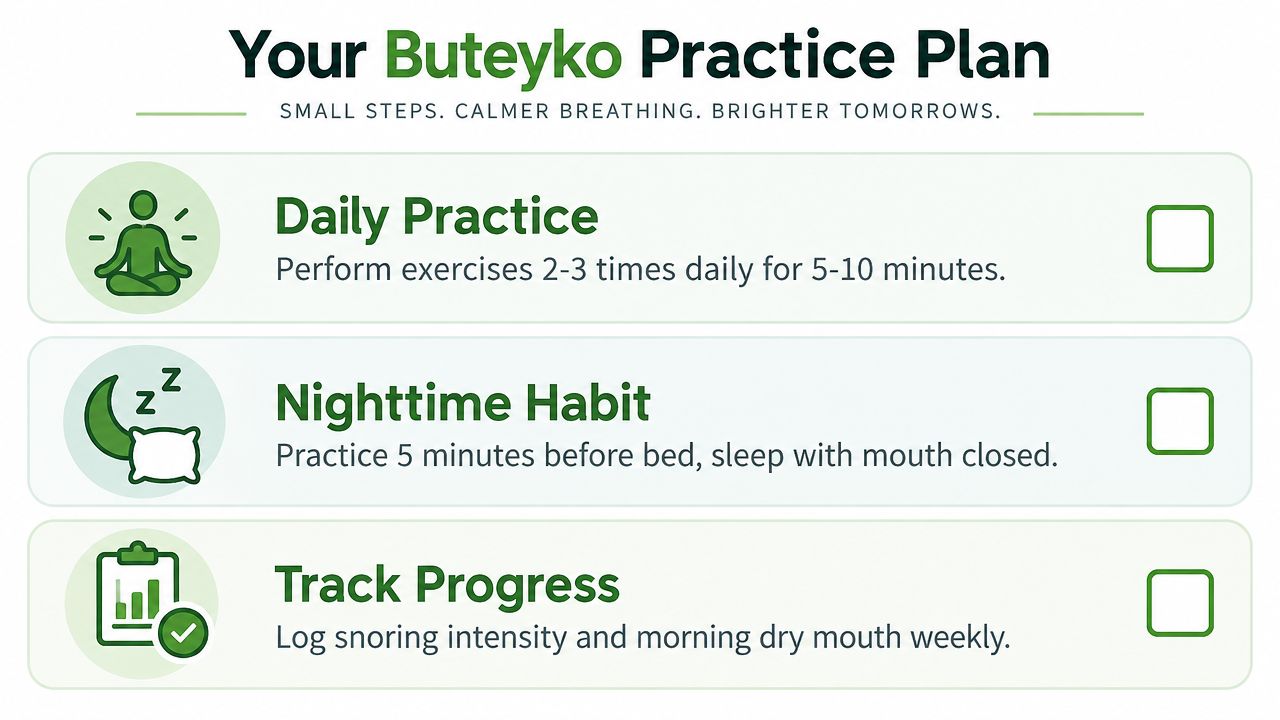
Consistency matters more than a demanding routine. If you miss a session, resume at the next convenient opportunity instead of compensating with longer breath holds.
Who Should Try Buteyko and Important Safety Considerations
Buteyko is most reasonable for a person who can breathe through the nose comfortably, notices habitual mouth breathing, and has mild or uncomplicated snoring without warning signs. It may also fit as an adjunct to orofacial myofunctional therapy when tongue posture, lip seal, and nasal breathing habits need attention.
It's not a substitute for airway evaluation when the complaint suggests obstruction or sleep-disordered breathing. Exercise-based programs work best for selected patients after clinicians consider nasal blockage, enlarged tonsils or adenoids, structural airway issues, and other contributors. The literature still doesn't establish a Buteyko protocol for people whose snoring is driven by anatomy, obesity, or moderate-to-severe obstructive sleep apnea.
Prioritize assessment when you notice these signs
Seek evaluation through a sleep clinician, ENT, dental sleep medicine provider, or qualified airway-focused practitioner if you have:
- Witnessed pauses: A partner sees breathing stop, restart, or become visibly strained.
- Strong daytime sleepiness: You struggle to stay alert, concentrate, or function safely.
- Persistent obstruction: Nasal breathing remains difficult despite reasonable nasal care.
- Complex symptoms: Morning headaches, uncontrolled hypertension, or frequent nighttime choking deserve medical attention.
- High-risk snoring: Loud, persistent snoring occurs alongside poor sleep or daytime impairment.
Don't tape your mouth shut to mask these signs. A clinician may need to assess the nose, jaw, tongue, throat, sleep breathing, and related health factors before recommending exercises. Buteyko can then be included where it's appropriate, alongside treatment rather than in place of it.
Putting It All Together for Lasting Quiet Sleep
The most useful plan combines breathing practice with airway habits that remove friction from nasal breathing. Keep the bedroom comfortable, reduce avoidable evening stimulation, and address nasal dryness or congestion rather than assuming every snoring sound comes from breathing volume.
Your sleep position may also matter. Side sleeping can be worth testing, and a supportive pillow may help you maintain a comfortable neck and jaw position. If you're comparing options, browse supportive pillows by Comfort Pure as part of a broader sleep setup, not as a treatment for airway obstruction.
Combine breathing with oral posture care
Some people need more than nasal breathing retraining. Orofacial myofunctional therapy may address tongue resting position, lip seal, swallowing mechanics, and the muscles that support the upper airway. Nasal hygiene, allergy care, ENT treatment, dental sleep medicine, or sleep testing may also belong in the plan.
Use partner feedback and a simple sleep diary. Record snoring quality, dry mouth, morning alertness, and any witnessed breathing pauses. If those observations don't improve, or if warning signs appear, arrange a personalized assessment rather than increasing breath holds.
Buteyko works best as a repeatable skill within airway-focused care. Practice gently, protect nasal comfort, and judge progress by function and sleep quality rather than by forcing a particular breathing score.
Pain and Sleep Therapy Center evaluates snoring, sleep-related breathing issues, nasal breathing patterns, oral posture, and related TMJ or facial concerns, then builds an individualized plan that may include Buteyko breathing and orofacial myofunctional therapy. Visit Pain and Sleep Therapy Center to request an assessment and discuss whether breathing retraining is appropriate for your symptoms.