
Does every forward tongue movement need to be fixed?
People who search for how to fix tongue thrust have often already answered yes. They've noticed a tongue that slips between the front teeth on every swallow, a mouth that hangs open at rest, a lisp, or teeth that crept forward after braces came off. The assumption is that the tongue is the culprit and the answer is a set of exercises.
That assumption is only half right. A forward tongue pattern is very common in childhood and often fades without anyone intervening. What decides whether it matters isn't the movement itself. It's the resting posture behind it, the breathing route that shaped it, the speech it affects, and the bite it may or may not be changing.
The useful first question isn't which exercise to start. It's whether this particular pattern is producing a measurable problem. Answer that, and everything after it, from referral to airway work to retraining to follow-up, follows a clear order.
Deciding Whether Tongue Thrust Needs Treatment
Tongue thrust, also called atypical swallowing, describes a swallow in which the tongue moves toward or between the front teeth rather than pressing against the palate. The resting position can differ: some people keep the tongue low, leave their lips apart, or breathe with their mouth open.
A forward tongue movement by itself does not show that treatment is needed. A foundational review published by the American Speech-Language-Hearing Association reported anterior tongue positioning during speech or swallowing in approximately 50% of otherwise normal 8-year-old children, while associated open-bite malocclusion occurred in about 4%. The review noted that both figures fall as children mature, so some childhood patterns resolve without intervention.
The review recommended checking whether the pattern contributes to a speech disorder or malocclusion before prescribing therapy. Swallowing therapy is generally not indicated when there is no speech or dental problem.
Why the movement alone doesn't decide anything
There are no clear criteria for predicting which people with a forward tongue will develop malocclusion. Research comparing orofacial myofunctional therapy alone with no treatment is limited and largely based on small, lower-quality studies. Resting tongue posture may affect tooth position differently from the brief contact between tongue and teeth during a swallow.
Assessment should focus on function and observable effects: where the tongue rests, whether nasal breathing is comfortable, whether the lips close easily, how the person swallows, which sounds are affected, and whether the bite has changed. Nasal blockage, allergies, or enlarged tonsils can also contribute to mouth breathing and a low tongue posture.
Practical rule: address a pattern when it is linked to a measurable functional or dental problem, rather than treating every forward movement seen on video.
| Finding | What It May Indicate | Next Step |
|---|---|---|
| Tongue tip between teeth during swallowing, with normal speech and bite | A developmental pattern that may resolve with age | Monitor; therapy is not automatic |
| Low or forward tongue at rest | A resting-posture concern | Myofunctional assessment |
| Open bite or displaced incisors | A possible dental effect | Orthodontic evaluation |
| Sibilant speech errors | A possible speech disorder | Speech-language pathologist evaluation |
| Mouth breathing, snoring, or enlarged tonsils or adenoids | A possible nasal or airway issue | ENT and sleep assessment |
| Limited tongue lift or extension | Possible restriction or tongue dysfunction | Structured tongue-function examination |
Bite changes need careful assessment because crowding and open bites can have several causes. The tongue may be one factor, not the whole explanation. Eric Wiitala DDS on malocclusion care describes how orthodontists distinguish tooth-position concerns from functional ones before selecting a plan.
A home check you can do this week
For several days, note four things:
- Resting posture: Where does the tongue sit when the person is not eating or talking? Do the lips meet without effort?
- Breathing at night: Is there snoring, dry mouth on waking, an open mouth during sleep, or observed pauses?
- Speech: Which sounds lisp or distort? Do they change when the person speaks more slowly?
- Bite changes: Are gaps opening between the front teeth, do the teeth meet differently, or has the bite shifted after braces?
Comfortable nasal breathing, an easy resting posture, and a stable bite may support monitoring. A persistent concern in any one area is a reason to seek professional assessment.
Confirm the Right Referral Before You Start Treatment
Choosing who to see first gets easy once the finding is clear. The harder part is arriving at that first visit with enough information for the clinician to work with, because a tongue pattern shows up differently in a 20-minute appointment than it does at home on a Tuesday night.
Bring a short written log instead of a summary from memory. Note how the person breathes at rest, whether the mouth hangs open while watching television or sleeping, when snoring started, and any moment a swallow or a sound seemed off. A 20-second phone video of the mouth at rest, and of a sip of water being swallowed, tells a clinician more than a paragraph of description. Parents can usually capture it without the child noticing.
What the first evaluation should cover
A proper assessment is more than a sleep study report and more than a quick look inside the mouth. It includes the structure of the jaw, the size of the tonsils and the position of the tongue, along with how the teeth meet. Pain and Sleep Therapy Center evaluates TMJ, sleep and airway questions with in-house 3D CBCT imaging and home sleep testing where those answers are needed, which keeps the structural and breathing pieces in one place instead of scattered across three offices.
Bring these to the appointment:
- Speech and swallowing notes: sounds that distort, foods avoided, coughing or gulping with liquids.
- Sleep symptoms: snoring, gasping, restless sleep, morning headaches, daytime fatigue.
- Jaw symptoms: clicking, locking, soreness on waking, clenching or grinding at night.
- Orthodontic history: braces, retainers, relapse, extractions, and any appliance currently worn.
Orofacial Myofunctional Therapy addresses tongue strength, nasal breathing and swallowing patterns, so if that's where the plan leads, the first visit becomes the baseline everything else is measured against.
For background on how these pieces connect, the practice's pages on TMJ and TMD, sleep apnea, snoring and the practice itself explain what each evaluation looks at. Parents of younger children can read about the pediatric airway assessment before the visit, because children are examined differently and the questions to bring change with age.
If a dentist or physician already raised the concern, keep that referral in the loop. Starting with the professional who noticed the problem is a reasonable route, and a short note from them saves time at the first appointment.
The Treatment Sequence From Breathing to Swallowing
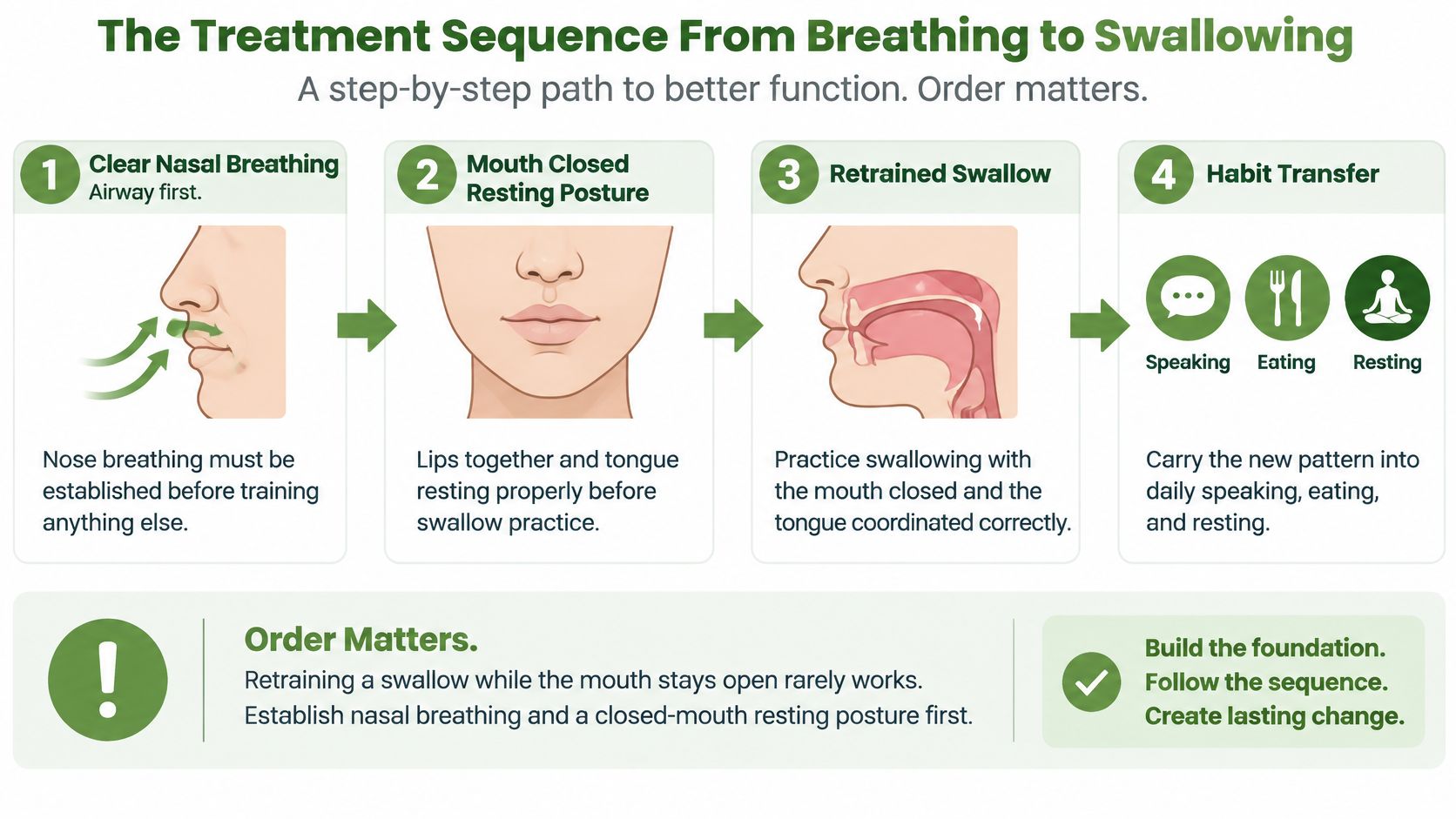
Order decides outcome here. A swallow retrained while the mouth stays open at night tends to unravel, because the airway keeps pulling the tongue back into the old position. So the sequence starts above the swallow, not with it.
The American Academy of Pediatric Dentistry notes that a forward resting tongue posture, rather than brief tongue-tooth contact during swallowing, is the factor more likely to displace incisors, and it recommends behavior modification, myofunctional therapy, habit appliances or multidisciplinary referral depending on the child's needs. That framing puts posture and breathing ahead of strengthening.
Why the airway comes first
Nasal obstruction holds the tongue low and forward no matter how diligently someone practices. Allergies, enlarged tonsils and adenoids, a deviated septum and chronic mouth breathing keep the pattern in place, and diagnostic methods vary widely enough that there's no single agreed protocol (review of mouth breathing and tongue thrust). The practical response is to check the nose before drilling the tongue, and to run rehabilitation alongside treatment of the obstruction rather than after it fails.
| Phase | Main Goal | Focus | Progress Check |
|---|---|---|---|
| 1. Airway first | Clear nasal breathing | Obstruction, allergies, mouth-breathing habit | Breathes through the nose at rest |
| 2. Resting posture | Stable tongue-up position | Tongue tip toward palate, closed lips | Holds posture at rest without reminders |
| 3. Isolated swallow | Correct saliva swallow | Controlled saliva swallows with tongue on palate | Swallows without forward thrust |
| 4. Generalization | Carry pattern into daily life | Chewing, speech and daily routines | Consistent use during meals and talking |
Phase two carries most of the work and most of the impatience. A tongue that has rested low for years won't hold a new position on command. It holds when the lips seal comfortably and the jaw stays relaxed. Phase three then isolates the swallow from food, using saliva only, so the pattern gets practiced without chewing and without an audience.
Phase four is the one people skip. A swallow that works in a therapy room but not at lunch hasn't generalized. Practicing during real meals and real conversation is the difference between a party trick and a habit.
Watch for this pitfall: treating the swallow while mouth breathing, nasal obstruction, thumb sucking or an orthodontic problem is still unresolved. The exercises look like they're working, then quietly stop working.
Exercise can't do the orthodontist's job either. Published clinical guidance states that myofunctional therapy cannot replace orthodontic correction or change craniofacial morphology, and that outcomes depend heavily on patient and parent adherence. Keep that in view when a plan promises to reshape a bite through tongue drills alone.
Where the barrier is habitual mouth breathing rather than tongue position, therapy targets the breathing pattern first, which is why myofunctional therapy for mouth breathing begins with the nose. The clinic matches therapy to the barrier in front of it, whether that's tongue posture, habitual mouth breathing or a sore jaw joint.
Place yourself in a phase with two questions. Do you breathe through your nose at rest with your lips together? Can you complete a swallow without the tongue pushing forward? Two yeses put you in phase four. Any no tells you where to start.
Orofacial Myofunctional Exercises That Retrain Posture
This is coordination training, not a strength contest. Evidence reviews describe orofacial myofunctional therapy as retraining coordinated tongue and facial-muscle activity rather than strengthening the tongue in isolation, and the 2024 systematic review of atypical swallowing and malocclusion describes exercises and tongue-elevator approaches built to help patients find a physiologically favorable resting position and stabilize it through repeated lip and tongue practice (Journal of Clinical Pediatric Dentistry review). Tongue position changes how the surrounding muscles behave, which is why the program works on the whole pattern.
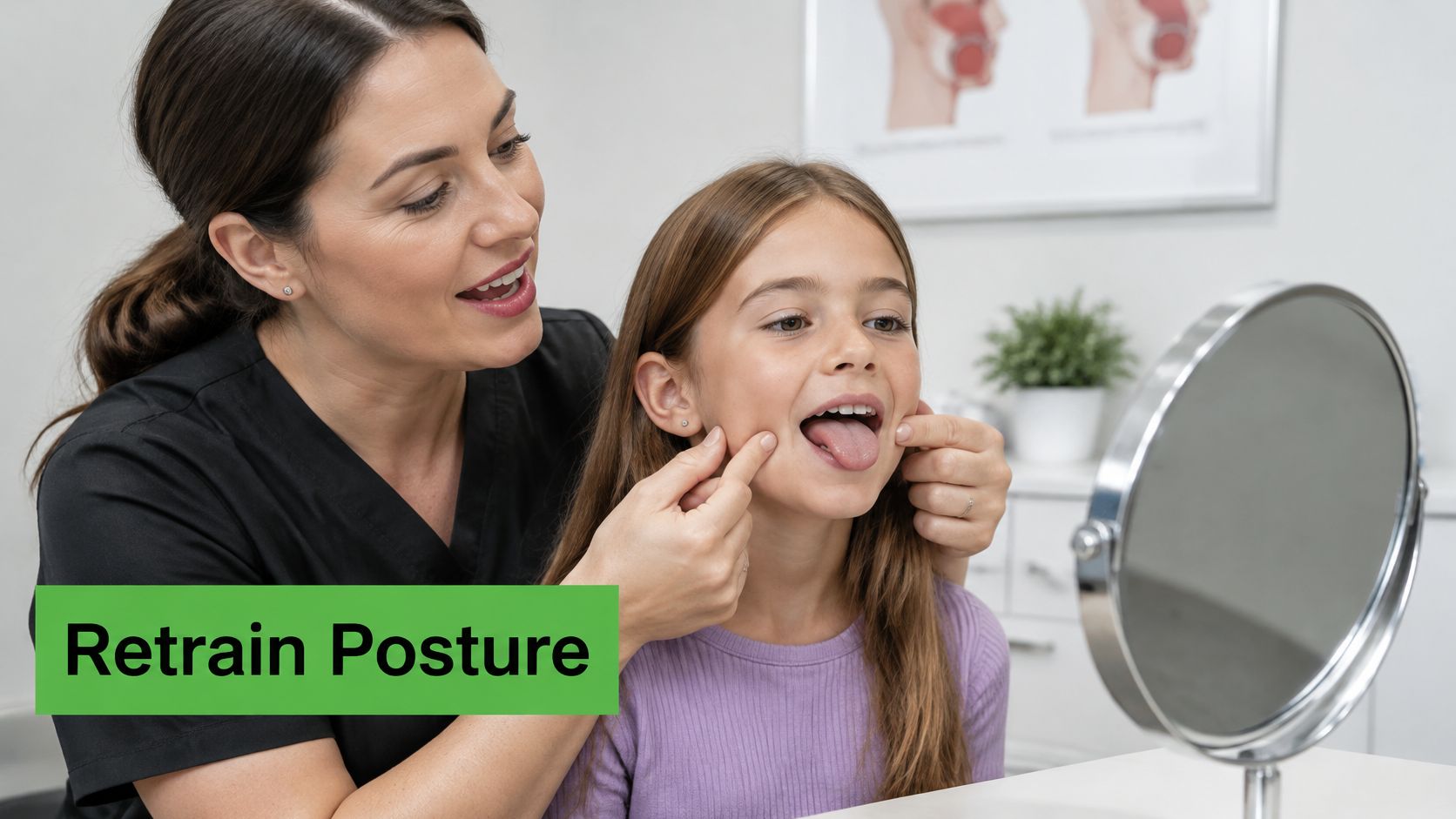
The five exercises, in order
- Resting posture practice. Tongue tip behind the upper front teeth, teeth slightly apart, lips closed. This is a position to return to dozens of times a day, not a pose to hold for a minute.
- Lip seal holds. Close the lips lightly and keep them closed for 10 to 15 seconds at a time, a few times an hour while reading or driving. The target is a closure that stops feeling like effort.
- Tongue-palate suction or elevation. Press the whole tongue up against the palate, hold briefly, release. This stabilizes the resting position so the tongue doesn't drift forward the moment attention moves elsewhere.
- Controlled saliva swallows. Swallow with the tongue staying on the palate and the lips closed. Practicing without food isolates the mechanics, since chewing adds a second job.
- Speech-specific drills. When sibilant sounds like s and z distort, target those sounds directly in syllables, then words, then conversation, with the tongue staying back.
For younger children, a structured device sometimes helps. The same 2024 review reported that Face Former Therapy produced a statistically significant improvement in palatal tongue position during swallowing in young children and achieved habitual mouth closure in less time than the myofunctional-therapy comparison group, though the authors stress that treatment choice should be individualized by a qualified clinician (review of atypical swallowing treatment).
Here's a short walkthrough of the posture work in practice:
Building a routine that survives a busy week
Short and frequent beats long and occasional. A routine of two to three minutes, three or four times a day, is easier to keep than a 20-minute session that gets postponed. Pair the practice with something that already happens: after brushing teeth, in the car before pulling out of the driveway, at a red light.
Keep a one-line weekly log. Note the days practiced, whether nasal breathing held at rest, and anything that felt harder than the week before. That log is what turns a vague sense of progress into something a clinician can adjust.
What good practice looks like: the exercise plan answers a specific finding. Tongue posture drills for a low resting posture, breathing work for a mouth-breathing habit, jaw-muscle care when clenching is part of the picture.
Resist the urge to turn this into tongue bodybuilding. Maximum force isn't the target, and pushing hard against the palate often recruits the jaw and neck muscles that are already overworked. Coordination, resting position and breathing are the levers that move outcomes.
Adults with a forward tongue but no open bite and no speech error follow the same order with a different goal. For them the payoff is nasal breathing, a resting posture that doesn't tire the jaw, and comfort during long meetings or long drives, not a change in tooth position. Adults with jaw pain, headaches or suspected clenching get assessed within the orofacial-pain picture before exercises are added, because adding drills to an irritated jaw joint usually makes both problems worse.
Tongue thrust and jaw-muscle activity can travel together. A 2023 cross-sectional study in the Journal of Oral Rehabilitation followed 63 children with spastic cerebral palsy and found tongue thrust was associated with 8.15-fold higher odds of bruxism, with a 95% confidence interval of 1.4 to 47.3. Narrow population, wide interval, useful signal: when grinding and a forward tongue appear together, both deserve attention.
Habit Retraining and Adjunct Care When Indicated
Habits outrank exercises. A thumb that goes in at bedtime, a mouth that opens the moment attention drifts, or a tongue that props forward during sleep will reassert the old pattern faster than daily drills can overwrite it. Habit retraining comes first for anything ongoing, during the day and during sleep.
Appliances and soft tongue restraints enter when a habit persists despite that work. They're aids, not cures, and they're chosen to fit the specific finding rather than added as a default. When an appliance is part of the plan alongside functional therapy, the appliance gives support at night while OMT and breathing retraining address the underlying issues.
Orthodontic correction gets coordinated rather than replaced when an open bite or displaced incisors persist into the teen years. A tongue retrained against teeth that are still out of position tends to drift back, and teeth moved while the muscle pattern stays forward tend to move again. Both jobs, done in the same window, hold better than either one alone. If aligners are part of that plan, whether Invisalign can fix an overbite in adults covers what clear aligners can and can't move, which is worth knowing before assuming a retainer will hold a pattern that muscle pressure keeps reopening.
The tongue-tie question
A visible frenulum isn't a diagnosis. A 2020 multidisciplinary consensus statement from the Royal Children's Hospital states that diagnosis requires both an anatomically restricted lingual frenum and a related functional limitation, supported by a thorough history and objective assessment of tongue function. The observations that count are practical: whether the tongue extends beyond the lower alveolar ridge, rises toward the palate, moves symmetrically, and can perform lateralization and spreading.
The American Academy of Pediatric Dentistry applies the same test, defining clinically relevant ankyloglossia as a frenum causing both anatomic restriction and functional impairment in lift, extension, lateral movement, cupping and coordinated swallowing. That distinction matters when tongue thrust and a suspected tongue-tie show up together. A visible frenulum doesn't by itself establish that it's driving the swallowing problem, the mouth breathing or the jaw strain.
Scoring tools exist for exactly this reason. The Hazelbaker Assessment Tool for Lingual Frenulum Function assigns up to 10 points for frenulum anatomy and 14 points for tongue function; a function score of 11 may be acceptable when the anatomy score is 10, while a function score below 11 indicates impaired function (StatPearls clinical reference). Frenotomy is considered only when conservative management has failed and the restricted movement is shown to result specifically from the frenulum. Those are assessment thresholds, not a reason to schedule a procedure.
| Adjunct | Typically Considered When | Decided By |
|---|---|---|
| Habit-correction appliance | Persistent habit such as thumb sucking, with tongue pattern effects | Orthodontist or pediatric dentist |
| Soft tongue restraint | Persistent forward thrust when habits continue despite exercises | Orthodontist or myofunctional therapist |
| Orthodontic correction | Open bite or displaced incisors that persist into puberty | Orthodontist |
| Airway and ENT evaluation | Nasal obstruction, enlarged tonsils or adenoids, mouth breathing | ENT physician |
| Frenotomy | Restriction confirmed by functional testing after conservative care has not worked | Trained dental or medical professional |
The practice evaluates frenulum function as part of a broader tongue and airway assessment before any release is discussed, which is what the tongue-tie release process is built around.
Three questions worth taking to the specialist: which habit is driving this pattern, is there an actual bite change or only a tongue position I've noticed, and has the frenulum been tested for function rather than judged by appearance?
Follow-Up Checks and Common Mistakes to Avoid
A forward tongue movement does not automatically need treatment. Follow-up should focus on whether a functional or dental problem is present and whether it changes over time. Four useful markers are bite position, speech clarity, nasal breathing at rest, and the swallow pattern. Record them periodically alongside a home-practice log so the clinician can distinguish a persistent difficulty from an occasional movement.
Retention can be difficult. One evidence synthesis reported successful correction in 58% of treated children, while atypical swallowing persisted or relapsed in 42% (evidence synthesis on tongue thrust treatment). The studies it reviewed often had small samples, short follow-up, and differing methods, so the results do not establish a guaranteed outcome.
A 2024 review searched PubMed, Scopus, and Web of Science for research published between January 2003 and November 2023. It identified 2,554 articles, of which 12 records met the criteria for qualitative analysis (ASHA evidence summary). That limited evidence supports individualized assessment, not a promise that exercises will correct every tongue pattern.
| Marker | What to Check | If It Persists |
|---|---|---|
| Bite position | Open bite or incisor position compared with the previous visit | Orthodontic review |
| Speech clarity | Sibilant sounds and any new speech errors | Speech-language pathologist review |
| Nasal breathing at rest | Whether breathing comfortably occurs through the nose | Consider assessment for nasal obstruction or sleep-breathing concerns |
| Swallow pattern | Tongue position during saliva swallows | Review the exercise plan with the treating clinician |
Three mistakes that undo good work
- Practising swallowing drills while mouth breathing continues. Check whether nasal breathing at rest is comfortable. If it is not, discuss possible airway barriers before making swallow exercises more demanding.
- Expecting exercises alone to change an open bite. Compare the bite with earlier observations. If the dental concern persists, an orthodontic assessment may be appropriate.
- Stopping reassessment once swallowing looks better. Check whether the pattern holds during meals and conversation, not only during a deliberate exercise. A skill that appears during practice may not yet carry over to everyday activities.
Lasting changes from myofunctional therapy typically take several months of consistent daily practice. Follow-up gives the clinician and patient a chance to review practice, adjust the exercise plan, and check whether the original functional concern is improving. If a custom oral appliance is also part of care, follow-up visits over the next few weeks can gradually adjust it to find the point where the airway is fully supported.
Use a tracking sheet with the four markers, a dated entry for each review, and a record of home practice. The aim is to notice a stalled or changing pattern early, rather than relying on memory or a single photo.
Tongue thrust does not always need a dramatic fix. Pain and Sleep Therapy Center provides root-cause evaluation and treatment for concerns including mouth breathing, sleep-related breathing issues, and TMJ tension. Its interdisciplinary team includes dental sleep medicine, orofacial myofunctional therapy, Buteyko breathing, neurology, and pediatric oral health. When tongue posture or oral habits are part of the problem, myofunctional therapy can address tongue strength, nasal breathing, and swallowing patterns. Learn more about the clinic at Pain and Sleep Therapy Center.