
You slept seven and a half hours. The tracker agrees, your partner agrees, and the alarm still lands like an insult. By mid-morning your eyes are heavy, by mid-afternoon your head aches, and by nine at night you're wide awake again, dreading a bed that no longer delivers. Then the sleep study comes back and the report uses a word that stings: normal.
That word is doing more work than it should. A routine report is built to count apneas and hypopneas and to record how far oxygen falls. It can miss a pattern where the airway never fully closes but every breath costs more effort than it should, night after night, waking the brain for a few seconds each time. The symptoms of upper airway resistance syndrome are mostly the symptoms of sleep that keeps getting interrupted, which is exactly why they get blamed on stress, hormones, weight, or age instead.
Night and Daytime Symptoms of UARS
A night of repeated breathing effort can leave someone tired even without loud snoring or obvious pauses. The symptoms may be easier to recognize by when they appear, though none of them alone confirms UARS.
| Symptom | When It Appears | What It May Point To |
|---|---|---|
| Snoring | Night, often quiet | Possible narrowing of the upper airway |
| Unrefreshing sleep | On waking | Sleep interrupted by brief arousals |
| Frequent unexplained awakenings | Night | Possible arousals linked to breathing effort |
| Insomnia or long time to fall asleep | Night | Sleep disruption, though other causes are possible |
| Morning headaches | Morning | Possible association with disrupted sleep |
| Excessive daytime sleepiness or fatigue | Day | A symptom included in commonly used research definitions |
| Difficulty concentrating | Day | Possible effect of repeatedly interrupted sleep |
| Mood changes | Day | Possible effect of poor sleep, though other causes are possible |
| Teeth grinding or clenching | Night | A possible accompanying sign |
| Jaw or TMJ discomfort | Day or night | Reported as a possible UARS-associated symptom |
Snoring may be soft, and some people with breathing resistance do not snore. Teeth clenching and jaw discomfort can occur alongside sleep problems, but they have other possible causes and do not establish that breathing effort is responsible.
What the definition actually requires
UARS describes repeated increases in breathing effort associated with a narrowed upper airway, followed by sleep arousals. The pattern may occur without the apneas, hypopneas, or substantial oxygen drops often associated with obstructive sleep apnea, as the clinical review of upper airway resistance syndrome explains. One research definition uses an apnea-hypopnea index below 5 events per hour, minimum oxygen saturation of at least 92%, airflow limitation during at least 5% of total sleep time, and daytime sleepiness or fatigue. Definitions and detection methods vary, so prevalence estimates also vary.
A detail to mention at an appointment: Ask whether the report includes respiratory-effort-related arousals and airflow limitation. A normal AHI alone may not describe every source of sleep disruption.
If several symptoms persist, discuss them with a physician or dentist rather than relying on a checklist to identify the cause. Fatigue can also overlap with hormonal changes. This overview of sleepiness explained for perimenopausal women may help you describe that context to a clinician.
How UARS Differs From Snoring and Sleep Apnea
A person can wake exhausted while a sleep study reports a low apnea-hypopnea index (AHI). That can happen because simple snoring, upper airway resistance syndrome (UARS), and obstructive sleep apnea involve different breathing patterns, and not every pattern is counted in the AHI.
Simple snoring involves vibration in the airway. UARS involves increased effort to breathe that can end in brief arousals, while obstructive sleep apnea involves apneas or hypopneas. These patterns are related, but their differences matter when interpreting symptoms and a sleep study.
What a RERA is
A respiratory-effort-related arousal (RERA) is more than ordinary snoring or shallow breathing. The American Academy of Sleep Medicine scoring guidance defines a RERA in adults as a sequence of breaths lasting at least 10 seconds, with increasing respiratory effort or flattening of the inspiratory portion of the nasal-pressure waveform, followed by an arousal from sleep. The event must not already meet the criteria for an apnea or hypopnea.
Because a RERA can end before a major reduction in airflow or oxygen appears, an index that counts only apneas and hypopneas may not reflect all the breathing-related sleep disruption.
| Feature | Simple Snoring | UARS | Obstructive Sleep Apnea |
|---|---|---|---|
| Breathing events scored | Airway vibration without arousals | RERAs and flow limitation; AHI often below 5 | Apneas and hypopneas, sometimes with RERAs |
| Oxygen drops | Usually none | Typically minimal in the research definition | Often present |
| Witnessed gasping or pauses | Usually none | Often not reported | Common |
| Main mechanism | Vibrating soft tissue | Increased effort against a narrowed airway, followed by brief arousal | Repeated airway collapse with breathing pauses |
| Daytime impact | Usually minimal when snoring does not cause arousals | Sleepiness, fatigue, or headaches may be significant | Sleepiness may be significant |
A normal or low AHI, then, does not by itself rule out UARS-type symptoms. If daytime symptoms seem out of proportion to the report, ask the physician whether RERAs and flow limitation were assessed. For a comparison of obstructive sleep apnea symptoms and simple snoring, see how the patterns differ.
Why Breathing Effort Wakes You Without Stopping Air
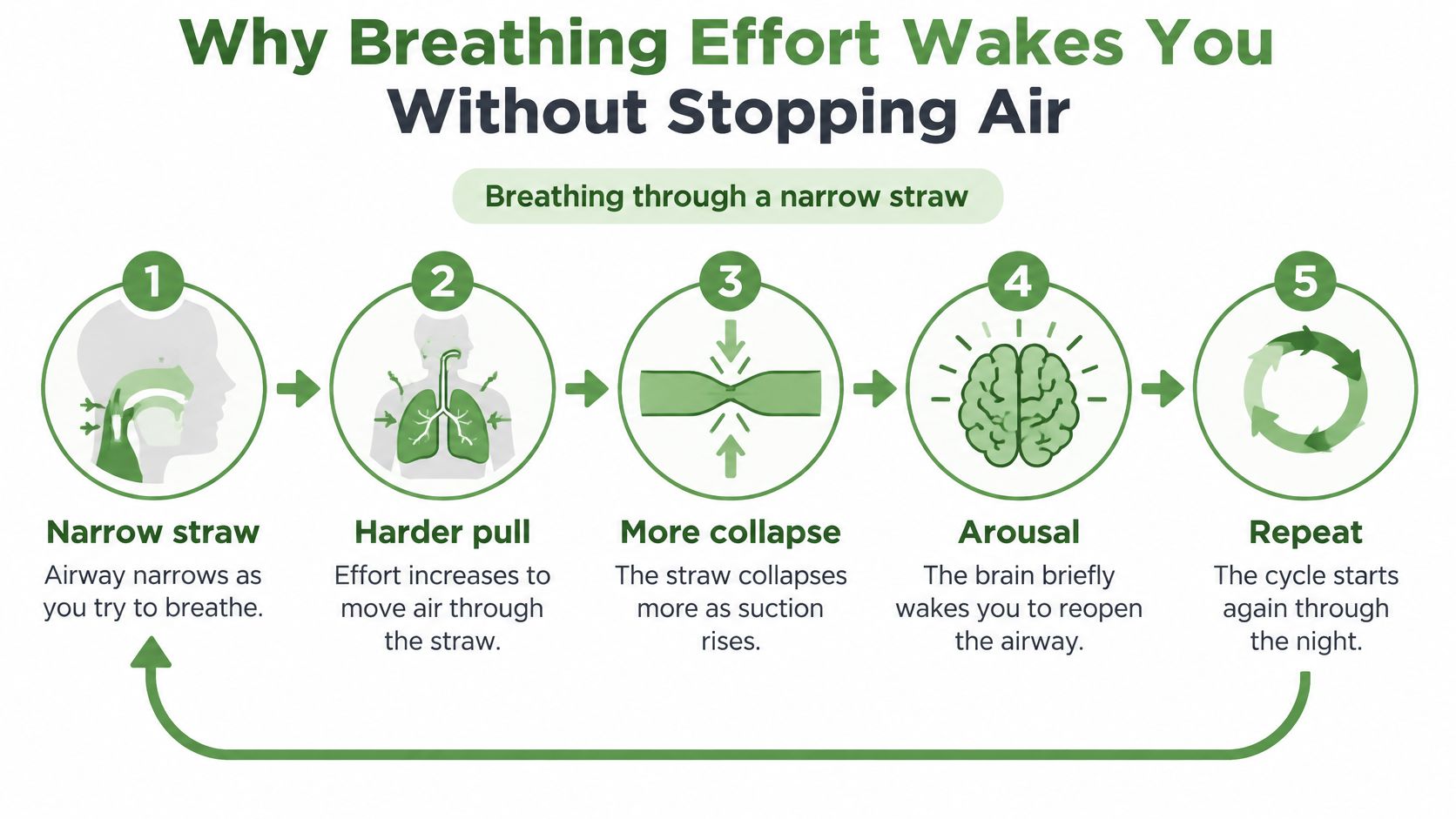
Think about drinking through a thin straw that partly collapses. The harder you pull, the more the straw flattens, so you pull harder still and get less. The throat behaves the same way when its walls are loose or the nose is blocked.
The five-step cycle
- The airway is narrowed or easily collapsed, from nasal blockage, a recessed jaw, a large tongue base, or relaxed throat muscles.
- The sleeper pulls harder to move the same volume of air through a smaller opening.
- Pressure inside the throat drops further, which pulls the walls inward and increases resistance again.
- A brief arousal restores airflow. The brain shifts toward wakefulness for a few seconds, muscle tone returns, and the airway opens.
- Sleep resumes without a recorded apnea. No pause, no desaturation, often no event on the summary page.
Research describes nasal obstruction as capable of lowering intrapharyngeal pressure and increasing upper-airway collapsibility, which may intensify inspiratory effort and promote repeated arousals, as outlined in the physiologic study of respiratory effort in UARS.
The measurable difference shows up in pressure and fragmentation. In a small comparative study, symptomatic patients had more negative pleural-pressure swings at the end of resistive events than matched asymptomatic participants, median −15 versus −11 cm H2O, with more associated cortical arousals, 10 versus 3 per hour of sleep. That study was small, so treat it as support for a model rather than proof of one.
What follows from the model is that the tiredness comes from fragmentation, not from missing oxygen. Ten extra awakenings an hour, none of them remembered, produce a night that never consolidates into deep sleep.
Practical screen: chronic nasal congestion, mouth breathing, snoring, insomnia or frequent awakenings, morning headaches, bruxism, neck or facial tension, and daytime fatigue despite a low index.
How Symptoms Differ Across Adults, Children and Conditions
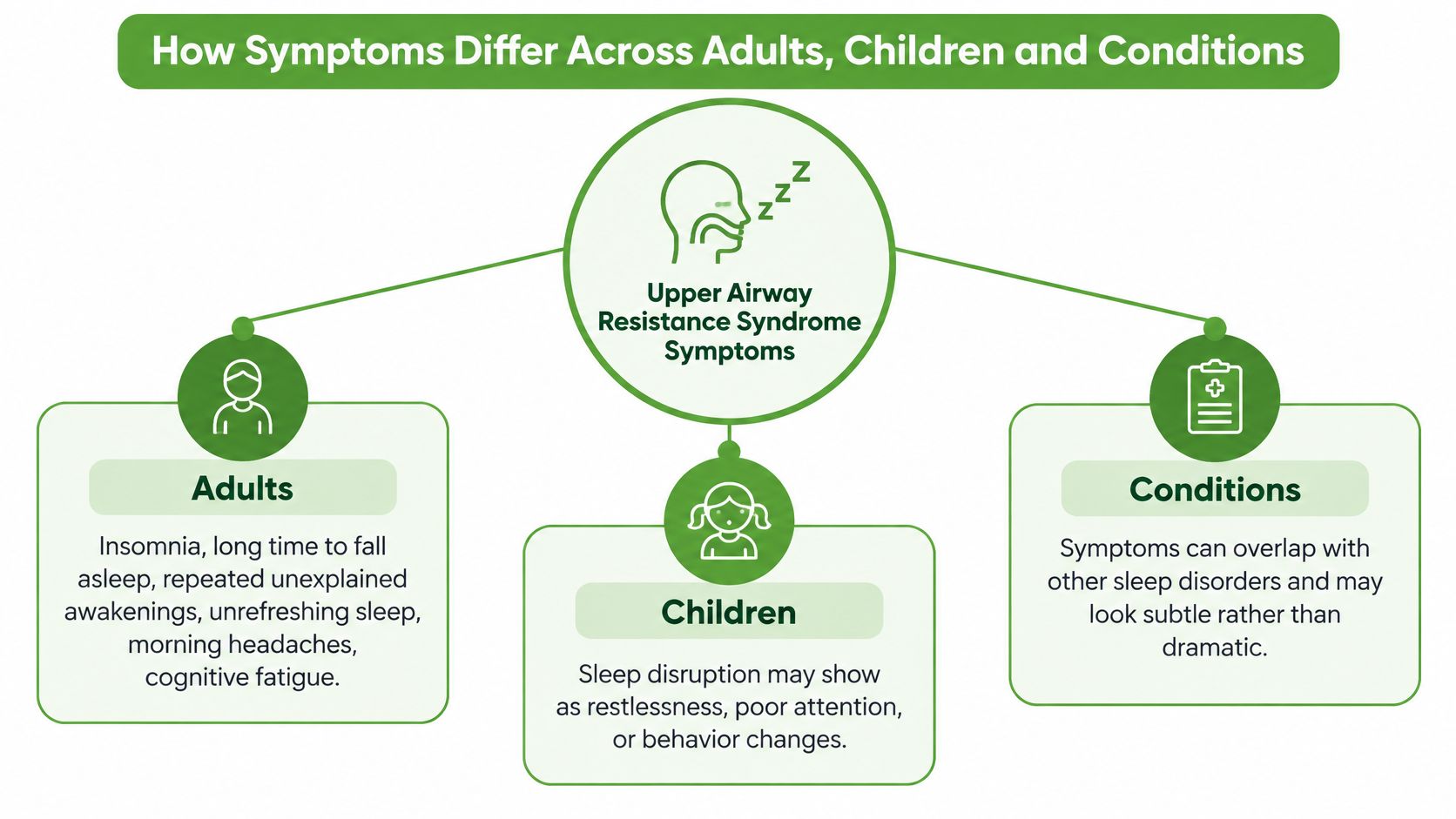
Two people can have similar breathing patterns during sleep but describe very different problems by day. Adults may report difficulty falling asleep, repeated awakenings, unrefreshing sleep, morning headaches, trouble concentrating, low mood, or fatigue. Some do not notice loud snoring, gasping, or witnessed pauses.
Sex, weight and the profile that doesn't fit
Older clinical literature reported that women were about three times more likely to have UARS than OSA patients. Estimates from one commonly used definition ranged from 3.1% to 4.4% in women and 1.5% in men. These figures are not universal population estimates: the definition and monitoring method affect the results.
Body weight and oxygen levels alone cannot settle the question. A person with a lower body weight or no obvious oxygen desaturation may still have symptoms that warrant review.
Fatigue in someone with polycystic ovary syndrome (PCOS) can have more than one possible explanation. A 2025 systematic review of UARS and sleep apnea studies covering 16 studies and 3,852 patients listed excessive tiredness, headaches, insomnia, and temporomandibular symptoms among reported features. Those symptoms do not establish a diagnosis, but they can be part of the discussion with a clinician.
Where the evidence stops
Research has not established a validated pediatric symptom profile for UARS, so adult scoring rules should not be assumed to describe a child's symptoms. Parents can raise snoring, restless or disrupted sleep, mouth breathing, and changes in daytime behavior or attention with a pediatrician or dentist. Pain and Sleep Therapy Center includes pediatric oral health and infant tongue-tie evaluation as part of its care.
Sex, BMI, jaw symptoms, and PCOS do not diagnose a breathing disorder on their own. They are context for a clinical evaluation, not a substitute for one.
How Current Scoring Classifies Breathing Events
Whether a night gets labeled comes down to how the laboratory scores it, and the rules are published. A clinician reviewing the scored pages is where that question gets settled.
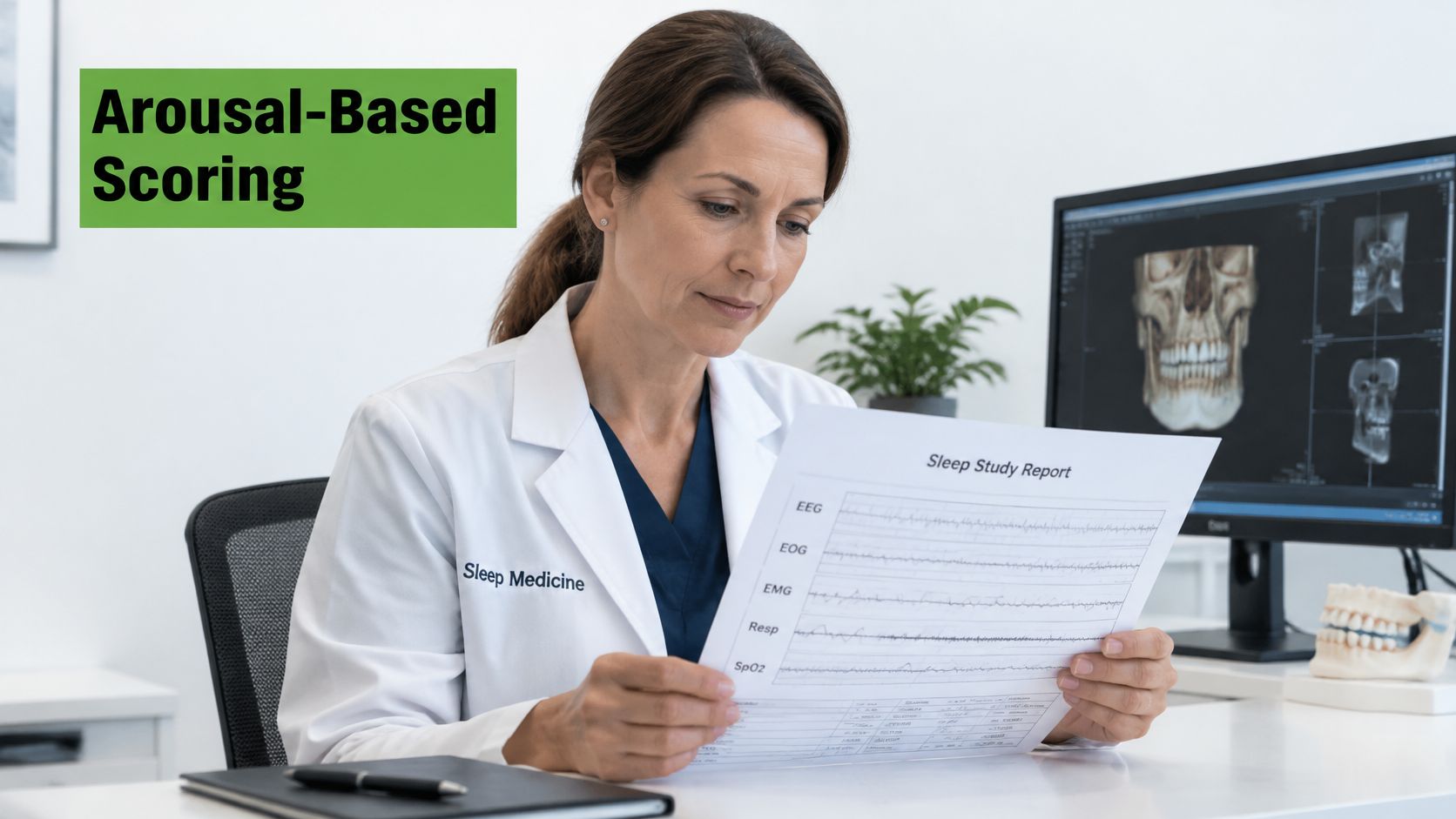
The American Academy of Sleep Medicine position statement on respiratory scoring states that arousal-based respiratory scoring should be considered during polysomnography for people with suspected obstructive sleep apnea, particularly when symptoms include excessive daytime sleepiness, fatigue, insomnia, or neurocognitive complaints. Translation: if the symptoms point that way, the study should be set up to catch effort-related events, not just pauses.
What the thresholds actually say
The adult framework counts predominantly obstructive apneas, hypopneas, and RERAs together. The number per hour then decides whether a diagnosis can be supported.
| Situation | Events per Hour | What It Can Support |
|---|---|---|
| Symptoms or relevant comorbidities present | At least 5 apneas, hypopneas and RERAs | Obstructive sleep apnea diagnosis |
| No additional symptoms or comorbidities | At least 15 apneas, hypopneas and RERAs | Obstructive sleep apnea diagnosis |
| RERAs only, previously labeled UARS | RERAs alone | Generally placed in the broader obstructive sleep apnea category |
That third row is the one to sit with. Patients once labeled as having UARS because they had exclusively RERAs are now generally considered within the broader obstructive sleep apnea category, which means the label changed but the biology didn't.
Here's the video walkthrough of how these evaluations are approached in practice.
Classification is a clinician's job, not a reader's. Two questions get you further than any internet quiz. First, which category does this report place me in. Second, what treatment follows from that category. If the report lists a low index and no arousal data, those questions can't be answered yet, which is why the next set of fields matters.
Sleep Study Fields to Review When AHI Looks Normal
Here's the practical problem. The index counts apneas and hypopneas, so a value below 5 can sit next to significant effort-related arousals that the summary page never displays. A normal index doesn't prove your symptoms are unrelated to breathing, and it doesn't mean every case of fatigue below 5 is resistance either. The point is to look at the right fields before concluding anything.
| Report Field | What It Measures | Why to Ask About It |
|---|---|---|
| Apnea-hypopnea index (AHI) | Apneas and hypopneas per hour | A value below 5 does not rule out effort-related arousals |
| RERA count | Respiratory-effort-related arousals per hour | Missing RERA data can hide UARS-type events |
| Arousal index | Arousals per hour of sleep | Shows how fragmented the sleep was |
| Lowest oxygen saturation | Lowest SpO2 during sleep | Helps place the pattern against the research definition |
| Nasal-pressure flow shape | Flattening of the inspiratory airflow waveform | Can show effort without apnea |
| Esophageal pressure monitoring | Respiratory effort measured directly | Traditional reference method when it was performed |
Why each field changes the reading
Arousal index is the fastest reality check on fragmentation. Twelve arousals an hour and an index of 2 tell a very different story than the same index with three arousals.
Flow shape is where effort leaves a signature. A flattened inspiratory curve on the nasal-pressure channel suggests the airway is being pulled against resistance even when nothing meets event criteria. Esophageal-pressure monitoring is traditionally the reference method for measuring respiratory effort directly, while nasal-pressure transducers offer a less invasive alternative, as the review of UARS diagnosis notes.
Fatigue has many causes, and the ones that still need ruling out include insomnia, circadian disorders, anemia, thyroid disease, medication effects, mood disorders, and nasal obstruction. A second read of raw data supports appropriate review; it doesn't replace a full workup.
Our diagnostic process goes beyond a standard sleep study to find the structural and functional problems causing airway collapse, using in-house 3D CBCT imaging and airway analysis to see the narrowest point, total airway volume, and jaw and tongue position. how obstructive sleep apnea is diagnosed beyond a single number is explained on that page.
What to bring: the full report with its detailed pages, not just the one-page summary. The summary is a conclusion; the pages behind it are the evidence.
Treatment Direction and When Symptoms Need Review
Treatment follows the barrier in front of it. If tongue posture and mouth breathing are driving the problem, the plan looks different than if a sore jaw joint is making sleep impossible or a recessed jaw is narrowing the airway. Matching therapy to that barrier is the principle; the specific option comes after.
Airway-focused directions include custom oral appliance therapy as a common alternative for people who can't tolerate CPAP, orofacial myofunctional therapy for tongue strength, nasal breathing and swallowing patterns, breathing retraining, and CPAP coordination when obstructive sleep apnea has been diagnosed. Some patients need one; others need a combination.
Set expectations about timing. With a mandibular device, snoring may improve before a follow-up sleep study shows the full effect on airway events, and with myofunctional or breathing work, daily-life changes in energy, snoring, mood, and the number of awakenings usually lag behind the first objective improvements. That lag isn't failure; it's the order things happen in.
When to route elsewhere
This practice treats TMJ and jaw pain, orofacial pain, snoring, and sleep-related breathing problems. Symptoms that suggest cardiac or neurological causes, or unexplained fatigue with red flags such as chest pain, fainting, or neurologic changes, belong with a physician. If you're mapping your own picture, the pages on sleep apnea, snoring, TMJ and TMD, and headaches and migraines each describe a different piece of it.
Decide Whether a Specialist Review Is Your Next Step
A normal AHI does not always explain persistent fatigue, unrefreshing sleep, or repeated awakenings. If symptoms continue, or your report does not include details such as RERAs, the arousal index, and airflow shape, ask your physician to review what the study measured and how its events were scored.
Bring the full sleep study report, including detailed pages and scoring notes. Write down when symptoms occur, such as during the night, on waking, or later in the day. Note nasal congestion, mouth breathing, or jaw tension, and prepare questions about RERAs, the arousal index, and what follow-up makes sense.
Pain and Sleep Therapy Center in Charlotte, NC, offers a diagnostic process that includes CBCT 3D imaging and airway analysis. The scan shows the airway's narrowest point and overall volume, along with jaw and tongue position. Learn when to see a sleep disorder specialist and discuss whether further evaluation is appropriate. Dr. Greg D. Larson is triple board-certified.
A symptom list alone cannot confirm UARS. An individualized evaluation can help clarify what may be contributing to breathing difficulty and what questions to take back to your physician. Visit Pain and Sleep Therapy Center to learn more or contact the practice for an individualized evaluation.