
If more treatment is always better, why do so many people with jaw pain feel worse after they've tried more things, not fewer? That question sits at the center of TMJ & Orofacial Pain Treatment, because a longer list of interventions isn't the same as a clearer plan. A splint, an exercise program, an injection, and a sleep appliance can each have a place, but they don't all belong at the same time or for the same diagnosis.
A stepped-care roadmap works differently. It starts with the least invasive option that fits what's driving the pain, sets a way to judge whether it's helping, and reserves advanced care for specific reasons. That sequencing matters as much as any single treatment choice. It also gives you a practical test at every visit. You should be able to name the stage you're in, what would count as progress, and what would trigger a change in direction.
Staged Treatment Options From Self-Care to Advanced Care
A staged plan works like a ladder. You step onto the lowest rung that fits the diagnosis, test whether it helps, and only climb when you have a reason to. Skipping rungs doesn't get you to the top faster. It just makes it harder to tell what worked and what didn't.
Long-term follow-up supports starting conservatively and reassessing. The National Institute of Dental and Craniofacial Research treatment-needs summary describes a Swedish cohort of 114 adolescents followed for 20 years, in which 18% received treatment for TMD during the observation period and treatment was reported as successful in 85% of those cases. The same summary describes a randomized trial of 96 patients with acute TMD in which early biopsychosocial intervention was associated with lower long-term treatment costs, with statistical significance reported at p=.029. Neither finding proves that one path fits everyone. Both point toward early, targeted assessment instead of automatic escalation.
How the Stages Fit Together
Stage one is self-care for recent flares and muscle soreness. That includes soft foods while things are irritated, heat or cold, gentle jaw stretching, and short-term over-the-counter anti-inflammatory medication when it's appropriate for you. Many flares settle here if the load on the joint drops early enough.
Stage two adds supervised jaw exercise and physical therapy when opening stays limited or muscles remain tender, with manual therapy and trigger point work where movement is restricted. A guided example is the center's resource on jaw exercises for clenching, which should still be matched to your exam rather than copied blindly, because the right exercise for a tight muscle can be the wrong one for an irritated joint.
Stage three addresses pain that's amplified by stress, daytime clenching, poor sleep, or fear of moving the jaw. Cognitive behavioral therapy with biofeedback or relaxation can help reduce the behaviors and tension that keep loading the system. This stage often confuses people, since it doesn't look like treatment for a joint. It's aimed at the volume knob on the whole system, not at the hinge itself.
Stage four considers a custom oral orthotic for night-time support, or orofacial myofunctional therapy when tongue posture, mouth breathing, or swallowing patterns contribute. The center combines functional therapies with oral appliances, where the appliance gives support at night while OMT and breathing retraining address the underlying issues.
A useful check: If you can't say what problem a treatment is meant to solve, it's not yet clear why it belongs in your plan.
Permanent changes from Orofacial Myofunctional Therapy typically take several months of consistent, daily practice, so it shouldn't be judged after a handful of sessions. Prescription medication and oral appliances are considered when simpler measures fall short, not as automatic first steps. Locking, neurological change, or jaw trauma moves you out of this sequence and into prompt evaluation before any stage below applies.
TMJ and Orofacial Pain Options by Problem and Stage
| Option | Problem it usually addresses | Where it fits | Evidence note |
|---|---|---|---|
| Self-care, soft foods, heat or cold, gentle stretching | Recent flares and muscle soreness | First step | Listed by NIDCR as an initial option |
| Jaw exercise and physical therapy | Limited mouth opening and muscle-related pain | First to early stage | Part of the conservative starting care NIDCR describes |
| Cognitive behavioral therapy with biofeedback or relaxation | Pain amplified by stress or clenching | Early to mid stage | Matches the biopsychosocial approach in the acute TMD trial above |
| Trigger point therapy | Myofascial muscle pain | Early to mid stage | Part of conservative care for muscle-driven pain |
| Custom oral orthotic | Night clenching and grinding | When simpler measures are not enough | Considered when simpler measures are insufficient |
| Orofacial myofunctional therapy | Tongue posture, nasal breathing and swallowing patterns | Alongside other care | Judged over months of daily practice, not sessions |
| Cold laser therapy | Adjunct pain relief | Adjunct to active rehabilitation | May be considered as an adjunct, not a replacement |
| Prolotherapy | Selected persistent joint or ligament pain | Later stage, after conservative care | Reserved for cases that haven't responded to simpler care |
| PRF injections | Selected persistent joint pain | Later stage, after conservative care | Reserved for cases that haven't responded to simpler care |
| Botox for TMD | Selected muscle pain | Selected cases only | Considered case by case after simpler care |
Read the table from top to bottom, not as a checklist to run all at once. Many patients use one or two rows at a time, then reassess. Notice the pattern in the right-hand column: the further down the table you go, the more the decision depends on what earlier stages showed. That dependence is the point of staging. An injection chosen after structured conservative care means something different from the same injection chosen on day one, because by then you know what the pain did when the load changed.
By the end of a first discussion, you should be able to name your current stage and the next option worth discussing if progress stalls.
What Causes TMJ and Orofacial Pain
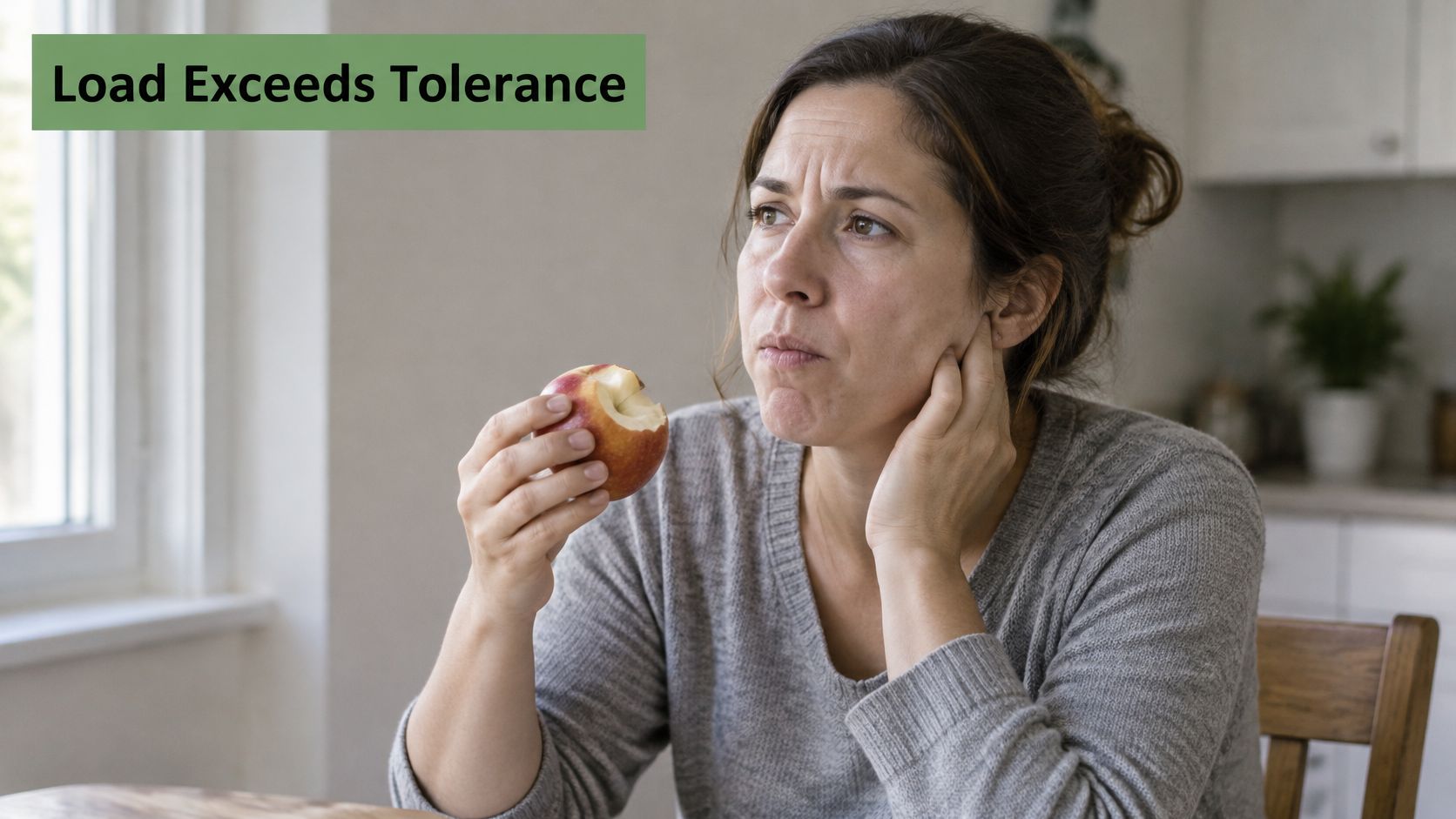
Think of the jaw joint as a hinge and the chewing and neck muscles as the cables that move and stabilize it. A hinge can look normal and still hurt if the cables pull too hard, too often, or unevenly. Pain appears when the load placed on the system exceeds what the tissues can tolerate that day.
Say someone bites into a firm apple and feels a pull in front of the ear. The apple didn't create the whole problem. It may have been the final load on muscles that were already tired from clenching through a stressful week, chewing gum daily, or sleeping poorly and grinding at night.
The Contributors That Usually Overlap
Overworked chewing muscles are a common starting point. Daytime bracing, clenching during concentration, and bruxism during sleep keep the masseter and temple muscles working without recovery time. Tender cables then refer pain into the cheek, temple, teeth, or ear area, which is why a muscle problem can feel like a tooth problem.
Disc and joint structures can also be involved. The small disc inside the joint can shift, joint surfaces can wear, and the result may be clicking, catching, or limited opening. A click without pain or locking isn't automatically a treatment target. For readers comparing muscle patterns beyond the jaw, this resource on myofascial pain relief for desk workers explains how sustained muscle tension behaves in a work setting, though jaw pain still needs a jaw-specific exam.
Parafunctional habits add load. Gum chewing, nail biting, leaning the chin on a hand, chewing mostly on one side, and holding the teeth together during the day all count. Stress and poor sleep amplify muscle tension and lower the threshold at which normal movement starts to hurt. TMJ pain can matter, especially in patients wearing oral appliances or clenching through the night.
Neck and posture patterns belong in the same picture because head position changes how the jaw hangs and how neck muscles share work. Headache, ear symptoms, and facial pain often overlap with jaw pain rather than arriving as separate problems. Sleep and airway patterns can add to night-time clenching, which is one reason morning jaw soreness deserves questions about sleep as well as teeth.
Population context helps explain why this is common. The U.S. National Institute of Dental and Craniofacial Research facial pain data reports that approximately 5% to 12% of the population experiences TMD or related jaw pain, and that TMDs are at least twice as prevalent in women as in men. Prevalence changes depending on the population studied and how TMD is defined or measured, so those figures shouldn't be turned into a personal prediction.
What matters clinically is identifying which contributors are active in your case. That's what determines whether exercise, habit change, muscle care, an appliance, or sleep evaluation makes sense, starting with the overview of TMJ and TMD symptoms and care.
How Clinicians Work Out the Diagnosis
A careful diagnosis works like a staged route, with each step narrowing the likely driver of pain. The center evaluates TMJ pain, jaw dysfunction, headaches, and related sleep or breathing concerns with an emphasis on individualized, non-surgical and root-cause care. More testing is not automatically better. The right next step depends on what the history and exam reveal.
The visual summary below condenses the workflow, and the numbered steps that follow add the detail behind it.
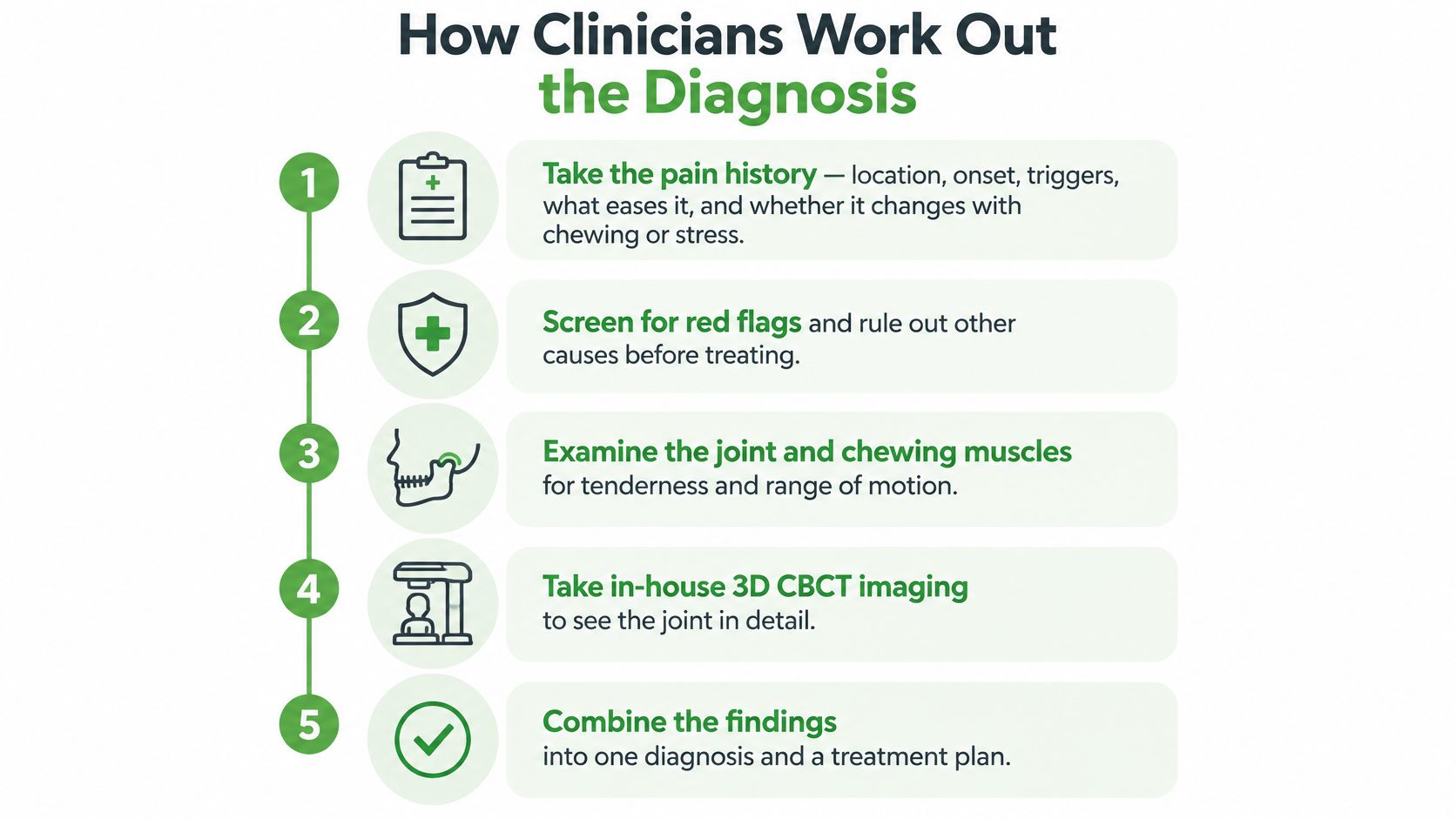
- Take the pain history. Location, onset, triggers, what eases it, and whether it changes with chewing or stress help separate muscle pain, joint pain, tooth pain, and nerve pain patterns.
- Screen for red flags. Locking, neurological signs, recent trauma, swelling, or systemic symptoms change the priority from routine care to ruling out other causes first.
- Measure jaw movement. Maximum opening, comfortable opening, and side-to-side movement show whether the limit looks muscular, mechanical, or both.
- Palpate muscles and the joint. Pressing gently on chewing muscles, neck muscles, and the joint maps tenderness and shows whether the exam reproduces familiar pain.
- Check bite and joint sounds. Clicking, popping, grating, and whether the jaw deviates on opening add context, but sounds alone don't make a diagnosis.
- Ask about connected symptoms. Headaches, ear symptoms, neck pain, grinding, clenching, and sleep quality reveal overlap that a tooth-only exam would miss.
- Screen for sleep-disordered breathing. When apnea is suspected, test choice should fit the medical picture rather than convenience alone.
- Use imaging only when it answers a question. Imaging can help when the clinician needs to see joint structures in detail, but it does not replace the history and hands-on exam.
Pain and Sleep Therapy Center evaluates TMJ pain, facial pain, sleep-breathing issues, and regenerative treatment options together rather than treating each complaint in isolation. That combined view matters because imaging can be normal while muscle-driven pain is still very real. A persistent facial pain complaint may involve chronic facial pain, nerve pain, and complex jaw and head conditions, so the exam has to look beyond the joint itself.
A normal scan with ongoing pain doesn't mean nothing is wrong. It often means the generator is muscle, behavior, or nerve signaling rather than visible joint damage.
Step seven needs careful wording because home testing is often oversold. The AASM diagnostic-testing guideline for obstructive sleep apnea permits either in-laboratory polysomnography or a technically adequate home sleep apnea test for uncomplicated adults with signs and symptoms indicating an increased risk of moderate-to-severe OSA. If a home test is technically inadequate, negative, or inconclusive and suspicion remains, laboratory polysomnography may be needed because a home test can fail to detect disease.
That distinction keeps the plan proportionate. A person with clear muscle tenderness and stress-linked clenching may need a different first step from someone with mechanical locking or suspected sleep apnea. Reassessment after early care helps show whether the chosen path fits the diagnosis or whether escalation is needed.
The short video below walks through how these findings come together into one diagnosis and plan.
Injection and Laser Options in Context
Advanced options are easier to judge when each one is described by its target tissue first and its promised benefit second. An injection into a muscle, a ligament, and a joint space are not interchangeable, even if they're discussed in the same appointment. Neither is a light-based treatment a stand-in for active rehabilitation.
What Each Option Actually Is
Prolotherapy involves injecting an irritant solution with the aim of stimulating the body's healing response in ligament and joint tissue. It's reserved for selected persistent cases after conservative care has been tried and the target tissue is clear. It isn't a general treatment for undiagnosed facial pain.
Platelet-rich fibrin, or PRF, uses a concentrated preparation made from the patient's own blood, placed at the treatment site. The logic is regenerative support at a specific location, not whole-jaw pain relief. As with prolotherapy, the useful question is which tissue is being targeted and why that tissue is believed to be the problem.
Botox for TMD is used for selected muscle pain, in selected cases only, after conservative care has been considered. A response doesn't correct daytime clenching habits, tongue posture, or sleep-breathing problems on its own. That's why it belongs in a plan rather than replacing the plan.
Cold laser therapy, also called low-level laser therapy or photobiomodulation, uses light to support tissue response and is usually discussed as an adjunct. Pain and Sleep Therapy Center uses cold laser therapy, also called low-level laser therapy or photobiomodulation, in TMJ and orofacial pain care, and chronic TMJ cases usually need a series of cold laser sessions rather than a single visit. The center's overview of cold laser therapy uses gives the practical detail, but the positioning stays the same. It's an addition to active care, not a replacement for it.
Where the Evidence Places These Options
The broader evidence base still favors conservative, combined care as the starting pathway for many presentations, including muscle-related pain and disc displacement without progressive structural disease. A 2024 systematic review of 38 randomized clinical trials reported that physical therapy and occlusal devices improved symptoms and function, and concluded that treatment should be conservative, multimodal, and suited to the patient's diagnosis and complaints. In that review's framing, photobiomodulation may be considered as an adjunct, but it should not replace active rehabilitation or diagnostic clarification.
That positioning protects you from a common trap. Pain can improve for a while without the underlying contributor being corrected. If night clenching, restricted movement, or breathing patterns continue unchanged, symptoms can return even after a technically successful procedure.
Pain relief and problem correction are related, but they aren't the same outcome. Ask about both.
Before agreeing to any injection or laser course, ask three questions.
- What tissue is the target? Muscle, ligament, or joint, and what finding points there.
- How many sessions are expected? A defined trial is easier to judge than an open-ended series.
- What active care continues alongside? Exercise, habit change, myofunctional work, or sleep care should usually continue.
Persistent pain, locking, neurological signs, trauma, or suspected inflammatory or degenerative joint disease warrants medical or dental evaluation before any invasive step. Escalating the procedure while the diagnosis is still unsettled usually adds risk without adding clarity.
Judging Progress and Knowing When to Escalate
Many patients receive a list of treatments without a sequence, time limits, or a way to judge whether care is working. That's the gap that causes people to stop too early, persist too long, or jump to injections and surgery out of frustration. A simple baseline, recorded before you start, fixes much of that confusion.
Set the Baseline Before You Judge the Result
Record pain intensity on the same scale each day, at roughly the same time. Measure maximum comfortable opening with a small ruler between the front teeth, again at a consistent time of day. Note chewing tolerance in plain terms, such as which foods you can manage without next-day soreness, and keep a simple weekly count of headache and poor-sleep days.
Reassess with those measures rather than imaging or joint sounds alone. A click can remain after pain and function have improved, and it doesn't need chasing. Conversely, a quieter joint with no improvement in eating isn't a success you can feel.
Progress Measures and What They Signal
| Measure | How to track it | Signal that matters |
|---|---|---|
| Pain intensity | Rate daily on the same scale | Lower on most days supports continuing, no change after a full course prompts reassessment |
| Maximum comfortable opening | Measure with a ruler at the same time of day | Gains support continuing exercise, a plateau prompts a review of the plan |
| Chewing tolerance | Note which foods are tolerated | A wider range of tolerated foods indicates functional progress |
| Headache and sleep days | Keep a simple weekly log | Fewer episodes support the plan, no change prompts a check of sleep and airway factors |
The escalation logic follows from the table. A treatment that lowers pain without improving function needs review, because something may be masking symptoms while the driver continues. Invasive care should be tied to a specific functional or structural indication, not to persistent pain alone. Symptoms that spread, change character, or fail to respond after a full, properly completed course are reasons to revisit the diagnosis, not to intensify the same plan.
Evidence supports giving active care a fair trial before escalating, while staying honest about its limits. A 2025 systematic review and meta-analysis of TMD treatments found that active approaches, especially manual therapy combined with exercises, and arthrocentesis generally outperformed passive or standard care for pain and function, but the authors emphasized that treatment heterogeneity prevents a definitive ranking and that escalation criteria remain unclear. Treat the measures above as decision aids for a conversation, not as fixed rules that replace one.
Digital self-care needs the same discipline. Online exercise programs and apps work best when they're structured and time-limited, with goals based on eating tolerance and comfortable opening rather than constant symptom scanning. Endless reading about worst-case jaw conditions can raise fear and vigilance, which makes muscles brace more, not less. Stop an exercise that produces sustained worsening rather than brief effort discomfort, and bring that response back to your clinician.
The decision rule is short enough to keep on your phone. If the measures improve, continue and consolidate. If they stall after a full course or clearly worsen, return for reassessment instead of adding more on your own.
How Sleep, Headaches and Airway Problems Connect to Jaw Pain
The jaw, airway, and sleep share the same muscles, posture, and nervous system, so a problem in one often shows up in the others. Morning jaw soreness, a headache that starts at the temples, and unrefreshing sleep aren't always three separate complaints. Sometimes they're one pattern viewed from three angles.
Night-time grinding and clenching load the chewing muscles for hours without conscious control. That load can produce sore masseters on waking, temple headaches, and tooth sensitivity that has no dental cause. Jaw-related headaches and migraine-pattern pain can also be amplified by poor sleep and neck tension, which is explored in the center's resource on jaw pain and headache connections.
Breathing pattern matters at the same time. Snoring, mouth breathing, and obstructive sleep apnea can fragment sleep, and fragmented sleep lowers pain thresholds the next day. Pain and Sleep Therapy Center offers root-cause evaluation and treatment for snoring, mouth breathing, sleep apnea, TMJ tension, and chronic breathing dysfunction, and the team combines airway-focused care, myofunctional therapy, and breathing retraining when those factors are part of the picture.
What the Sleep Guideline Actually Says
Oral appliances have a defined role, and it's narrower than many advertisements suggest. The AASM and AADSM oral appliance guideline recommends that sleep physicians consider oral appliance therapy instead of no treatment for adults with obstructive sleep apnea who cannot tolerate CPAP or prefer an alternative. When an appliance is prescribed, a qualified dentist should provide a custom, titratable device rather than a noncustom appliance, because titratable devices can be adjusted progressively.
The same guidance is clear on the other half of the decision. CPAP generally remains the preferred treatment when it can be used, particularly because it's more effective at improving oxygen saturation and reducing the apnea-hypopnea index. An oral appliance is an evidence-based alternative for selected adults, not a universal replacement for CPAP.
An appliance that helps the airway shouldn't be chosen without checking what it does to the jaw, and jaw treatment shouldn't ignore the airway that may be driving night clenching.
That balance is why sleep and jaw care should be planned together when both are present. A sleep evaluation is coordinated when apnea is suspected, and jaw status is monitored in anyone wearing an appliance. Readers can compare the center's pages on sleep apnea evaluation and snoring treatment, and those with headache patterns can review headaches and migraines related to jaw function.
When to Refer and How to Book an Evaluation in Charlotte
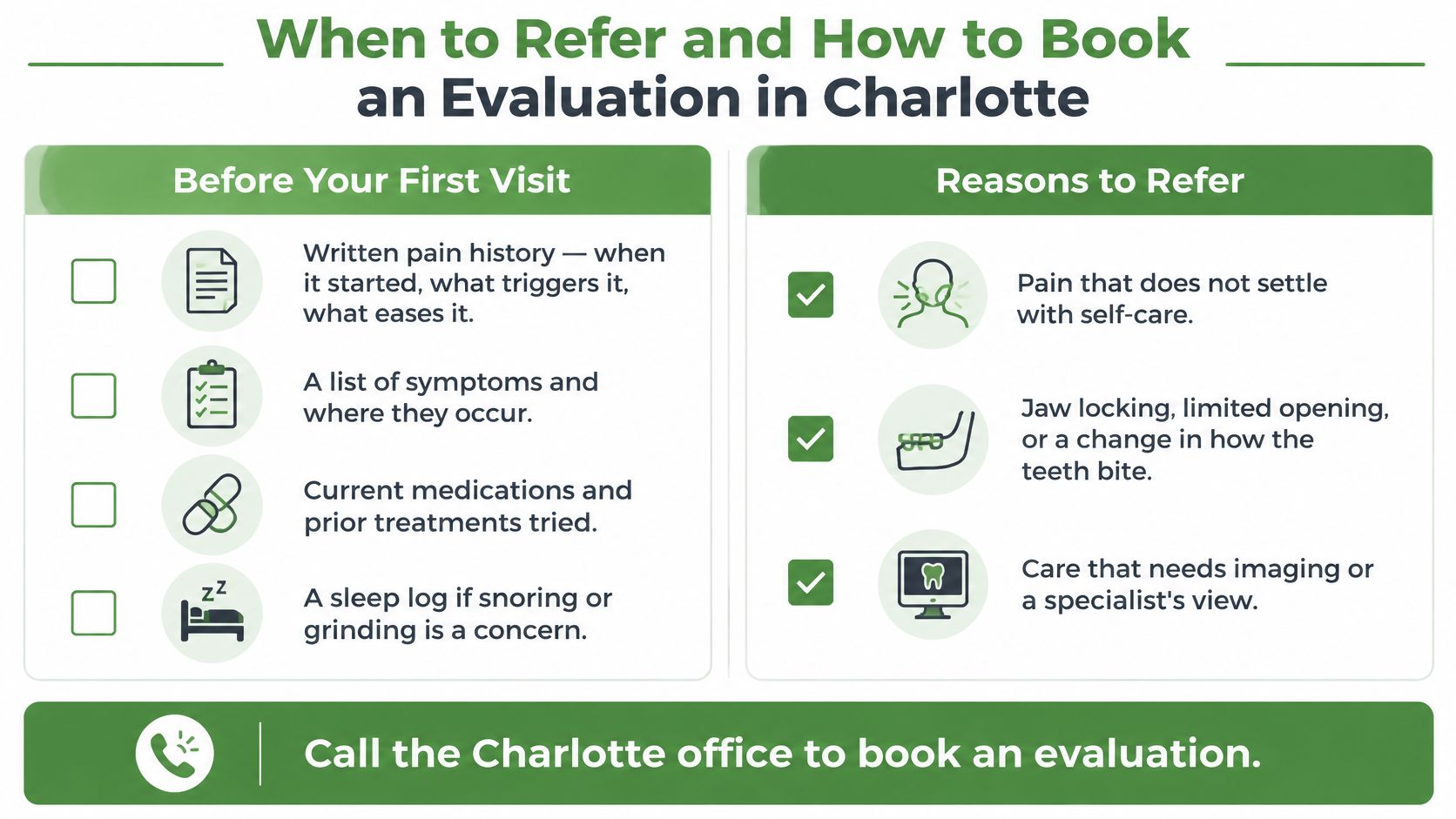
A first evaluation works better when you bring the raw material a clinician needs, rather than trying to reconstruct months of symptoms from memory. Preparing five items takes a few minutes and shortens the path to a clear diagnosis.
- Written pain history: When it started, what triggers it, what eases it, and whether it's changing.
- Symptom map: A list of symptoms and where each one occurs, including ear, temple, neck, and tooth sensations.
- Medications and past treatment: Current medicines plus prior appliances, therapy, injections, or dental work tried.
- Sleep log: A brief record of snoring, waking, grinding, and daytime tiredness if any of those apply.
- Previous imaging: Copies or reports of any prior scans, so imaging isn't repeated without a reason.
The checklist below gathers those preparations and the common reasons to refer into one view.
Findings That Warrant Prompt Evaluation
| Finding | Why it matters | Where to go |
|---|---|---|
| Jaw locking or stuck open | Mechanical problem that may need prompt assessment | Dentist or TMJ specialist |
| Numbness, weakness or new neurological signs | May indicate nerve involvement | Physician or dentist, promptly |
| Jaw or facial trauma | Injury may involve the joint or bone | Physician or dentist, promptly |
| Swelling, fever or signs of joint inflammation | May indicate a systemic or inflammatory cause | Physician |
| Pain persisting beyond an expected course of conservative care | Suggests the diagnosis or plan needs review | TMJ specialist |
| Snoring with daytime sleepiness or witnessed breathing pauses | Possible obstructive sleep apnea | Sleep evaluation with a physician or dentist |
Any finding outside the scope of TMJ, orofacial pain, and dental sleep medicine should go to your physician or general dentist first. Brief, electric, shock-like facial pain, for example, points toward trigeminal nerve involvement and needs medical input rather than jaw exercises. A good referral is a sign of careful care, not a dead end.
At the Charlotte, NC practice, a clinician assesses jaw mechanics, muscles, headache overlap, and sleep together rather than in isolation. The practice offers in-house 3D CBCT imaging and home sleep testing, with the approach outlined on the technology and testing page. Imaging and testing are used when they answer a specific clinical question for an appropriately selected patient.
Clinical leadership matters for complex cases that cross pain and sleep. Dr. Greg Larson, DDS, is a Diplomate of the American Board of Craniofacial Pain, the American Board of Craniofacial Dental Sleep Medicine, and the American Board of Dental Sleep Medicine, with more than 27 years of experience treating TMJ, facial pain, and sleep-breathing disorders. His practice is exclusively focused on TMJ disorders, orofacial pain, and dental sleep medicine in Charlotte, NC, with background available on the about page.
If your checklist shows pain that isn't settling, limited opening, or sleep symptoms alongside jaw pain, you're welcome to request a complimentary consultation and bring the checklist with you. There's no obligation to commit to a course of treatment at that first conversation. The goal is a diagnosis you understand and a staged plan you can judge.
Pain and Sleep Therapy Center in Charlotte, NC evaluates TMJ pain, orofacial pain, headaches, and sleep-breathing concerns together, using in-house 3D CBCT imaging and home sleep testing to build staged, non-surgical plans that start conservatively and escalate only for clear reasons. If jaw pain, facial pain, or fragmented sleep fits the patterns described here, visit Pain and Sleep Therapy Center to request a complimentary consultation and bring your pain history, symptom list, and sleep log to the first visit.