You're in Charlotte, trying to chew breakfast without provoking your jaw. It clicks when you open, aches by afternoon, and the headaches or neck tension are becoming hard to ignore. Then comes the practical question: does insurance cover TMJ treatment, or will you be paying for every evaluation, appliance, therapy visit, and procedure yourself?
The honest answer depends on three things: the anatomy involved, how the insurer classifies the condition and proposed service, and the wording of your specific medical and dental plans. “Covered” isn't one decision. It can mean that an evaluation is payable while an appliance isn't, or that physical therapy requires a different benefit than surgery.
When the Jaw Click Becomes a Coverage Question
At a Charlotte TMJ clinic, a patient may describe months of jaw clicking, morning headaches, and tightness through the neck. The symptoms feel connected, but the insurance conversation quickly separates them into codes, provider types, benefit categories, and authorization rules. After hearing the clinical explanation, the patient often asks the question everyone wants answered: “Will my insurance pay for this?”
That question has no reliable yes-or-no answer until the claim is examined service by service. A medical plan may view imaging, injections, physical therapy, or joint treatment as medical care. A dental plan may be the only place that recognizes an oral appliance, while excluding the examination or rehabilitation that makes the appliance part of a broader plan.
Three decisions shape the claim
First, the joint is part of the body's musculoskeletal system, but treatment may be delivered by a dentist, physician, physical therapist, or another specialist. Second, insurers use their own definitions for dental treatment, medical treatment, orthodontics, appliances, and functional impairment. Third, your contract may impose exclusions, authorization requirements, benefit limits, or separate claims administration.
That's why two patients with similar clicking and pain can receive different answers. One record may emphasize restricted jaw opening and difficulty chewing. Another may focus on bite alignment or an appliance. The insurer may evaluate those records very differently.
You should also plan for the possibility that care and payment won't move at the same pace. If insurance leaves a gap, patients sometimes compare payment options before delaying medically appropriate care. A general guide to loan alternatives for subprime borrowers may help explain financing considerations, but it shouldn't replace a written clinic estimate or a benefits review.
At Pain and Sleep Therapy Center, the useful starting point is not a promise of payment. It's a written map of the proposed services, the likely benefit track, the documents required, and the portion that may remain your responsibility.
Why TMJ Lives Between Medical and Dental Coverage
TMJ coverage becomes confusing because the joint sits at the intersection of two insurance systems. Medical insurers may treat it as part of the jaw and musculoskeletal system. Dental insurers may focus on the teeth, bite, appliance, or provider delivering the service.
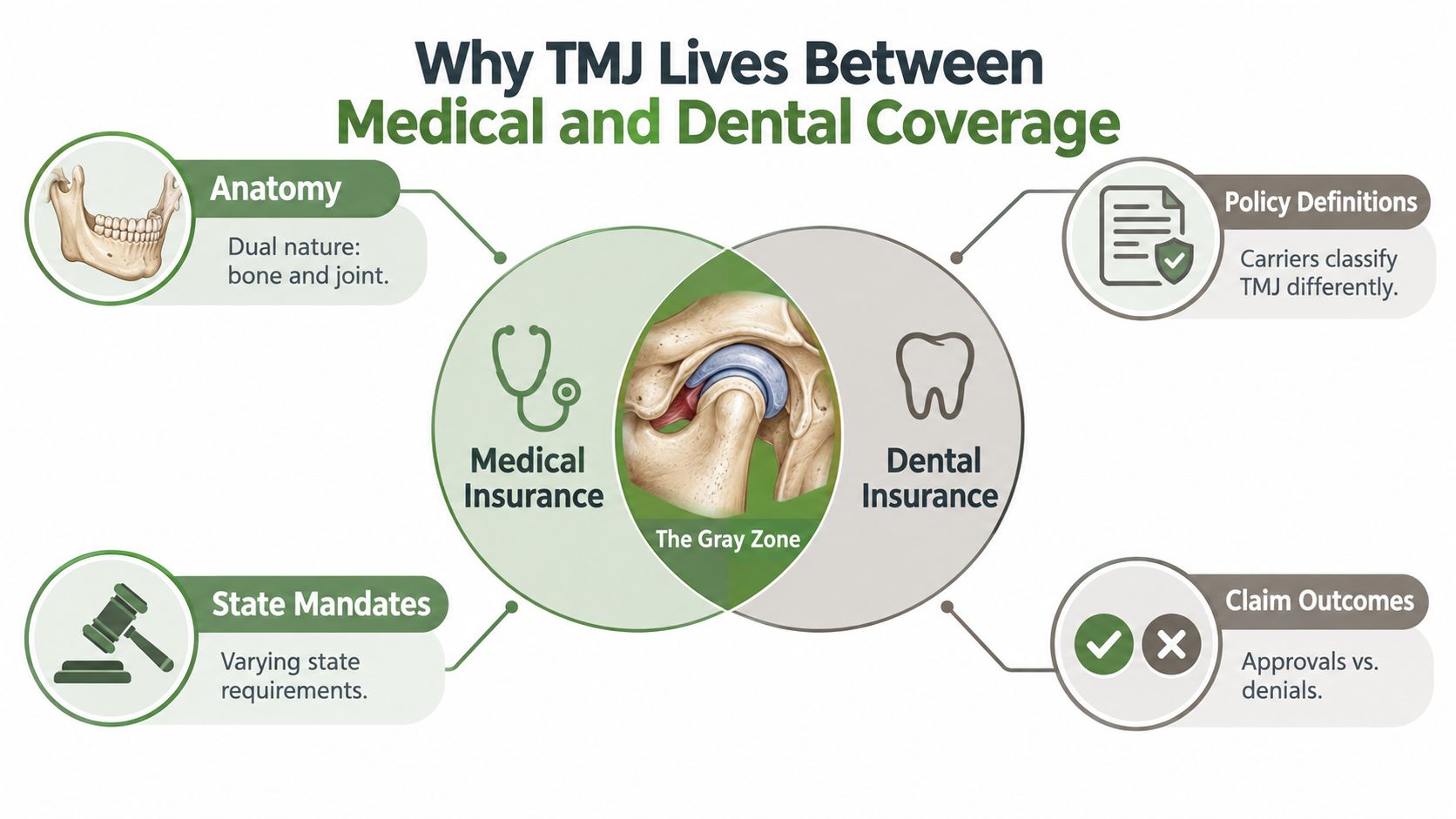
A 2020 National Academies report found that health insurers may classify the temporomandibular joint as part of the tooth-supporting structures and exclude it from medical coverage. The same report explained that dental plans may exclude physical therapy, injections, and cognitive-behavioral treatment because medical rather than dental providers deliver those services. The National Academies report explains this coverage conflict.
Ask which plan administers each service
Start with these questions before treatment:
- Medical or dental benefit: Ask which plan processes the evaluation, imaging, therapy, appliance, injection, or procedure.
- Required documentation: Confirm whether the insurer needs medical-necessity records, prior authorization, specific diagnostic codes, or an in-network provider.
- Functional evidence: Ask your clinician to document restricted jaw movement, impaired chewing, persistent pain, headaches when clinically relevant, and other measurable limitations.
- Claim coordination: Find out whether the medical and dental plans require separate claims or a particular order of submission.
The diagnosis alone may not carry the claim. Records that connect the condition to function are generally more useful than records focused only on tooth alignment or cosmetic goals. A code such as M26.601 or M26.621 may appear in a record, but the insurer still reviews the diagnosis, treatment, policy language, and clinical rationale together.
Practical rule: Before scheduling treatment, ask both insurers, “Which benefit covers this exact service, and what must my provider submit for medical necessity?”
The classification can change the outcome even when the recommended care stays the same. Medical plans may scrutinize functional impairment and authorization. Dental plans may apply exclusions or narrow TMJ benefits to specific appliances. Your clinic's billing team can help organize the submission, but the insurer's written policy controls the final review.
What Medical Plans Typically Cover vs What Dental Plans Cover
A Charlotte patient may receive one treatment plan but face two different coverage decisions. Medical and dental benefits often divide TMJ care by the service involved, and each plan can exclude the treatment the other appears more likely to cover.
Medical benefits may apply to evaluation, diagnostic work-up, imaging, physical therapy, injections, arthrocentesis, arthroscopy, or surgery when the contract's medical-necessity criteria are met. Dental benefits may address oral appliances, occlusal guards, or bite splints, though exclusions and limits are common.
BCBS NC's published policy shows how that division can work. It identifies medical evaluation, diagnostic work-up, myofascial-pain physical therapy, arthrocentesis, and arthroscopy as services that may be covered under contract terms. The same policy example lists dental evaluation, occlusal adjustment, occlusal therapy, and oral appliances such as bite splints among exclusions. Review BCBS NC's TMJ policy language.
Aetna illustrates a different limitation. Its dental clinical policy describes a TMJ physical-therapy benefit of 25 covered treatment sessions per year, available only through dental plans that include TMJ services. Aetna's policy describes the TMJ physical-therapy benefit. A therapy benefit, therefore, may still have a defined annual limit.
Typical TMJ Coverage by Benefit Track
| Service | Medical Plan, typical | Dental Plan, typical |
|---|---|---|
| Evaluation | May cover when documented as medically necessary | May cover dental evaluation, depending on the contract |
| Diagnostic imaging | May apply when tied to joint disease or functional symptoms | May be limited or processed under dental benefits |
| Physical therapy | May apply when medically necessary and authorized | May apply only when the plan includes a TMJ benefit |
| Oral appliance | Often excluded when classified as dental | May cover a guard, splint, or appliance, subject to exclusions and limits |
| Injections | May be reviewed as medical treatment | Often outside ordinary dental benefits |
| Arthrocentesis or arthroscopy | May be covered when criteria are satisfied | Usually outside standard dental coverage |
| Orthodontics | Commonly excluded as dental treatment | May be subject to separate orthodontic rules |
A coordinated claim may be more practical than routing every service through one plan. Ask for an itemized estimate that separates medical services, dental components, and excluded or elective items before treatment. If you are weighing dental coverage for your team, comparing the scope and limits of a dental benefit can clarify what an appliance plan may and may not pay for before renewal.
For a Charlotte-focused explanation of oral-surgery claims, review this TMJ oral surgery insurance resource. Use it as background, then request a written benefits determination from the insurer for the specific procedure.
North Carolina's Jaw-Joint Coverage Law and What It Protects
North Carolina gives Charlotte patients an important statutory argument when a plan covers comparable bone or joint procedures elsewhere in the body. Under N.C. General Statutes § 58-3-121, a health benefit plan that covers diagnostic, therapeutic, or surgical procedures for bones or joints generally can't exclude the same type of procedure for a bone or joint of the jaw, face, or head when the condition prevents normal function and results from congenital deformity, disease, or traumatic injury. Read the North Carolina statute.
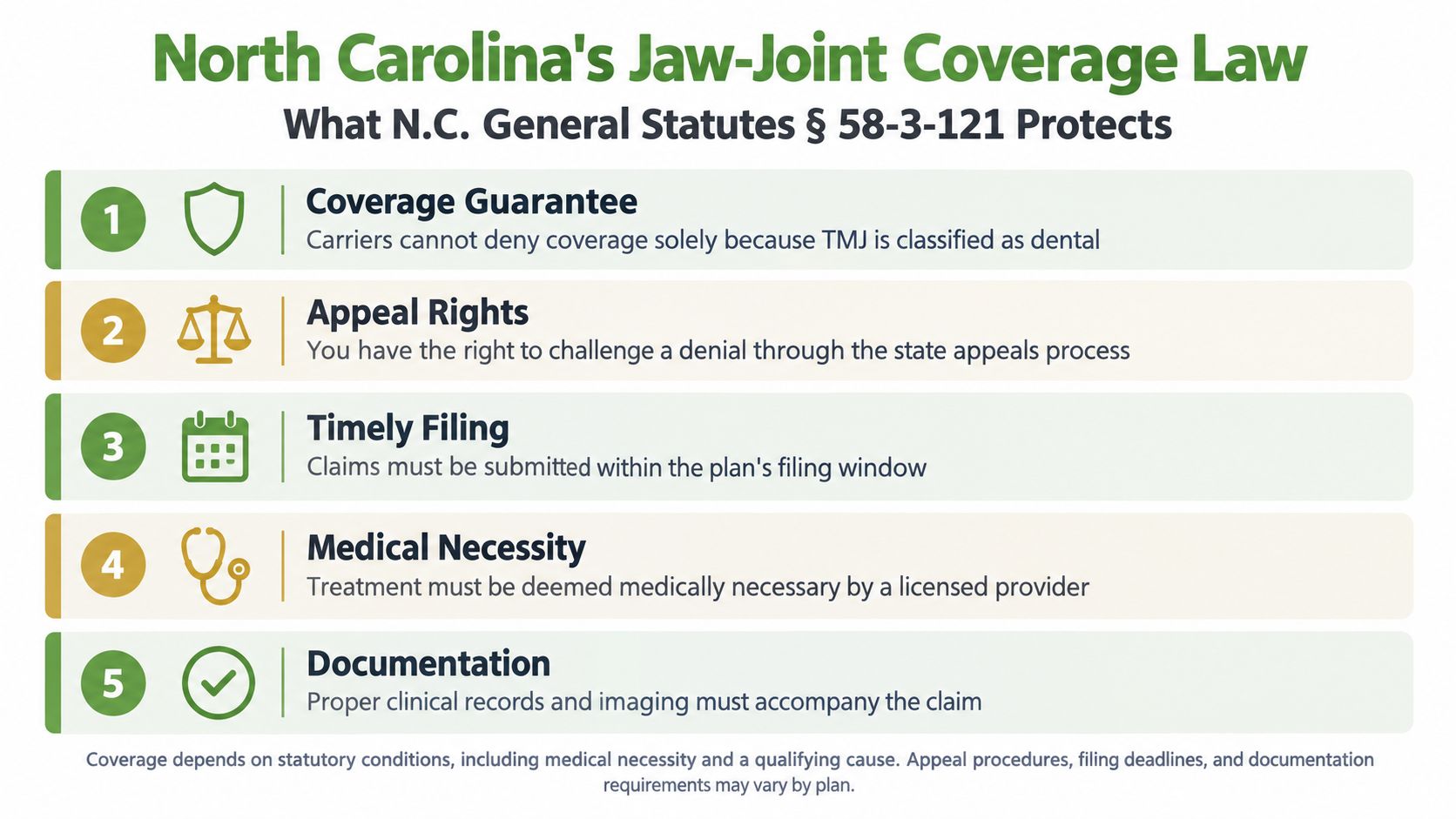
The statute expressly identifies “splinting” and “intraoral prosthetic appliances used to reposition the bones” as authorized therapeutic procedures for TMJ conditions. That language can matter when a carrier treats every appliance as routine dental care.
What the law does not require
The statute doesn't turn every dental procedure into a covered TMJ service. It preserves exclusions for orthodontic braces, crowns, bridges, dentures, periodontal treatment, dental implants, and root canals. It also allows an insurer to impose a reasonable lifetime dollar maximum on nonsurgical TMJ services.
Your coverage review should therefore answer two questions:
- Does the plan cover diagnostic, therapeutic, or surgical procedures for bones or joints in general?
- Does the jaw condition prevent normal function and result from a congenital deformity, disease, or traumatic injury?
Evidence of restricted opening, impaired chewing, joint degeneration, persistent pain, or other functional consequences can help your clinician connect the condition to the statutory requirements. A TMJ diagnosis by itself doesn't guarantee payment.
The law is especially useful during a denial review, but it doesn't eliminate policy conditions. Deductibles, exclusions, authorization rules, network requirements, coding, and benefit maximums can still affect payment. Patients using public benefits should also ask how the plan applies the statute and whether the service requires advance approval. Charlotte patients can review oral surgeons in Charlotte who accept Medicaid when seeking a provider familiar with that benefit environment.
Codes, Records, and Documentation That Strengthen a Claim
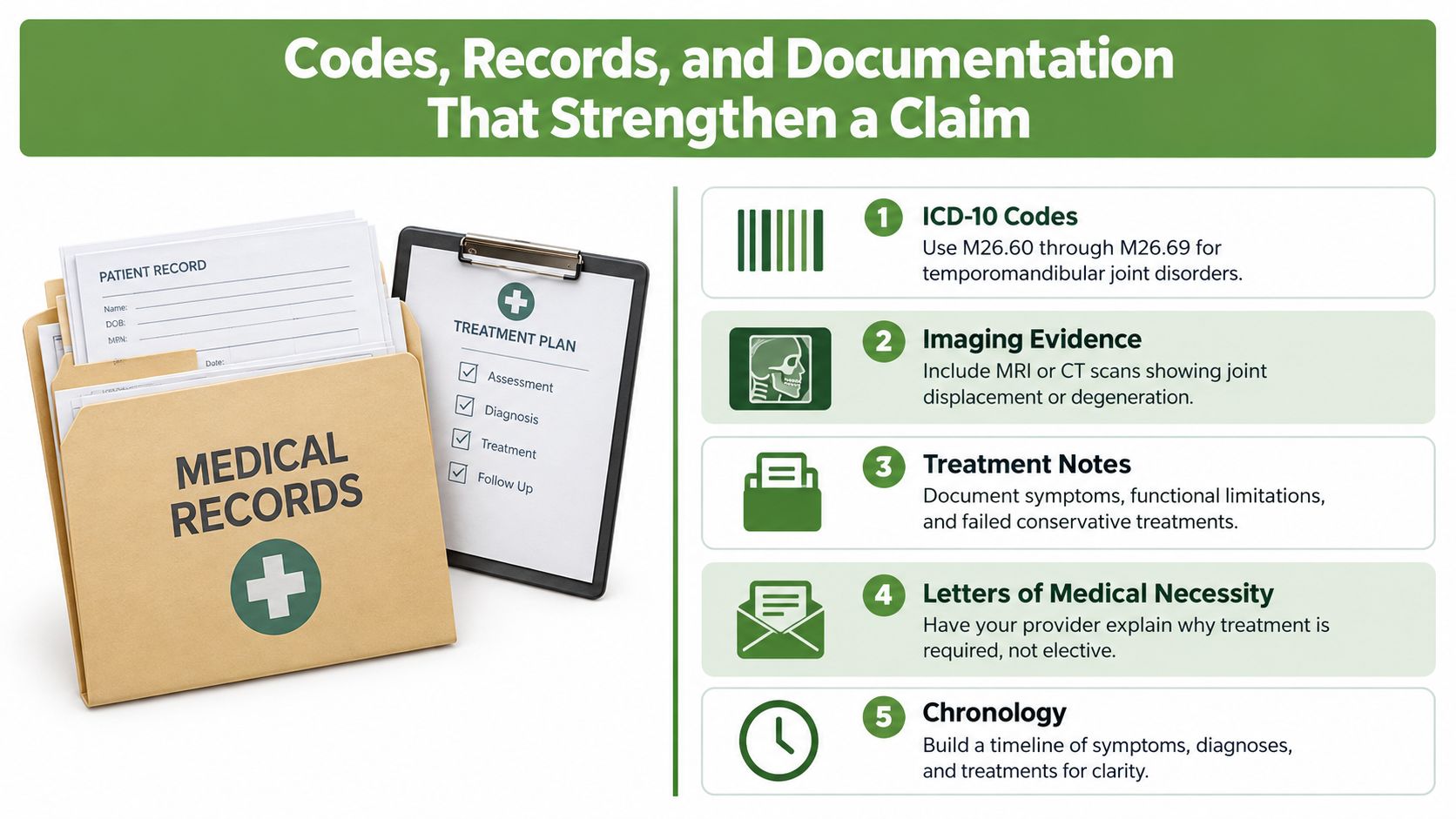
Documentation often determines whether an insurer sees TMJ care as functional treatment or an excluded dental service. A strong submission connects the diagnosis to symptoms, objective findings, limitations, prior care, and the proposed intervention.
For TMJ disorders, providers may use ICD-10 codes in the M26.60 through M26.69 range when clinically appropriate. A related headache code such as G44.309 may be relevant in a documented post-traumatic context, but the provider should select codes that accurately describe the patient's condition rather than choosing a code because it seems more likely to receive payment.
Build the clinical record around function
A useful packet may include:
- Diagnosis and duration: Record the suspected disorder, when symptoms began, how often they occur, and whether they're worsening.
- Examination findings: Include jaw opening, deviation, tenderness, joint sounds, muscle findings, and neurological observations when relevant.
- Functional limitations: State whether pain or restricted movement affects chewing, speaking, yawning, eating, or sleep.
- Imaging: Attach relevant imaging reports and images when they support the diagnosis, such as evidence of joint displacement or degeneration.
- Prior treatment: List self-management, medication, physical therapy, appliances, injections, or other conservative care already attempted, along with the response.
- Proposed care: Explain what the service is intended to accomplish and why it is medically necessary now.
Cigna's coverage policy requires a letter of medical necessity for all TMJ-surgery requests. The letter should contain a detailed history, diagnostic-imaging results, and documentation of prior medical and surgical treatment. Cigna's TMJ surgery criteria outline the required submission components.
Use the letter to answer the policy
A clinician-signed letter shouldn't say that treatment is recommended. It should address the insurer's criteria directly:
“The proposed service is medically necessary because the documented joint or muscle disorder causes measurable functional impairment, and the requested treatment is intended to restore or improve that function.”
That language must be supported by the actual examination and treatment history. For conservative care, the same approach can support preauthorization for physical therapy or other services. For surgery, the record should distinguish functional joint treatment from orthodontic, cosmetic, or routine dental components.
Preauthorization and Appeals When the First Answer Is No
You get the denial after weeks of visits, records, and imaging, and the letter makes it sound simple: not enough proof, no prior authorization, or treatment not medically necessary. In practice, that first answer usually means the file did not line up tightly enough with the plan's rules.
For Charlotte patients, the best appeal starts with the stated reason for denial. If a joint procedure was denied because the carrier says the chart does not show enough conservative care or enough functional loss, the response should match that issue point by point. Send a clinician-signed appeal. Include the diagnosis, exam findings, imaging, a dated treatment timeline, and clear examples of what the patient cannot do normally because of the condition.
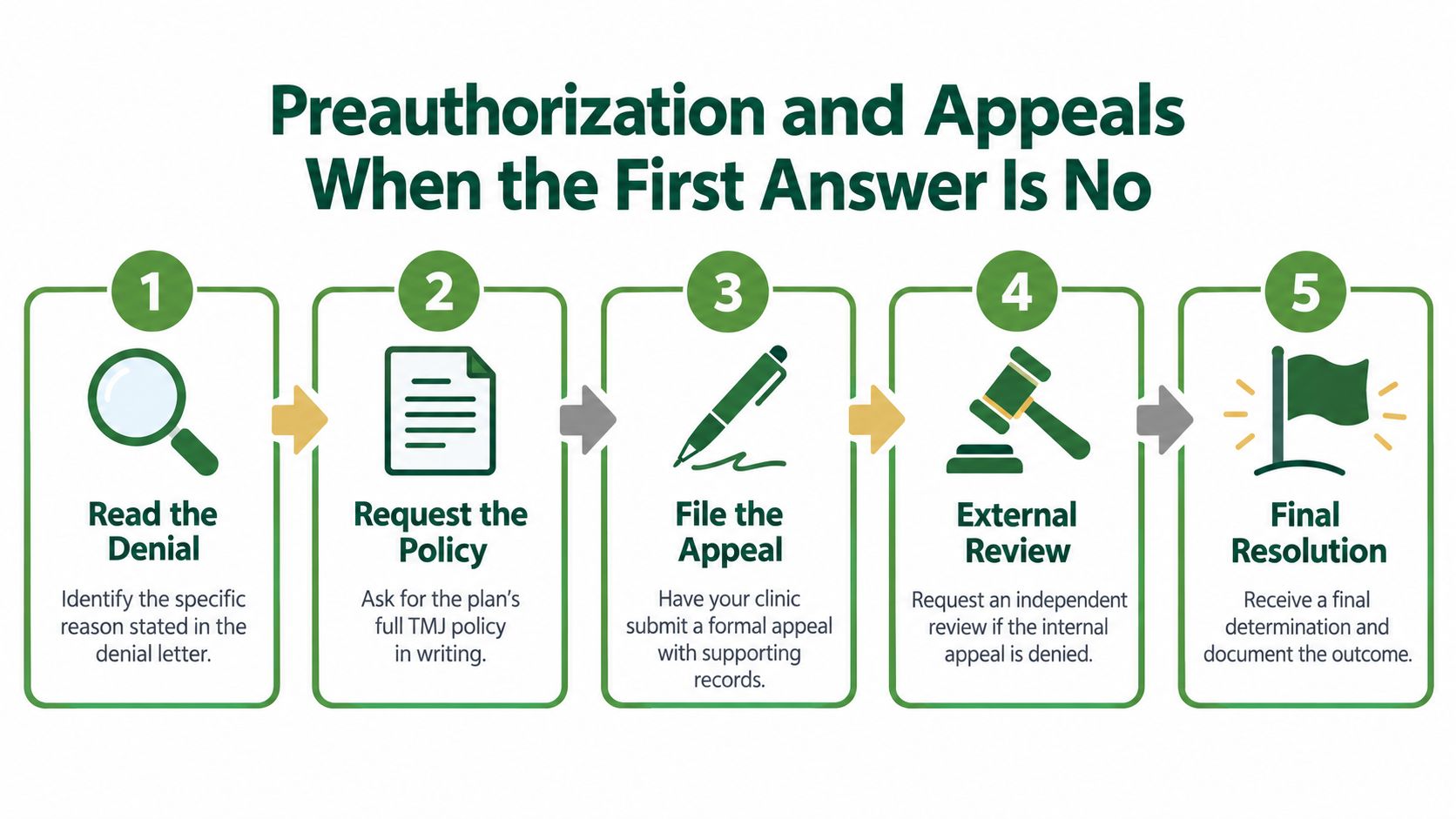
A practical appeal sequence
- Read the denial closely. Pin down whether the carrier relied on an exclusion, missing authorization, lack of medical necessity, out-of-network status, coding errors, or weak documentation of conservative care.
- Request the full plan language. Ask for the TMJ policy, clinical criteria, exclusions, filing deadlines, and appeal steps in writing.
- Ask for peer-to-peer review. In some cases, the treating clinician can speak directly with the plan's medical reviewer before or during the appeal.
- Submit a focused appeal. Include the diagnosis, symptom history, examination findings, imaging, functional limitations, prior treatment, and the exact service requested.
- Escalate if needed. If the internal appeal fails, North Carolina patients can review complaint and appeal options through the Department of Insurance. Self-funded ERISA plans may follow a separate federal review path.
I tell patients to avoid broad statements like “my jaw hurts and I need treatment.” Appeals work better when the record is concrete. “The patient has failed medication, appliance therapy, and physical therapy, continues to have restricted opening and pain with chewing, and the requested service is intended to improve documented function” is the kind of language reviewers can act on.
Timelines matter. If the plan expects a course of conservative care before surgery or another higher-cost service, the chart should show what was tried, for how long, and why it was not enough.
While an appeal is pending, patients also need to understand what costs may arise before ordinary cost-sharing begins. Reviewing how 1st dollar coverage for law firms works can help clarify that financial exposure.
A denial often means the insurer wants more precise documentation, not that appropriate TMJ care can never be covered.
Payment Plans and Out-of-Pocket Options at Charlotte TMJ Clinics
Even a successful benefits review may leave deductibles, coinsurance, exclusions, or services that fall outside the plan. Planning for that gap before treatment is more responsible than assuming coverage will absorb the full care plan.
Charlotte specialty clinics may offer payment plans and accept health savings account or health reimbursement account funds when the expense qualifies under the account rules. A clinic can also provide a written estimate before care begins, but the estimate should separate services clearly.
Request an itemized document showing:
- Covered medical services: Identify the proposed billing category, authorization status, and expected patient responsibility.
- Dental components: List appliances, splints, guards, or other services that may be processed through dental benefits.
- Excluded or investigational care: Separate services that the plan may not recognize or reimburse.
- Payment schedule: Tie installments to treatment milestones rather than leaving the timing unclear.
Regenerative services such as prolotherapy, platelet-rich fibrin injections, and cold laser therapy may be considered investigational or excluded by some carriers. Ask whether the proposed therapy is billed under a covered CPT code, whether authorization is required, and what happens if the insurer denies it.
The broader coverage environment can be uneven. A 2023 study of Medicare coverage policies found arthrocentesis coverage for knee osteoarthritis in all states and districts examined, but 0% coverage for TMJ osteoarthritis. The National Academies discussion describes this comparison. That finding doesn't determine your individual claim, but it shows why patients shouldn't assume that coverage for a comparable joint procedure guarantees coverage for the jaw.
For a Charlotte-focused estimate of potential expenses, review TMJ treatment cost information and ask the clinic to explain which figures are estimates rather than insurer-confirmed benefits.
Charlotte TMJ Coverage Questions Patients Ask Most
Does North Carolina Medicaid cover TMJ treatment?
Coverage is generally limited and may depend on prior authorization and a case-by-case medical-necessity review. Ask the provider and Medicaid plan which services are recognized, whether the provider is enrolled, and what records must accompany the request.
Does Medicare cover TMJ treatment?
Medicare may consider treatment when it is billed as medical care and meets medical-necessity documentation requirements. Dental exclusions and plan-specific rules still matter, so verify the exact service, diagnosis, provider, and authorization pathway before scheduling.
Are nightguards and bruxism splints covered?
Medical plans usually classify nightguards and bruxism splints as dental appliances and exclude them from medical benefits. A dental plan may provide partial coverage, but the benefit can depend on whether TMJ services are included, how the appliance is defined, and whether a limit applies.
Will orthodontic braces be paid for alongside TMJ treatment?
Usually not. Carriers commonly classify orthodontics as dental treatment, even when a clinician recommends it alongside joint care or for bite stability. Ask for an itemized treatment plan so orthodontic charges aren't mistaken for medically necessary joint services.
Charlotte patients should verify benefits in writing, request prior authorization where required, and keep copies of every policy response, estimate, clinical note, and denial. Pain and Sleep Therapy Center can review TMJ symptoms, discuss treatment options, and help organize documentation for medical or dental benefits. Visit Pain and Sleep Therapy Center to schedule a Charlotte consultation and begin with a clear plan for both care and coverage.