You're halfway through breakfast when chewing sends a dull ache into one side of your jaw, then up toward your temple. Perhaps the headache has been sitting there since waking, and you've noticed a click near the ear or a tendency to clench when concentrating. The immediate question is understandable: is this a TMJ problem, or something else?
Jaw pain and headache on one side describe a pattern, not a diagnosis. The pain may come from the jaw joint or chewing muscles, but it can also reflect migraine, a dental problem, a nerve disorder, sinus inflammation, neck-related pain, or a condition that needs urgent medical attention. The useful question is not only where the pain is, but when it starts, what reproduces it, how long it lasts, and what symptoms travel with it.
When One Side of the Jaw and Head Hurt Together
Consider a reader named Maya. She notices tenderness in front of her right ear while eating, then feels pressure in the right temple during the afternoon. Her jaw clicks when she opens wide, but she isn't sure whether the click causes the headache or happens alongside it. By evening, she's searching for answers and wondering whether she should call a dentist, a doctor, or wait for the discomfort to pass.
That uncertainty is common because the jaw, face, head, teeth, and neck share overlapping pain pathways. One-sided symptoms can be real and connected without proving that the jaw is the original source. Research describes TMD-related headaches as frequently unilateral, often affecting the preauricular, temporal, or retro-orbital regions, with findings such as same-side masseter or temporalis tenderness and restricted mouth opening (clinical review of TMD-related headaches).
Start with the behavior of the pain
A jaw-driven pattern often becomes more noticeable with chewing, clenching, speaking, yawning, or examination-related jaw movement. A migraine may bring throbbing head pain with sensitivity to light or sound, while nerve pain can arrive as brief electric shocks. A dental infection may focus around a tooth and bring swelling, fever, or increasing sensitivity.
The first goal isn't to label the pain. It's to identify the pattern that tells you which clinician should evaluate it.
This guide follows that pattern. You'll first see how the jaw and head share a “wiring diagram,” then compare common causes by their behavior. From there, the focus turns to warning signs, clinical evaluation, treatment choices, sleep and breathing, and practical next steps in Charlotte, NC.
For broader background on jaw symptoms and treatment pathways, you may also find this guide to TMJ treatment for Las Vegas useful, even if you live elsewhere.
How the Jaw, Head, and Face Share a Wiring Diagram
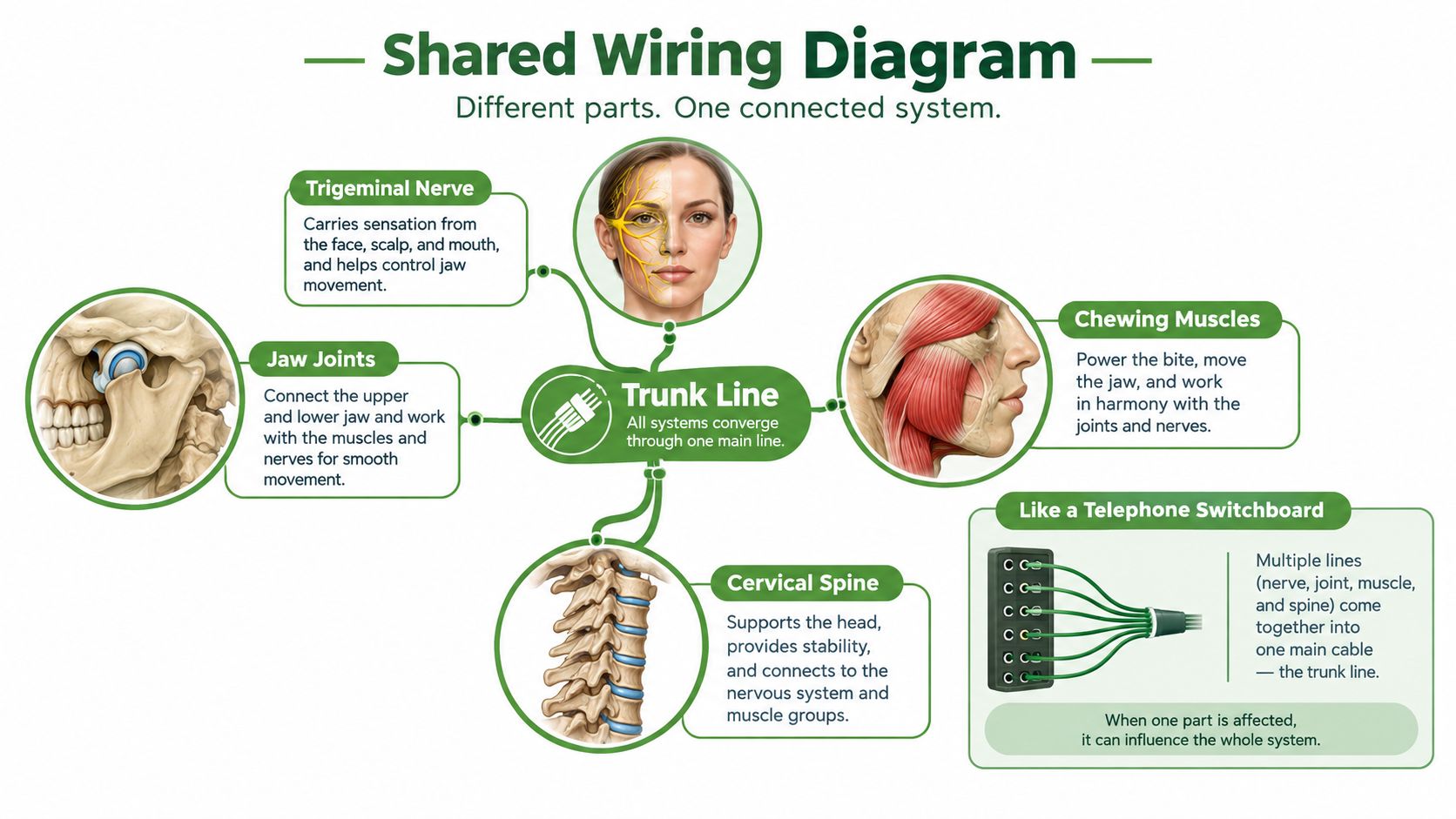
Think of the nervous system as a telephone switchboard. Several lines enter the same central trunk, so the operator may register a problem in the wrong-looking location. The jaw joint, chewing muscles, teeth, sinuses, upper neck, and parts of the head all send signals into overlapping pain-processing networks.
The trigeminal nerve is especially important. It carries sensation from much of the face, teeth, jaw, and front of the head. When the masseter or temporalis muscles become irritated, the brain may interpret some of that input as temple or facial pain rather than a small, local muscle ache.
The temporomandibular joints sit just in front of the ears, where the lower jaw meets the skull. Each joint works with the surrounding capsule, ligaments, and muscles to help you speak, chew, yawn, and swallow. The masseter helps close the jaw, while the temporalis contributes to jaw closing and positioning. If one side becomes overloaded by clenching, grinding, altered movement, or guarding, pain may spread beyond the joint itself.
Why the neck and sinuses can confuse the picture
The upper cervical spine has its own referral patterns. Irritation or stiffness in the upper neck can contribute to pain felt around the back of the head, temple, or face. That doesn't mean every headache comes from posture, but it explains why a jaw examination may include the neck and shoulders.
Sinus inflammation can create pressure in the cheek or upper jaw, especially when nasal symptoms accompany it. A tooth with pulp inflammation, a cracked tooth, or an infection can also feel like diffuse jaw or facial pain. The shared wiring makes the location less reliable than the combination of quality, trigger, duration, and associated signs.
A clinical study of 625 patients with TMD found headache in 67.3% of participants and reported statistically significant relationships between same-side jaw-joint pain and headache intensity (Migraine Research Foundation overview). That association matters, but it doesn't mean every headache beside jaw pain is caused by TMD. It means the two systems can meaningfully interact and deserve assessment together.
The Main Causes and How Each One Behaves
The same-side relationship between jaw and head pain can point toward TMD, but it should be tested against other patterns. TMD often feels aching, tight, or fatigued and may worsen with chewing, clenching, prolonged talking, or wide opening. Migraine is usually more severe and throbbing, often unilateral, and may include nausea or sensitivity to light and sound.
Trigeminal neuralgia behaves differently. It can produce sudden, brief, electric-shock-like pain triggered by touching the face, brushing teeth, chewing, or a breeze. Cluster headache tends to cause intense one-sided head or facial pain with autonomic signs such as tearing, nasal symptoms, or eyelid changes. Sinus-related pain usually makes more sense when congestion, facial pressure, or recent respiratory symptoms are present.
Dental pain often has a precise trigger. A cracked or inflamed tooth may hurt when you bite, or react strongly to hot or cold foods. Cervical referred pain may change with neck position or movement and can spread from the upper neck toward the head.
A 2025 study found painful TMD in 26.4% of young adults. Among participants with painful TMD, 80.5% reported headaches at least once per month, 13.8% reported headaches on more than 15 days per month, and 21.8% of the total population had both painful TMD and headaches occurring at least one day per month (study summary for referring doctors). These findings show overlap, not a shortcut to self-diagnosis.
| Cause | Pain quality | Typical trigger | Duration | Key clue |
|---|---|---|---|---|
| TMD or chewing-muscle pain | Dull, tight, aching, fatigued | Chewing, clenching, talking, wide opening | Variable, often recurring | Same-side jaw tenderness, clicking, limited or deviated opening |
| Migraine | Throbbing, severe, sometimes pulsating | Light, sound, activity, hormonal or personal triggers | Episodic | Nausea, light or sound sensitivity, recurring headache history |
| Trigeminal neuralgia | Electric, stabbing, shock-like | Touch, chewing, brushing, breeze | Brief attacks | Trigger zones and repeated bursts |
| Cluster headache | Severe, piercing, one-sided | Often occurs in recurring bouts | Attacks with symptom-free periods | Tearing, nasal symptoms, eyelid changes |
| Sinus inflammation | Pressure, fullness, facial ache | Congestion, bending, respiratory illness | Persists with sinus symptoms | Nasal obstruction or discharge |
| Dental disease | Sharp, throbbing, localized | Biting, hot or cold foods | Persistent or escalating | One tooth, swelling, sensitivity, bad taste |
| Cervical referred pain | Aching or pressure-like | Neck movement, sustained posture | Variable | Neck stiffness or pain that travels forward |
If your symptoms sound primarily jaw-related, a focused resource on headaches from jaw tension can help you prepare questions for an evaluation. The page shouldn't replace a diagnosis, especially when the pain is new, severe, or changing.
Red Flags That Change the Timeline
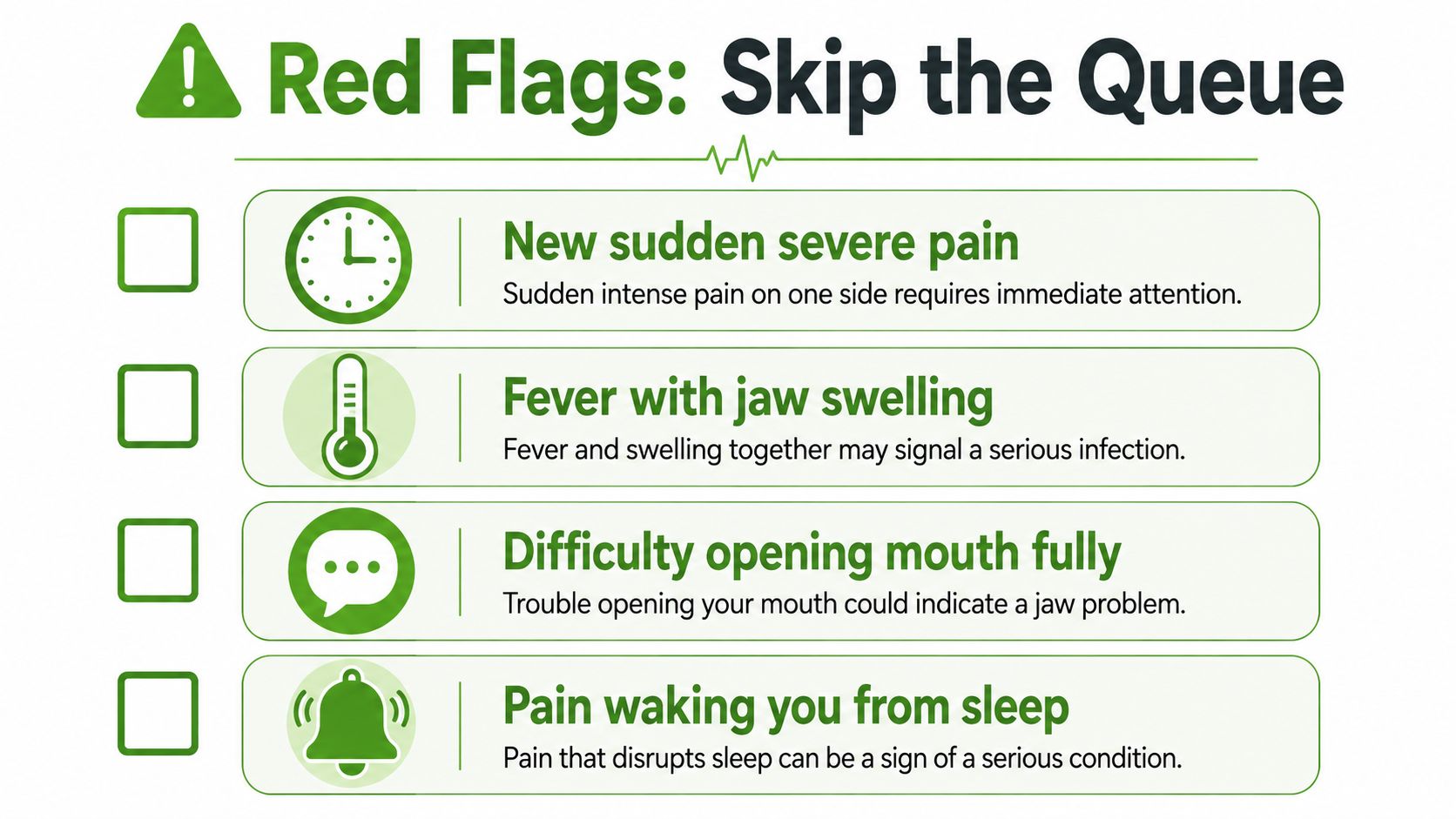
Most one-sided jaw and head pain isn't an emergency. Certain combinations, however, change the correct next step from “book an appointment” to same-day or emergency assessment.
New headache with chewing pain after age 50
In an adult older than 50, a new one-sided temporal headache with jaw pain during chewing can signal giant cell arteritis, an inflammatory condition that can threaten blood flow to the optic nerve. Jaw claudication, meaning pain or fatigue that appears with chewing and improves with rest, occurs in nearly half of patients in one clinical guideline. Temporal-artery tenderness or thickening is reported in roughly 45% to 75% of cases (NHS Tayside guidance on giant cell arteritis).
Scalp tenderness, fever, shoulder or hip stiffness, and visual disturbance make the concern stronger. Suspected GCA requires same-day medical evaluation and inflammatory testing, not watchful waiting. New visual symptoms, tongue pain during use, or a rapidly worsening headache should be treated as an emergency.
Chest-related jaw pain
Jaw pain that spreads from the chest or shoulders, especially with pressure, shortness of breath, sweating, nausea, faintness, or exertional symptoms, may be referred cardiac pain. Call 911 rather than arranging a routine dental visit. Cleveland Clinic guidance also advises contacting a healthcare provider when jaw pain lasts longer than one week (jaw pain and emergency warning signs).
Fever, swelling, or loss of function
Fever with facial or jaw swelling, difficulty swallowing or breathing, a bad taste, or inability to open the mouth can indicate infection. Seek urgent medical or dental assessment, especially if symptoms are progressing. Trauma followed by a changed bite, inability to close the mouth, or severe movement restriction also needs prompt evaluation.
A sudden, severe headache, new weakness, confusion, speech difficulty, fainting, or facial numbness warrants emergency care. Don't use a jaw explanation to delay assessment of neurological symptoms.
How Clinicians Evaluate One-Sided Jaw and Head Pain
A careful evaluation starts with the story. The clinician will ask whether the pain is near the ear, in a tooth, below the jaw, in the temple, or behind the eye. They'll also ask whether chewing, clenching, neck movement, light, sound, touch, temperature, or sleep changes the symptoms.
The physical examination
A jaw and facial pain assessment may include:
- Movement: The clinician observes opening, closing, deviation, catching, locking, and pain during motion.
- Muscle palpation: The masseter, temporalis, and related muscles are checked for tenderness and reproduction of your familiar headache.
- Joint loading: Gentle testing helps determine whether jaw-joint loading recreates the symptom.
- Neck screening: Cervical mobility, posture, and muscle tension can reveal a referred contributor.
- Dental and intraoral review: Teeth, gums, bite, sensitivity, swelling, and signs of clenching receive attention.
- Symptom mapping: Comparing the painful and less painful sides can make asymmetry easier to identify.
The facial pain diagnosis resource can help you understand the kinds of questions that may arise during this process.
When tests and referrals help
Imaging isn't automatically needed for every clicking jaw or headache. Depending on the findings, a clinician may consider dental radiographs, panoramic imaging, cone-beam CT, or MRI. Laboratory testing becomes important when conditions such as giant cell arteritis, infection, or inflammatory disease are suspected. Neurology, ENT, primary care, dentistry, physical therapy, and dental sleep medicine may all have a role, depending on the pattern.
Bring a short symptom record and ask:
- Does jaw movement reproduce my usual headache?
- Do my teeth, joint, muscles, or neck appear to be the main contributor?
- What findings would justify imaging?
- Should I receive a dental, neurological, ENT, or sleep evaluation?
- Which symptoms mean I should seek urgent care instead of waiting?
Treatment Options from Conservative to Clinic-Specific
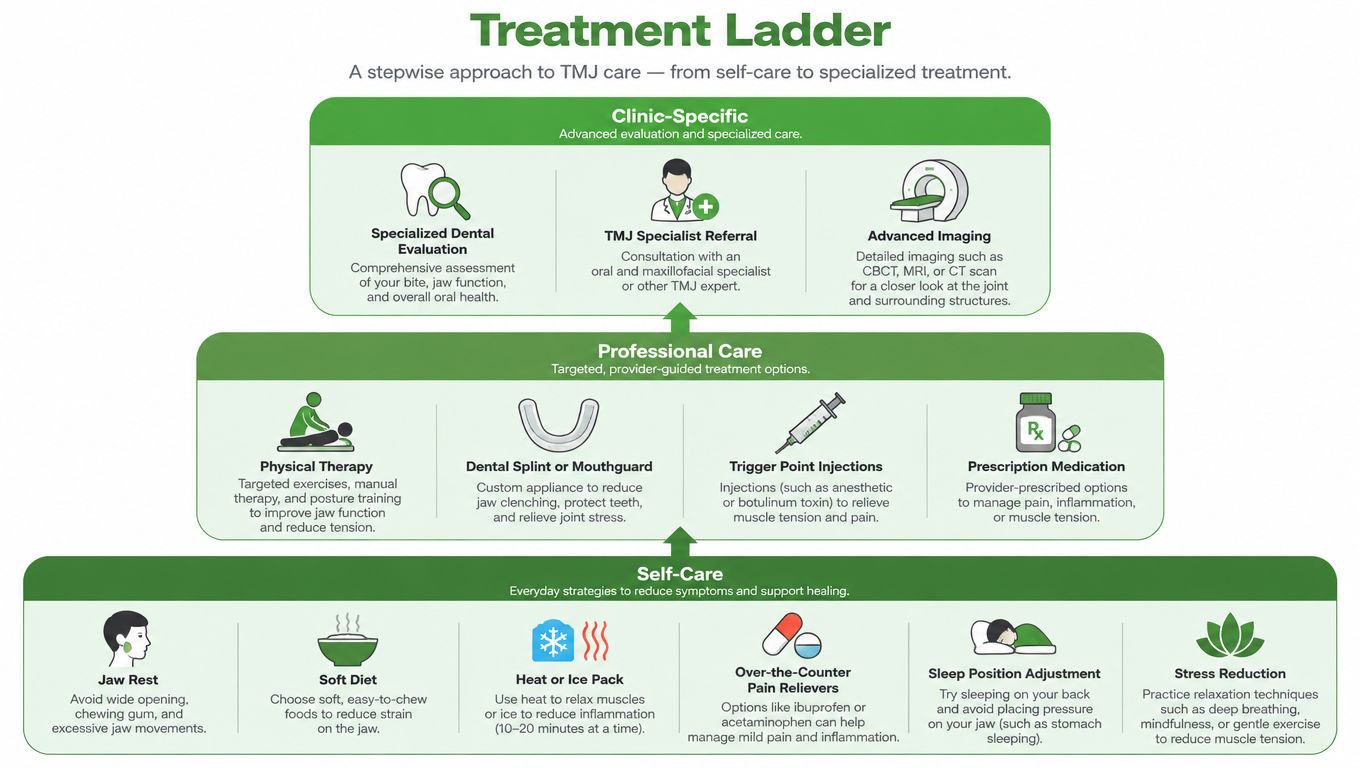
Treatment should follow the cause rather than the label. For a manageable muscular or joint pattern, start with reversible steps: temporarily choose softer foods, avoid gum and extreme opening, use heat or cold according to comfort, notice daytime clenching, and discuss anti-inflammatory medication with a clinician if it's safe for you.
A useful resting cue is lips together, teeth apart. That position reduces the habit of holding the jaw under constant pressure. Sleep position, stress, neck mechanics, and chewing on one side can also influence symptoms.
Matching treatment to the driver
Manual therapy and physical therapy may address the jaw, neck, posture, and movement coordination. Orofacial myofunctional therapy can work on tongue posture, swallowing, nasal breathing, and resting habits. Buteyko-style breathing retraining may be considered when dysfunctional breathing contributes to mouth breathing or airway strain.
Clinic-specific options can include custom oral appliances, trigger-point care, neurologic headache treatment, and dental treatment for a cracked or infected tooth. Pain and Sleep Therapy Center offers manual therapy, orofacial myofunctional therapy, Buteyko breathing work, Prolotherapy, Platelet-Rich Fibrin injections, cold laser therapy, and frenectomy services. These options aren't interchangeable, and not every patient needs them.
Regenerative procedures such as Prolotherapy or PRF may be discussed for selected joint or tissue problems, while cold laser therapy may be used as part of a broader pain plan. A clinician should explain the evidence, alternatives, expected course, and limits before proceeding. For a broader explanation of hands-on, whole-body care, you can review osteopathic manipulative treatment benefits.
Where trade-offs matter
A mandibular advancement device may improve airway opening for one person but aggravate jaw symptoms for another. Neurology-led migraine prevention won't repair a cracked tooth, and a night guard won't treat giant cell arteritis. Avoid irreversible bite changes or repeated procedures until the diagnosis is clear.
A 2025 integrative review reports that people with obstructive sleep apnea had a 2.5-fold higher risk of developing TMD. It recommends screening people with orofacial pain using tools such as the Epworth Sleepiness Scale or Berlin Questionnaire, while noting that mandibular advancement therapy can trigger TMJ pain in a small percentage of patients even as it sometimes reduces bruxism-related pain (integrative review of sleep apnea and TMD).
Why Snoring and Morning Headaches Belong in the Same Conversation
A headache that is strongest on waking deserves more than a quick question about clenching. Ask whether you snore, wake with a dry mouth, feel unrefreshed, experience daytime fatigue, or have someone notice pauses in breathing. Those clues can point toward sleep-disordered breathing, which may interact with jaw tension and nighttime muscle activity.
TMD is a recognized potential cause of one-sided jaw pain with headache. The National Institute of Dental and Craniofacial Research estimates that it affects about 5% of U.S. adults, occurs about twice as often in women as in men, and has especially high occurrence among women aged 35 to 44 (NIDCR information on TMD). Those figures describe TMD, not the cause of every morning headache.
Why an appliance needs supervision
A mandibular advancement device moves the lower jaw forward to help support the airway. That can reduce breathing-related symptoms for some patients, but the same jaw position can irritate the joint or chewing muscles in others. Appliance design, gradual titration, bite changes, and follow-up matter.
An airway-focused evaluation may include sleep questionnaires, referral for sleep testing, jaw and muscle examination, and review of nasal breathing. The obstructive sleep apnea diagnosis resource can help clarify what questions to bring to that conversation.
Orofacial myofunctional therapy and Buteyko breathing retraining may support nasal breathing, oral posture, and swallowing mechanics when clinically appropriate. People exploring noninvasive approaches to snoring may also encounter laser therapy for snoring, but any airway treatment should be selected after assessing the cause of the breathing problem and the condition of the jaw.
Your Next Step and Questions Worth Asking
Track the symptoms for two weeks if no red flag is present. Record which side hurts, when symptoms begin, whether the pain is worse in the morning, how sleep felt, whether chewing or clenching reproduces it, and whether you notice congestion, tooth sensitivity, nausea, light sensitivity, or neck stiffness.
Bring the record to a Charlotte evaluation and ask:
- Could jaw movement reproduce my usual headache?
- Should I be screened for snoring or sleep apnea?
- Would dental, neurological, ENT, or primary care coordination help?
- Which treatments are reversible, and what trade-offs should I expect?
- Is imaging necessary based on my examination?
Common questions
Is a one-sided headache usually TMJ? No. TMD is one possibility, but migraine, dental disease, nerve pain, sinus problems, neck-related pain, and urgent medical conditions can overlap.
When is imaging needed? It depends on examination findings, trauma, restricted movement, suspected structural disease, or an unclear diagnosis. Imaging isn't automatically useful for every symptom.
Can children have this pattern? Yes, children can experience jaw, dental, muscular, headache, sleep, or airway problems. Persistent pain, restricted opening, swelling, trauma, or neurological symptoms deserves professional evaluation.
How can I tell migraine from jaw-driven pain? Jaw-driven pain is more likely to be reproduced by chewing, clenching, or jaw examination. Migraine may be more throbbing and may include nausea or light and sound sensitivity. The patterns can coexist, so avoid treating either description as a final diagnosis.
Pain and Sleep Therapy Center in Charlotte evaluates TMJ disorders, facial pain, headaches, snoring, and obstructive sleep apnea with coordinated jaw, airway, sleep, and breathing care. Visit Pain and Sleep Therapy Center to request an evaluation and discuss which next step fits your symptoms.