
Prolotherapy generally takes weeks to months to deliver meaningful improvement, not days, with gradual improvement often expected over 1–3 months. During the first two weeks, distinguish short-term post-injection soreness from genuine treatment benefit rather than assuming that discomfort means healing is complete or treatment has failed.
You might be checking your jaw every morning, wondering whether breakfast feels easier or whether the injection has made things worse. That uncertainty is understandable, especially when you're trying to plan work, meals, sleep, and another appointment. A useful recovery plan gives you milestones to watch, not a promised date when everything should feel better.
When Patients First Ask About Prolotherapy Results
Consider a Charlotte patient sitting down for a consultation after a frustrating stretch of jaw pain. Chewing has become a calculation, opening wide feels uncomfortable, and another disrupted night has made the decision feel urgent. The question isn't abstract: How long does prolotherapy take to work before daily life becomes easier?
That's an illustrative situation, not a patient case report. It captures why a timeline needs to account for the activity someone wants back, rather than just the appointment date.
For someone exploring TMJ or facial-pain care in Charlotte, NC, the most important starting point is the diagnosis. A knee study can help explain how researchers assess prolotherapy, but it can't supply a guaranteed deadline for a painful jaw.
The expectation that needs resetting
A patient may compare the proposed treatment with a previous cortisone injection that seemed to help before the weekend. That personal experience is worth discussing, but it shouldn't become the standard against which every injection is judged. Prolotherapy is intended to produce a different type of response.
Useful consultation questions include:
- What are we treating? Ask which joint or surrounding structure the clinician believes is contributing to symptoms.
- What should change first? Clarify whether the initial goal is easier movement, less activity-related pain, or better tolerance of rehabilitation.
- What would change the plan? Agree on what would justify continuing, pausing, or investigating another explanation.
Practical rule: A treatment plan should tell you what progress looks like and what happens if that progress doesn't appear.
The wrong expectation is that every uncomfortable day means failure, or that every comfortable day proves tissue repair. Neither conclusion is dependable on its own. A better approach is to compare repeatable activities over time and make treatment decisions from the overall pattern.
What Prolotherapy Actually Does in the Body
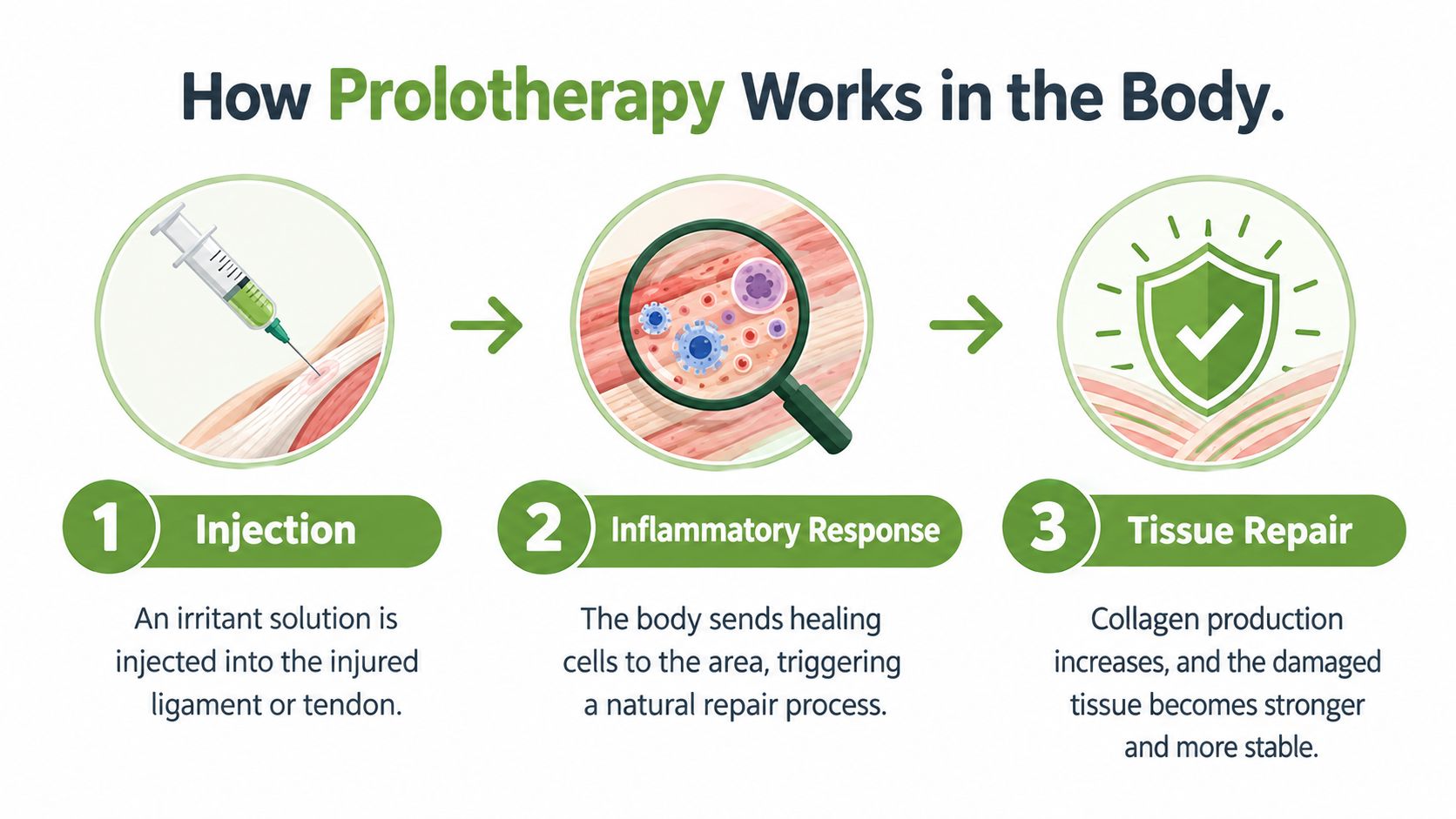
Dextrose prolotherapy uses an injection intended to stimulate a local repair response. The proposed process involves an inflammatory signal followed by tissue repair and remodeling, rather than suppressing the sensation of pain. Clinical improvement, however, doesn't prove that every proposed biological step occurred in an individual patient.
Think of repairing a worn fabric seam. Stitching brings attention to the damaged area, scaffolding supports the repair, and rebuilding takes longer than placing the initial stitch. This is an analogy for the treatment's intended mechanism, not a claim that an injection mechanically stitches a ligament together.
The illustration below shows that proposed sequence.
Why the mechanism changes the timetable
In clinical knee-osteoarthritis research on dextrose prolotherapy, meaningful improvement was detectable around 12–16 weeks after a course of three to five injections, supporting assessment over a multi-month period rather than immediately afterward.
That doesn't establish the same response for TMJ disorders. It also doesn't make prolotherapy interchangeable with corticosteroid injections or viscosupplementation. Ask the clinician to explain the purpose of the proposed injection rather than treating these options as different names for the same intervention.
For jaw-specific context, the clinic's explanation of prolotherapy for TMJ treatment can help you prepare questions about the target structure and treatment rationale.
If you're comparing broader approaches, Atlanta Hyperbaric Center provides a resource to explore natural pain relief methods. Use it to organize questions about alternatives, not as proof that different therapies share the same evidence or recovery schedule.
The injection is an intervention intended to encourage repair. It isn't proof that repair has happened, and a reduction in pain isn't a direct measurement of stronger tissue.
That distinction matters when deciding whether a treatment is delivering useful, sustained improvement.
A Realistic Week by Week Recovery Timeline
Use a recovery timeline as a set of review windows, not deadlines your body must meet. The diagram offers a broad framework; its phases shouldn't be interpreted as proof that soreness must last throughout the initial phase or that strengthening begins on a particular day.
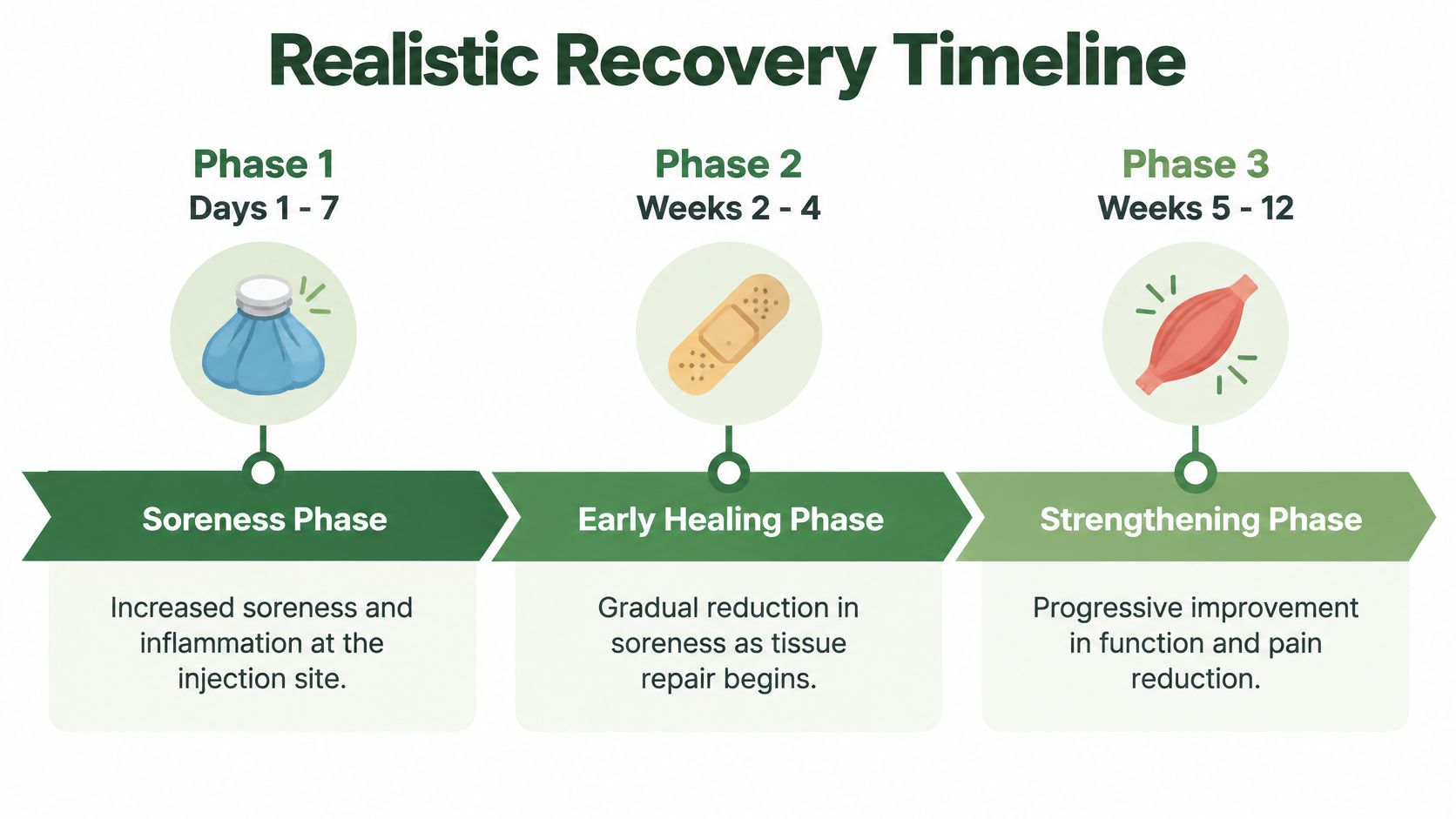
Early recovery and the first functional changes
Immediately afterward, the question is whether the injection site is settling as expected. Follow the treating clinician's aftercare instructions and distinguish local tenderness from the pain that originally brought you in. Don't repeatedly provoke the painful movement just to test whether the procedure worked.
During the early reassessment window, look for small, repeatable changes rather than a dramatic breakthrough. In a randomized knee-osteoarthritis trial, measurable improvements appeared at 2 weeks, with stronger differences at 4 and 8 weeks when intra-articular and peri-articular injections were combined. Those findings support checking early progress, but they don't establish an equivalent jaw-pain timeline.
For a TMJ patient, useful observations might include finishing a familiar meal more comfortably or opening the mouth with less hesitation. Record what happened without forcing harder chewing or wider opening.
Later reassessment and durability
During the main review period, compare pain and function against the baseline recorded before treatment. A modest but consistent improvement may justify a different conversation than no change at all. Worsening function deserves review rather than an automatic decision to wait longer.
Over subsequent months, the question becomes whether improvement lasts. A systematic review of randomized knee-osteoarthritis trials found ongoing benefit in nine studies assessing outcomes at 2–3 months; of six studies assessing 5–6 months, five reported persistence, while two studies reported benefit through 12 months.
Those results describe study groups, not a promise of permanent relief. They also show why a short-lived response and a sustained functional gain shouldn't be treated as identical outcomes.
For additional discussion of injury recovery, the following video provides another educational resource.
If you encounter Peak Performance's discussion of GLP-1 Ozempic recovery strategies, keep it separate from your prolotherapy instructions. A discussion of medications or other recovery interventions isn't evidence that adding them will accelerate TMJ recovery.
Factors That Change How Quickly Prolotherapy Works
Diagnosis and protocol matter more than a generic recovery calendar. Published studies don't all treat the same structure, use the same solution, or measure success the same way. Comparing their timelines without those details can create misleading expectations.
A clinical evidence summary of dextrose prolotherapy reported intra-articular dextrose concentrations of 5%–25%, with 1–5 injection sessions over a maximum of 5 months; most shoulder studies assessed outcomes around 3–4 months. These are research ranges, not a prescription for your jaw.
Factors That Speed Up or Slow Down the Prolotherapy Timeline
The comparisons below are planning considerations, not validated predictions of how quickly an individual will respond.
| Factor | Faster Timeline | Slower Timeline |
|---|---|---|
| Diagnostic clarity | A defined target allows a focused treatment trial | An uncertain pain source may require further assessment |
| Rehabilitation fit | Exercises address the mechanical problem identified during evaluation | An unsuitable or poorly tolerated program needs adjustment |
| Activity planning | Agreed modifications make progress easier to interpret | Repeatedly provoking symptoms can obscure the response |
| Treatment protocol | A clear schedule provides planned review points | Unclear spacing or changing targets complicates assessment |
| Outcome tracking | Consistent measurements reveal useful trends sooner | Relying on memory makes subtle changes harder to judge |
What belongs in the medical history
Bring information about age, overall health, smoking, sleep quality, and symptom duration into the discussion. These deserve attention when planning care, but the evidence presented here doesn't support assigning a specific delay to each factor. A clinician shouldn't claim that your age or a poor night's sleep adds a predictable amount of time to recovery.
For orofacial care, discuss jaw habits, exercise tolerance, and sleep-related concerns without assuming they all have the same cause. An injection plan and an airway or myofunctional evaluation answer different clinical questions.
The distinction between patient factors and protocol factors is useful because it separates what you can influence from what your clinician must justify. You can follow agreed activity guidance and report symptoms accurately. The clinician must explain the injection target, concentration, session spacing, and evidence relevant to your diagnosis.
How Many Sessions Most Charlotte Patients Need
There isn't a defensible universal session count for Charlotte patients, particularly for TMJ or facial pain. Local geography doesn't determine the biological response, and published protocols from another body region shouldn't become an automatic package of care.
A planned course should remain conditional on response. Before committing, ask what the clinician expects an additional session to accomplish and what findings would make another injection inappropriate.
The consultation should produce a plan you can understand, not just a list of appointment dates.

What a reasonable course includes
- A baseline assessment: Record symptoms, movement limitations, and the activities you want to regain before treatment starts.
- A rationale for repeat treatment: Ask whether another session depends on partial improvement, examination findings, or a predefined protocol.
- A rehabilitation plan: Clarify which exercises to perform, what to avoid, and whom to contact if exercises aggravate symptoms.
- A decision point: Agree on when the clinician will reconsider the diagnosis or recommend a different approach.
A systematic review of chronic low-back-pain studies included follow-up measurements ranging from 15 minutes to 52 weeks and described three sessions associated with pain and function improvements lasting up to 12 months in a cited study. The same review discusses conflicting findings, including trials without a meaningful advantage over control injections.
That's why a successful course described in a back-pain study can't establish what most jaw-pain patients need. The number of visits is part of a protocol, not independent proof of effectiveness.
Before booking another session: Ask what has changed since baseline and why repeating the procedure is more appropriate than reassessing the problem.
Stopping before the agreed review can make a gradual response difficult to evaluate. Continuing indefinitely without meaningful improvement is the opposite mistake. Good follow-up protects against both.
How to Tell When It Is Working or Not Working
Less pain matters, but it isn't the only useful outcome. For jaw symptoms, treatment should be judged against the activities that prompted you to seek care. A lower pain score with unchanged difficulty eating deserves a more detailed discussion than calling the treatment successful.
Choose familiar activities that don't require pushing through discomfort. Compare similar meals, comfortable jaw movement, and sleep comfort rather than inventing increasingly demanding tests.
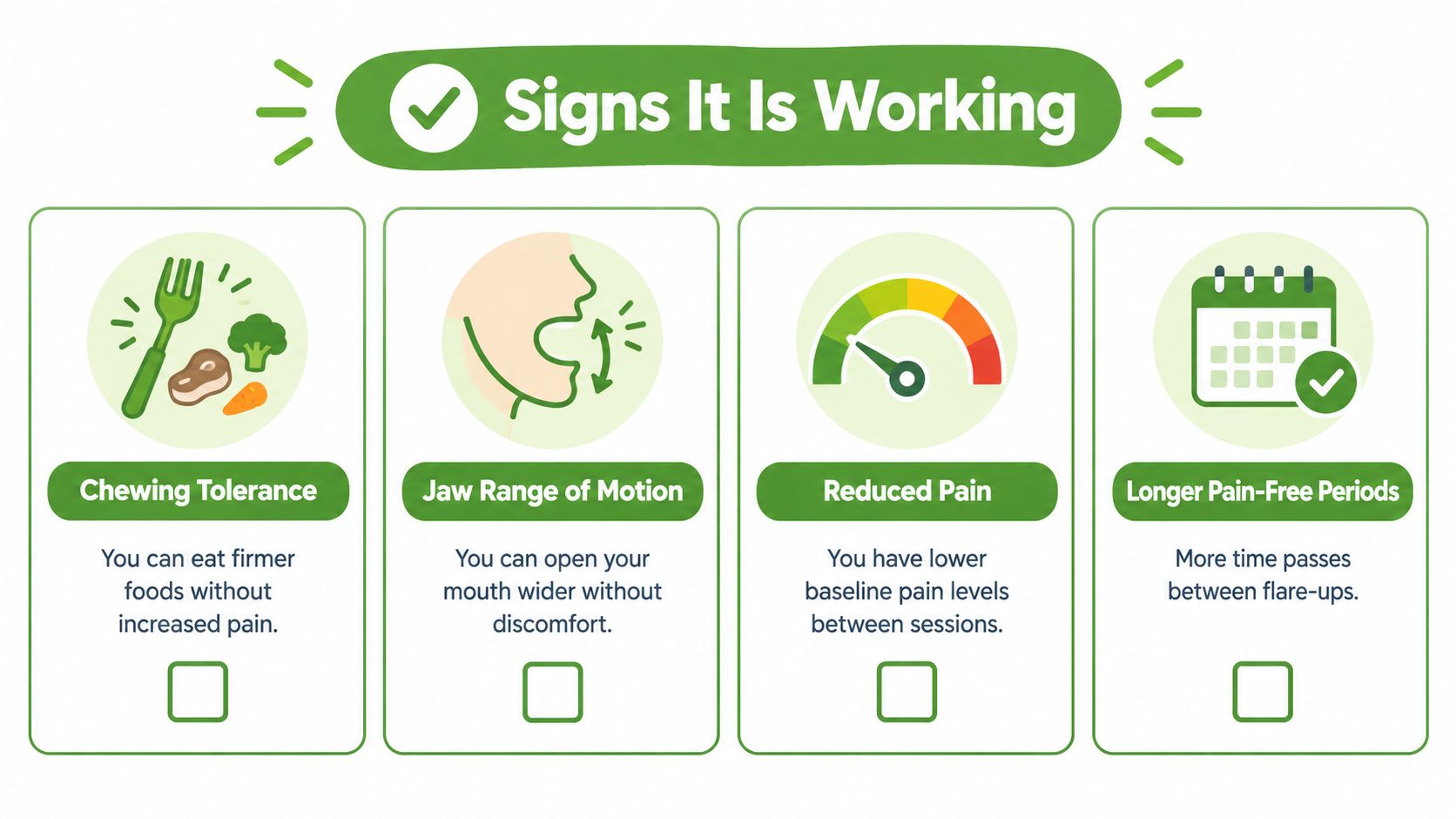
Separate a local reaction from a useful response
A review discussing hypertonic dextrose prolotherapy and its evidence limitations notes that soreness and swelling commonly resolve within 1–2 days, while most studies followed patients for only 3–6 months, limiting conclusions about durability and long-term safety.
That means the opening recovery period shouldn't be interpreted as an expectation of continuous soreness. Pain is not proof that treatment is working. Persistent or escalating discomfort needs clinical review.
Useful markers to record include:
- Chewing tolerance: Can you manage your usual comfortable foods with less symptom escalation?
- Jaw movement: Is ordinary opening easier without forcing the range?
- Sleep comfort: Is jaw discomfort less disruptive, without assuming an associated breathing disorder has resolved?
- Rescue medication: Has use changed under your prescriber's guidance? Don't stop prescribed medication just to test the injection.
When to contact the clinic
As a safety precaution, contact the treating clinician for worsening pain, increasing swelling, redness or warmth, fever, new numbness or weakness, or declining function. Seek urgent medical help for breathing or swallowing difficulty rather than waiting for a routine appointment.
The clinic's TMJ treatment before-and-after information can help frame questions about outcomes, but another person's result isn't your benchmark. Your baseline, examination, and functional goals are more useful.
A mixed response isn't automatically failure. It is information that should guide the next decision.
Planning a Charlotte NC Prolotherapy Consultation
A useful Charlotte, NC prolotherapy consultation should leave you with a working diagnosis, an explanation of uncertainty, and a plan for measuring progress. It shouldn't require you to accept a guaranteed healing date.
Bring prior imaging reports if available, a medication list, and a summary of treatments you've tried. Include oral appliances, exercises, injections, physical therapy, and whether each helped, aggravated symptoms, or made no noticeable difference. Existing information can support the evaluation without assuming new imaging is always necessary.
Bring goals that can guide decisions
Describe what you want to do more comfortably. Examples include eating a regular meal, opening for dental care, or sleeping without jaw discomfort. If you also report grinding, locking, snoring, or daytime fatigue, ask which concerns require separate assessment rather than expecting an injection to address them all.
Questions worth taking into the appointment include:
- Diagnostic confidence: What findings support the proposed pain source, and what alternatives remain possible?
- Injection details: What solution and concentration are proposed, and where will they be injected?
- Treatment spacing: Why is this interval appropriate for the target condition?
- Progress measurement: Which pain and function measures will determine whether care continues?
- Alternatives: What would favor rehabilitation, another intervention, or referral instead?
Compare options without assuming equivalence
For knee osteoarthritis, evidence supports potential pain improvement, but the primary-care review of prolotherapy across conditions also describes important limitations and inconsistent superiority over controls in low-back-pain trials. That condition-specific uncertainty belongs in the consent discussion for jaw applications.
Prolotherapy, Platelet-Rich Fibrin injections, and cold laser therapy should be discussed as distinct options, not interchangeable ways to guarantee regeneration. Ask what evidence supports each for your diagnosis and whether combining treatments would make the response harder to interpret.
Practical planning includes the financial side. Review the clinic's prolotherapy cost information and request an individualized estimate covering the proposed course and reassessment visits. Don't assume that paying for additional procedures necessarily produces a better outcome.
Consultation summary: Establish the target, document your starting function, agree on review milestones, and know when to call. Judge the treatment by sustained, useful change rather than the injection-day experience.
The most helpful answer to the timeline question is therefore personal but not vague: what you're treating, what improvement should look like, and when you and the clinician will decide whether the plan still makes sense.
Pain and Sleep Therapy Center offers Charlotte, NC evaluation and care for TMJ disorders, facial pain, and sleep-related concerns, with prolotherapy among its regenerative treatment options. Visit Pain and Sleep Therapy Center to arrange a consultation and discuss whether prolotherapy fits your diagnosis, what milestones to monitor, and when your response should be reassessed.