
Those researching PRF injections in the face often look for the fastest visible change. That expectation makes sense in a cosmetic market shaped by fillers that can restore contour during a single appointment. But PRF belongs to a different category. It isn't designed to push tissue outward immediately. It's intended to encourage your own skin to improve gradually.
Platelet-rich fibrin, or PRF, uses material made from your own blood to support a biological healing response. The treatment may be relevant for skin thinning, crepiness, fine lines, and declining tissue quality, but it shouldn't be sold as an instant replacement for structural filler. A good result depends on choosing the right indication, using a carefully prepared product, and allowing the tissue time to respond.
Rethinking Facial Rejuvenation Beyond Instant Fillers
A fuller face isn't always a healthier-looking face. When aging skin becomes thin, loose, dry-looking, or finely wrinkled, adding volume beneath it may address only one part of the problem. The skin itself may still lack thickness, elasticity, and resilience.
That's where the distinction between a traditional dermal filler and a biostimulatory treatment matters. A filler primarily creates physical support or occupies space. PRF injections in the face take a different route by placing your own concentrated blood components into selected tissue and encouraging a repair response.
The difference is easy to summarize:
- Fillers change shape directly. They're chosen when a patient needs contour, projection, or support.
- PRF supports tissue quality. It's considered when the main concern is delicate, crepey, or tired-looking skin.
- PRF develops gradually. The treatment doesn't promise a dramatic change as soon as you leave the clinic.
This doesn't make PRF superior to every other option. It makes PRF appropriate for a different goal. Someone seeking stronger cheek projection may need a volumizing treatment. Someone bothered by thin under-eye skin or fine surface changes may prefer a gradual approach that doesn't create obvious added fullness.
A practical rule: Choose PRF for the quality of the tissue, not for the expectation of instant contour.
The appeal of an autologous treatment is also understandable. Because the material comes from the patient's own blood, the approach aligns with a preference for regenerative care rather than a manufactured injectable. Still, “natural” doesn't mean effortless or universally suitable. The preparation method, injection technique, anatomy, health history, and treatment plan all affect the clinical decision.
The most realistic way to view PRF is as a slow-release biological therapy. It may help the skin behave more like healthier tissue over time, but it can't recreate every lost facial structure. Patients who value subtle change and long-term tissue support may find that tradeoff worthwhile. Patients who want immediate lifting or sharply defined contours may be disappointed if the treatment is presented as a filler alternative.
The Biological Mechanism of PRF Injections in Face
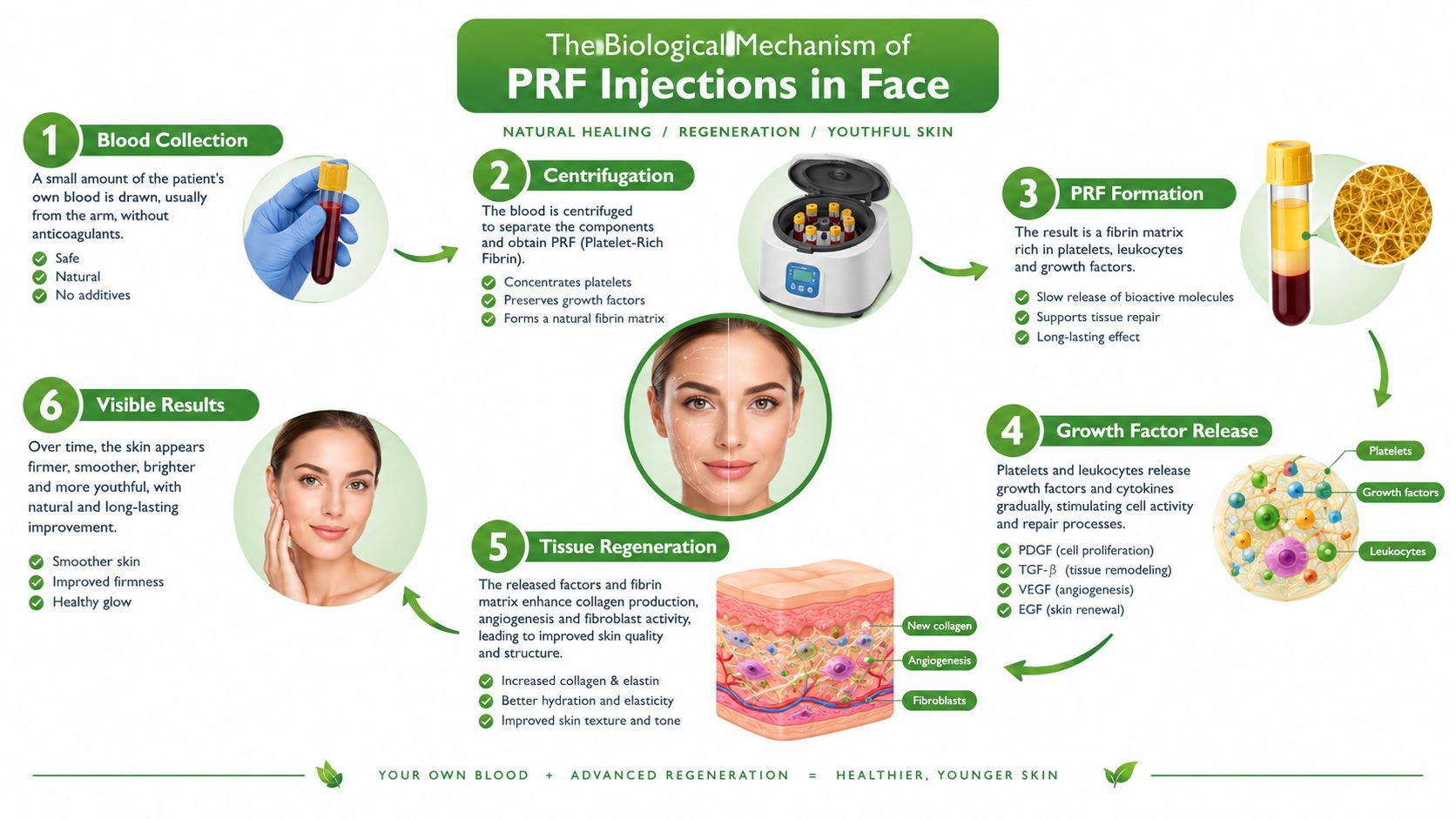
PRF begins with a small blood draw. The sample is processed in a centrifuge, separating its components so the practitioner can collect a platelet-rich fibrin layer for treatment. Unlike a simple liquid containing platelets alone, PRF includes a developing fibrin matrix, which gives the material a soft, three-dimensional structure.
A useful analogy is a temporary scaffold at a construction site. The scaffold doesn't become the finished building. It gives repair-related cells a place to gather and creates an environment where biological signaling can continue after the injection.
What happens after preparation
Once injected into the targeted tissue, the fibrin structure can help hold platelets and other blood-derived components near the treatment site. Those platelets release signaling molecules involved in the body's normal repair process. The aim isn't to force the skin to change instantly. The aim is to encourage local cells, including fibroblasts, to participate in gradual tissue remodeling.
Fibroblasts help produce structural proteins such as collagen. As the skin responds, the potential clinical targets include texture, elasticity, thickness, and fine surface irregularity. That biological sequence explains why PRF is better understood as a stimulator than as a volumizer.
The process can be described in four plain-language steps:
- Collection: A clinician draws the patient's blood using standard sterile technique.
- Processing: The sample is centrifuged to separate the desired fibrin-rich component.
- Placement: The prepared i-PRF is injected into selected facial areas.
- Remodeling: Local repair signals encourage a gradual response within the treated tissue.
Why the fibrin component matters
The fibrin network helps distinguish PRF from a purely liquid platelet preparation. It provides structure and may support a slower release of signaling factors rather than delivering them all at once. That slower pattern fits the treatment's purpose, which is to support progressive biological activity instead of immediate mechanical correction.
This mechanism also creates an important limitation. A scaffold can support repair, but it cannot guarantee a specific cosmetic outcome. Skin aging involves sun exposure, genetics, muscle movement, fat loss, bone changes, and overall health. PRF addresses only part of that picture, so a careful provider should define the intended endpoint before recommending injections.
Clinical Evidence and Realistic Treatment Timelines
A responsible discussion of PRF starts with the limits of the evidence. Clinical research in aesthetic PRF remains relatively small, so patients should be cautious about claims that promise dramatic, permanent transformation. Available studies are encouraging for certain measures of skin quality, but they don't justify treating PRF as a guaranteed replacement for every rejuvenation procedure.
The clearest facial example is a 2020 prospective, single-center study involving 11 healthy women. Each participant received three monthly intradermal i-PRF sessions directed at the malar areas, nasolabial folds, and upper-lip skin. At the three-month assessment, objective analysis found statistically significant improvement in skin surface spots, with P = .01, and pores, with P = .03. FACE-Q satisfaction scores also improved across several facial regions, and the study reported no major adverse effects. The study details are available in the published clinical report on i-PRF facial rejuvenation.
Why one appointment may not tell the whole story
The protocol matters because the treatment is cumulative. The skin needs time to process the biological signals, build structural proteins, and remodel the surrounding tissue. A patient may notice an early change in swelling, hydration, or surface appearance, but that temporary effect shouldn't be confused with mature collagen remodeling.
A sensible timeline looks more like a process than a reveal:
- At the appointment: The clinician completes the injection and records the treatment areas.
- During early healing: Local tenderness, swelling, or bruising may affect the appearance temporarily.
- After the treatment series: The provider can compare photographs, skin measurements, or imaging with the baseline.
- Over subsequent follow-up: The team evaluates whether the intended changes in texture or elasticity are developing.
The study's use of objective analysis and patient-reported outcomes is important. Photographs taken under different lighting can make skin appear better or worse without any true biological change. Consistent documentation gives the patient and practitioner a more reliable basis for evaluating progress.
A broader review of PRF research in aesthetic medicine found that the published clinical literature remains limited, while available studies generally report improvements in facial texture, wrinkles, and crepiness. The same review described moderate to significant gains in skin texture and elasticity across a small group of facial rejuvenation studies. It also noted that a comparative study found a modest short-term PRF advantage over PRP in some canthal measurements, with those differences no longer present later.
The realistic promise: PRF may support a gradual improvement in tissue quality, but the evidence is still developing and the result depends on the patient, the protocol, and the endpoint being measured.
Readers comparing patient experiences can also review PRF injection reviews and treatment considerations, while remembering that personal testimonials can't replace a clinical assessment or controlled evidence.
Comparing PRF with PRP and Synthetic Dermal Fillers
PRF, PRP, and hyaluronic acid fillers are often grouped together because all can be delivered by injection. Their purposes are not interchangeable. PRF and PRP are blood-derived treatments intended to support biological activity, while a hyaluronic acid filler is generally selected to provide physical volume, contour, or support.
PRP, or platelet-rich plasma, is typically prepared as a liquid platelet concentrate. PRF develops a fibrin structure that can retain cells and signaling factors at the treatment site. The exact preparation parameters matter, so patients shouldn't assume that every clinic's product is biologically identical just because the label says PRF.
Hyaluronic acid fillers work through a different mechanism. They can create a visible change in shape or fullness because the product occupies space and interacts with water within the tissue. That can be useful for defined structural concerns, but it doesn't make the product a tissue-regeneration treatment.
| Feature | PRF, Platelet-Rich Fibrin | PRP, Platelet-Rich Plasma | Hyaluronic Acid Fillers |
|---|---|---|---|
| Source | Patient's own blood | Patient's own blood | Manufactured injectable gel |
| Primary purpose | Support gradual tissue remodeling | Deliver platelet-derived biological signals | Add volume, contour, or structural support |
| Physical form | Fibrin-rich biological matrix | Primarily liquid platelet preparation | Gel |
| Best suited to | Skin quality, crepiness, and subtle rejuvenation goals | Selected regenerative or aesthetic indications | Noticeable volume loss and facial contouring |
| Immediate fullness | Not the main objective | Not the main objective | Often part of the intended effect |
| Main planning consideration | Preparation quality and realistic biological endpoints | Preparation quality and clinical indication | Product selection, anatomy, and placement |
A 2024 literature review reported that aesthetic PRF studies generally showed moderate to significant gains in skin texture and elasticity, while also emphasizing that clinical trials remain limited. Its comparison of PRF and PRP suggested that PRF had only a modest short-term edge in certain canthal texture and wrinkle measurements, and that the difference disappeared later. That finding supports a measured conclusion, not a marketing slogan: PRF may offer a useful biological approach, but it isn't automatically better for every patient.
The choice often depends on the problem being treated. Thin, crepey skin may call for a regenerative discussion. A deep fold caused by structural volume loss may require a different strategy. Some patients may ultimately need a combination of approaches, but the clinician should explain which treatment is addressing skin quality and which is addressing shape.
For a more focused comparison of the two blood-derived treatments, read about PRF versus PRP injections.
What to Expect During the PRF Procedure
A PRF facial appointment usually begins with a consultation rather than a syringe. The clinician reviews your goals, examines skin quality and facial anatomy, discusses medical history, and decides whether the concern is better addressed through regeneration, volume correction, or another treatment.
If PRF is appropriate, the provider draws a small blood sample in a process similar to routine laboratory work. The sample is then placed into a centrifuge in or near the treatment room. Because the injectable layer can begin changing as it forms a fibrin structure, the clinician needs to process and use it with careful timing.
From blood draw to injection
The prepared i-PRF is placed into selected facial areas according to the treatment plan. A clinician may use small intradermal injections, a blunt cannula, or another technique suited to the anatomy and goal. Commonly discussed areas include the malar region, nasolabial folds, upper lip, and delicate skin beneath the eyes, but the exact placement should be individualized.
A topical numbing agent may be applied before treatment. Patients often describe the injections as brief pinches or pressure, although comfort varies with the area treated, the technique used, and personal sensitivity. The clinician should explain where the product is going and what sensation to expect rather than rushing through the appointment.
Before treatment: Ask which facial changes PRF is intended to address, how progress will be documented, and what would make another treatment more appropriate.
Immediately afterward, the skin may look flushed or slightly swollen at injection points. Bruising is possible, especially in areas with delicate blood vessels. Those short-term signs don't show whether the longer-term biological response will succeed, so the provider should avoid judging the final result on the day of treatment.
Follow the clinic's specific instructions, particularly if the practitioner used a technique or treated an area that requires extra care. Don't change prescribed medication without medical guidance, even if you're concerned about bruising.
Recovery Protocols and Safety Considerations
Using your own blood reduces concern about an allergic reaction to a foreign filler, but PRF is still an injection procedure. Sterile technique, anatomical knowledge, accurate preparation, and appropriate patient selection remain essential. “Autologous” describes the source of the material, not a guarantee that complications are impossible.
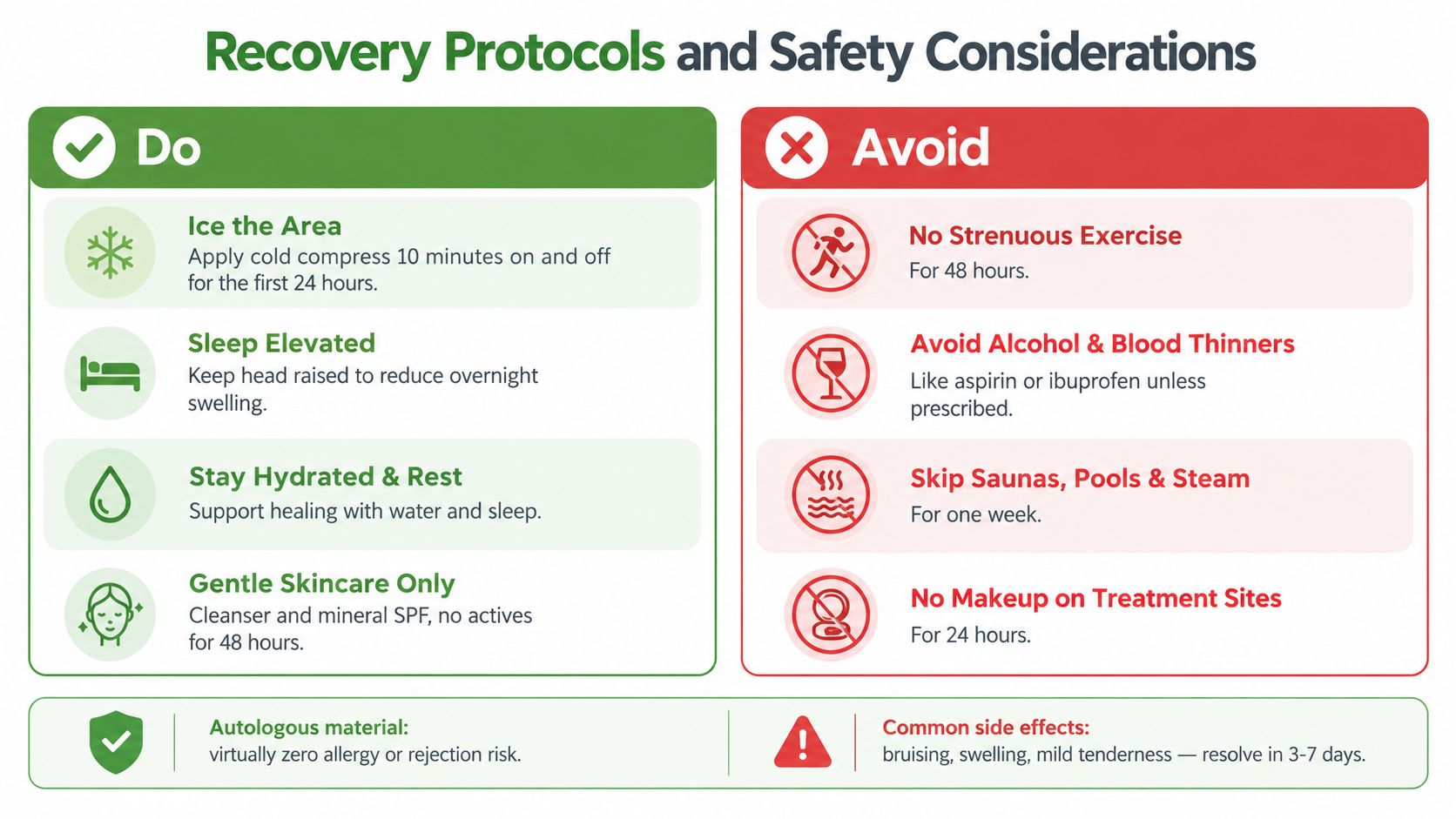
The most common short-term issues are local swelling, redness, bruising, and tenderness. These effects can make the face look temporarily uneven, particularly when treatment is performed near the eyes or around the mouth. Cooling the area gently, resting, and following the provider's aftercare instructions can make the recovery period easier.
Supporting uncomplicated healing
The recovery infographic recommends practical measures such as cold compresses, sleeping with the head raised, hydration, rest, and gentle skincare. It also advises avoiding strenuous exercise, alcohol and blood thinners unless prescribed, saunas, pools, steam, and makeup on treatment sites during the specified recovery windows.
Medication decisions need care. Some patients take aspirin, ibuprofen, or other medicines for legitimate medical reasons. They shouldn't stop a prescribed medicine just to reduce bruising. Instead, they should discuss the medication with the treating clinician before the appointment.

When a consultation should come first
A clinician should know about active skin infections, a history of abnormal bleeding, platelet or blood disorders, immune-related illness, cancer treatment, pregnancy-related considerations, and any medication that affects clotting or healing. These factors don't automatically produce the same answer for every patient, but they can change whether treatment is appropriate or when it should occur.
Contact the clinic promptly if pain becomes severe, swelling worsens rather than settles, the skin changes color unexpectedly, or you develop symptoms that concern you. Those signs require professional assessment rather than online reassurance.
The safest plan begins with an honest medical history and a clear explanation of the intended endpoint. A provider who promises that PRF has no risks, works for everyone, or produces instant rejuvenation is simplifying a treatment that deserves more careful discussion.
Evaluating If PRF Is Right for Your Aesthetic Goals
PRF may suit someone who wants subtle improvement in skin quality, especially when crepiness, fine lines, or a generally thin-looking texture matter more than dramatic contouring. It may be less suitable for someone who expects immediate cheek projection, a sharply defined jawline, or instant correction of significant structural volume loss.
Start with the outcome, not the product name. Ask yourself whether you want the skin to look healthier and more resilient over time, or whether you primarily want a visible change in facial shape today. That answer helps the clinician determine whether PRF, a filler, another regenerative option, or no injection is the most sensible path.
Questions that improve the consultation
Bring specific questions rather than asking only whether PRF “works”:
- What problem are we treating? Skin texture, laxity, fine lines, hollowing, and contour loss require different reasoning.
- What will count as success? Ask whether the provider will use standardized photographs, imaging, or a structured clinical assessment.
- How is the PRF prepared? Preparation conditions influence the biological product, so the clinician should be able to explain the process clearly.
- What are the alternatives? A trustworthy recommendation includes options that may not involve PRF.
- What happens if the response is limited? You deserve a plan that doesn't depend on optimistic assumptions.
Independent review literature notes that PRF may stimulate more collagen production than PRP in laboratory settings, particularly under certain lower relative centrifugation forces. The same evidence also makes the practical point clear: preparation parameters and realistic endpoints are critical for predictable clinical results. Laboratory findings can inform a treatment rationale, but they don't guarantee the same magnitude of benefit in a person.
A qualified, medically supervised provider should assess your health, facial anatomy, skin condition, expectations, and treatment history. You can also explore PRF versus fillers when deciding whether your priority is tissue quality or immediate structural support.
PRF makes the most sense when you're comfortable with a gradual process and willing to evaluate the result over time. It's a biological intervention, not a one-visit promise. The best decision is the one that matches your actual goal, your medical circumstances, and the level of evidence behind the proposed treatment.
Pain and Sleep Therapy Center provides medically supervised regenerative care, including PRF injections, as part of individualized approaches to facial pain and tissue healing. Visit Pain and Sleep Therapy Center to learn how a consultation can connect your concerns with an appropriate, root-cause treatment plan.