
Star ratings can help, but they don't answer the question when they search for PRF injections reviews: what treatment was done, for what problem, with what timeline, and under whose care?
That's the gap. PRF sits in an awkward middle ground between aesthetic medicine, regenerative therapy, and procedure marketing. A glowing review might reflect bedside manner, a smooth booking process, or a patient's satisfaction with subtle skin changes. It doesn't automatically prove that PRF was the right intervention, that results will last, or that the same protocol makes sense for under-eyes, hair, TMJ pain, or post-procedure healing.
The clinical literature is promising in some areas and still unsettled in others. A systematic review covering dental evidence found overall clinical benefit for PRF in oral medicine, oral surgery, and periodontology, but the same review said benefits were unclear in endodontology and no clear benefit was found in orthodontics, which is a useful reminder that PRF isn't one uniform answer across every use case (ten-year injectable PRF review and dental evidence summary).
That matters when you compare providers. Some pages offer treatment-specific reviews, visible pricing, and a realistic timeline. Others lean more on brand reputation or education than on review transparency. For readers interested in PRF through the lens of facial pain, TMJ, and sleep-related care, Pain and Sleep Therapy Center in Charlotte belongs in that conversation. But this roundup stays editorial. The point isn't to crown a winner. It's to show what each provider documents, and what their PRF reviews can and can't tell you.
1. PRF vs Fillers An Honest Comparison for Facial Aesthetics
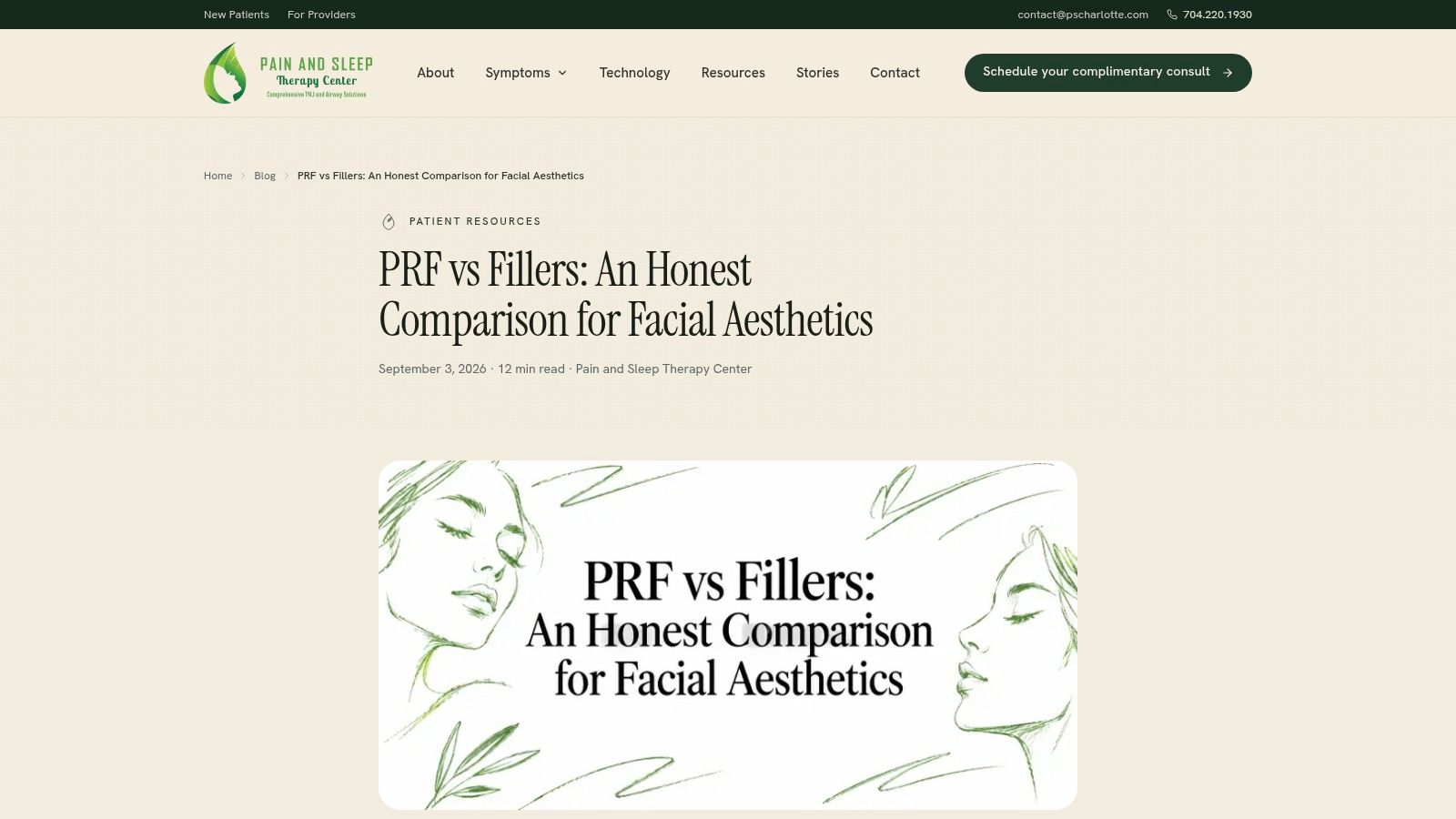
Pain and Sleep Therapy Center takes a useful approach for people who are tired of vague regenerative language. Instead of selling PRF as a magic substitute for everything else, its PRF vs fillers comparison explains the core trade-off plainly. PRF is aimed at gradual tissue support and skin-quality improvement. Fillers are for immediate volume and contour.
That distinction matters because many PRF injections reviews blur "rejuvenation" into one broad promise. This page doesn't. It frames PRF as biologic remodeling, not an instant volumizer, and that kind of expectation-setting is more valuable than a stack of generic compliments.
Why this page stands out
Pain and Sleep Therapy Center is unusual in this list because the PRF discussion sits inside a broader specialty setting focused on TMJ, facial pain, and sleep care. For a patient who wants aesthetic improvement but also has jaw tension, clenching, or facial discomfort, that context may matter more than a med spa menu.
The clinic also gives readers a path to compare related regenerative options through its explanation of PRF vs PRP injections. That's helpful because many patients still confuse those two categories, and a provider that explains the difference usually does a better job of counseling on what PRF can realistically do.
Practical rule: If a provider compares PRF with fillers honestly, instead of implying they're interchangeable, that's usually a good sign that your consultation will be more grounded.
The evidence backdrop supports that measured framing. Across oral and maxillofacial uses, PRF's stronger support is for wound-healing and tissue-regeneration effects rather than blanket superiority in every indication. A review of periodontal intrabony defects found that adding PRF to open flap debridement improved clinical measures versus debridement alone, while implant-related evidence was more moderate and limited by heterogeneity (systematic review on PRF in clinical dental applications).
Best for
Patients who want a conservative, biologic approach and don't expect immediate filler-like volume may find this setup appealing. It's also relevant for people who want their facial treatment discussed in a functional context, not only a cosmetic one.
A few trade-offs are clear:
- Natural-material approach: PRF uses your own blood, which may appeal to patients trying to avoid synthetic volumizers.
- Gradual change: Results build over time, so it's not the right match if your goal is instant contour correction before an event.
- Clinical context: The interdisciplinary setting may appeal to TMJ and facial-pain patients, but pure cosmetic shoppers might prefer a high-volume aesthetic chain.
- Practical downside: A blood draw, possible bruising, and elective pricing are part of the deal.
2. NakedMD
NakedMD stands out for a different reason than the provider above. The main signal here is not a medical framing or interdisciplinary context. It is how much a shopper can verify before booking on the PRF product page.
The page functions more like a service catalog than a classic med spa landing page. Readers can see separate PRF options, including under-eye treatment, microneedling with PRF, and hair-focused sessions, alongside pricing and booking details. That structure does not prove better outcomes. It does make review claims easier to place in context because the comments sit next to a defined service rather than a broad homepage testimonial feed.
That distinction matters with PRF. Reviews often describe satisfaction with convenience, bedside manner, or subtle cosmetic change after one visit. Those are useful signals, but they are not the same as evidence that a given protocol works equally well for every indication.
One practical advantage of NakedMD's setup is expectation-setting through logistics. Session timing, treatment variants, and purchase flow are visible upfront, so readers can judge the commitment before speaking with staff. People comparing facial aesthetics with other uses of platelet concentrates may also want context on orthobiologic therapy, since PRF in cosmetic care is not evaluated the same way as PRF used in joint or tissue-repair settings.
The trade-off is tone. Some shoppers will like the clarity of a product-style page tied to a booking system. Others may read the same layout as more retail than clinical, especially if they want a deeper discussion of candidacy, limits, and alternatives before checkout.
For readers sorting providers by review quality, NakedMD scores well on transparency and less strongly on clinical context from the page itself. That makes it useful for comparison shopping, especially if your priority is seeing what is offered, what it costs, and how reviewers are responding to a specific service name.
Best fit: someone who wants visible pricing, treatment-specific comments, and an easy way to compare options online. Less ideal: someone who wants the website itself to do more of the medical framing before the consult.
3. KORA Aesthetics
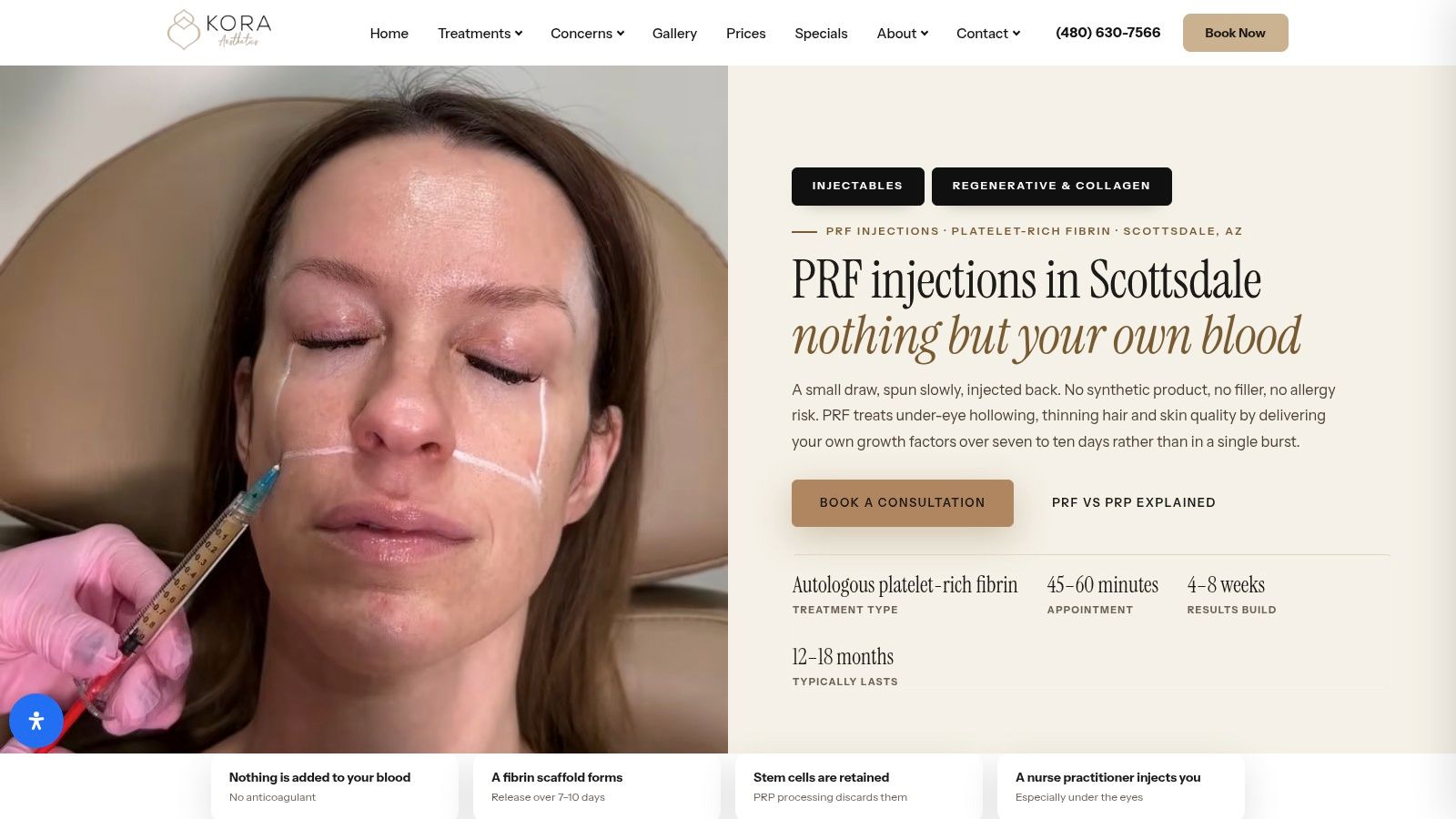
How much can you verify before anyone calls you back? KORA Aesthetics does better than many med spas on that test.
Its PRF injections page gives readers several things they can check on their own: a visible service rating, access to patient reviews, named injector credentials, and posted prices for different treatment paths. For an article comparing providers by review evidence and transparency, that matters more than another polished testimonial.
The pricing detail is the clearest strength here. KORA lists options such as $450 for a single area, $1,199 for a three-treatment package, and $1,800 for a hair restoration bundle. That does not tell a reader whether PRF will work well for their anatomy or goals. It does make the financial commitment easier to judge, especially since platelet-based treatments are often pitched as a series rather than a one-time visit.
KORA also gives more context than a simple sales page. The FAQ section explains differences between PRF and PRP, addresses side effects, and says results are not immediate. That kind of framing is useful because review pages tend to highlight satisfaction, comfort, or friendliness first. Those are real parts of the patient experience, but they do not substitute for a clear explanation of treatment cadence, limits, and variability.
One caution: visible reviews and visible pricing can create a stronger impression of certainty than the evidence supports. Readers should treat those elements as transparency signals, not proof of effectiveness.
KORA's other advantage is attribution. The page identifies who may perform the injections instead of keeping the clinician in the background. For patients comparing providers, that adds clinical context missing from many PRF landing pages, where the treatment brand gets more attention than the injector.
Overall, KORA ranks well for readers who want to compare evidence quality rather than count stars. The review trail appears easier to inspect than at many competitors, the pricing is unusually open, and the educational material does some expectation-setting before the consultation. The trade-off is that it still reads primarily as a med spa service page. Readers looking for a more medical discussion of candidacy, alternatives, or supporting research may still need that conversation in the consult.
4. ELLEMES Medical Spa
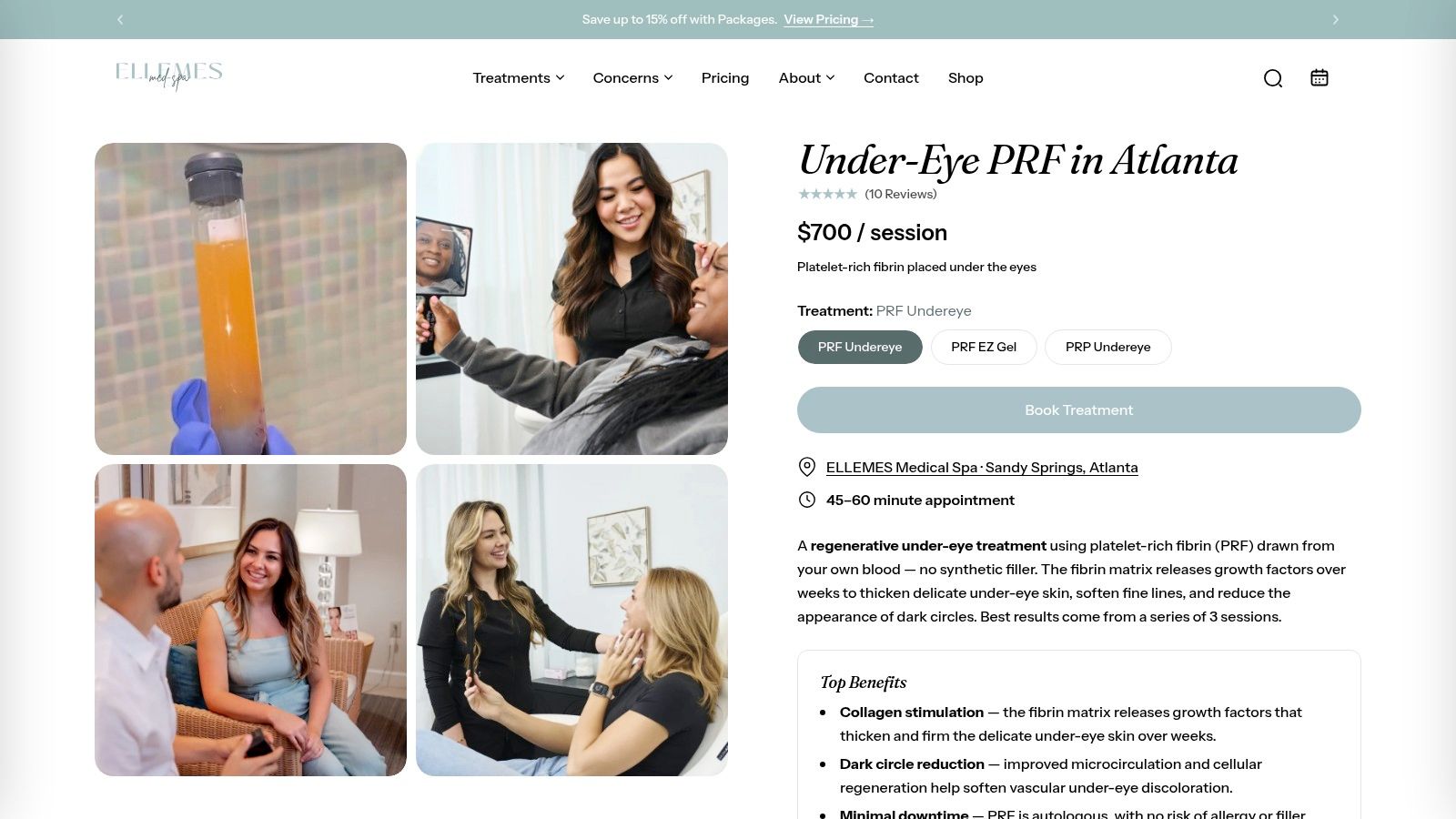
How much can a provider's PRF page tell you before you ever book? ELLEMES gives more than many competitors, especially for readers focused on the under-eye area, where expectations often drift toward filler-like results even though PRF works differently.
Its under-eye PRF page is narrower than a general facial rejuvenation pitch, and that focus helps. Rather than relying only on glowing testimonials, the page puts PRP, PRF, and PRF EZ Gel next to each other and explains that these options are not interchangeable. For comparison shoppers, that adds useful clinical context, even if it still comes from a service page written to attract patients.
The strongest signal here is expectation-setting. ELLEMES says results are gradual and pairs that message with practical details about pre-care, post-care, and downtime. That matters in the under-eye category, where reviews often emphasize comfort, friendliness, or visible freshness without clarifying how long improvement may take or how subtle it may be.
Pricing is also unusually visible for this niche. The page lists PRP at $600, PRF at $700, and EZ Gel at $900 per session. Public pricing does not prove value or outcomes, but it does make it easier to judge the full commitment instead of the headline visit cost, especially if a clinic later recommends repeat treatment.
A limitation is evidence depth. ELLEMES offers clearer framing than many med spa pages, yet the review material still functions more as patient satisfaction evidence than as proof of effectiveness. Readers should separate three things: what reviewers say they experienced, what the clinic says the treatment can do, and what published studies on PRF have or have not established for under-eye use specifically.
That puts ELLEMES in a solid middle-to-upper tier for transparency. It is particularly useful for patients deciding among adjacent under-eye options and wanting visible pricing before a consult. It is less useful for readers seeking a broader medical discussion of candidacy, contraindications, or long-term evidence beyond the clinic's own presentation.
5. AustinMD Aesthetics & Wellness
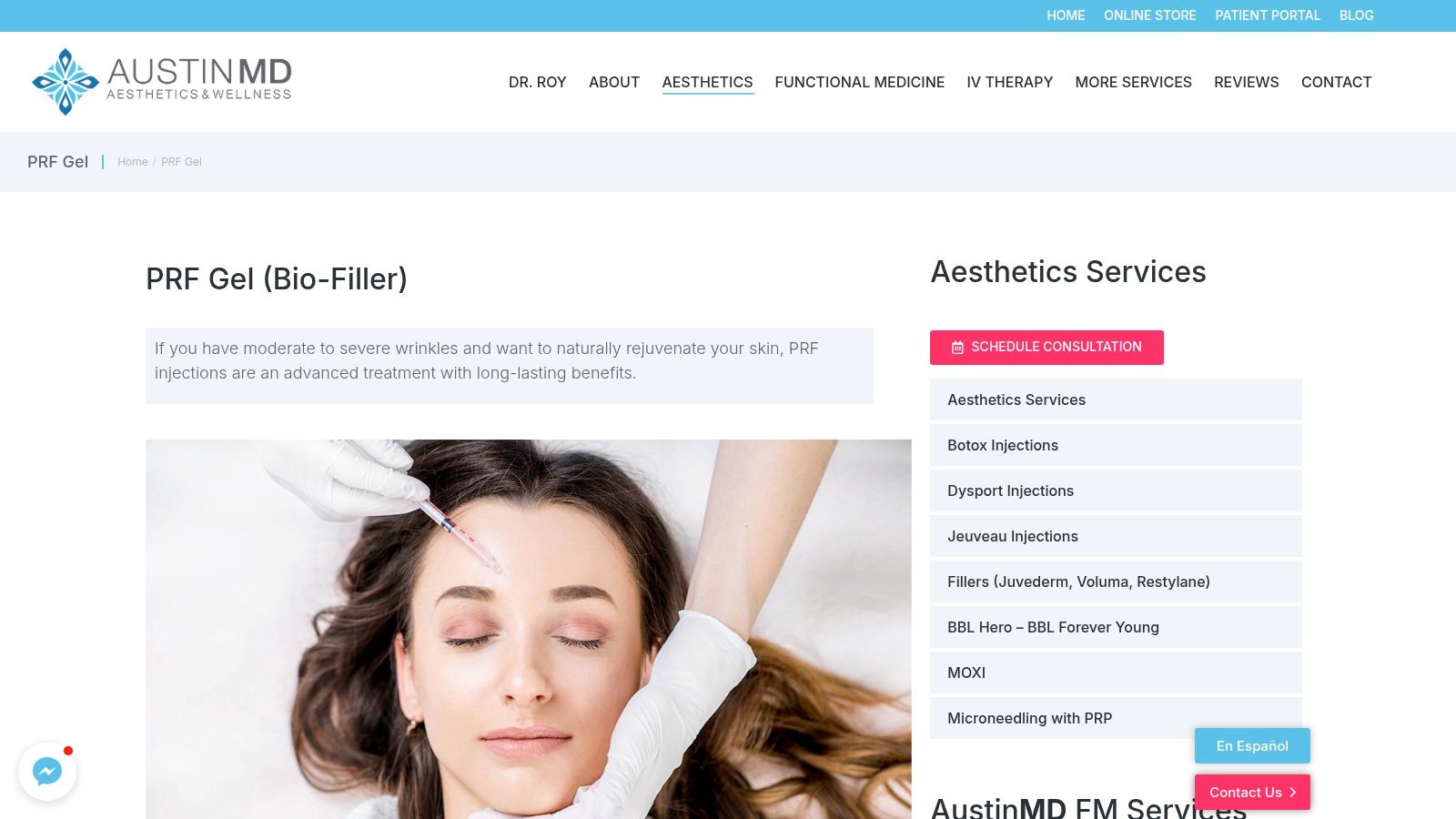
What can a reader verify before booking? At AustinMD, more than at some single-location clinics, the answer is price and treatment format. Its PRF Gel page sits within a broader service menu that also lists PRF injections, microneedling with PRF, and hair restoration, giving prospective patients a clearer sense of how the clinic packages platelet-based options.
That menu structure matters because PRF reviews often blur together treatments that are not identical. AustinMD at least separates liquid PRF from PRF Gel and frames the gel version as a filler alternative, which helps readers compare what is being offered rather than treating every blood-derived injectable as the same procedure.
Public pricing is the strongest transparency signal here. The site lists PRF injections from $599, microneedling with PRF from $549, and hair restoration at $899, with specials and membership discounts layered on top. That does not answer whether the treatment is worth the cost, but it does make budget planning easier before a consultation.
The weaker point is review evidence. AustinMD gives shoppers a usable menu, yet the PRF pages do not provide much PRF-specific patient commentary that can be checked against a particular indication, injector, or time course of improvement.
A more useful clinical caution here is not whether PRF is "new" in a general sense, but how variable its use can be. A 2024 review of injectable platelet-rich fibrin in facial esthetics describes differences across preparation methods, injection techniques, and treatment intervals. That kind of protocol variation makes clinic reviews harder to interpret. One patient's positive result may reflect a specific method rather than PRF as a category.
AustinMD lands well for readers who rank cost visibility and service comparison above testimonial depth. It is less persuasive for readers who want detailed, indication-specific review evidence before booking.
6. SkinSpirit
SkinSpirit is a different kind of entry because the appeal isn't one standout PRF review page. It's network consistency. The SkinSpirit locations hub lets readers find clinics where microneedling with PRP or PRF and PRF-trained injectors are part of the broader service ecosystem.
For some patients, especially frequent travelers or people relocating between cities, that matters more than one especially polished treatment page.
What a network gives you, and what it doesn't
Large aesthetic networks tend to standardize booking, branding, and service design better than single-location clinics. SkinSpirit appears to benefit from that model. Provider bios often mention PRF or PRF EZ Gel training, which gives patients at least some basis for comparing staff credentials.
The trade-off is review specificity. You usually won't find one neat archive of PRF-only patient comments. You'll often have to sort through location-level reviews and ask directly how often a given injector performs the treatment.
That uncertainty mirrors part of the larger PRF evidence problem. Durability and protocol standardization remain open questions. A 2025 review of PRF analgesic effects found that 65.5% of studies reported less pain, 31.0% found no difference, and 3.5% found worse pain, while a 2026 review found no dedicated long-term safety data beyond 12 months for PRF or i-PRF in facial aesthetic use (review on PRF outcomes, durability, and safety limits).
Best for
SkinSpirit makes sense if you value brand consistency, location choice, and easy online scheduling more than treatment-page review depth. If cost matters a lot, ask early, since regenerative therapy cost considerations can vary widely by market and protocol.
Bigger networks can offer smoother logistics. They don't automatically offer better evidence on the exact PRF protocol you care about.
7. Evolve Med Spa
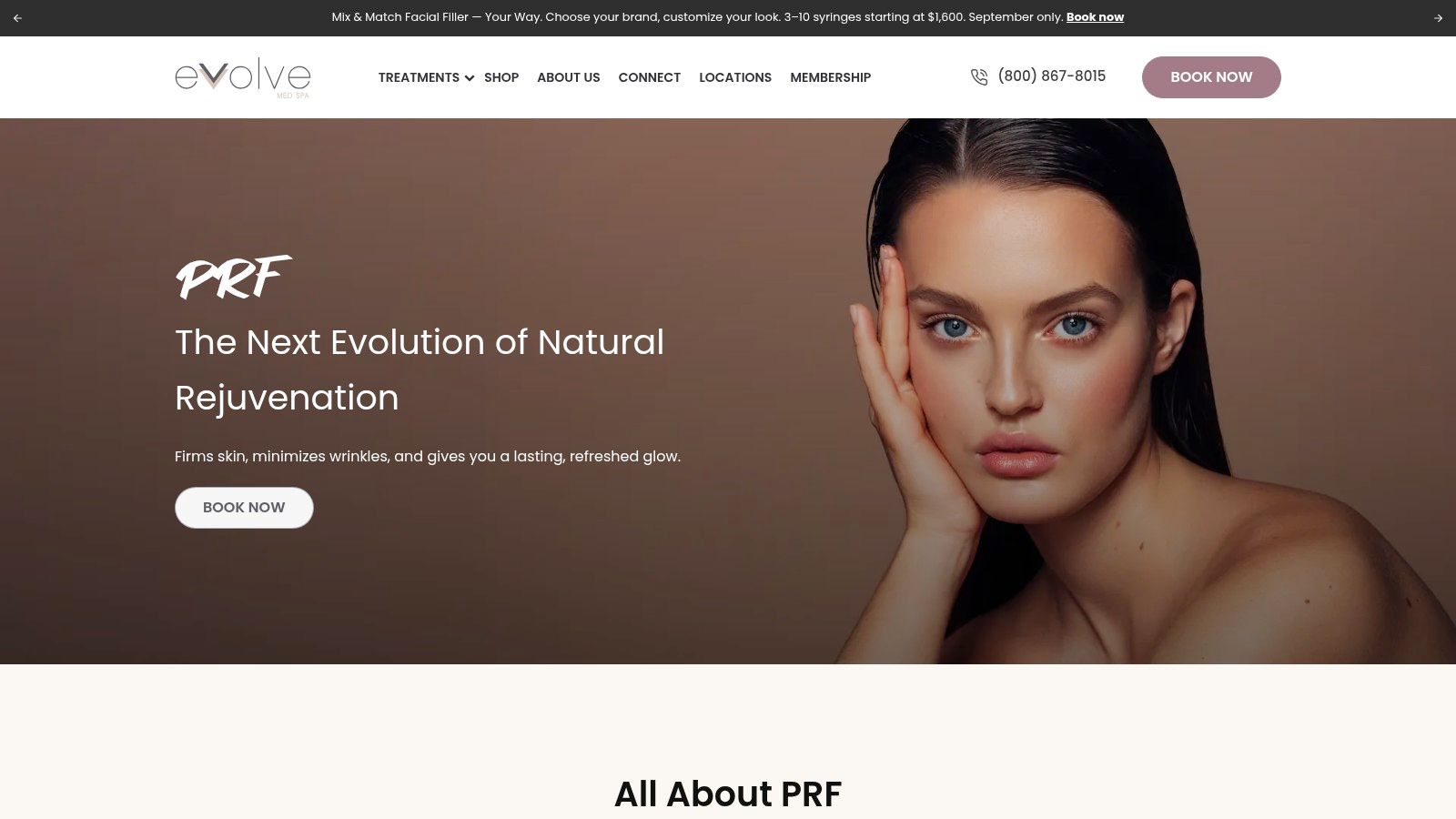
Evolve Med Spa lands well for readers who want educational framing before they book. Its PRF service page is supported by clinician-reviewed explainers on PRF, EZ Gel, and related options, and the brand also shows combination-treatment galleries that place PRF inside a broader rejuvenation plan.
That's useful because many PRF results online don't come from PRF in isolation. They come from PRF layered into microneedling, radiofrequency, or other protocols.
The key question Evolve helps surface
When you read prf injections reviews, are you evaluating PRF itself, or PRF as an add-on to another procedure?
That's not a trivial distinction. A 2024 systematic review and meta-analysis found that PRP or PRF used as adjuncts to TMJ arthrocentesis significantly reduced pain at one month, three months, and at least six months, but the literature showed wide heterogeneity and didn't cleanly answer whether PRF alone was the main driver of benefit. A 2026 review of injectable PRF in TMJ disorder also reported better pain and mouth-opening outcomes in some studies while noting that formulation questions remain unresolved (systematic review and meta-analysis on PRP/PRF adjunct use in TMJ arthrocentesis).
That clinical issue isn't identical to cosmetic use, but it teaches the same reading habit. Combination protocols can help patients. They can also muddy attribution.
Best for
Evolve is a strong option for readers who want medically reviewed educational content and guidance on choosing between liquid PRF and PRF EZ Gel. It's weaker if your main priority is seeing a single page of PRF-only star ratings and fixed public prices.
- Education quality: Better than many med spa sites.
- Combination-protocol context: Helpful if you're considering layered treatments.
- Review aggregation: Less direct than product-page review models.
- Price certainty: Limited without a consult.
PRF Injection Reviews, 7 Providers Compared
| Item | Complexity 🔄 | Resource needs ⚡ | Expected outcomes 📊 | Ideal use cases 💡 | Key advantages ⭐ |
|---|---|---|---|---|---|
| PRF vs Fillers: An Honest Comparison (TMJ Sleep) | 🔄 Medium, multi‑session protocol and interdisciplinary coordination | ⚡ Low–Medium, brief blood draw, clinic visits, possible adjunct therapies | 📊 Gradual collagen remodeling and skin quality improvement; not immediate volume | 💡 Patients seeking natural, regenerative rejuvenation integrated with functional care | ⭐ Autologous approach; integrated TMJ/sleep/regenerative care; focuses on tissue quality |
| NakedMD | 🔄 Low, streamlined product page and booking flow | ⚡ Low, short sessions (45–60 min), online checkout, visible pricing | 📊 Variable, many reviews; some report minimal change after a single session | 💡 Consumers who want easy online booking and many PRF‑specific reviews | ⭐ Transparent pricing, abundant PRF reviews, direct online purchase/booking |
| KORA Aesthetics (Scottsdale, AZ) | 🔄 Low–Medium, packaged options with clear FAQs and consult as needed | ⚡ Low, published prices and packages; local clinic visit required | 📊 Predictable expectations with published packages; gradual regenerative results | 💡 Patients wanting transparent pricing and injector credentials before booking | ⭐ Clear pricing (single & multi‑session), detailed FAQs, named injector credentials |
| ELLEMES Medical Spa (Atlanta) | 🔄 Low, focused under‑eye program with clear timelines | ⚡ Low–Medium, per‑session tiers, pre/post care guidance, online booking | 📊 Gradual under‑eye improvement; compares PRP/PRF/EZ Gel outcomes | 💡 Patients focused on under‑eye rejuvenation who want pricing comparisons | ⭐ Apples‑to‑apples pricing, verified Google reviews, candid timelines and care notes |
| AustinMD Aesthetics & Wellness (Cedar Park/Austin) | 🔄 Medium, offers both liquid PRF and PRF Gel options and treatment series | ⚡ Medium, multiple formats, seasonal promos, membership discounts available | 📊 Options range from regenerative improvement to bio‑filler volume (PRF Gel) | 💡 Patients wanting format choices (liquid vs gel) and discount programs | ⭐ Public pricing for many services, PRF Gel option, membership savings |
| SkinSpirit | 🔄 Low, standardized protocols across many locations | ⚡ Medium, wide network availability, easy booking but variable pricing by market | 📊 Consistent care potential; PRF often as microneedling add‑on; outcomes depend on protocol | 💡 People who value a vetted multi‑location network and continuity of care | ⭐ National footprint, standardized staff training, convenient scheduling across markets |
| Evolve Med Spa | 🔄 Low–Medium, clinician‑reviewed education and combination protocols | ⚡ Medium, multi‑location NE presence, before/after galleries, varied offerings | 📊 Improved results when PRF combined with RF/microneedling; outcomes depend on combos | 💡 Patients seeking medically reviewed guidance and combination treatment plans | ⭐ Strong educational resources, clinician review, galleryed combination protocols |
How to Use PRF Reviews Before You Book
The best PRF reviews don't just say someone loved their result. They tell you what area was treated, what form of PRF was used, whether it was combined with microneedling or another procedure, how long improvement took, and what trade-offs came with it. If those details are missing, the review may still reflect a good patient experience, but it won't tell you much about whether the same plan fits your goals.
Start by matching the review to your actual concern. Under-eye PRF, hair restoration PRF, full-face microneedling with PRF, and TMJ-focused PRF are not interchangeable categories. If a provider mixes them together under one "regenerative" label, ask for examples that reflect your own treatment area and protocol.
Then listen for timeline language. PRF is often framed as collagen support, tissue remodeling, or regenerative improvement. Those are gradual concepts. A clinic that promises filler-like speed without explaining the difference deserves more scrutiny than one that says results build progressively and may require more than one session.
Ask the clinic to describe what you should notice first, what may take longer, and what would count as a normal subtle response after a single treatment.
Cost deserves the same level of specificity. A posted starting price is useful, but it isn't the whole decision if the likely plan involves multiple sessions, add-ons, PRF Gel instead of liquid PRF, or a companion treatment such as microneedling. Ask for the full anticipated cost range before you book, not just the introductory figure.
Also confirm who performs the injections and what clinical context surrounds the treatment. Some readers want a med spa visit that moves efficiently. Others want PRF discussed alongside airway issues, TMJ symptoms, sleep-related strain, or broader regenerative options. Neither preference is wrong, but they lead to different provider choices.
The literature supports a balanced view. A major systematic review of PRF in oral surgical procedures identified 559 studies in the literature, but only 30 met eligibility for qualitative analysis and 13 for quantitative meta-analysis, showing how widely PRF has been studied while also underscoring that high-quality evidence is still relatively limited. That same review reported positive findings in selected settings including alveolar preservation, some implant-related outcomes, alveolar cleft bone regeneration, and reduced alveolar osteitis prevalence in third molar surgery, with implant stability improved at one week and one month after surgery (systematic review of PRF in oral surgery).
That's the right mindset for PRF reviews in general. Look for specifics. Separate patient satisfaction from proof of effectiveness. Compare education, pricing clarity, and protocol transparency with your own goals before deciding between PRF, PRF Gel, fillers, or another option entirely.
Pain and Sleep Therapy Center offers PRF injections within a broader specialty practice focused on TMJ disorders, facial pain, and sleep-related care, which makes it especially relevant if your interest in PRF overlaps with jaw symptoms or functional concerns. If you want a provider that explains regenerative options in that clinical context, visit Pain and Sleep Therapy Center and review its PRF and TMJ resources before booking a consultation.