You're pressing the soft area beneath your chin, checking for a swollen gland, a bad tooth, or something unusual. The ache may seem to come from the middle of your neck, yet chewing, talking, yawning, or clenching makes it worse. That mismatch is unsettling, but it has a common explanation: TMJ pain under the chin can be referred from the jaw joint or the muscles that move it.
The temporomandibular joint sits just in front of each ear, not beneath the chin. Still, the jaw muscles and the soft tissues attached to the lower jaw can send pain into the chin, floor of the mouth, face, and upper neck. TMD, or temporomandibular disorder, includes more than one condition affecting these joints and muscles, so the location of pain alone can't identify the cause. NHS physiotherapy guidance on TMJ pain also describes symptoms that may spread through the face, jaw, and neck.
The useful questions are straightforward. Where is the pain really coming from? How can a clinician confirm it? What can relieve it before anyone considers an invasive procedure?
Why Your Chin Hurts and Your Jaw Is to Blame
A patient may point to the center under the chin and say, “That's where it hurts.” Then they open their mouth, and the jaw shifts slightly to one side. They chew a piece of food, and the same ache returns. When a clinician presses the jaw muscles rather than the chin itself, the familiar pain may appear immediately.
That pattern suggests referred pain. The source may be the temporomandibular joint, the chewing muscles, or the connected muscles forming the floor of the mouth. The brain doesn't always map deep jaw and upper-neck pain to the exact tissue causing it, so discomfort can be felt several centimeters away from its origin.
The muscles that can send pain below the jaw
The suprahyoid muscles sit beneath the lower jaw and help coordinate swallowing, speaking, and opening the mouth. The digastric muscles are part of this group. The medial pterygoid, a deeper chewing muscle behind the angle of the jaw, helps close and stabilize the jaw. When these muscles stay active because of clenching, grinding, prolonged talking, or guarded movement, they can become tender and refer pain toward the submental area.
A patient may describe the sensation as:
- A dull ache: Often linked with sustained muscle tension.
- A pulling feeling: Common when the floor-of-mouth muscles are working hard.
- A bruised spot: More likely when palpation reproduces the familiar discomfort.
- A sharp flare: Often triggered by a wide yawn, hard food, or sudden jaw movement.
Practical rule: If the pain changes with jaw movement or clenching, assess the jaw and its muscles before assuming the chin itself is the problem.
TMD affects about 5% of adults in the United States, while broader estimates place prevalence between 5% and 12% of the population, according to the National Institute of Dental and Craniofacial Research overview of TMD and jaw pain. That doesn't mean every ache beneath the chin is TMD. It does mean the diagnosis deserves a place near the top of the list when jaw activity reproduces symptoms.
The rest of the evaluation comes down to three tasks: tracing the pain through the jaw and neck, distinguishing muscle referral from dental or gland problems, and choosing reversible care before more invasive options.
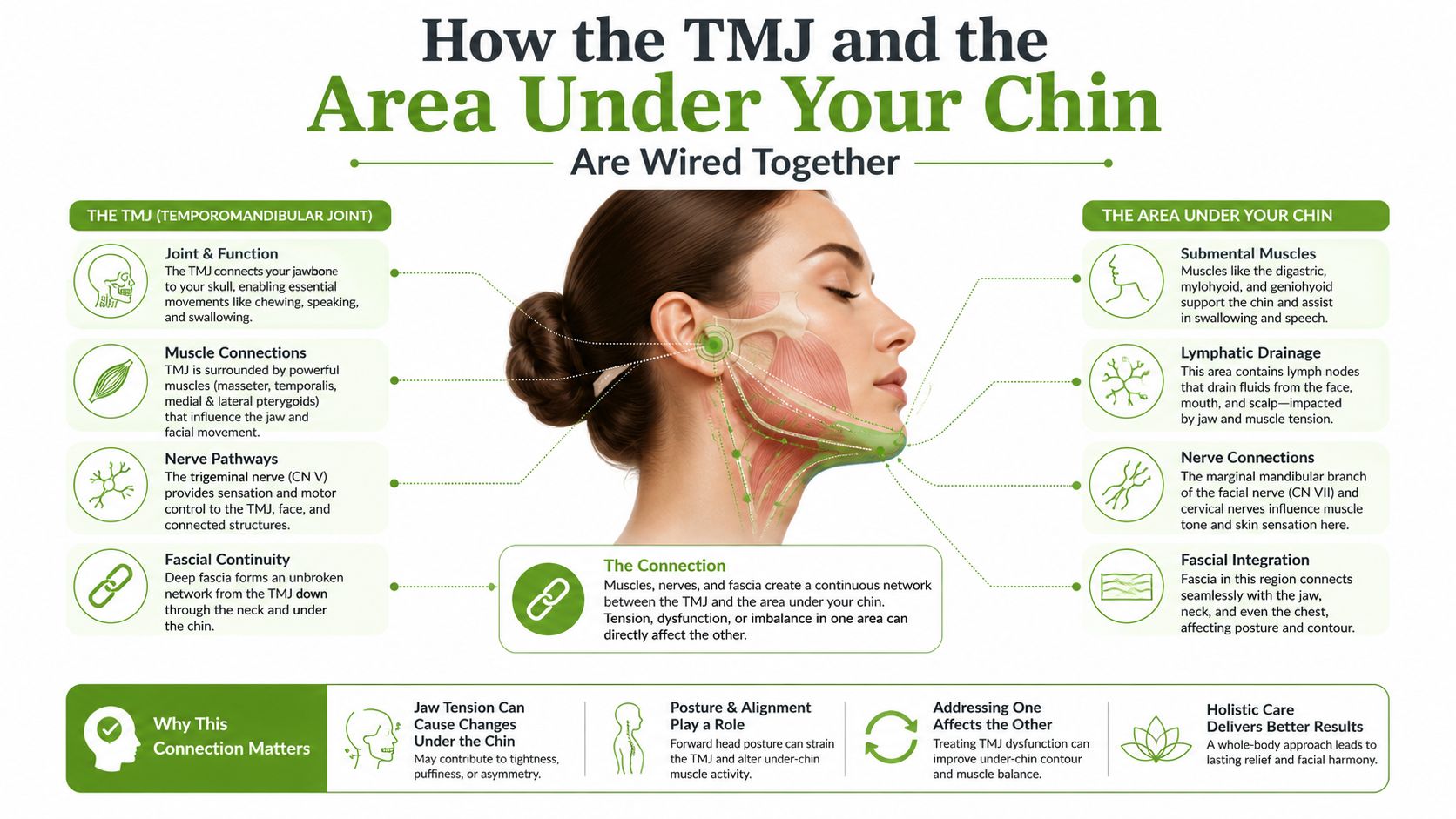
How the TMJ and the Area Under Your Chin Are Wired Together
Start at the jaw hinge. Each TMJ sits just in front of the ear, where the lower jaw meets the skull. The joint lets the mandible hinge, slide, and rotate so you can chew, speak, yawn, and swallow.
From there, follow the load chain downward. The mandible forms the lower frame of the mouth. Beneath it, the suprahyoid muscles create a flexible muscular sling that connects the jaw with the hyoid bone, a small support structure in the upper neck. These tissues coordinate with the chewing muscles, tongue, and cervical muscles every time the jaw moves.
A suspension bridge is a useful comparison. The TMJ and mandible are part of the bridge structure, while the muscles under the chin act like cables anchored below. If one cable stays tight, the rest of the bridge carries force differently. Clenching, forward-head posture, a prolonged dental procedure, or a sudden wide bite can increase tension across this chain.
Why referred pain feels misplaced
Trigger points in the medial pterygoid and digastric muscles may send discomfort toward the area beneath the mandible. The joint itself usually isn't the structure creating pain directly in the middle of the chin. More often, the muscles and fascia connected to the jaw transmit or refer the sensation there.
This is also why jaw pain can overlap with facial nerve symptoms. The trigeminal nerve pain resource explains a related pain pathway that clinicians consider when facial discomfort doesn't follow a simple skin or tooth pattern.
A helpful self-observation is to compare activities. Does the ache appear after chewing steak, gum, or crusty bread? Does it build during a long conversation? Does it flare when you hold your teeth together while concentrating? Those patterns point toward a loaded jaw-muscle system, although they don't prove TMD on their own.
The spot you can point to is not always the spot that needs treatment.
The jaw, neck, and floor of the mouth work as a coordinated system. A clinician therefore examines movement and muscle tenderness, not just the place where your finger lands.
Who Gets TMJ Disorders and What the Numbers Say
TMD isn't restricted to people with obvious joint damage. Muscle overuse, clenching, grinding, stress-related bracing, and altered jaw movement can all contribute. Under-chin discomfort fits especially well with a muscular pattern because the floor-of-mouth muscles may work harder when the jaw is held rigid or moved inefficiently.
The NIDCR information on TMD reports that TMDs are about twice as common in women as in men, with a particularly strong pattern among women ages 35 to 44. Historical U.S. data cited by NIDCR found jaw-joint or preauricular pain over a six-month period in 5.3% overall, including 3.5% of men and 6.9% of women. A review in American Family Physician reports that TMD affects up to 15% of adults, with peak incidence between ages 20 and 40.
These figures describe population patterns, not a personal diagnosis. They show why a working-age adult with morning jaw fatigue, daytime clenching, and pain below the chin shouldn't dismiss TMD as unusual.
TMD prevalence and risk patterns
| Group | Reported TMD symptom rate | Relevance to under-chin pain |
|---|---|---|
| U.S. adults | About 5%, according to NIDCR | A jaw-related source is plausible when movement reproduces pain |
| General population estimates | 5% to 12%, according to NIDCR | Under-chin referral belongs in a broader orofacial pain assessment |
| Women compared with men | About twice as common in women, according to NIDCR | Sex and age pattern can support, but cannot establish, suspicion |
| Adults ages 20 to 40 | Peak incidence reported in American Family Physician | Clenching and muscle loading may overlap with this life stage |
Other factors can raise suspicion without proving causation. A history of whiplash, prolonged mouth opening during intubation or dental treatment, frequent gum chewing, nail biting, or orthodontic treatment may change how the jaw muscles work. The important clue is the combination of risk context with reproducible pain, restricted movement, joint sounds, or muscle tenderness.
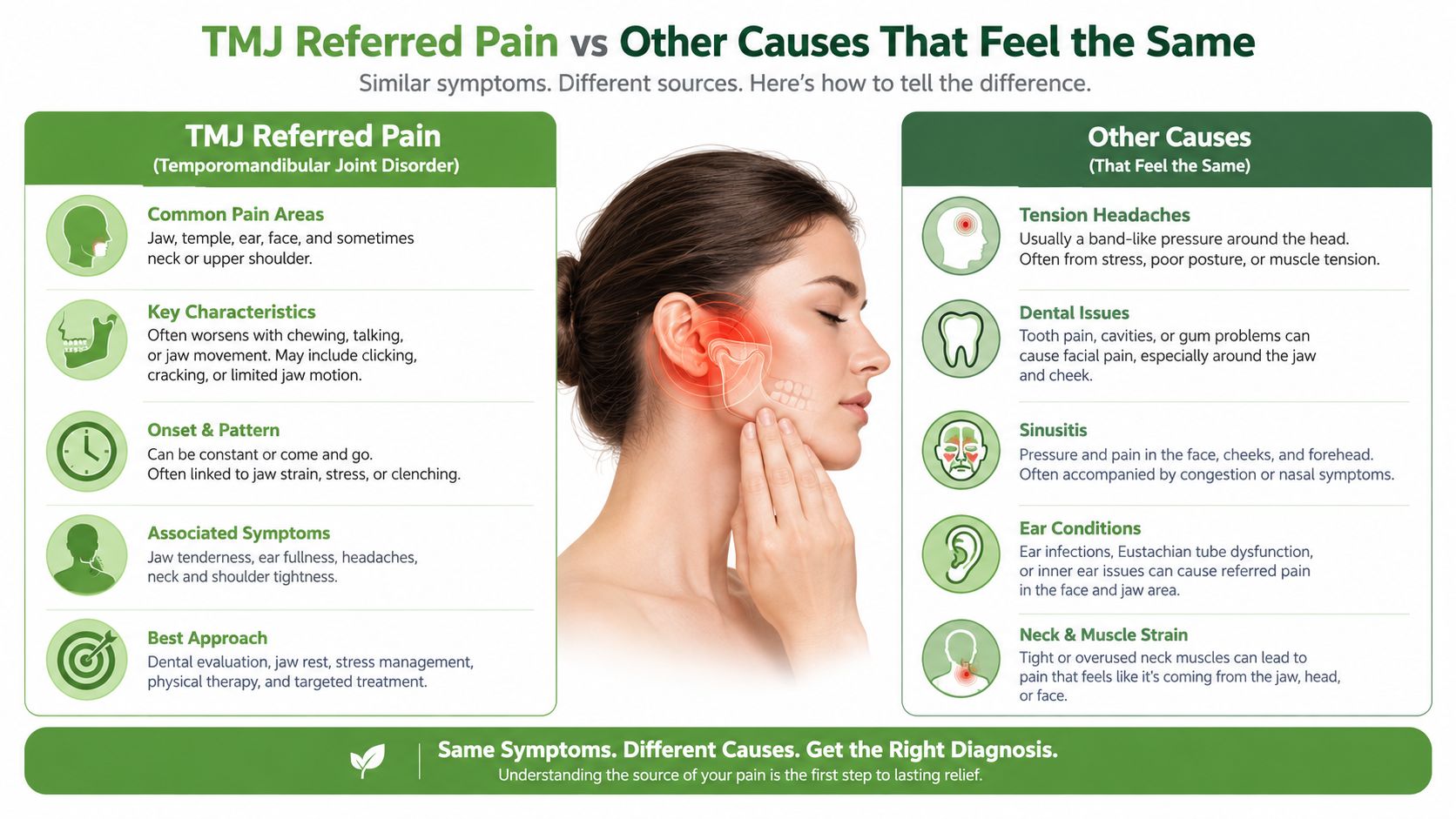
TMJ Referred Pain vs Other Causes That Feel the Same
Pain beneath the chin has several possible sources. TMD becomes more likely when chewing, yawning, prolonged talking, resisted jaw movement, or clenching reproduces the ache. It becomes less convincing when the main finding is a visible lump, fever, drainage, or a clear tooth problem.
Use this framework as a way to organize observations, not as a home diagnosis.
- Jaw movement points toward TMD: Pain that increases with chewing or wide opening may come from the joint, masseter, temporalis, pterygoid, mylohyoid, or suprahyoid muscles. Clinical guidance from the Royal Australian College of General Practitioners describes TMD pain that can spread into the face, neck, and mandibular region.
- A tooth points toward dental disease: A cracked tooth, deep cavity, or dental infection may create focused pain, sensitivity, gum tenderness, or pain when biting. A dentist should assess suspected dental causes rather than relying on jaw massage.
- Food-related swelling points toward a salivary duct: Sharp pain or swelling triggered by sour or sweet foods suggests that saliva flow may be irritating an obstructed or inflamed gland.
- A tender lump points toward lymph nodes: A palpable lump under the jaw or chin, particularly alongside a recent throat or dental infection, needs direct examination. Don't repeatedly press it, since that can make the tissue more irritated.
- Throat symptoms point elsewhere: Tonsil or throat irritation may cause pain with swallowing, hoarseness, fever, or a sensation deep in the neck.
A gentle location check
Pressing under the chin may fail to reproduce pain when the joint is the source. By contrast, careful palpation of the digastric belly or mylohyoid may bring on the familiar muscle ache. A clinician performs this comparison with knowledge of anatomy and pressure, because aggressive self-testing can aggravate already sensitive tissue.
Two causes can coexist. A person may clench because a tooth hurts, then develop muscle pain from guarding the bite. Someone with a salivary gland problem may also brace the jaw. A symptom pattern narrows the possibilities, but a dental, medical, or TMJ evaluation confirms them.
The short video below provides another visual explanation of how TMJ symptoms can overlap with other facial pain patterns.
What a Specialist Actually Checks During an Evaluation
A TMJ evaluation usually starts with your story. The clinician asks when the under-chin pain began, what makes it worse, whether you clench or grind, and whether you have dental, throat, ear, or neck symptoms. Most TMD diagnoses are primarily clinical, so the examination often provides more useful direction than ordering a scan immediately.
The hands-on examination
The provider may palpate the TMJs in front of the ears, then examine the masseter, temporalis, medial pterygoid region, and suprahyoid muscles. The goal is not just to find tenderness. It is to determine whether pressure reproduces your familiar pain and whether the pattern matches the movement that triggers it.
They'll also observe opening, closing, side-to-side movement, and forward movement of the jaw. Restriction, deviation, locking, or pain during resisted opening and closing can reveal whether the joint or muscles are limiting function.
Joint sounds add context. A clinician may listen directly or use Doppler equipment to distinguish a fine grinding sound from a click associated with altered disc movement. A sound without pain or functional change doesn't automatically mean the joint needs treatment.
Bite, airway, and imaging questions
A bite assessment may use articulating paper, a digital system such as T-Scan, or mounted models to identify premature contacts and uneven loading. Airway screening can include tongue posture, a Mallampati assessment, breathing habits, and sleep questions, particularly when nighttime clenching, snoring, or unrefreshing sleep is part of the history.
For coding and documentation questions, a clinician or practice administrator may also consult a practical Happy Billing pain ICD-10 guide. That type of reference supports administrative accuracy, but it doesn't replace a clinical diagnosis.
Imaging is selected for a reason. A panoramic film can screen teeth and broad bony structures. CBCT provides detailed views of joint bone, while MRI is more useful when disc position, soft tissue, or inflammation is suspected. A facial-pain evaluation may be appropriate when the symptoms extend beyond routine jaw soreness, and resources for finding facial pain specialists can help patients identify the right type of care.
Conservative and Regenerative Treatment Options
Treatment usually begins with reversible care. That means reducing load, calming irritated tissues, and restoring coordinated movement before changing the bite permanently or considering surgery.
A short period of softer foods, smaller bites, moist heat, and clinician-approved anti-inflammatory medication may reduce the strain on the jaw. Physical therapy can add posture work, cervical mobilization, jaw coordination exercises, and targeted myofascial techniques, including intra-canalicular work when clinically appropriate.
Appliances have different jobs
A flat stabilization splint may help protect teeth and reduce the effects of clenching or grinding. An anterior bite plane may be used for a shorter period in selected cases when a clinician is trying to influence jaw movement or disc-related symptoms. These appliances aren't interchangeable, and an over-the-counter night guard may fit poorly, increase muscle activity, or fail to address a neck or airway contributor.
The appliance should support a wider plan, not become the entire plan. If the muscles remain overactive, covering the teeth alone may not resolve the pain beneath the chin.
Where regenerative care may fit
Some specialty practices offer prolotherapy, platelet-rich fibrin injections, or cold laser therapy. Prolotherapy is intended to stimulate a healing response in selected lax or painful ligament tissues. Platelet-rich fibrin may be placed in or around a joint under a specific clinical protocol, while cold laser therapy is used by some providers to support local symptom management and tissue response.
Evidence is still evolving for several regenerative approaches, and suitability depends on the diagnosis. Injection therapy should complement movement retraining and physical therapy rather than replace them. A conservative chronic facial pain treatment approach may combine these options with individualized assessment.
Treatment principle: Start with the least invasive plan that matches the findings, measure the response, and escalate only when the diagnosis and symptoms justify it.
Surgery and Botox aren't routine first answers for under-chin pain. A systematic review of seven randomized trials found no better clinical outcomes for TMJ surgery than nonsurgical rehabilitation in the cases studied, as summarized by American Family Physician. That supports a careful rehabilitation-first approach, while leaving room for specialist escalation when conservative care fails or a different disease process is suspected.
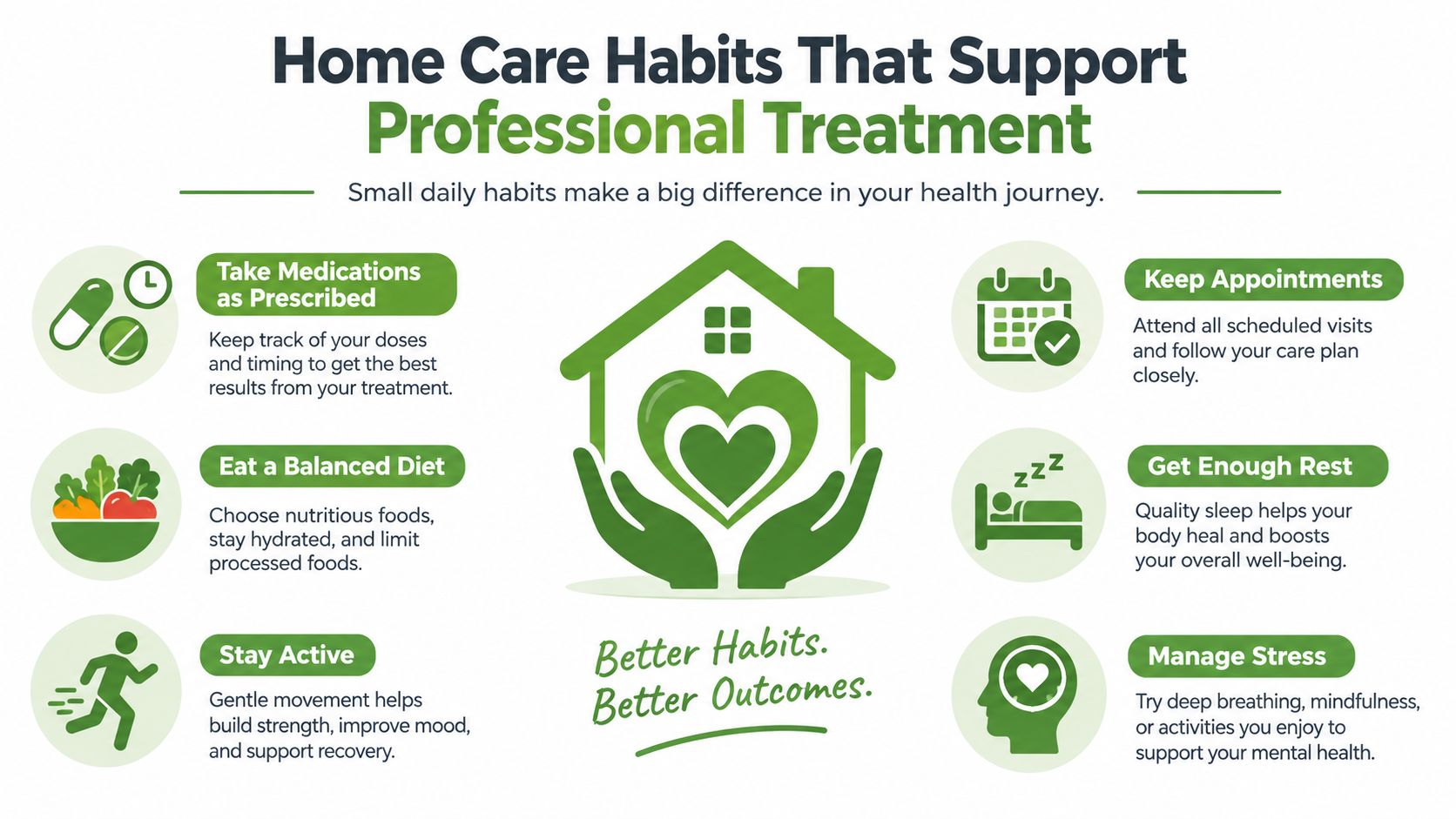
Home Care Habits That Support Professional Treatment
Home care should lower irritation while you arrange appropriate evaluation. It shouldn't become a way to ignore a lump, infection signs, progressive locking, or pain that keeps worsening.
Try these practical adjustments:
- Rest the jaw: Choose softer foods temporarily, cut meals into smaller pieces, and avoid gum, chewy candy, and very wide bites.
- Control the yawn: Support the lower jaw with your hand and avoid forcing the mouth open to its maximum range.
- Use heat or ice thoughtfully: Moist heat often helps a tight muscle. A brief cold application may feel better after an acute flare. Protect the skin and stop if either worsens symptoms.
- Massage gently: With clean hands, use light pressure along the floor-of-mouth and digastric region. Don't dig into a lump or press hard enough to create lingering soreness.
- Reset your posture: During screen use, let the tongue rest comfortably, keep the teeth slightly apart, and bring the head back over the shoulders instead of jutting the chin forward.
- Reduce nighttime strain: Side or back sleeping with neutral neck support may be more comfortable than sleeping with the jaw pressed into a pillow.
Over-the-counter anti-inflammatory medicines or topical analgesics may help some people, but check the product instructions and confirm safe dosing with a pharmacist or healthcare provider. Medication isn't appropriate for everyone, particularly people with certain stomach, kidney, bleeding, allergy, or medication-interaction risks.
These habits can reduce flare-ups and protect progress from professional treatment. They can't identify whether the pain comes from a joint, muscle, tooth, gland, lymph node, or throat, so persistent symptoms still deserve an examination.
Red Flags and When to Book a Specialist Visit
Not every ache beneath the chin belongs in a watch-and-wait category. Swelling, a palpable lump, fever, unexplained weight loss, trouble swallowing, or difficulty opening the mouth should prompt medical or dental assessment rather than repeated self-massage.
Seek timely evaluation for sudden lock-jaw, numbness, persistent hoarseness, ear discharge, or pain that wakes you at night. These findings don't automatically indicate a serious condition, but they can signal a problem outside routine muscle overload or a TMD pattern that needs closer investigation.
A practical appointment checklist
Book a TMJ-focused visit when:
- The pain persists: Symptoms don't settle with sensible jaw rest and gentle care.
- Movement is changing: Your opening becomes restricted, deviates, or locks.
- The pattern is repeatable: Chewing, clenching, or palpation consistently recreates the pain.
- Self-care has failed: Heat, softer foods, posture changes, and clinician-approved medication haven't helped.
- Other symptoms are present: Dental sensitivity, throat symptoms, ear complaints, swelling, or a lump complicate the picture.
A dental or medical professional may decide that you need a dentist, oral and maxillofacial specialist, ENT clinician, neurologist, or TMJ-focused physical therapist. Administrative support can also make access easier, and practices may use a hire virtual dental receptionist service to help coordinate calls and appointments. That service doesn't determine the cause, but it may help you reach the appropriate office sooner.
Early assessment can prevent you from treating the chin while the jaw, tooth, gland, or throat remains the actual source. Bring a short symptom record, including triggers, duration, swelling, fever, tooth sensitivity, jaw sounds, and any episodes of locking.
Pain and Sleep Therapy Center evaluates TMJ disorders, facial pain, and sleep-related contributors with individualized, root-cause-focused care, including conservative and regenerative options when appropriate. If your jaw movement reproduces pain under the chin or your symptoms keep returning, visit Pain and Sleep Therapy Center to learn about an evaluation and the next practical step.